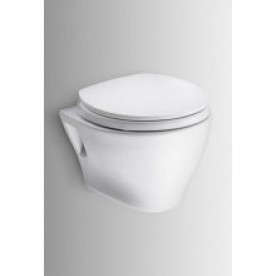
The Toto CWT418MFG-1#01 Aquia Wall-Hung Toilet is the kind of bathroom fixture that makes visitors pause and wonder where the rest of the toilet went. Its tank and carrier disappear inside the wall, leaving an elongated bowl that appears to float above the floor. The result is modern, compact, and wonderfully easy to clean around.
This model is more than a style exercise. The original package paired an Aquia bowl with a DuoFit in-wall tank system, dual-flush operation, and a wall-mounted actuator plate. It offered 0.9- and 1.6-gallon flushes, an adjustable mounting height, a CEFIONTECT-coated bowl, and a carrier engineered to handle substantial loads.
However, the exact CWT418MFG-1#01 package is now considered a legacy or discontinued product. Buying one today may require more detective work than simply clicking “add to cart.” This review examines the original specifications, flushing performance, installation demands, maintenance considerations, and practical experience of living with the Toto Aquia wall-hung toilet.
Quick Verdict
The Toto Aquia CWT418MFG-1#01 remains an appealing option for a carefully planned bathroom remodel, particularly when floor space, clean lines, and easy maintenance matter. Its short projection, elongated bowl, dual-flush system, and adjustable height make it more practical than its minimalist appearance suggests.
The catch is installation. This is not a casual Saturday-afternoon toilet replacement unless your Saturdays normally involve opening walls, modifying drains, anchoring a steel carrier, and measuring tile tolerances to the sixteenth of an inch. It is also a discontinued package, so buyers must verify every included component before purchasing old stock.
Toto CWT418MFG-1#01 Specifications at a Glance
| Feature | Original Specification |
|---|---|
| Toilet type | Wall-hung elongated bowl with concealed in-wall tank and carrier |
| Flush volume | 0.9 GPF light flush and 1.6 GPF full flush |
| Flush system | Toto Dual-Max dual-flush system |
| Bowl finish | Cotton White #01 with CEFIONTECT ceramic glaze |
| Bowl material | Vitreous china |
| Bowl dimensions | Approximately 21-1/16 inches long by 14-3/16 inches wide |
| Mounting height | Adjustable rim height of approximately 15 to 19 inches |
| Water surface | Approximately 5-1/2 by 4-3/4 inches |
| Minimum water pressure | 8 psi static |
| Carrier capacity | Rated for up to 880 pounds when properly installed |
| Wall framing | Designed for 2-by-6 framing; 2-by-4 installation possible with the correct outlet kit |
| Seat | Sold separately in most original configurations |
| Product status | Discontinued legacy package; availability varies |
A small but important SKU detail deserves attention. Historical listings generally identify the “-1” package as the version with a PEX supply line, while “-2” listings commonly refer to a copper supply line. Toto revised its in-wall carrier packages over time, and some product documents show different tank numbers or kit combinations.
Anyone buying remaining inventory should verify the tank, carrier, supply line, actuator plate, outlet kit, mounting hardware, and bowl model printed on the actual boxes. A photograph of a complete toilet system does not guarantee that every pictured component is included.
Design: The Floating-Toilet Effect Has Practical Benefits
More Visible Floor Makes a Bathroom Feel Larger
The visual trick is simple: when the floor continues beneath the bowl, the room appears less crowded. The Aquia projects only about 21 inches from the finished wall, and historical product literature claimed it could save up to nine inches of floor space compared with some conventional floor-mounted toilets.
In a compact powder room, that difference can improve knee clearance, door movement, or the space available for a vanity. Nine inches may not sound dramatic until a bathroom door stops bumping into the toilet. Suddenly, nine inches feels like prime waterfront property.
The benefit is not merely psychological. A floor-mounted toilet has a pedestal, bolt caps, curved edges, and a narrow space near the wall that somehow attracts dust with the determination of a tiny vacuum cleaner. The wall-hung Aquia eliminates the base entirely. A mop, vacuum head, or cleaning cloth can pass underneath without requiring bathroom yoga.
Minimalist Without Looking Sterile
The rounded elongated bowl softens the fixture’s contemporary shape, while the skirted sides conceal much of the trapway geometry. Cotton White is Toto’s familiar bright white finish, so the bowl coordinates easily with common white sinks, tubs, and bathroom tile.
Because the tank is hidden, the flush plate becomes the main visible hardware. Its shape and finish should be treated as part of the bathroom design rather than as a last-minute plumbing accessory.
Dual-Max Flushing and Water Consumption
The Toto CWT418MFG-1#01 uses two flush volumes: 0.9 gallon for liquid waste and 1.6 gallons for solid waste. The full flush provides additional water when needed, while the smaller option prevents the toilet from using 1.6 gallons on every visit.
This configuration differs from many newer wall-hung toilets that combine a 0.9-gallon light flush with a 1.28-gallon full flush. Although the Aquia’s 1.6-gallon setting uses more water than a current 1.28 GPF model, some users may appreciate having the stronger full-flush volume available.
Consider an illustrative pattern of five light flushes and one full flush per person each day. The dual-flush total would be 6.1 gallons. Using 1.6 gallons for all six flushes would consume 9.6 gallons. That represents a potential difference of approximately 1,278 gallons per person annually, assuming users consistently choose the appropriate button.
Of course, dual flush only saves water when household members do not treat the two buttons like a personality quiz.
The bowl has a relatively compact water surface, which is common among wall-hung and dual-flush designs. Owners moving from an older high-water toilet may notice this immediately. A smaller visible water area does not automatically indicate weak performance, but it changes how the bowl looks between uses.
CEFIONTECT Glaze and Bowl Cleaning
The “G” in the CT418FG bowl number identifies the version equipped with Toto’s specialized ceramic glaze. Now known as CEFIONTECT, the finish was previously marketed under the SanaGloss name in older documentation.
The glaze creates an exceptionally smooth ceramic surface intended to make it more difficult for waste, mold, and mineral residue to adhere to the bowl. It is not a force field, and someone must still clean the toilet, but the coating can reduce stubborn buildup and the amount of aggressive scrubbing required.
A mild toilet cleaner and soft brush are the safest choices. Abrasive powders, metal scrubbers, and harsh cleaning tools can scratch or dull specialized ceramic finishes. Following Toto’s cleaning guidance helps preserve the glaze instead of attacking it with a product that sounds as though it could also strip paint from a pickup truck.
The skirted exterior is similarly straightforward to maintain. Fewer exposed curves and plumbing contours mean fewer places for dust and splashes to settle.
One limitation is that the Aquia bowl is not completely seamless at the sides. Its mounting access areas can collect some dust depending on the installation. The floor remains much easier to clean than it would be around a conventional toilet base, but newer wall-hung designs may offer more fully enclosed side panels.
Comfort and Adjustable Mounting Height
Because the carrier determines the bowl’s position, the installer can set the rim at approximately 15 to 19 inches above the finished floor. The selected toilet seat adds a little more height.
This flexibility is useful for taller adults, shorter users, aging-in-place projects, and bathrooms designed around accessibility goals. A family is not forced to accept the fixed height supplied by a conventional floor-mounted toilet.
However, “Universal Height” does not mean every installation automatically meets every accessibility standard. Final seat height, clear floor space, grab-bar placement, flush-control position, and local building requirements must all be considered.
The target height should be decided before the carrier is enclosed. Changing it after the tile is installed is less of a quick adjustment and more of an unexpected sequel to the renovation.
The elongated bowl offers better thigh support than a round-front toilet while remaining comparatively short from front to back. It is a useful compromise for small bathrooms where comfort and clearance are fighting over the same few inches.
What Is Hidden Inside the Wall?
The concealed assembly contains the water tank, fill valve, flush valve, carrier frame, water connection, and waste outlet. The steel frame transfers the user’s weight into the building structure rather than expecting the porcelain bowl or drywall to perform heroics.
When properly anchored and installed according to the manufacturer’s instructions, the carrier system was rated to support up to 880 pounds. That figure depends on correct structural bracing, suitable framing, and professional installation. It should not be interpreted as permission to use the toilet as gym equipment.
Original Toto documentation describes an insulated, blow-molded polyethylene tank designed to help prevent leakage and exterior condensation. Most routine service is performed by removing the wall-mounted flush plate. The resulting opening provides access to internal fill and flush components without requiring demolition of the finished wall.
The service opening is clever, but it is not spacious. Replacing internal components can feel a little like assembling a ship in a bottle while wearing plumbing gloves.
The CWT418MFG family was designed primarily around 2-by-6 wall construction. Installation in a 2-by-4 wall may be possible with the correct residential outlet kit and appropriate carrier configuration. Framing depth, drain routing, venting, supply-line type, wall thickness, and fixture position must all be coordinated before drywall or tile is installed.
Toto Aquia Wall-Hung Toilet Installation
Professional Planning Is Strongly Recommended
A wall-hung toilet installation generally happens in two stages. During rough-in, the installer anchors and levels the carrier, connects the drain and water supply, and sets the desired bowl height. After the finished wall and tile are completed, the inlet and waste sleeves are cut to length, the bowl is mounted, and the actuator plate and seat are installed.
Precision matters throughout the process. Toto’s installation diagrams call for adequate structural bracing and show the back of the bowl positioned almost flush with the finished wall, leaving only a very small gap.
Uneven tile, a projecting baseboard, incorrect connector cuts, or a carrier that is not square can leave the bowl crooked, loose, difficult to seal, or noticeably separated from the wall. A minor rough-in error can become a major visual problem once expensive tile surrounds it.
Confirm Every Component Before Closing the Wall
Verify that the package includes the correct bowl, in-wall carrier and tank, flush plate, supply connection, outlet pieces, and mounting hardware. The toilet seat was usually sold separately in original configurations.
This step is especially important when buying discontinued inventory. A seller may display a complete system in the product photograph but ship only the ceramic bowl. Conversely, a listing may say “seat included” even though the photographed product documentation says otherwise.
Homeowners interested in adding a Toto WASHLET or another bidet seat should plan electrical power, water routing, seat dimensions, and cord placement before the wall is finished. Adding an outlet during construction is much easier than asking the tile installer to return after everyone believed the project was over.
Maintenance and Long-Term Ownership
The concern most first-time wall-hung toilet buyers express is simple: what happens when something inside the wall needs repair?
Under normal conditions, the flush plate acts as a service access panel. Once removed, it allows a plumber to reach replaceable fill-valve, flush-valve, and actuator components. The carrier and tank remain inside the wall, but the parts that typically require service are designed to pass through the access opening.
The more relevant challenge for this particular toilet is identifying the installed tank revision. Toto provides manuals and parts information for many discontinued products, but the CWT418MFG family appeared with multiple carrier and supply-line configurations.
Before the wall is closed, photograph the carrier, record all model and serial numbers, save the installation manual, and retain the plumber’s invoice. Future You will be unusually grateful when a replacement seal or valve is needed several years later.
Owners should watch for continuously running water, slow refilling, weak flush activation, moisture near the wall connection, or movement in the bowl. A properly mounted wall-hung toilet should feel solid. Any rocking or loosening deserves prompt inspection because repeated movement can stress seals, connectors, and mounting hardware.
Advantages of the Toto CWT418MFG-1#01
- Clean, contemporary wall-hung appearance
- Short projection suitable for compact bathrooms
- Open floor area simplifies mopping and vacuuming
- Choice of 0.9- and 1.6-gallon flush volumes
- CEFIONTECT-coated vitreous china bowl
- Adjustable installation height
- Comfortable elongated bowl without excessive room intrusion
- Concealed tank reduces visible bathroom clutter
- Carrier engineered to handle heavy loads when correctly installed
- Routine tank parts can generally be reached through the flush-plate opening
Potential Drawbacks
- The complete CWT418MFG-1#01 package has been discontinued
- Remaining inventory may contain inconsistent components
- Installation labor costs more than replacing a standard toilet
- The project requires wall access and precise rough-in work
- The seat may need to be purchased separately
- The compact water surface may surprise some users
- Side mounting details are not as seamless as those on some newer bowls
- Future service depends on correctly identifying the installed tank model
- Relocating the toilet later is more complicated than moving a floor-mounted model
Who Should Consider This Toto Aquia Toilet?
The CWT418MFG-1#01 makes the most sense for a full bathroom renovation, new construction project, or remodel where the wall is already open. It is particularly attractive for small urban bathrooms, contemporary powder rooms, and projects that benefit from a customized sitting height.
It also suits homeowners who rank easy floor cleaning suspiciously high on their list of life goals. Eliminating the conventional toilet base makes a meaningful difference in bathrooms that collect pet hair, dust, or moisture around floor-mounted fixtures.
The Aquia is less suitable for a low-budget cosmetic update, a rental property where opening the wall is impractical, or a homeowner who wants the convenience of a current product with widely stocked accessories.
Because this package is discontinued, an attractively priced listing is only a bargain if all components are compatible, complete, undamaged, and supported by available replacement parts.
Buying a Discontinued CWT418MFG-1#01
Old-stock plumbing fixtures are not automatically bad purchases. A vitreous china bowl does not become obsolete simply because it has spent several years in a warehouse. The larger risk is receiving an incomplete or mismatched kit.
Check the Bowl Carefully
Inspect the ceramic around the mounting openings, rear water connection, waste outlet, rim, and seat holes. Wall-hung bowls are heavy, and impact damage during shipping may create cracks that are difficult to see in online photographs.
Identify the Carrier and Tank
Ask the seller for photographs of the tank and carrier model labels. Do not rely solely on the product title. Confirm whether the system uses PEX or copper and whether the supplied connections match the planned installation.
Verify the Flush Plate
The actuator plate must be compatible with the concealed tank. A visually similar plate from another Toto generation may not operate the internal mechanism correctly.
Confirm Warranty and Return Conditions
Original documentation generally listed a one-year limited warranty, but old-stock or resale purchases may no longer qualify. The seller’s return policy matters, particularly when the product is heavy, fragile, and expensive to ship.
Real-World Experience With the Toto Aquia Wall-Hung Toilet
The following section synthesizes recurring themes from owner reviews, remodeling discussions, product documentation, and typical wall-hung toilet ownership experiences. It does not represent a single household’s laboratory test.
The first everyday difference is visual. A conventional toilet occupies a block of floor and clearly announces itself as plumbing. The Aquia feels more like part of the architecture. Its concealed tank removes visual bulk, and the floating bowl makes a narrow room appear less crowded.
In a small bathroom, the short projection can make the route between the vanity and shower feel noticeably less restricted. People may never take out a tape measure, but they notice that their knees, the bathroom door, and the laundry basket are no longer negotiating treaties with the toilet.
Cleaning is the benefit owners continue to appreciate long after the novelty of the floating design fades. There is no pedestal to wipe, no caulked footprint collecting grime, and no cramped channel behind a conventional base. A mop passes beneath the bowl in seconds. Pet hair has fewer places to establish a permanent address.
The exterior still includes mounting recesses and side access details, so the bowl is not completely free of dust-catching areas. Nevertheless, the overall cleaning routine is faster and less awkward than cleaning around a floor-mounted toilet.
The dual-flush control generally becomes intuitive after a few days. The smaller button handles liquid waste, while the larger button releases the full 1.6 gallons. Users who remember disappointing early low-flow toilets may value having the stronger full-flush option available.
Flush noise depends partly on the carrier, wall insulation, tile, and room construction. Hiding the tank does not make the toilet silent. A well-insulated wall can soften refill sounds, while a hollow partition may behave like a small plumbing drum. This is another reason to discuss insulation and wall construction during the rough-in stage.
The bowl’s lower visible water level is often the biggest adjustment. Some users initially assume that a small water surface means something has been installed incorrectly. In most cases, it is simply part of the bowl design.
In practice, correct use of the full-flush button and regular gentle cleaning matter more than the apparent depth of the water. The CEFIONTECT surface helps limit adhesion, although occasional brushing may still be needed, particularly in homes with hard water.
Comfort depends heavily on the mounting decision. When the bowl is set at an appropriate height, it feels customized in a way that a standard toilet cannot. When it is mounted too high or too low, every member of the household is reminded of the mistake several times a day.
Mocking up the final sitting height before closing the wall is worthwhile. Place a sample seat at the proposed height and let the primary users try it. A stack of lumber is not glamorous, but neither is discovering after the tile is finished that shorter family members cannot place their feet comfortably on the floor.
Another ownership lesson is that the flush plate is more important than it first appears. It is the user control, service door, and most visible accessory in one component. A cheap-looking or mismatched plate can undermine an otherwise elegant bathroom. The buttons should operate crisply, and the plate must remain removable for maintenance.
Some new owners worry about placing their full weight on a bowl that appears to float. A professionally mounted unit should feel completely solid. After a short adjustment period, most people stop thinking about the concealed carrier and use the toilet exactly as they would any other fixture.
Long-term confidence comes from documentation. Owners who photograph the open wall, save the installation manual, and record the carrier model are much calmer when a fill valve eventually needs service. People who inherit an unlabeled concealed system may spend more time identifying the parts than replacing them.
With this discontinued Toto package, preparation matters even more. Several generations of Toto tanks and carriers have been associated with the Aquia bowl, and replacement components must match the actual system behind the wall rather than merely the visible toilet.
Overall, the ownership experience is favorable when the installation is excellent. The bowl feels stable, the bathroom appears larger, the floor cleans quickly, and the dual flush provides useful control over water consumption.
Most reported frustrations are not caused by the wall-hung concept itself. They usually trace back to incomplete packages, rushed rough-ins, uneven finished walls, incorrect mounting heights, or uncertainty about legacy components. In other words, the toilet is elegantly dressed, and the planning must arrive in an equally good outfit.
Final Assessment
The Toto CWT418MFG-1#01 Aquia Wall-Hung Toilet was a thoughtful combination of compact design, dual-flush efficiency, adjustable comfort, and easier bathroom maintenance. Its approximately 21-inch projection and concealed tank remain attractive in tight spaces, while the 0.9/1.6 GPF setup gives users a practical choice between water conservation and a stronger full flush.
The CEFIONTECT-coated bowl is easier to maintain than untreated ceramic, and the open floor beneath the fixture eliminates one of the least enjoyable areas of bathroom cleaning. The adjustable carrier also allows the installation height to be tailored to the household rather than dictated by a fixed porcelain base.
As a legacy model, however, the CWT418MFG-1#01 should be purchased carefully. Confirm the exact bowl and carrier numbers, supply-line type, actuator plate, outlet hardware, seat requirements, warranty status, and availability of service parts.
For a professionally managed remodel with verified components, this Aquia system can still deliver the polished floating appearance that made it popular. Buyers beginning a new project without existing components may find that a current-generation Toto wall-hung system offers a simpler route to the same design goal.