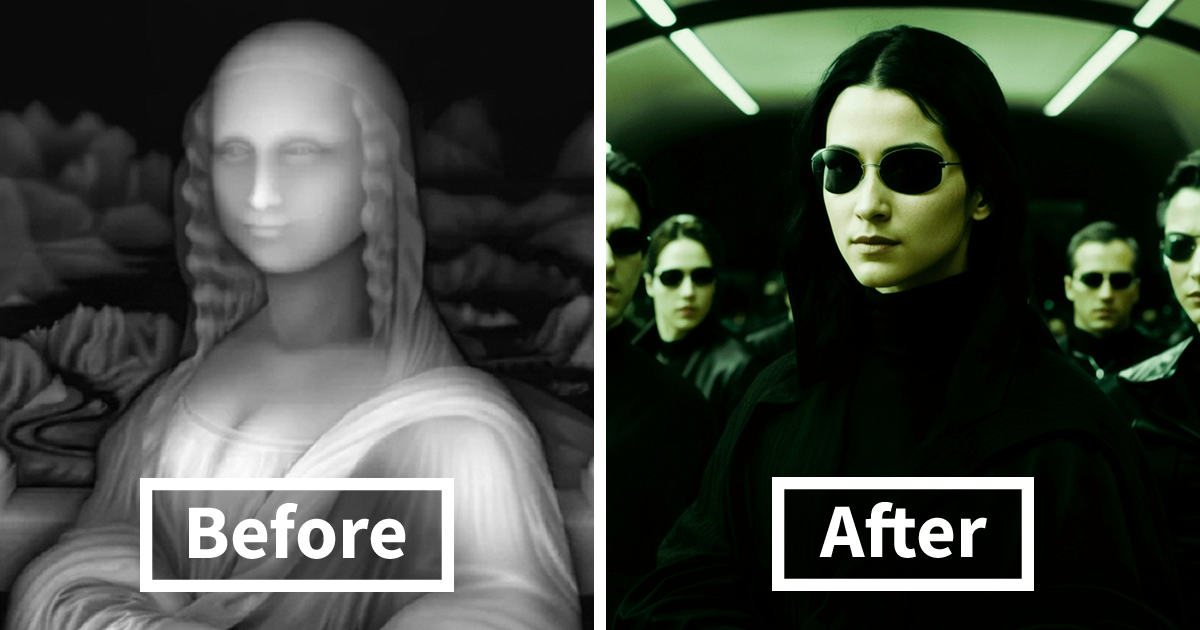
For more than five centuries, Mona Lisa has been sitting politely, folding her hands, and refusing to explain herself. Is she amused, bored, affectionate, skeptical, or quietly remembering that she left the oven on in Florence? Leonardo da Vinci’s famous portrait has survived changing tastes, scientific examinations, a sensational theft, endless parody, and enough theories to fill a museum gift shop. Now the age of the AI image generator has given her another role: the world’s most recognizable test subject for digital imagination.
A collection of 40 AI-generated Mona Lisa recreations does more than swap costumes and backgrounds. It reveals how strongly we depend on context when reading a face. Place that same restrained smile beneath neon lights, inside a royal court, on a futuristic android, or in a modern street photograph, and its meaning changes before the lips do. The result is part art experiment, part cultural remix, and part reminder that humans can project an entire novel onto a facial expression smaller than a coffee stain.
Why the Mona Lisa Still Captivates Us
The portrait is generally identified as Lisa Gherardini, the wife of Florentine merchant Francesco del Giocondo. Leonardo began the work in the early 1500s and appears to have continued refining it rather than simply finishing, delivering, and moving on like a person who respects deadlines. The composition was innovative: a half-length sitter presented with unusual monumentality, subtle atmospheric depth, and an expression that never settles into one obvious emotion.
Leonardo Painted Transitions, Not Outlines
Much of the mystery comes from sfumato, Leonardo’s method of blending light and shadow so gently that hard borders seem to evaporate. Instead of drawing a firm line around the mouth, cheeks, and eyes, he built soft transitions that behave differently depending on distance, lighting, and where the viewer focuses. The National Gallery of Art summarizes the principle through Leonardo’s own advice that shadows and lights should blend like smoke. In other words, the smile is not a logo. It is weather.
Scientific study has deepened rather than solved the puzzle. Conservation specialists have examined the painting with noninvasive imaging, including infrared and X-ray methods, to learn more about its layers, materials, condition, and working process. More recent chemical analysis of a microscopic paint sample has also offered clues about Leonardo’s experimental preparation techniques. Every new test seems to answer one question while politely introducing three more.
The Science Behind the Enigmatic Smile
The Mona Lisa smile appears to change partly because central and peripheral vision process visual information differently. When viewers look directly at the mouth, they see fine detail and may perceive a restrained or almost neutral expression. When they look toward the eyes, hands, or background, the mouth falls into peripheral vision, where broader shadows around the cheeks can make the smile seem stronger.
Researchers have tested the expression from several angles. Some experiments suggest viewers interpret the original face as predominantly happy. Other work emphasizes the smile’s asymmetry, noting that one side appears more expressive than the other and raising questions about whether it represents a spontaneous smile. These findings do not produce a final emotional verdict. They demonstrate something more interesting: the portrait remains stable while perception moves around it.
Why AI Is Fascinated by the Same Face
An AI generator is especially effective at remixing a cultural icon because the image already carries a strong visual template: centered figure, folded hands, dark clothing, distant landscape, controlled gaze, and famous half-smile. Generative systems learn statistical patterns from training data and create new outputs in response to prompts. They do not uncover the “real” Mona Lisa hidden behind the paint. They build plausible visual variations from learned relationships among words, styles, faces, clothing, lighting, and composition.
How 40 AI Mona Lisa Recreations Transform the Original
The most interesting AI recreations preserve just enough of Leonardo’s composition to remain recognizable while changing the visual language around it. A weak version merely adds sunglasses. A stronger version asks what happens when the portrait’s psychology is translated into another era, medium, or identity.
1. Historical Reimaginings
AI can reposition Mona Lisa as an ancient queen, a Victorian aristocrat, a 1920s film star, or a mid-century fashion model. The smile then absorbs the social rules of the period. In a rigid royal portrait, it may seem rebellious. In a glamorous studio photograph, it can read as professional poise. In a wartime setting, it may feel brave, guarded, or haunted. The mouth barely needs to change; the costume does the emotional paperwork.
2. Futuristic and Cyberpunk Versions
Give Mona Lisa chrome skin, synthetic eyes, holographic jewelry, and a skyline glowing behind her, and the old mystery becomes technological. Is the android developing feelings? Is she judging humanity? Has she just calculated the exact number of tourists who have taken a blurry selfie in front of the original? Cyberpunk recreations work because Leonardo’s calm pose contrasts beautifully with chaotic neon environments.
3. Photorealistic “Living” Portraits
Some AI images attempt to imagine Mona Lisa as a photographed person with visible skin texture, individual hairs, natural eyes, and contemporary lighting. These may feel startlingly intimate, but they should not be confused with historical reconstruction. AI can create a convincing face without providing evidence that Lisa Gherardini actually looked that way. Photorealism is a style of persuasion, not a time machine.
4. Fantasy, Myth, and Surrealism
As a forest spirit, celestial oracle, underwater queen, or guardian of an impossible landscape, Mona Lisa becomes less like a sitter and more like a myth. This direction suits the original because Leonardo’s background already feels dreamlike, with winding paths, distant water, and geological forms that resist easy geography. AI exaggerates that strangeness until the landscape appears to be remembering a planet that never existed.
5. Pop Culture and Everyday Life
The funniest recreations often remove the aura of untouchable genius. Mona Lisa can become a commuter, a barista, a gamer, a rock musician, or someone sitting through a meeting that should have been an email. The contrast is instantly readable. Her composed posture makes ordinary inconvenience look historic, while her smile becomes the universal expression for “I have thoughts, but Human Resources is nearby.”
6. Changes in Age, Mood, and Expression
AI can imagine younger, older, cheerful, exhausted, furious, or openly laughing versions of the sitter. These variations highlight how carefully balanced the original expression is. Push the mouth too far upward and the mystery becomes a grin. Lower it slightly and serenity becomes sadness. Open the lips and the entire social distance of the portrait changes. Leonardo’s version survives because it stays near the emotional border without crossing it.
What AI Gets Rightand What It Usually Gets Wrong
AI image generators are excellent at atmosphere, rapid variation, and unexpected combinations. They can place a recognizable Mona Lisa archetype into dozens of visual worlds in minutes, allowing creators to compare styles that would otherwise require extensive illustration, photography, makeup, set design, or digital painting.
Yet the systems often struggle with the qualities that made the original extraordinary. Sfumato is not simply blur. Leonardo’s transitions are tied to anatomy, light, glaze, and patient observation. An AI version may imitate smoky edges while flattening the face or replacing ambiguity with generic prettiness. It may also produce inconsistent jewelry, strange fingers, mismatched pupils, decorative nonsense, or fabric that appears to have negotiated its own laws of physics.
There is another limitation: AI tends to explain too much. The original portrait withholds information. Many generated images pile on visual cluesdramatic tears, glowing symbols, elaborate crowns, cinematic explosionsuntil mystery has nowhere to sit. The best recreations know when to stop. They preserve silence.
Is AI Reimagining a Masterpiece Creative or Disrespectful?
Reworking famous art is not a new digital habit. Artists have quoted, copied, parodied, and challenged the Mona Lisa for generations. AI simply makes the process faster and available to a much larger audience. That accessibility can inspire curiosity about art history, visual perception, and Leonardo’s technique. A playful remake may be the doorway that leads someone back to the original.
However, responsible presentation matters. An AI-generated recreation should be labeled clearly, especially when it resembles a restoration or supposed historical reconstruction. Viewers should not be told that a speculative face is the definitive “real Mona Lisa.” Creators should also distinguish between using a public-domain masterpiece as source material and claiming exclusive ownership over machine-generated visual elements.
In the United States, the Copyright Office has stated that generative AI outputs may receive copyright protection only when sufficient expressive elements are determined by a human author. Human selection, arrangement, or substantial modification can matter, while merely supplying prompts is generally not enough by itself. That makes thoughtful editing, sequencing, captioning, and design important not only artistically but also legally.
How to Read This 40-Picture AI Art Collection
Do not look only for the most realistic image. Realism is one possible game, not the scoreboard. Instead, compare what each recreation changes and what it protects. Does the image keep the folded hands? Does it maintain the distant gaze? Does the background support the emotion or merely show off? Most importantly, does the smile still seem different when you shift your attention?
Notice how color changes interpretation. Warm gold and brown tones can make the sitter feel familiar and historical. Blue-green lighting can make her remote or futuristic. Bright commercial colors turn her into pop art, while monochrome may make her look documentary, mournful, or severe. Also watch the eyes. A tiny adjustment in eye direction can transform the famous calm gaze into flirtation, suspicion, confidence, or accidental awkwardness.
The 40-image format is useful because repetition becomes analysis. One recreation is a novelty. Forty can reveal patterns: which features are essential for recognition, which styles preserve ambiguity, and which transformations turn Mona Lisa into someone else entirely. The gallery becomes a visual laboratory with better costumes.
The Experience of Viewing 40 AI-Generated Mona Lisas
Scrolling through a long collection of AI Mona Lisa recreations creates a curious rhythm. At first, the experience is driven by recognition. You see the familiar pose and instantly understand the joke or transformation. Renaissance portrait becomes space traveler. Museum icon becomes street photographer. Quiet Florentine sitter becomes fantasy empress. The brain gets a tiny reward each time it identifies the reference, like solving a puzzle that has been wearing the same dress for 500 years.
After several images, however, the experience becomes less about costumes and more about identity. How much can the generator change before Mona Lisa stops being Mona Lisa? The folded hands may disappear, the landscape may become a city, and the clothing may belong to another century, yet the face remains recognizable because of the controlled expression and direct-but-not-quite-direct gaze. In other images, the composition stays faithful while an exaggerated grin destroys the connection. That reversal is surprisingly revealing: likeness depends on mood as much as anatomy.
The strongest images invite a pause. They do not merely announce a concept; they create a small emotional uncertainty. A weathered older Mona Lisa may suggest endurance. A childlike version can feel playful but also unsettling because viewers know the original as an adult. A robotic interpretation can seem cold from a distance, then oddly tender when the familiar half-smile survives beneath the metal. These reactions come from the viewer as much as the image. AI supplies the visual prompt, but humans complete the psychological story.
There is also a comic pleasure in watching a masterpiece enter ordinary life. A modern Mona Lisa in casual clothes can look like someone waiting for a delayed train while pretending everything is fine. Put her behind a café counter and the smile reads as customer-service diplomacy. Place her in an office and she becomes the patron saint of muted microphones. The humor works because Leonardo’s sitter never overreacts. She brings museum-grade composure to situations that deserve at least one dramatic sigh.
By the final stretch of the gallery, viewers may begin returning mentally to the original. The AI versions are louder, sharper, brighter, younger, older, stranger, and often more cinematic. Yet many cannot reproduce the delicate uncertainty that made the source image immortal. This is not necessarily a failure. It is the collection’s most valuable lesson. Generative technology can multiply possibilities, but multiplication is not the same as mastery. Leonardo’s portrait does not dominate because it contains the most detail or the wildest concept. It dominates because every major elementpose, gaze, landscape, shadow, and smileholds something back.
That makes viewing 40 recreations feel like both entertainment and comparison. The gallery celebrates what AI can invent while quietly demonstrating what remains difficult to imitate: restraint, perceptual subtlety, and emotional timing. You may arrive for cyberpunk Mona Lisa and stay for the realization that the original has been winning a staring contest with civilization for centuries.
Conclusion: The Smile Survives Every New Version
AI-generated Mona Lisa art succeeds when it does more than decorate a famous face. The best recreations test how identity, emotion, and cultural meaning change across visual styles. They turn one portrait into many questions: What makes an image iconic? How much of a person’s expression comes from the face, and how much comes from the world around it? Can technology recreate mystery, or does mystery depend on knowing when not to generate another detail?
Leonardo could not have predicted generative image models, prompt engineering, or a 40-picture online gallery. He probably would have been fascinated by the machinery, skeptical of the shortcuts, and extremely interested in taking the device apart. What remains certain is that Mona Lisa adapts. Whether she appears as a queen, android, dream figure, movie star, or tired commuter, the enigmatic smile keeps doing its oldest trick: changing without moving.