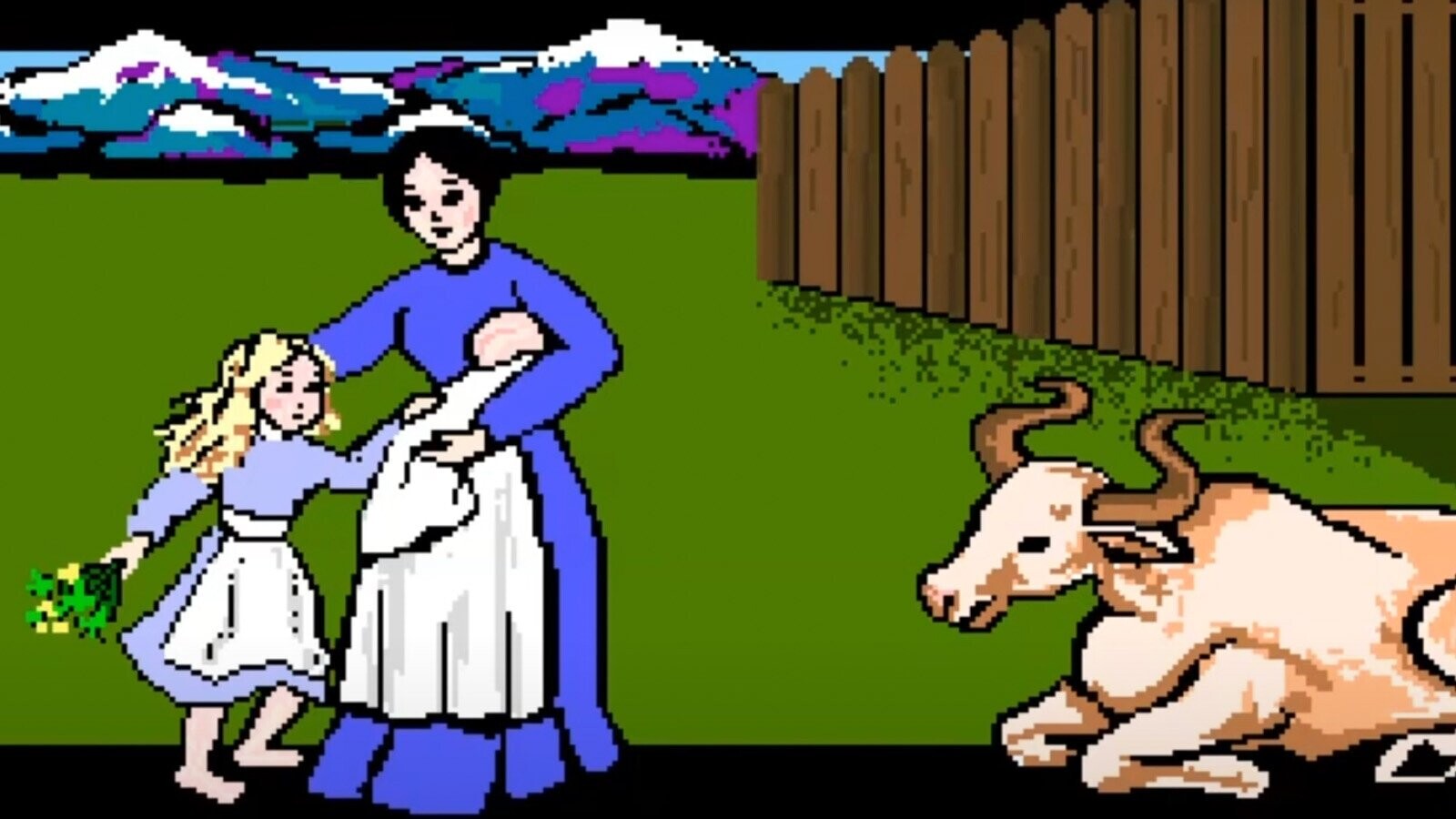
Some video games ask you to save the princess. Some ask you to defeat aliens. The Oregon Trail asked you to ration flour, pray your oxen didn’t wander off, and emotionally prepare for the sentence every school computer lab veteran still hears in their nightmares: “You have died of dysentery.” Naturally, Hollywood looked at that cheerful buffet of starvation, river drownings, broken wagon axles, snakebites, cholera, and frontier paperwork and said, “Perfect. Let’s make it an action-comedy.”
Yes, the famously grim educational game The Oregon Trail is being developed as a feature film by Apple Original Films, and early reports describe the project as an action-comedy with musical numbers. That sounds absurd at first, like turning a tax audit into a tap-dancing pirate movie. But the longer you think about it, the more it makes a strange kind of sense. The game was always funny in the way disaster is funny after enough emotional distance: brutal, random, educational, and just pixelated enough to keep children from realizing they were role-playing a slow-motion historical catastrophe.
What Is the Oregon Trail Movie Actually About?
The upcoming Oregon Trail movie is reportedly in early development at Apple Original Films. Will Speck and Josh Gordon, the directing duo behind Blades of Glory, Office Christmas Party, and Lyle, Lyle, Crocodile, are attached to direct and produce. That alone tells us the film probably will not be a somber, sepia-toned meditation on westward suffering where every character coughs meaningfully beside a wagon wheel.
The creative team also includes Benj Pasek and Justin Paul, the award-winning songwriting duo associated with La La Land, The Greatest Showman, and Dear Evan Hansen. They are expected to contribute original music, with reports comparing the musical approach to the playful, self-aware energy of Barbie. The screenplay is tied to The Lucas Bros. and Max Reisman, which suggests a script that may lean into satirical chaos rather than dusty historical homework.
As of now, the film does not have a confirmed cast, release date, trailer, or final plot synopsis. What we do know is deliciously weird: a game remembered for sudden death, limited supplies, and catastrophic river crossings is being reimagined as a big-screen action-comedy. Somewhere, a digital banker from Independence, Missouri is nervously counting spare wagon tongues.
Why The Oregon Trail Is So Bleakand So Beloved
To understand why this adaptation is funny before a single joke is written, you have to understand what The Oregon Trail meant to generations of American students. The game began in 1971 as a classroom project created by Don Rawitsch, Bill Heinemann, and Paul Dillenberger. It was designed to teach students about 19th-century pioneer life, not to become one of the most recognizable educational video games ever made. But history had other plans, and by “history,” we mean millions of children gleefully naming wagon party members after their friends and then watching them perish from typhoid.
The premise is simple: you lead a wagon party from Independence, Missouri, toward Oregon’s Willamette Valley. Along the way, you buy supplies, hunt for food, decide whether to ford rivers, repair your wagon, and try not to lose everyone to illness. The brilliance of the game is that it turns resource management into drama. The horror is that the drama often ends with a tombstone reading “Here lies your best friend, who died because you bought too many bullets and not enough clothes.”
That bleakness is exactly why the game stuck. It was educational software with the emotional timing of a slapstick disaster movie. You could be feeling confident one minute, then lose an ox, catch cholera, break an axle, and realize you spent your last dollar on bacon. It taught planning, probability, history, geography, and humility. Mostly humility.
Why an Action-Comedy Might Be the Smartest Possible Adaptation
At first glance, The Oregon Trail sounds better suited to a survival drama than an action-comedy. The historical Oregon Trail involved real hardship, displacement, disease, environmental danger, and complicated consequences for Indigenous peoples. A movie cannot ignore those realities without feeling shallow. But a comedy does not automatically mean a story lacks seriousness. Some of the best action-comedies work because danger is real, stakes are high, and characters cope badly, loudly, and hilariously.
Think about the game’s structure. A wagon train is already a moving ensemble cast. Every river crossing is a set piece. Every hunting trip can become an action sequence. Every supply stop is a chance for comic negotiation. Every random disaster is a punchline written by fate. The game practically begs for a group of mismatched travelers arguing over whether to caulk the wagon or ford the river while someone in the background is already composing a dramatic ballad about dysentery.
The action-comedy format also solves a major adaptation problem: The Oregon Trail does not have a single famous main character. There is no Mario, no Master Chief, no Lara Croft. The “star” is the journey itself. A movie needs personalities, conflict, and emotional arcs. Comedy gives the filmmakers room to invent a memorable group of travelers while still honoring the game’s core loop: make a plan, watch the plan fail, panic, survive, repeat.
The Musical Angle Is StrangeBut Not Random
The musical element may be the most surprising detail, but it could also be the adaptation’s secret weapon. The Oregon Trail has always had a strange relationship with tone. It is historically serious, mechanically unforgiving, and culturally nostalgic. A straightforward drama might feel too heavy. A pure parody might feel too thin. A musical action-comedy can walk the line between affectionate and absurd.
Original songs could turn the game’s familiar beats into memorable sequences: a cheerful supply-store number about overspending on oxen, a tense river-crossing anthem, a campfire song that starts hopeful and ends with everyone realizing the coffee is gone. The trick will be balance. If the songs are too silly, the movie risks flattening a complicated historical subject. If they are too earnest, audiences may wonder why the dysentery movie is trying to win a Tony Award.
The comparison to Barbie is useful because that film showed how a nostalgic brand can become more than a toy commercial. It used comedy, music, visual spectacle, and self-awareness to explore identity and cultural memory. The Oregon Trail could attempt something similar: a movie that laughs at the shared school-computer trauma while also asking what stories Americans were taught about westward expansionand what those stories left out.
The Hard Part: Handling History Responsibly
Here is where the wagon wheels hit rough ground. The Oregon Trail is not just a meme machine. It is connected to a real period of American history involving migration, settler expansion, Indigenous displacement, disease, and environmental hardship. A modern adaptation has to be smarter than “LOL, everyone died.” That joke works on a T-shirt. It cannot carry a feature film by itself.
Recent versions of The Oregon Trail have made efforts to include more respectful representation of Native American characters and perspectives. That matters. The older classroom versions largely framed the journey through the settler viewpoint, which was common for the era but incomplete. A 2020s film has the opportunityand responsibilityto widen the lens. It can still be funny, but the humor should come from character flaws, bad decisions, and absurd survival situations, not from erasing the people whose lands were being crossed.
The smartest version of this movie would let the comedy expose myths rather than reinforce them. It could poke fun at pioneer overconfidence, the ridiculous optimism of underprepared travelers, and the gap between heroic frontier fantasies and muddy, mosquito-filled reality. In other words, make the wagon party the butt of the joke, not the history.
Why Video Game Adaptations Are Finally Getting Better
For decades, “video game movie” was a phrase that made audiences lower their expectations faster than a wagon sinking in the Snake River. But the genre has improved. Recent adaptations have shown that filmmakers do not need to copy gameplay literally; they need to understand what players emotionally remember. The Super Mario Bros. Movie leaned into visual delight and brand familiarity. Sonic the Hedgehog found a family-comedy rhythm. The Last of Us succeeded by treating the game’s story with dramatic seriousness. Fallout proved that tone, world-building, and dark humor can translate beautifully from console to screen.
The Oregon Trail belongs to a different category. It is not famous for cinematic lore. It is famous for shared experience. People remember classroom computers, green or blue screens, floppy disks, bad hunting aim, and the cruel comedy of random misfortune. The movie’s job is not to recreate every menu option. Nobody needs a ten-minute scene about buying 600 pounds of meat unless the song absolutely slaps. The job is to capture the feeling: hope, chaos, bad math, worse weather, and the knowledge that no matter how carefully you prepare, history may still throw measles at Todd.
What Fans Probably Want From the Movie
Fans will likely expect certain touchstones. Someone must die of dysentery, or the internet will riot politely but firmly. A river crossing should go horribly wrong. An overconfident character should insist the party can travel at a grueling pace and then immediately regret it. Hunting should be both exciting and ridiculous. At least one tombstone joke is legally, spiritually, and culturally required.
But nostalgia alone is not enough. The film needs a story that works for viewers who have never played the game. That means strong characters, clear stakes, and a reason to care whether this wagon party reaches Oregon. The best approach may be an ensemble comedy where every traveler represents a different attitude toward the American frontier: the dreamer, the schemer, the know-it-all, the realist, the coward, the accidental leader, and the person who somehow packed twelve clocks but no medicine.
The movie should also resist the temptation to become a two-hour meme compilation. Yes, the dysentery jokes will arrive. They must. But the reason The Oregon Trail lasted for decades is not just because children enjoy digital suffering. It lasted because its systems made choices matter. A good film adaptation can make those choices emotional: who gets medicine, when to stop, whether to risk a shortcut, whether ambition is worth the cost.
Could This Actually Work?
Oddly enough, yes. In fact, The Oregon Trail may be better suited for adaptation than many games with more obvious cinematic packaging. It has a clean premise, built-in danger, recognizable brand value, and enough tonal flexibility to support comedy, action, music, satire, and heartfelt character moments. It is a road movie, a survival story, a historical spoof, and a group project where everyone gets a C because Brandon spent the entire budget on bullets.
The risk is tone. If the film becomes too goofy, it may feel disrespectful to the real history behind the trail. If it becomes too serious, it may waste the absurd comic potential that made the game memorable. The sweet spot is darkly funny, fast-moving, and surprisingly thoughtful. Imagine a movie that starts with cheerful pioneer ambition, escalates into slapstick survival chaos, and quietly reveals that the old classroom version of history was only part of the story.
That is a difficult wagon to steer. But if the filmmakers pull it off, The Oregon Trail could become one of the strangest and most interesting video game adaptations in years. And if they do not pull it off, well, at least we can all gather around the cultural campfire and carve “Here lies a promising idea” into a pixelated tombstone.
Personal Experiences: Why This News Hits a Weird Nostalgia Nerve
Anyone who grew up playing The Oregon Trail in school knows the experience was never just about the game. It was about the whole ritual. You walked into the computer lab, sat in front of a beige machine that looked like it could survive a minor earthquake, and waited for your turn to guide five doomed names across the American West. The room smelled faintly of plastic, carpet cleaner, and educational ambition. The teacher thought you were learning history. You thought you were becoming a wilderness strategist. The game knew you were about six clicks away from disaster.
The funniest part was how serious everyone became. Choosing supplies felt like a life decision. You could watch a room full of children debate oxen efficiency with the intensity of Pentagon analysts. Someone always bought too many bullets. Someone always tried to ford the river because patience had not yet developed in the adolescent brain. Someone named every character after classmates, which guaranteed emotional chaos when “Jessica has cholera” appeared on screen. No modern game lobby has ever produced tension quite like a fourth-grader realizing he has accidentally killed his entire spelling group.
That is why the idea of an action-comedy feels less bizarre than it sounds. For many players, The Oregon Trail was already a comedy of failure. We laughed because the game was merciless in a clean, blunt, almost bureaucratic way. It did not deliver a dramatic cutscene when disaster struck. It simply informed you that your wagon had tipped, your food was wet, your cousin was sick, and your ox had apparently chosen a solo career. The lack of emotional cushioning made it funnier.
At the same time, the game left a deeper impression than most classroom activities. It taught that travel was dangerous, resources were limited, and confidence was not the same thing as competence. It also taught, unintentionally, that historical stories depend on perspective. As kids, many of us focused on winning the journey. As adults, we can look back and ask more complicated questions about whose journey was being centered, whose land was being crossed, and how a movie might tell the story with more care.
That combinationnostalgia, absurdity, danger, and historical discomfortis exactly what makes the upcoming movie fascinating. It is not just another brand revival. It is a chance to revisit a strange shared memory and ask why a bleak little educational game became so beloved. Maybe we loved it because it made failure funny. Maybe because it made history interactive. Maybe because it gave us a safe way to experience catastrophe while sitting in a rolling chair under fluorescent lights. Or maybe because, deep down, every American child deserves one unforgettable lesson in the importance of packing medicine.
So yes, an Oregon Trail action-comedy sounds ridiculous. It also sounds potentially perfect. If the movie remembers the panic of the river crossing, the dark humor of the tombstone, the thrill of surviving one more mile, and the need to treat history with more honesty than the old software could manage, it may turn the bleakest educational game into something unexpectedly alive. Just please, for the love of all oxen, do not forget the dysentery.
Conclusion
The Oregon Trail becoming an action-comedy is one of those Hollywood ideas that sounds like a joke until you realize the joke may be brilliant. The game has everything a movie needs: danger, momentum, nostalgia, recognizable imagery, dark humor, and a built-in audience that still flinches at the word “dysentery.” With Apple Original Films developing the project, Will Speck and Josh Gordon attached to direct, and Pasek and Paul expected to bring original music, the film could become a wild mix of frontier chaos, musical comedy, and sharp cultural reflection.
The challenge will be honoring both sides of the material. The movie should embrace the absurdity that made the game unforgettable, but it should also approach the history behind the trail with care. If it can do both, this strange adaptation might not just survive the journeyit might arrive in Oregon with a full wagon, a catchy soundtrack, and only minor emotional damage.
Note: This article synthesizes publicly reported information about the developing Oregon Trail film, the history of the original game, and broader trends in video game adaptations, rewritten in original editorial form for web publication.