Power outages have a special talent for arriving at the worst possible moment: right after you filled the fridge, during a storm, or exactly when your laptop battery is gasping at 3 percent. That is where the best solar generators of 2025 earn their keep. Unlike gas generators, solar generators use a rechargeable battery, an inverter, and compatible solar panels to store and deliver electricity without fumes, fuel runs, or the neighborhood soundtrack of a lawn mower trapped in a metal box.
Based on Bob Vila’s 2025 hands-on solar generator testing and broader current buying guidance, today’s top models are much more useful than the underpowered “phone charger in a box” devices of a decade ago. The best portable power stations can run a refrigerator, charge laptops, keep lights on, power tools at a jobsite, or make a camping trip feel less like a survival audition. The trick is matching the generator to the job. A 155Wh unit is great for phones and small electronics; a 2,000Wh-plus model is more realistic for refrigerators, tools, and longer outage backup.
Quick Answer: Best Solar Generators of 2025
For most homeowners and serious emergency-preparedness shoppers, the Generac GB2000 Portable Power Station stands out as the best overall solar generator in Bob Vila’s tested lineup. It offers 2,106 watt-hours of capacity, 1,600 running watts, 3,200 peak watts, several useful ports, quiet operation, and enough muscle to handle appliances, devices, and some tools.
For compact travel power, the EcoFlow River 2 Pro is easier to move and still offers a practical 768Wh capacity with 800W output. For larger outdoor needs, the EcoFlow Delta 2 Max delivers 2,048Wh, 2,400W output, and expansion options. If you want a midrange home-backup workhorse, the Bluetti Elite 200 V2 deserves attention for its LiFePO4 battery, 2,073.6Wh capacity, and 2,600W output. For budget device charging, the Aimtom PowerPal X 155Wh is small, simple, and surprisingly handy.
What Is a Solar Generator?
A solar generator is not technically a generator in the old-school fuel-burning sense. It does not create electricity by spinning an engine. Instead, it stores electricity in a battery and releases it through AC outlets, USB ports, DC ports, or wireless charging pads. When paired with solar panels, it can recharge from sunlight. Many models also recharge from a wall outlet or vehicle port, which is useful when the forecast says “clouds with a chance of your plans collapsing.”
The main parts include a battery, charge controller, inverter, display, ports, and sometimes app controls. The battery stores energy in watt-hours. The inverter determines how many watts the unit can deliver at once. Solar input determines how quickly compatible panels can refill the battery under good sun. These three numberswatt-hours, running watts, and solar inputmatter more than marketing phrases like “ultimate power beast,” which sounds exciting but will not keep your fridge cold.
Best Overall: Generac GB2000 Portable Power Station
Why It Stands Out
The Generac GB2000 is the most balanced pick for shoppers who want dependable home backup, off-grid power, and emergency peace of mind without moving into whole-house battery territory. Bob Vila’s test team selected it as the best option for most users after evaluating popular solar generators for power, ease of use, portability, noise, and value.
Its 2,106Wh capacity gives it enough stored energy for practical outage tasks: running a refrigerator for a while, charging phones and laptops, powering lamps, or helping with tools when an outlet is not nearby. The 1,600 running watts and 3,200 peak watts make it more capable than small camping-only units. It also includes three 120V AC outlets, USB-A ports, USB-C ports, a 12V DC port, and a wireless charging pad.
Best Use Cases
This is a strong choice for homeowners who want a portable solar generator for emergency backup but do not want to install a permanent solar battery system. It also makes sense for tailgating, car camping, mobile work, and short-term off-grid use. At about 43 pounds, it is portable in the “carry it from the garage to the kitchen” sense, not the “skip happily across a meadow” sense. Still, the handle helps, and the weight is reasonable for the capacity.
Best Budget Pick: Aimtom PowerPal X 155Wh Portable Power Station
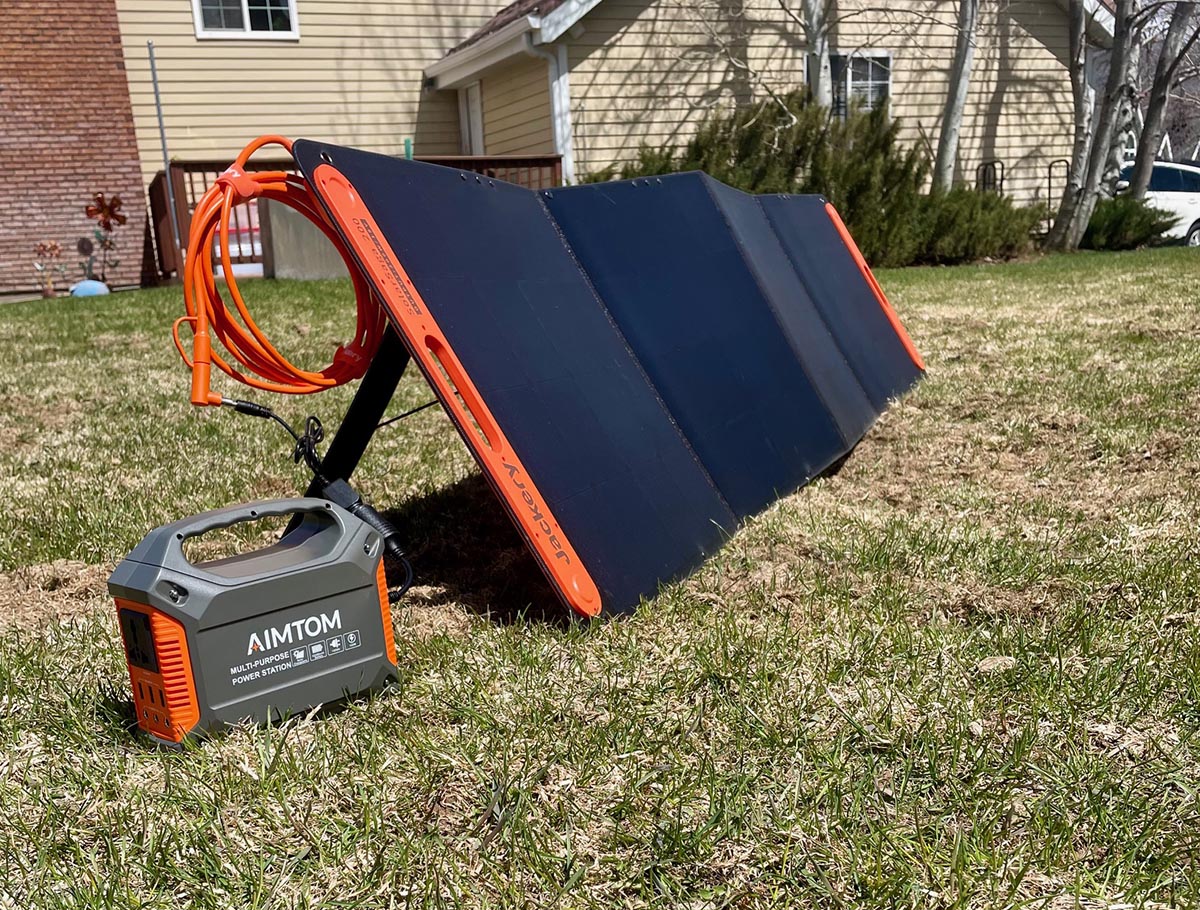
The Aimtom PowerPal X 155Wh is not going to run your entire kitchen, and it will not impress a refrigerator with its biceps. But for small electronics, it is a smart budget solar generator. With 155Wh of capacity, 100 running watts, and 150 peak watts, it is best for phones, tablets, earbuds, cameras, small fans, and other low-wattage devices.
Its biggest advantage is convenience. It weighs under 4 pounds, includes USB-A ports, DC ports, and a 110V AC outlet, and can recharge from AC power, a car port, or compatible solar panels. This makes it a practical glove-box or camping-bin companion. If your goal is to keep communication devices alive during a short outage, road trip, or beach day, this little unit makes sense. If your goal is to run a microwave, please step away from the tiny battery and no one gets disappointed.
Best Compact Solar Generator: EcoFlow River 2 Pro
Small Size, Real Utility
The EcoFlow River 2 Pro is one of the most appealing compact solar generators because it offers a useful middle ground: small enough for travel, powerful enough for more than phone charging. With 768Wh of capacity and 800 running watts, it can support laptops, lights, routers, fans, cameras, and some small appliances.
It also offers multiple charging methods, including AC, solar, vehicle charging, and USB-C. EcoFlow lists a fast AC recharge time of about 70 minutes, which is excellent for people who want to top up before a storm or finish charging before leaving for a weekend trip. Its LiFePO4 battery chemistry is also a plus because LFP batteries are generally valued for long cycle life and stability.
Who Should Buy It?
Choose the River 2 Pro if you want a portable power station for camping, work-from-anywhere days, road trips, and short emergency backup. It is not the best pick for heavy appliances over long periods, but it is extremely useful for keeping the essentials alive. Think of it as the reliable friend who brings snacks, extra cables, and somehow always has a flashlight.
Best Midrange Solar Generator: Bluetti Elite 200 V2
The Bluetti Elite 200 V2 is a serious midrange power station for shoppers who need more than travel charging but do not want an enormous wheeled system. It offers 2,073.6Wh capacity and 2,600W output, with the ability to handle heavier loads. In Bob Vila’s testing, this model performed well for larger household demands, including refrigerator use and portable AC use.
Its LiFePO4 battery is a key selling point. Bluetti promotes a long cycle life, and the built-in battery management system helps monitor performance and safety. The unit also supports AC, solar, and DC charging, and the app gives users a clearer look at charging status, battery health, and power consumption.
The main downside is weight. At more than 50 pounds, it is better suited for home backup, RV use, tailgating, and car camping than backpacking or frequent hand-carrying. But for people who want a strong balance of capacity, output, and long-term durability, the Bluetti Elite 200 V2 is one of the most compelling solar generators of 2025.
Best for Outdoors: EcoFlow Delta 2 Max Solar Generator
The EcoFlow Delta 2 Max is built for people who ask, “Can I power more?” and then immediately pack a coffee maker, string lights, a fridge, a laptop, and probably a blender because smoothies are important in the wilderness. With 2,048Wh capacity and 2,400W AC output, it is strong enough for many home, RV, and outdoor scenarios.
One of its best features is expandability. The Delta 2 Max can connect with extra batteries to reach up to 6,144Wh, making it more flexible than a fixed-capacity unit. It also supports high solar input, fast charging, and multiple outlets for running several devices at once. Bob Vila’s test notes highlighted its usefulness for refrigerator backup and weekend-trip extras.
This is a great choice for campers, RV travelers, homeowners preparing for storms, and anyone who wants a solar generator with enough room to grow. The lack of a 30-amp RV outlet may bother some RV users, but for most outdoor and emergency setups, it offers an excellent mix of capacity, charging speed, and practical power.
How to Choose the Best Solar Generator
1. Match Capacity to Your Real Needs
Battery capacity is measured in watt-hours. A 500Wh solar generator can theoretically run a 50W device for about 10 hours, though real-world efficiency losses reduce that number. A refrigerator, coffee maker, heater, or power tool can drain a battery much faster than phones and LEDs. If you want emergency backup for a fridge, router, lamps, and device charging, look at models around 1,000Wh to 2,000Wh or more.
2. Check Running Watts and Surge Watts
Running watts tell you how much continuous power a solar generator can deliver. Surge watts show how much short burst power it can provide when motors start. Refrigerators, pumps, compressors, and power tools often need extra startup wattage. If your generator cannot handle the surge, the appliance may shut down or refuse to start.
3. Look for LiFePO4 Batteries
Many top solar generators now use lithium iron phosphate batteries, often called LiFePO4 or LFP batteries. They are popular because they offer long cycle life, good thermal stability, and strong long-term value. They may weigh a bit more than some lithium-ion alternatives, but for frequent use and emergency backup, the durability advantage can be worth it.
4. Consider Solar Input
A big battery is only half the story. Solar input determines how fast you can recharge from panels. If a 2,000Wh generator only accepts a small amount of solar input, recharging may take a long time. If it accepts 800W, 1,000W, or more, it can recover much faster under strong sunlight. Always check compatible voltage, connector type, and maximum wattage before pairing panels.
5. Count the Ports
The best solar generator should match your devices. AC outlets are important for household appliances. USB-C ports are useful for laptops and modern phones. USB-A ports still matter for older accessories. A 12V car-style outlet can help with coolers, air pumps, and vehicle accessories. Wireless charging is a nice bonus, though not essential.
Solar Generators vs. Gas Generators
Solar generators are quieter, cleaner, and safer for indoor use because they do not burn fuel or emit exhaust. That makes them attractive for apartments, condos, camping, and homes where storing gasoline is inconvenient. They also require less maintenance because there is no engine oil, spark plug, carburetor, or fuel stabilizer drama.
Gas generators still win for high-output, long-duration power when fuel is available. They can run large loads and refuel quickly. However, they must be used outdoors, far from windows and doors, due to carbon monoxide danger. Solar generators are better for essential electronics, short-term appliance backup, quiet operation, and indoor-friendly emergency power.
Common Mistakes to Avoid
The first mistake is buying too small. A tiny power station may look affordable, but it will not support major appliances. The second mistake is ignoring solar panel compatibility. Not every panel works with every generator, and exceeding voltage limits can damage equipment. The third mistake is expecting unlimited power. A solar generator is a battery, not a magic box from a superhero movie. It must be charged, sized correctly, and used wisely.
Another common mistake is forgetting storage maintenance. Even low-maintenance portable power stations should be stored in a dry location, protected from extreme temperatures, and periodically recharged according to the manufacturer’s instructions. Treat the battery well and it is more likely to treat your outage like a minor inconvenience instead of a candlelit crisis.
Best Solar Generator by Situation
For Home Backup
Choose the Generac GB2000, Bluetti Elite 200 V2, or EcoFlow Delta 2 Max if you want to power refrigerators, lights, internet equipment, and devices during outages. These models offer the capacity and output needed for more demanding household tasks.
For Camping and Road Trips
The EcoFlow River 2 Pro is a practical pick for camping because it balances size, battery capacity, and charging flexibility. The Aimtom PowerPal X is better for minimalist trips where phones, cameras, and small gadgets are the main concern.
For RV and Outdoor Events
The EcoFlow Delta 2 Max is the strongest choice in this group for outdoor events and expandable power needs. It can run multiple devices and grow with extra batteries, which is useful when your “simple weekend setup” mysteriously becomes a mobile kitchen, office, and entertainment lounge.
Final Verdict
The best solar generator of 2025 for most people is the Generac GB2000 Portable Power Station because it delivers the right blend of capacity, power, quiet operation, and value. It is not the lightest model, and solar panels are sold separately, but it offers enough performance to justify its place at the top of Bob Vila’s tested list.
For lighter needs, the EcoFlow River 2 Pro is the better compact option. For bigger outdoor setups, the EcoFlow Delta 2 Max is the more flexible powerhouse. For value-focused small-device charging, the Aimtom PowerPal X is simple and useful. For midrange backup with a long-lasting battery, the Bluetti Elite 200 V2 is a standout.
The smartest solar generator purchase is not always the biggest or most expensive. It is the one that fits your actual appliances, your outage risk, your travel habits, and your patience for carrying a 50-pound box across the yard. Choose well, charge it before you need it, and the next blackout may feel less like an emergency and more like an oddly quiet camping trip in your living room.
Real-World Experience: Living With a Solar Generator in 2025
Using a solar generator in real life feels different from reading a spec sheet. On paper, watt-hours and running watts look tidy and mathematical. In daily use, the experience is more practical: Can I keep the fridge cold? Can I make coffee? Can I charge everyone’s phones before the kids start treating 12 percent battery like a national emergency?
The first thing most users notice is silence. A solar generator does not rumble in the driveway or make you shout across the patio. During a power outage, that silence is comforting. You can plug in a lamp, router, fan, or refrigerator and still hear the rain outside. For apartment dwellers and suburban homeowners, that alone is a major reason to choose battery backup over a fuel generator for smaller loads.
The second real-world lesson is that planning matters. A 2,000Wh power station sounds huge until you connect a high-wattage appliance. A coffee maker, electric kettle, or space heater can drain capacity quickly. On the other hand, phones, LED lights, Wi-Fi routers, and laptops sip power gently. The best strategy is to prioritize essentials: refrigerator first, communication devices second, lights third, comfort items last. Yes, the waffle maker is emotionally important, but during an outage it may need to wait its turn.
Solar charging is also more realistic when expectations are grounded. Under bright sun with properly angled panels, a good system can recover meaningful energy during the day. Under clouds, shade, winter sun, or lazy panel placement, charging slows down. Users get better results by moving panels throughout the day, keeping them clean, and avoiding shade from trees, porch rails, or that one patio umbrella that suddenly becomes the enemy of renewable energy.
Portability is another practical factor. Anything under 20 pounds feels easy to move. Around 40 to 55 pounds, a power station becomes “portable” in the same way a full cooler is portable: technically yes, but you will respect it. If you plan to move the unit often, handles, wheels, and storage location matter. For home backup, place it where it can reach the appliances you care about without creating a spaghetti festival of extension cords.
One of the best everyday uses is not dramatic at all: keeping a work setup alive. A solar generator can power a laptop, monitor, modem, router, desk lamp, and phone charger through short outages. For remote workers, that can mean finishing a meeting instead of vanishing mid-sentence like a low-budget magician. Campers also benefit from the same quiet reliability. A power station can run lights, recharge camera batteries, power a cooler, and keep devices topped off without disturbing the campsite.
The biggest experience-based recommendation is simple: test your solar generator before an emergency. Plug in your fridge for a few hours. Charge it with your solar panels. Try your router, laptop, fan, CPAP machine, or tools. Learn which outlets work best and how fast the battery drains. The middle of a storm is a terrible time to discover that you bought the wrong adapter or that your “portable” generator lives behind ten boxes of holiday decorations.
In 2025, solar generators are no longer novelty gadgets. The best models are practical, quiet, and powerful enough for real backup tasks. They still have limits, but when used wisely, they turn outages, road trips, and off-grid weekends into manageable situations. And frankly, any device that keeps the coffee flowing when the grid gives up deserves a little applause.
Conclusion
The best solar generators of 2025 prove that portable power has grown up. Whether you choose the well-rounded Generac GB2000, the travel-friendly EcoFlow River 2 Pro, the expandable EcoFlow Delta 2 Max, the durable Bluetti Elite 200 V2, or the compact Aimtom PowerPal X, the right model can make outages and off-grid adventures far easier to manage. Focus on capacity, output, solar input, battery chemistry, and real-world usenot just flashy marketing. Buy for the devices you actually need to power, keep the unit charged, and your future self may thank you when the lights go out.