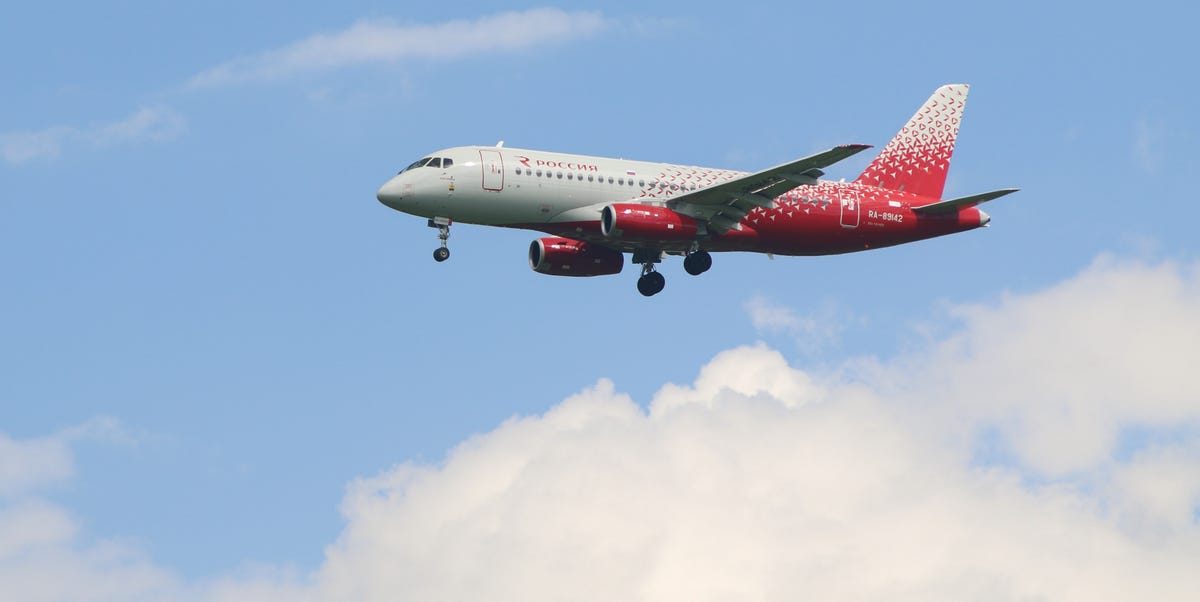
Imagine buying an ordinary domestic airline ticket and discovering that your aircraft has a loading ramp, folding troop seats, exposed cargo fittings, and all the cabin charm of a very determined warehouse. That scenario sounds like aviation satire, but Russia’s prolonged shortage of serviceable passenger aircraft has made it increasingly plausibleespecially on remote regional routes where flying is less a luxury than a geographic necessity.
Western sanctions imposed after Russia’s full-scale invasion of Ukraine cut Russian airlines off from new Boeing and Airbus aircraft, manufacturer-approved spare parts, software, technical guidance, and many international maintenance services. Russia has kept much of its fleet operating through stockpiled components, domestic repairs, parallel imports, and the cannibalization of grounded aircraft. Those methods have bought time, but they have not manufactured an unlimited supply of engines, landing-gear components, avionics, tires, or certified replacement parts.
Editor’s note: The idea of using military transports for civilian passengers was initially presented as an expert prediction in 2022. A January 2026 report later described passengers in Russia’s Irkutsk region being moved from a scheduled An-24 flight to a cargo-configured An-26. That specific account originated with Ukraine’s Center for Countering Disinformation and should be treated cautiously because it has not received the same level of independent verification as Russia’s documented fleet, maintenance, and production problems.
Why Russia’s Commercial Aviation System Is Under Pressure
Russia’s aviation problem begins with the composition of its airline fleet. Before the war, Russian carriers relied heavily on Western-built jets, particularly members of the Airbus A320 and Boeing 737 families. These aircraft were efficient, familiar to crews, and supported by a global network of manufacturers, maintenance organizations, leasing companies, and parts distributors.
That global support structure was disrupted in 2022. The U.S. Department of Commerce introduced licensing restrictions covering aircraft and aircraft parts destined for Russia, while Boeing and Airbus suspended support for Russian operators. U.S. authorities also issued enforcement orders against several Russian airlines and identified aircraft being operated in violation of American export controls.
Russia did not immediately run out of airplanes. Aircraft are not disposable coffee cups, and the country inherited experienced engineers, maintenance facilities, and a substantial inventory of jets. Airlines also had spare parts in storage. Over time, however, every landing, pressurization cycle, and hour of engine operation consumes a portion of an aircraft’s service life.
Some components can be repaired domestically. Others can be acquired through intermediaries. Still others are removed from parked aircraft so that a smaller number of planes can remain active. This process, commonly called cannibalization, is legitimate when it is carefully documented and performed under approved procedures. The difficulty arises when operators lack manufacturer support, verified component histories, current software, or access to the original technical data needed to test and certify the repair.
How a 2022 Prediction Became More Credible
In June 2022, an aviation expert interviewed by Popular Mechanics suggested that Russia could eventually use military aircraft to transport civilians. At the time, the proposal was theoretical. Russia still had hundreds of operational airliners, and nobody expected every Western-built plane to turn into a lawn ornament before the next weekend.
The logic was straightforward: Russia’s military transport fleet had separate supply chains, state-controlled maintenance resources, and aircraft designed to work from austere airports. If commercial fleet availability declined sharply, the government could use military transports as an emergency bridge.
Developments since then have made that theory harder to dismiss. Reuters reported in 2025 that Russian manufacturers delivered only one of 15 commercial aircraft planned for that year. Since the beginning of the war, only a small number of new passenger planes had joined the fleet, while serial production schedules for the MC-21, SJ-100, and Il-114 were repeatedly delayed. Russia also began seeking help from Central Asian airlines to serve some domestic demand.
By 2026, Russian carriers were returning mothballed Soviet-era aircraft to service. The revived types reportedly included the Tupolev Tu-204 and Tu-214, Ilyushin Il-96, Antonov An-148, and even older Boeing 747s. Bringing stored airplanes back may add capacity, but it also resembles searching the attic for a winter coat because the clothing store has stopped accepting your credit card. It solves an immediate problem without creating a modern replacement fleet.
Why Military Transport Aircraft Look Tempting
They are controlled by the state
Military aircraft are not dependent on commercial leasing companies or ordinary airline financing. The Russian government can assign them to emergency missions, reposition them quickly, and prioritize their maintenance. In a severe regional transportation shortage, that degree of control matters.
They can operate from difficult airfields
Aircraft such as the Antonov An-26 were built to move personnel and cargo into remote locations with relatively limited airport infrastructure. The An-26 has a large rear cargo door and loading ramp and can be configured with folding seats for roughly 38 to 40 people. That makes it useful for isolated communities, industrial settlements, and northern routes where rail and highway alternatives may be slow, seasonal, or nonexistent.
They already move people
Military transports routinely carry troops, technicians, medical teams, evacuees, and government personnel. In purely physical terms, putting human beings inside these aircraft is not revolutionary. The real issue is whether the aircraft, operator, cabin configuration, crew procedures, and airport handling meet the standards expected for scheduled civilian service.
A Military Cargo Plane Is Not an Airliner With Tougher Paint
Military transports are designed around mission flexibility, not passenger comfort. A commercial airliner devotes enormous engineering attention to cabin evacuation, lighting, ventilation, noise reduction, baggage storage, seat strength, accessibility, fire protection, and the orderly movement of passengers. A cargo aircraft prioritizes payload, loading speed, ruggedness, and the ability to carry items that would make an airport gate agent quietly resign.
A cargo-configured An-26 may have folding seats along the walls rather than forward-facing airline seats. Cargo restraints, rails, exposed structures, and loading equipment may remain in the cabin. Noise and vibration can be much greater than on a modern passenger jet. Toilets may be basic or unavailable, temperature control may be inconsistent, and boarding through a ramp is not ideal for elderly passengers, young children, or travelers with limited mobility.
Certification creates another hurdle. A military aircraft may be safe for its intended mission while still failing to comply with civilian commercial requirements. Passenger operations would require approved seating, restraints, emergency equipment, crew training, maintenance programs, operating manuals, liability arrangements, and oversight. The government could rewrite domestic rules or classify flights as special charters, but changing paperwork does not automatically install better exits or quieter engines.
Russia’s Delayed Domestic Aircraft Programs
Russia’s preferred solution is not to turn military transports into flying buses. It is to replace foreign aircraft with domestically produced passenger planes. The main programs include the MC-21 narrow-body jet, the import-substituted SJ-100 regional jet, the Tu-214, and the Il-114-300 turboprop.
Each program has encountered delays, component shortages, financing difficulties, or performance compromises. Russia previously used imported engines, avionics, composite materials, and other systems even on aircraft marketed as domestic products. Replacing those components requires testing, certification, redesigned manufacturing processes, trained suppliers, and production equipment. Making a plane “all Russian” is not like changing the language setting on a smartphone.
Reuters reported that the domestically equipped MC-21 became heavier than the version that incorporated imported components, reducing range and fuel efficiency. Production targets have also been repeatedly revised. In 2021, Russian airlines added dozens of new commercial aircraft. During the first several years after the invasion, additions slowed to a fraction of that pace.
That gap between retiring aircraft and new deliveries is the central problem. Airlines can reactivate old planes, repair components, and buy parts through indirect channels, but those measures do not provide the predictable flow of new aircraft needed for a large national transportation system.
Grounded Aircraft Are Already Reshaping the Market
By June 2026, several Russian airlines reportedly had unusually large portions of their fleets out of service. Around one-third of S7’s fleet was grounded, while Nordwind reportedly had an even higher percentage unavailable. Ural Airlines, Utair, Red Wings, and Azimut were also operating with varying levels of reduced availability. Aeroflot’s main operation was in a stronger position, demonstrating that the crisis was uneven rather than an immediate nationwide collapse.
The unevenness matters. Russia is unlikely to wake up one morning with every airport closed and every jet missing. Instead, pressure is more likely to appear as fewer frequencies, less competition, longer connections, higher ticket prices, and older aircraft concentrated on secondary routes.
Major routes between Moscow, St. Petersburg, Sochi, and other large cities will receive priority because they carry more passengers and generate more revenue. Remote communities in Siberia and the Russian Far East face greater risk because their routes are thin, costly, and often served by regional aircraft that are difficult to replace.
What Military-Civilian Flying Might Actually Look Like
A realistic military-aircraft program would probably be limited and targeted. Russia is not likely to replace Aeroflot’s entire Airbus fleet with gray cargo planes and ask passengers to bring their own folding chairs. Military transports are generally less fuel-efficient, less comfortable, and too valuable to defense operations to become ordinary airline substitutes.
They could, however, be used for temporary flights after cancellations, emergency evacuations, seasonal service to remote regions, transportation of workers to strategic industrial sites, or government-subsidized routes with no commercial alternative.
The January 2026 Irkutsk-region report fits that pattern. Passengers allegedly expecting an An-24 passenger aircraft were transferred to a cargo-configured An-26. Although the details require independent confirmation, the type of substitution is technically plausible because the two aircraft share related designs, and the An-26 can carry people when properly configured.
Safety Concerns Extend Beyond Spare Parts
The Federal Aviation Administration downgraded Russia’s aviation-safety rating after determining that the country’s civil aviation authority did not meet international oversight standards. The U.S. State Department currently advises that American government personnel generally should not fly on Russian airlines because of safety concerns.
A downgraded rating does not prove that every individual flight is unsafe. It indicates concerns about the regulatory system responsible for inspections, enforcement, licensing, documentation, and continuing airworthiness. Those institutional safeguards become particularly important when aircraft are aging, manufacturers are unavailable, and parts are moving through opaque supply chains.
Russia’s July 2025 An-24 crash in the Far East, which killed everyone aboard, intensified attention on the country’s reliance on Soviet-era regional aircraft. Investigators must evaluate each accident individually, and the age of an aircraft alone does not establish the cause. Nevertheless, an aging fleet requires rigorous maintenancenot optimism, patriotic speeches, or a mechanic named Yuri saying, “It should probably be fine.”
The Military Also Needs Its Transport Planes
Using military aircraft for civilians carries a strategic cost. Russia’s armed forces need transport planes to move troops, ammunition, vehicles, medical supplies, and replacement equipment. The war in Ukraine has placed sustained pressure on military logistics and aircraft maintenance.
Every transport assigned to a civilian route is temporarily unavailable for military operations. It also consumes engine hours, tires, fuel, crew time, and maintenance capacity. If Russia faces shortages in both civilian and military aviation, shifting aircraft between the two sectors does not eliminate scarcity. It merely moves the shortage to a different spreadsheet.
This constraint is one reason civilian use would probably remain selective. The government might deploy military transports when political embarrassment, humanitarian necessity, or regional economic disruption outweighs the military value of keeping the aircraft available elsewhere.
Passenger Experience: What Flying on a Military Transport Could Feel Like
Checking in would feel surprisingly ordinaryat first
A passenger might purchase a ticket through an airline or regional authority, arrive at a familiar terminal, and pass through normal security. The first sign that this is not an average flight could be the boarding announcement. Instead of a jet bridge and assigned seat groups, travelers might be taken by bus to a remote parking area where a high-wing turboprop sits with its rear ramp lowered.
There may be no polished airline branding, priority lane, or cheerful argument about whether a roller bag is two centimeters too tall. Boarding could involve walking up a metal ramp while ground personnel direct passengers around secured freight, equipment, or mail.
The cabin would be functional rather than friendly
Inside, travelers could encounter folding seats positioned along the sides of the fuselage. Depending on the configuration, passengers might face one another across the cargo compartment rather than looking forward. Insulation and interior panels could be limited, leaving structural ribs, cables, ducts, and cargo hardware visible.
Carry-on baggage would need to be secured carefully because conventional overhead bins might not exist. The cabin crewif civilian cabin attendants were carried at allwould focus heavily on restraints, emergency procedures, and keeping passengers away from cargo systems.
The atmosphere would be closer to a utility flight than a commercial airline cabin. Nobody would ask whether you prefer sparkling water. The beverage service would probably consist of whatever you wisely purchased before boarding.
Takeoff would be louder and more physical
Turboprop military transports can produce intense vibration and cabin noise. Conversation may require raised voices, and hearing protection could be helpful on some configurations. Passengers unfamiliar with exposed aircraft sounds might interpret every mechanical clunk as a developing emergency, even when the noise is completely normal.
Temperature could vary noticeably. Cargo aircraft designed for equipment and troops may not provide the evenly controlled cabin environment passengers expect from a modern jet. The ride may also feel more direct: fewer layers of insulation mean more engine noise, airflow sounds, and vibration reach the cabin.
On the positive side, aircraft such as the An-26 are designed for challenging regional operations. Their ability to use smaller airfields could preserve access to communities that might otherwise lose service entirely. For residents of a remote northern town, a noisy flight may be preferable to a multi-day journey involving roads, trains, ferries, or heroic amounts of instant coffee.
Comfort would not be the biggest concern
The most important passenger questions would involve transparency and safety. Were travelers informed about the aircraft change? Is the plane approved to carry civilians? Are proper seats, restraints, emergency exits, oxygen systems, fire extinguishers, and trained crew available? Is cargo separated and secured? Can children, elderly travelers, and passengers with disabilities be evacuated safely?
A military transport can move people safely when it is maintained, configured, and operated correctly. Armed forces around the world do it every day. The troubling scenario is not simply “civilian inside military plane.” It is a last-minute substitution involving an aircraft not properly prepared for scheduled passenger service.
For travelers, the experience could range from unusual but professionally managed to uncomfortable and poorly communicated. The difference would depend less on the color of the aircraft and more on maintenance discipline, cabin configuration, crew preparation, regulatory oversight, and whether passengers were treated as customers or merely as cargo that complains.
Could Military Flights Become Common Across Russia?
Widespread use remains unlikely unless Russia’s civilian fleet deteriorates much faster than replacement aircraft can be delivered. Military transports are expensive to operate, offer limited passenger capacity, and would create logistical conflicts with defense requirements.
The more probable future is a patchwork system. Aeroflot and other priority carriers may keep relatively modern aircraft flying through favored access to parts and maintenance. Smaller airlines may ground larger percentages of their fleets. Older Soviet-designed passenger aircraft may return to service. Foreign airlines from politically friendly countries may operate selected routes. Military or cargo aircraft could appear when those measures fail to provide enough capacity.
That would not represent the complete disappearance of Russian commercial aviation. It would represent a gradual decline in consistency: one route served by a modern jet, another by a reactivated airliner, another reduced to three weekly flights, and a remote destination receiving an emergency cargo-plane substitution.
Conclusion
The possibility that Russia may use military aircraft for civilian travel is no longer merely an imaginative prediction from the first months of sanctions. Russia has preserved much of its airline network, demonstrating considerable engineering and logistical resilience. Yet the underlying pressures are accumulating: Western aircraft are aging, approved parts remain difficult to obtain, domestic replacements are late, older planes are returning from storage, and some airlines are reporting significant grounding rates.
Military transports cannot replace a national commercial fleet. They can, however, serve as an emergency pressure valveparticularly for remote routes where the alternative is no air service at all. Whether such flights are acceptable depends on proper configuration, transparent communication, qualified crews, verified maintenance, and genuine safety oversight.
For passengers, the ultimate question is not whether the aircraft once carried soldiers or cargo. It is whether the people operating it have completed the unglamorous but essential work required to carry civilians safely. Aviation, after all, runs on engineering, documentation, and maintenancenot on confidence alone, no matter how impressive the confidence looks in a press conference.
Research note: This analysis synthesizes official U.S. export-control and aviation-safety information with reporting and technical material from Reuters, Popular Mechanics, The Wall Street Journal, Wired, Forbes, The Guardian, Radio Free Europe/Radio Liberty, The Moscow Times, UNITED24 Media, the U.S. Departments of State, Commerce, and Justice, and aircraft technical references.