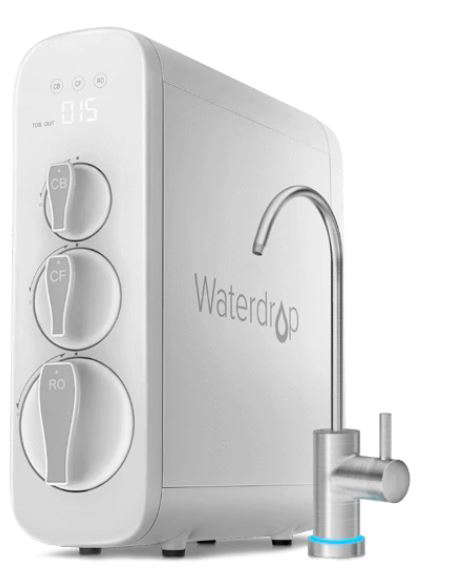
Most under-sink water filters are not especially glamorous. They hide beside the garbage disposal, quietly collecting dust and hoping nobody asks them to explain what “five-stage filtration” actually means. The Waterdrop Reverse Osmosis Water Filtration System, WD-G3-W, takes a more ambitious approach. It combines a tankless design, a high-capacity reverse osmosis membrane, automatic flushing, replaceable cartridges, and a smart faucet that displays water-quality information.
Also known in some newer listings as the Waterdrop G3 or G3P400, the WD-G3-W is rated to produce up to 400 gallons of purified water per day. That does not mean the average family will suddenly begin drinking swimming-pool quantities of water. It means the membrane and internal pump are designed to provide a considerably faster flow than many traditional residential reverse osmosis systems.
This in-depth review examines how the WD-G3-W works, what it can realistically do, where it fits under the sink, how much maintenance it requires, and which households are most likely to appreciate it.
What Is the Waterdrop WD-G3-W?
The WD-G3-W is an electrically powered, point-of-use reverse osmosis system installed beneath a kitchen sink. Unlike conventional RO systems that store purified water in a pressurized tank, it filters water on demand. The result is a slimmer installation, fresher output, and more usable cabinet space.
The system measures approximately 18.12 inches long, 5.67 inches wide, and 17.72 inches high. Its narrow body is one of its most practical features. It still occupies meaningful cabinet space, but it is far less likely to evict every bottle of dish soap from the neighborhood than a bulky tank-and-canister setup.
The manufacturer specifies municipal tap water as the intended feed source. Recommended operating conditions include an incoming water temperature of roughly 41 to 100 degrees Fahrenheit and pressure between approximately 14.5 and 87 psi. An electrical outlet is also required because the WD-G3-W uses a pump, electronic monitoring, and automatic flushing.
How the WD-G3-W Reverse Osmosis System Works
Reverse osmosis uses pressure to push water through a semipermeable membrane. Water molecules pass through, while many dissolved substances are rejected and directed to the drain in a separate concentrate stream.
The WD-G3-W combines its RO membrane with sediment and activated-carbon filtration. These components perform different jobs rather than competing for employee of the month.
Composite Pre-Filtration
The first cartridge helps capture sediment and other suspended material while reducing substances that can affect taste and odor. This stage also protects the more expensive RO membrane from premature fouling.
Reverse Osmosis Membrane
The RO membrane is the central purification component. It is designed to reduce total dissolved solids and many dissolved contaminants that may pass through simpler carbon-only filters. Reverse osmosis can be useful for reducing substances such as lead, arsenic, fluoride, nitrate, chromium, sodium, and other dissolved minerals, although performance depends on the system’s tested claims, incoming water chemistry, temperature, pressure, and filter condition.
Activated-Carbon Post-Filtration
After the membrane has done the heavy lifting, a carbon stage helps polish the water’s taste and odor before it reaches the dedicated faucet. This matters because technically purified water that tastes like the inside of a plumbing aisle is not an especially persuasive upgrade.
Filtration Certifications and What They Mean
The WD-G3-W has been tested and certified against NSF/ANSI Standard 58 for total dissolved solids reduction. Published product information reports a TDS reduction rate of up to 91.9% under the applicable test conditions. The system is also certified to NSF/ANSI 372 for compliance with lead-free material requirements.
These certifications are meaningful, but they should be interpreted correctly. NSF/ANSI 58 covers reverse osmosis system safety, structural integrity, TDS reduction, and any specifically certified contaminant-reduction claims. Certification to a standard does not automatically mean that a product is certified to remove every contaminant mentioned in advertising or general discussions of RO technology.
Before purchasing any drinking-water system, consumers should identify the substances they are concerned about and examine the model’s current performance data sheet. A certified laboratory water test is especially important for private wells, older plumbing, or homes with a known contamination problem.
Fast 400-GPD Water Production
The WD-G3-W is rated at 400 gallons per day, with a typical advertised flow of about one liter per minute. Under favorable conditions, it can fill an eight-ounce glass in approximately 12 seconds.
That is a noticeable improvement over many tank-based systems once their storage tanks begin running low. The Waterdrop delivers filtered water continuously without waiting for a reservoir to refill. It is suitable for drinking, making coffee, filling reusable bottles, washing produce, and cooking.
There is an important reality check: the 400-GPD figure is a maximum production rating measured under defined conditions. Actual performance can change with feed-water pressure, temperature, TDS concentration, filter age, and household plumbing. Filling a stockpot will still take longer than opening the main kitchen faucet. The WD-G3-W is fast for a reverse osmosis system, not a fire hydrant wearing a smart faucet.
Tankless Design and Cabinet Space
A traditional reverse osmosis system stores purified water in a pressurized tank because its membrane produces water slowly. The WD-G3-W uses a high-capacity membrane and internal pump to eliminate that tank.
This design offers several advantages:
- It occupies less horizontal space beneath the sink.
- It avoids storing purified water for long periods.
- It provides a more consistent on-demand flow.
- Its enclosed housing creates a cleaner-looking installation.
- Filter replacement does not require opening multiple canisters.
The tradeoff is dependence on electricity. During a power outage, the system cannot operate normally. The pump also produces some sound when water is being filtered or when the automatic flushing cycle runs. It is usually a brief mechanical hum rather than a dramatic kitchen event, but it is not completely silent.
Water Efficiency and the 1:1 Drain Ratio
Every reverse osmosis system creates reject water. This stream carries away concentrated dissolved solids that the membrane has separated from the purified water.
The original WD-G3-W is commonly listed with a 1:1 pure-to-drain ratio. In practical terms, it may send about one cup of concentrate to the drain for every cup of purified water produced under suitable operating conditions. That is more efficient than many older residential RO systems, which may waste several gallons for each gallon of treated water.
However, the ratio is not an unbreakable law of kitchen physics. Recovery can vary with pressure, water temperature, incoming mineral levels, membrane condition, and usage patterns. Automatic flushing also uses water because it helps reduce buildup on the membrane.
The Smart Faucet and TDS Display
The included faucet displays the outgoing water’s TDS reading and provides filter-life information. This makes it easier to notice a significant change in system performance without crawling under the sink while holding a flashlight in your teeth.
TDS stands for total dissolved solids. It represents the combined concentration of dissolved substances in water, including minerals and salts. A large reduction between feed water and treated water generally indicates that the RO membrane is functioning.
A TDS meter is not a complete water-safety analyzer. It does not identify individual contaminants, reliably detect microorganisms, or prove that water is free of every hazardous chemical. Water with a low TDS reading is not automatically safe, just as water with a moderate reading is not automatically dangerous. The display is best treated as an operating indicator rather than a miniature laboratory.
Installation Requirements
Installing the WD-G3-W involves connecting it to the cold-water supply, attaching a drain saddle, positioning the filtration unit, installing its dedicated faucet, flushing the system, and connecting electrical power.
Before Installation
Check that the cabinet has enough height and depth for the housing and sufficient clearance to remove the cartridges. Confirm that a grounded electrical outlet is available. An outlet shared with a garbage disposal may be switched, which can accidentally turn off the filtration system whenever the disposal is not running.
The dedicated faucet can often use an existing soap-dispenser or accessory hole. Otherwise, a new hole may need to be drilled through the countertop or sink. Drilling stainless steel, granite, quartz, porcelain, or other materials requires the correct tools and technique. When countertops are expensive or emotionally significant, professional installation can be cheaper than an accidental abstract-art project.
After Installation
All tubing should be inserted fully, and every connection should be inspected for leaks. The system must be flushed according to the manufacturer’s instructions before the water is consumed. Some temporary cloudiness or fine bubbles may appear during initial flushing as trapped air leaves the system.
Filter Replacement and Maintenance
The WD-G3-W uses three twist-in cartridges. Typical replacement intervals are:
- CF cartridge: approximately six months or 550 gallons.
- CB cartridge: approximately 12 months or 1,100 gallons.
- RO membrane cartridge: approximately 24 months or 2,200 gallons.
These figures are estimates rather than guaranteed expiration dates. High sediment, hard water, unusually high TDS, heavy consumption, or other source-water conditions can shorten cartridge life.
Replacement is straightforward: shut off the appropriate water supply, twist out the old cartridge, insert the compatible replacement, lock it into position, and follow the reset and flushing procedure. Proprietary cartridges are convenient, but they also tie the owner to model-specific replacements. Availability and long-term cost deserve consideration before purchase.
Owners should periodically inspect the tubing, drain connection, supply valve, and cabinet floor. A water alarm placed beneath the sink is an inexpensive addition for any plumbed filtration system, because leaks have a habit of beginning precisely when nobody is looking.
Water Taste, Minerals, and Remineralization
RO-treated water often tastes cleaner and more neutral because much of its dissolved mineral content has been removed. People accustomed to mineral water may describe the result as light or slightly flat.
The basic WD-G3-W does not include a remineralization stage. An optional compatible remineralization filter may be added by consumers who prefer a more mineral-like taste or want to modestly increase the water’s pH. Remineralization is mainly a taste and preference decision for most healthy households; food remains the primary source of essential minerals.
Removing calcium and magnesium can also be useful for kettles, coffee makers, ice machines, and humidifiers because it reduces scale. Coffee enthusiasts may need to experiment, however, since extremely low-mineral water can extract coffee differently from moderately mineralized water.
Important Limitations
The WD-G3-W should not be used as the sole treatment for microbiologically unsafe water or water of unknown quality without adequate disinfection. A home RO membrane can reduce microorganisms, but damaged seals, improper installation, contamination after filtration, or manufacturing imperfections can compromise protection.
Private-well owners should test their water before selecting equipment. Sediment, iron, manganese, hardness, sulfur compounds, or microbial contamination may require pretreatment. The WD-G3-W is designed primarily for treated municipal water, not for converting a mysterious backyard well into bottled-water advertising.
RO filtration also does not solve contamination elsewhere in the home. Because the WD-G3-W is a point-of-use system, it treats only water delivered through its dedicated faucet. It does not filter shower water, bathroom faucets, washing machines, or the home’s entire plumbing system.
Pros and Cons of the WD-G3-W
Advantages
- Space-saving tankless construction.
- Fast 400-GPD production rating.
- Approximately one-liter-per-minute advertised flow.
- NSF/ANSI 58 certification for TDS reduction.
- NSF/ANSI 372 compliance for lead-free materials.
- Smart faucet with TDS and filter-life indicators.
- Simple twist-and-lock cartridge replacement.
- More efficient reject-water ratio than many traditional RO systems.
- Automatic flushing to help maintain membrane performance.
Disadvantages
- Requires an under-sink electrical outlet.
- Produces wastewater, as all conventional RO systems do.
- Uses proprietary replacement cartridges.
- Does not include remineralization in its standard configuration.
- The pump and flushing cycle create some noise.
- A dedicated faucet and drain connection are required.
- Not intended to make untreated or microbiologically unsafe water safe by itself.
Who Should Consider the Waterdrop WD-G3-W?
The WD-G3-W is best suited to homeowners who want significant TDS reduction, quick access to RO water, and a streamlined under-sink installation. It is particularly attractive for kitchens where a large pressure tank would consume too much cabinet space.
It can also make sense for families that regularly purchase bottled water and want an on-demand alternative for drinking and cooking. The system’s fast flow and filter reminders reduce two common frustrations associated with older RO equipment.
It may not be the best choice for renters who cannot modify plumbing, homes without an accessible outlet, or households needing whole-house filtration. Consumers concerned only about chlorine taste may be able to meet their needs with a less expensive certified carbon filter.
A Realistic Ownership Experience With the WD-G3-W
A typical experience begins with the arrival of a surprisingly substantial box. The system itself looks more like a compact computer tower than traditional water-treatment equipment. Before installation, the most useful step is not grabbing a wrench; it is emptying the cabinet and discovering how many cleaning products have quietly expired beneath the sink.
In a kitchen with an existing faucet hole and a nearby electrical outlet, installation is manageable for a careful homeowner. The cold-water adapter and color-coded tubing are reasonably intuitive. The drain saddle usually requires the most attention because its position affects noise and drainage. A badly placed drain connection can create gurgling sounds, which is charming only when produced by a coffee machine in a cartoon.
After the connections are completed, the first flush takes patience. Water may look cloudy because of harmless air bubbles, and the initial TDS reading may fluctuate while the filters become saturated. The correct response is to follow the flushing instructions, inspect every fitting, and resist judging the system after the first half-glass.
During everyday use, the difference from a pitcher filter is immediately noticeable. There is no container to refill and no slow drip through a small gravity cartridge. A drinking glass fills quickly, reusable bottles are easy to prepare before work, and filtered water is always available for coffee or cooking.
The pump can be heard while the faucet is open. In a quiet kitchen, it sounds like a low mechanical hum from inside the cabinet. Most users stop noticing it, although someone expecting complete silence may need to adjust expectations. The system may also flush automatically after certain operating periods, producing a brief sound and sending water to the drain.
The smart faucet becomes more useful over time. At first, watching the TDS display is mildly entertaining in the way a new kitchen timer is entertaining. Later, it functions as a quick reassurance that the membrane is still producing a substantial reduction. Owners should remember that the number reflects dissolved solids, not a full contaminant analysis.
Water taste is usually the most persuasive daily benefit. Chlorine-like flavors and mineral heaviness may be reduced, making water taste neutral and clean. Tea may appear clearer, kettles accumulate less scale, and ice cubes may have less noticeable flavor. People who enjoy mineral water may find the result too neutral and choose to add a remineralization cartridge.
Maintenance is less intimidating than with systems that have several exposed canisters. When a filter indicator changes, the appropriate cartridge can be twisted out and replaced without dismantling half the cabinet. Some water may drip, so a towel remains the most technologically advanced accessory required.
The recurring cost of proprietary cartridges is the main long-term compromise. The convenience is excellent, but owners cannot substitute generic filters from any hardware shelf. Keeping one replacement cartridge available in advance prevents an overdue-filter warning from turning into a shipping-tracker hobby.
After several months, the WD-G3-W tends to feel less like a luxury appliance and more like part of the kitchen routine. Its strongest benefits are not dramatic laboratory numbers but the absence of bottled-water cases, the quick faucet flow, the extra cabinet space, and the ability to fill a glass without planning ahead. For the right household, those small conveniences add up every day.
Final Verdict
The Reverse Osmosis Water Filtration System, WD-G3-W, remains a capable tankless RO design. Its 400-GPD rating, slim housing, smart faucet, automatic flushing, and straightforward cartridge changes address many of the inconveniences associated with conventional reverse osmosis equipment.
It is not maintenance-free, wastewater-free, silent, or suitable for every water source. It also should not be purchased solely because a low TDS number looks impressive. The best results begin with understanding the home’s water quality and matching certified treatment claims to actual concerns.
For households using municipal tap water that want fast, space-efficient reverse osmosis filtration at a dedicated kitchen faucet, the WD-G3-W offers a strong balance of performance and convenience. It is especially appealing to users willing to accept proprietary filters and an electrical connection in exchange for cleaner-tasting water without a bulky storage tank.