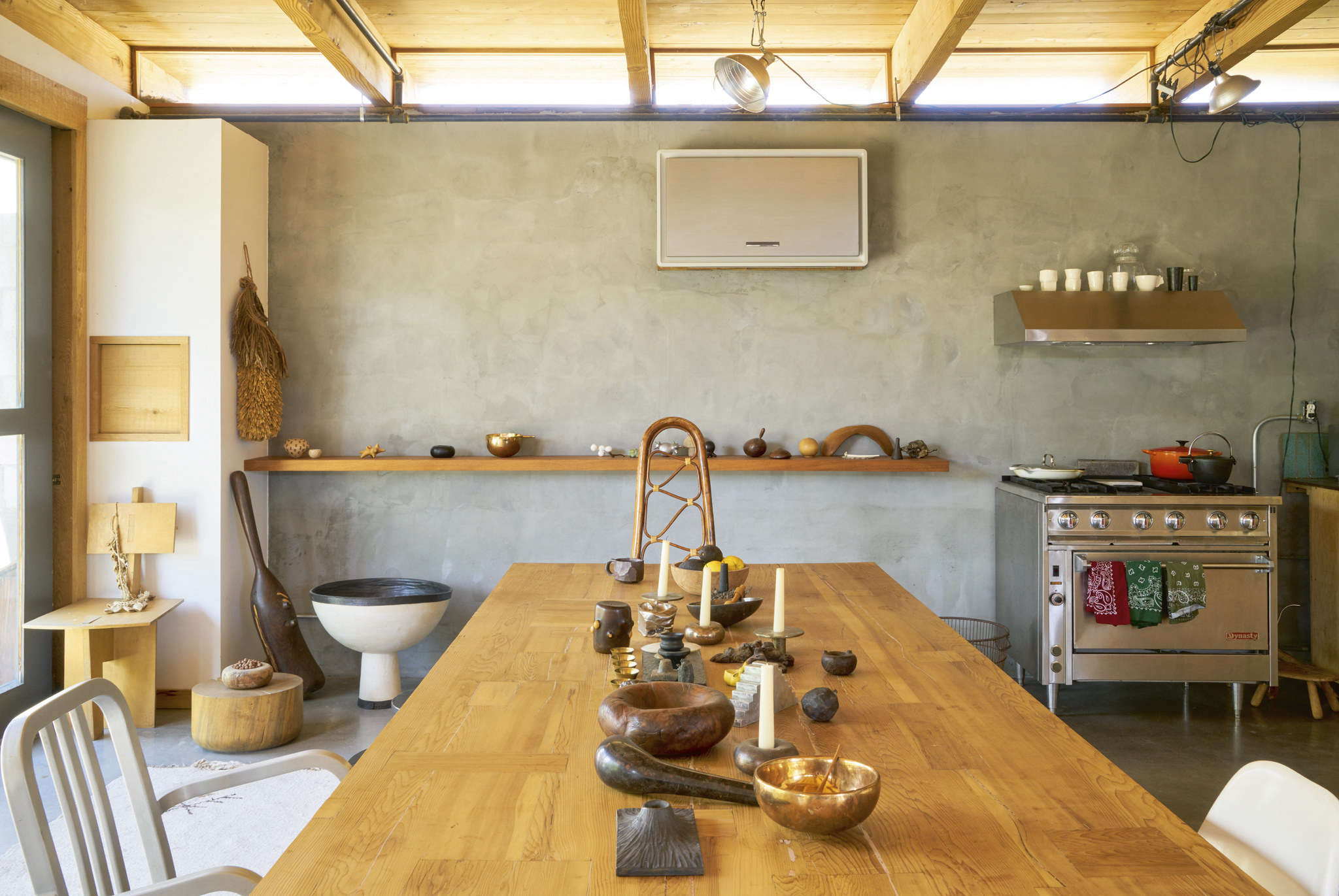
Most interior photography asks a room to stand up straight, hide its power cords, and pretend nobody has ever spilled coffee on the rug. Leslie Williamson takes a more interesting route. In Interior Portraits: At Home with Cultural Pioneers and Creative Mavericks, she treats a home not as a showroom but as evidence: a layered record of work, memory, taste, friendship, and daily ritual.
Published by Rizzoli in 2018, the 256-page book visits 13 distinctive California homes, moving from the rugged northern coast to modernist spaces in Los Angeles and San Diego. The subjects include artists, architects, designers, writers, and culinary innovators whose rooms reveal nearly as much as a conventional portrait might. The result is a California design book with sunlight in its lungs and sawdust under its fingernails.
Why Interior Portraits Is More Than a Coffee-Table Book
Calling Interior Portraits a coffee-table book is accurate in the same way that calling a house “a box with plumbing” is accurate. It describes the format while missing the experience. Williamson combines atmospheric photographs with personal writing, allowing each chapter to unfold as a compact biography told through rooms, objects, surfaces, gardens, and studios.
The book’s central idea is simple but powerful: the spaces people make for themselves become physical portraits of their inner lives. A hand-built table can express patience. A crowded shelf can reveal lifelong curiosity. A garden can explain a philosophy more clearly than a framed manifesto in the hallway.
Her images are aspirational, but not because every room is spotless or expensive. They are aspirational because the homes feel inhabited with intention. No bowl of lemons has been deputized to impersonate a lifestyle. The beauty comes from use.
Leslie Williamson’s Approach to Interior Photography
Williamson is an artist, photographer, and writer known for viewing interiors as intimate portraits of their occupants. Her signature combines warmth, patience, natural light, and an ability to notice the quiet detail that another photographer might tidy out of the frame.
Curiosity Before Styling
Her photographs suggest that she enters a home as a guest and investigator rather than a visual real-estate appraiser. She looks for emotional logic: why an object was kept, how a maker moves between studio and kitchen, and which surfaces carry decades of touch.
That curiosity gives the photographs their sense of trust. Books remain stacked, tools stay nearby, and collections retain their odd little democracies. A masterpiece may share a shelf with a shell or a gift from a relative. Personal significance does not always arrive with a museum label.
California Light as a Storytelling Tool
Light slides across concrete, softens wood, catches woven fibers, and links rooms to courtyards, gardens, coastlines, and desert terrain. Williamson uses it not merely to flatter a space but to explain how architecture responds to place and how creative routines develop within it.
A California Design Journey Through 13 Creative Homes
The homes resist a single design label. Some are handcrafted and earthy; others are crisp, modernist, improvised, archival, rustic, or quietly eccentric. Together, they form a broader portrait of California creativityless a unified “look” than a shared permission to invent a life on one’s own terms.
Alma Allen’s Joshua Tree Home and Studio
Sculptor Alma Allen’s desert compound is among the book’s most memorable settings. Organized around an enclosed courtyard, the home and studio use elemental materials including cinder block, concrete, wood, and broad glass openings. Allen’s biomorphic sculptures introduce forms that appear both ancient and slightly extraterrestrial.
Finished pieces sit near works in progress, while functional objects share the maker’s sculptural language. The question becomes not “Where is the art displayed?” but “Where does the art stop?” The house is not decorated with creativity; it has been metabolized by it.
Alice Waters’s Book-Lined Berkeley Home
Chef and activist Alice Waters’s Craftsman home offers a different richness. Books, textiles, kitchen, and garden reflect decades of cooking, hospitality, friendship, and advocacy. The rooms show the infrastructure of a lived philosophy: reading, growing, gathering, cooking, and sharing.
The garden matters because Waters’s work connects food to soil, season, and community. Things belong here because they have participated in a life, not because they received approval from a trend forecast.
Kay Sekimachi’s Layered Berkeley Victorian
Fiber artist Kay Sekimachi’s renovated Victorian, shared for many years with her late husband, woodturner Bob Stocksdale, is a deeply layered creative home. Japanese tansu cabinets, woven works, turned bowls, natural finds, furniture, and working tools create a conversation across materials and generations.
A loom is not merely handsome equipment; it belongs to a practice. A bowl is not merely an accessory; it carries the presence of its maker. The home becomes a record of marriage, artistic discipline, friendship, and remembrance without feeling embalmed.
Christina Kim’s Downtown Los Angeles Loft
Fashion designer Christina Kim’s airy loft performs several jobs at once: residence, showroom, exhibition space, and archive. In such a hybrid setting, Williamson looks for modest signs of private lifeold planners, family-made objects, and the small distinctions between public and personal zones.
The chapter demonstrates her detective instinct. Personality can hide beneath professional order, and Williamson finds it without forcing the loft to become something it is not.
Coastal Stone, Sea Ranch Wood, and Southern California Modernism
The book stretches from poet Robinson Jeffers’s stone structures on the Carmel coast to architect Charles Moore’s Sea Ranch house and modernist environments associated with Ray Kappe. Designer and artist Roy McMakin’s San Diego home develops the indoor-outdoor theme. Across these settings, geography changes the architecture’s accent.
The recurring lesson is that a meaningful home is rarely assembled in one shopping season. It evolves through work, repair, travel, gifts, and the occasional object that makes no logical sense but would cause a household rebellion if removed.
From Handcrafted Modern to Interior Portraits
Interior Portraits was Williamson’s third major book, following Handcrafted Modern in 2010 and Modern Originals in 2014. Those earlier volumes photographed the homes of influential midcentury designers and architects as lived environments rather than frozen monuments.
The 2018 book broadens that method to cultural pioneers in food, craft, fashion, poetry, art, and architecture. California becomes the connecting thread: a landscape where people repeatedly tested new relationships among work, home, nature, and community. Readers do not need to identify every chair from across the room like design-world bird-watchers. The human story arrives first.
The Book as a Designed Object
The hardcover’s tactile materials, tipped-in image, restrained typography, and album-like character support Williamson’s idea of a personal California pilgrimage. Inside, full-bleed photographs alternate with smaller details, creating a rhythm closer to walking through a home than scanning a catalog.
The format encourages slow looking. That is fortunate, because speed-reading an interior photography book is like sprinting through a garden and reporting only that it contained green.
Lessons for Designers, Photographers, and Homeowners
Design for a Life, Not a Photograph
The strongest rooms support habits and values. Studios keep tools where tools are needed. Kitchens encourage gathering. Outdoor areas participate in daily routines. Authenticity is not a style category; it is the visible result of choices that fit the way people actually live.
Let Materials Age Honestly
Wood darkens, metal develops patina, textiles soften, and concrete acquires marks. Williamson treats these changes as character. This is not permission to worship every stain as a spiritual event, but it is a reminder that durable materials can become more expressive through use.
Photograph Relationships, Not Just Rooms
A strong interior story needs relationships: studio to landscape, object to maker, old work to new work, and public identity to private ritual. The most revealing image may be technically modest but emotionally exact.
Who Should Read Interior Portraits?
The book belongs on the reading list of interior designers, architects, photographers, artists, craftspeople, and anyone interested in California creative culture. It is especially refreshing for readers tired of homes that resemble luxury waiting rooms. Williamson’s rooms contain texture, contradiction, time, and evidence of work.
It also rewards repeat visits. On one pass, readers may admire the architecture; on another, they may study routines, objects, and relationships. Eventually, they may wonder whether a stack of books on the floor is intellectual atmosphere or simply a stack of books. Often, delightfully, it is both.
The Experience of Reading and Living With Interior Portraits
The most satisfying way to experience Interior Portraits is slowly. Open it when there is enough time to remain with a chapter instead of skimming ten homes in a rush. Williamson’s photography rewards the reader who notices the second and third layer: the worn edge of a worktable, the direction of sunlight, the object placed beside a bed, or the way a studio opens toward weather. These details create the sensation of being shown around by someone who trusts you not to touch everything.
A first reading often centers on visual pleasure. The California landscapes, natural materials, collected objects, and idiosyncratic architecture are immediately compelling. On a later reading, the book begins to operate less like inspiration and more like a set of questions. Which objects in your own home carry real stories? Which rooms support your best habits? Where has convenience crowded out pleasure? Does your workspace help you begin, or does it require a minor archaeological expedition before anything can happen?
Those questions can lead to useful changes without encouraging imitation. Copying Alma Allen’s desert compound is not practical for most readers, particularly those whose landlord becomes nervous when they hang a shelf. But the underlying principle is portable: organize space around the work and life that matter. A small desk can be placed where morning light makes it inviting. Frequently used tools can remain visible. A collection can be grouped by memory rather than market value. A kitchen table can recover its purpose as a place for conversation instead of serving as permanent headquarters for unopened mail.
The book also changes how one experiences other people’s homes. After spending time with Williamson’s images, it becomes easier to notice biography in ordinary arrangements. A repaired chair may reveal thrift, affection, or both. A crowded pinboard can map a creative process. A garden path may show where the owner prefers to think. This is not permission to psychoanalyze every spice rack at a dinner party. It is an invitation to look with more generosity.
For photographers, a valuable exercise is to study a chapter as a sequence. Notice how it establishes location, introduces a person, moves through rooms, pauses at meaningful objects, and returns to a broader sense of place. Then photograph a familiar home using the same narrative logic. Begin outside. Observe light at different hours. Ask which objects have stories. Include signs of labor and repetition. The resulting pictures may be less conventionally perfect and far more truthful.
Living with the book over time can also recalibrate expectations about a “finished” home. The featured spaces feel coherent, yet many remain active, adaptable, and incomplete. Works are in progress. Archives grow. Gardens change. Objects migrate. This is reassuring because real homes are verbs disguised as nouns. They are continually being made, unmade, cleaned, neglected, repaired, and reconsidered.
Ultimately, the experience is not about longing to possess someone else’s house. It is about becoming more alert to the life already visible in one’s own. The book encourages readers to value use over display, memory over instant coordination, and character over anonymous perfection. That shift may not produce a magazine-ready room by Saturday, but it can produce something better: a home that knows who lives there.