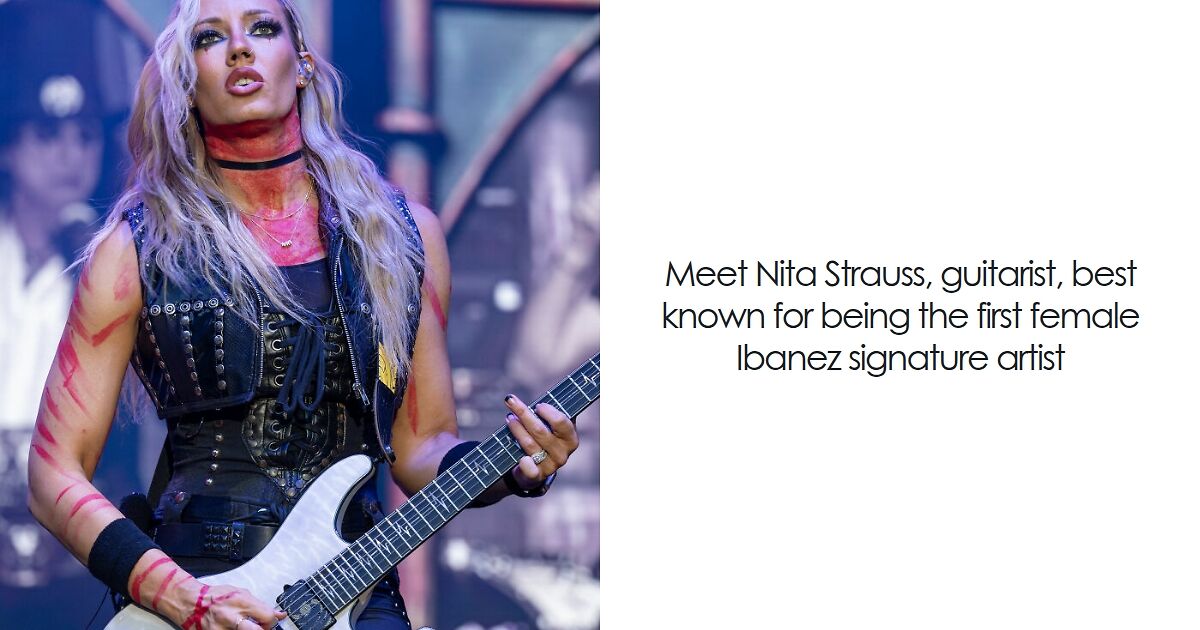
Nita Strauss is not the kind of guitarist who quietly stands in the corner pretending the spotlight is allergic to her. She is the kind of player who walks onstage, plugs in an Ibanez, and makes a crowd remember that electric guitar can still sound like a dragon learning martial arts. Known to fans as “Hurricane Nita,” Strauss has built one of modern rock’s most exciting careers through blistering technique, athletic stage presence, smart career moves, and a work ethic that seems suspiciously powered by espresso, discipline, and heavy metal lightning.
Born Vinita Sandhya Strauss in Los Angeles, California, Nita grew up surrounded by music and performance culture. Over the years, she has become famous as Alice Cooper’s lead touring guitarist, Demi Lovato’s rock-era secret weapon, a solo artist with chart-topping success, the first female Ibanez signature artist, and an educator who helps aspiring guitarists understand that “practice more” is not just adviceit is a lifestyle with calluses.
This in-depth Nita Strauss biography explores her early life, major career highlights, signature sound, solo albums, collaborations, awards, fitness-driven mindset, and the reasons she has become one of the most recognizable guitar heroes of her generation.
Who Is Nita Strauss?
Nita Strauss is an American rock and heavy metal guitarist best known for her work with Alice Cooper, her solo music, and her high-profile touring role with Demi Lovato. She was born on December 7, 1986, in Los Angeles, a city where dreams are often measured in traffic, talent, and how many guitar cases can fit in a van.
Strauss began playing guitar at a young age and quickly developed the kind of technical command associated with shredders, metal virtuosos, and players who make non-musicians say, “Wait, are hands supposed to move that fast?” Her playing blends classic metal vocabulary, modern hard rock aggression, melodic phrasing, and athletic precision. She is often praised for combining speed with feel, which is important because guitar solos should not sound like someone spilled notes down a staircase.
Her career has included performances with The Iron Maidens, Femme Fatale, Critical Hit, Alice Cooper, Demi Lovato, and her own solo band. She has also worked in sports entertainment, video game music, guitar education, and fitness. That range matters. Nita Strauss is not just a guitarist; she is a full-scale rock brand with a whammy bar.
Early Life And Musical Roots
Nita Strauss was raised in Los Angeles, a place that has produced more guitar players than some cities have parking violations. Her family background includes a musical connection often mentioned in profiles: she is related on her father’s side to classical composer Johann Strauss II. That does not mean she was destined to play waltzes in a velvet jacket, but it does add a fun historical wink to her story. Somewhere between classical heritage and modern metal chaos, Nita found her own lane.
She began touring as a teenager and left traditional schooling behind to pursue music full time. That decision was not exactly the safest career path. Becoming a professional guitarist is a bit like deciding to climb a mountain while juggling amplifiers. But Strauss had the rare combination of talent, discipline, stamina, and stubborn belief required to turn a risky dream into a real career.
Before she became a household name among rock fans, she developed her chops in different bands and live environments. Those early years helped shape her into a versatile player. She learned how to handle the stage, read a crowd, lock in with a drummer, and deliver the kind of performance that makes people forget they were just checking their phones.
Breaking Through With The Iron Maidens
One of Nita Strauss’s most important early platforms was The Iron Maidens, the all-female Iron Maiden tribute band. Tribute bands can be misunderstood by casual listeners, but a serious Iron Maiden tribute is no small job. The music demands harmony leads, speed, endurance, precision, and a deep understanding of classic metal style.
With The Iron Maidens, Strauss performed under the stage name “Mega Murray,” a nod to Iron Maiden guitarist Dave Murray. This period helped introduce her to metal audiences and showcased her ability to honor classic material while still bringing her own personality to the stage.
The Iron Maidens also gave Strauss valuable touring experience. Night after night, she had to deliver demanding guitar parts with confidence and consistency. In rock, reputation is built one show at a time. Strauss’s reputation grew because she did not simply “play the songs.” She attacked them with energy, accuracy, and charisma.
Joining Alice Cooper: A Career-Defining Moment
In 2014, Nita Strauss received the opportunity that transformed her career: she joined Alice Cooper’s touring band, replacing Orianthi. Alice Cooper’s stage show is not a casual jam session. It is theatrical, precise, loud, weird, funny, dark, and full of musical expectations. Basically, it is Broadway with more eyeliner and better guitar solos.
For Strauss, the Alice Cooper gig placed her on major stages around the world. She had to perform classic songs such as “Poison,” “School’s Out,” “No More Mr. Nice Guy,” and “I’m Eighteen” while fitting into a long-established rock legacy. She succeeded because she brought both respect and fire. Her style added a modern metal edge to Cooper’s live sound without overpowering the songs.
Alice Cooper himself has praised Strauss’s shredding ability and her fit within the band. That endorsement matters. Cooper has worked with many elite musicians over his decades-long career, so when he says someone nails it every night, it is not a participation trophy. It is a rock-and-roll stamp of approval.
Solo Career: From Side-Stage Star To Main Attraction
Although many fans discovered Nita Strauss through Alice Cooper, her solo career proved she was much more than a hired gun. In 2018, she released her debut solo album, Controlled Chaos, through Sumerian Records. The album was largely instrumental and displayed her wide musical personality: melodic, aggressive, technical, cinematic, and sometimes gloriously dramatic.
The project also showed Strauss’s independence. She launched a crowdfunding campaign for the album, and fan support arrived quickly. That response proved something important: people were not only interested in seeing her play behind famous singers. They wanted to hear what Nita Strauss sounded like when she had the whole canvas to herself.
Controlled Chaos And Its Impact
Controlled Chaos featured tracks such as “Our Most Desperate Hour,” “Alegria,” and “Mariana Trench.” The album lived up to its title by mixing sharp metal riffing, elegant melodic passages, and high-speed guitar fireworks. It was not background music for folding laundry unless your laundry routine includes windmills and stage fog.
The album performed well on rock and hard music charts and helped position Strauss as a serious solo instrumental artist. It also earned attention from guitar media, metal fans, and musicians who appreciated her ability to combine technique with structure. In a genre where instrumental records can sometimes become endless note marathons, Strauss focused on songs with shape, movement, and emotion.
“Dead Inside” And A Historic Rock Radio Moment
One of the biggest milestones in Nita Strauss’s career came with the single “Dead Inside,” featuring David Draiman of Disturbed. Released after Controlled Chaos, the song marked her first solo single with a lead vocalist. The collaboration worked because Draiman’s powerful voice matched Strauss’s muscular riffing and polished arena-metal production.
“Dead Inside” became a major success at rock radio and made Strauss the first female solo artist in decades to reach No. 1 on Billboard’s Mainstream Rock Airplay chart. That achievement was more than a headline. It challenged assumptions about instrumental guitarists, women in hard rock, and what modern rock radio could embrace.
The song also widened her audience. Fans who may not have followed instrumental guitar music discovered Strauss through a vocal-driven hard rock single. That crossover strategy was smart, but it never felt fake. The guitar remained central, the riffs were heavy, and the solo had enough attitude to kick down a door politely, then apologize to the hinges.
The Call Of The Void: Expanding The Sound
In 2023, Nita Strauss released her second solo album, The Call Of The Void. Compared with Controlled Chaos, this album expanded the formula by featuring multiple guest vocalists alongside instrumental tracks. It was a bigger, more collaborative record that blended melodic metal, modern hard rock, and guitar-driven intensity.
The album included guest appearances from major names in rock and metal, including David Draiman, Alissa White-Gluz of Arch Enemy, Alice Cooper, Lzzy Hale of Halestorm, Chris Motionless of Motionless in White, and Marty Friedman. That guest list is not casual. It reads like a metal festival lineup accidentally compressed into one album.
Key Songs From The Call Of The Void
“The Wolf You Feed,” featuring Alissa White-Gluz, became one of the standout tracks. The song combined Strauss’s sharp riffing with White-Gluz’s extreme vocal power, creating a fierce modern metal anthem. “Winner Takes All,” featuring Alice Cooper, offered a full-circle moment by pairing Strauss with the rock legend who had helped elevate her global profile.
The album also demonstrated Strauss’s growth as a songwriter. Instead of relying only on speed, she built tracks around hooks, dynamics, and mood. Her guitar voice remained unmistakable, but the record showed that she could adapt her playing to different singers without losing her identity.
Demi Lovato Tour: Bringing Shred To Pop-Rock
In 2022, Nita Strauss made another bold career move by joining Demi Lovato’s touring band. At first glance, some hard rock fans reacted as if someone had plugged a metal amp into a pop playlist and waited for sparks. But the move made perfect sense. Lovato’s music was entering a heavier pop-punk and rock-influenced era, and Strauss brought instant credibility, energy, and guitar authority to the live show.
Her work with Lovato introduced her to a broader audience, especially younger fans who might not have been raised on classic shock rock or instrumental metal. It also showed that great guitar playing is not trapped inside one genre. A powerful riff can live in a metal club, an arena, a festival, or a pop-rock tour. Good tone does not check IDs at the door.
After her run with Lovato, Strauss returned to Alice Cooper’s band in 2023, proving that her career was not a straight line but a smartly managed series of expansions. She did not leave one world behind; she added another world to her map.
First Female Ibanez Signature Artist
Another major Nita Strauss career highlight came in 2018, when she became the first female guitarist to receive an Ibanez signature model. Her JIVA signature guitar line was a landmark moment in the guitar industry, where signature models have historically been dominated by male players.
The Ibanez JIVA series reflects Strauss’s playing needs: fast necks, sleek design, powerful pickups, and stage-ready reliability. For guitar fans, a signature model is not just merchandise. It is a statement that a player’s sound, style, and influence are strong enough to shape an instrument.
For young female guitarists, Strauss’s Ibanez milestone carried extra meaning. Representation matters, especially in a field where women have often been treated as exceptions rather than central figures. Nita Strauss did not simply get a signature guitar; she kicked open a door and left it wide enough for the next generation to run through with a pedalboard.
Signature Style And Guitar Technique
Nita Strauss’s guitar style is built on speed, precision, melody, and stage power. She uses techniques such as alternate picking, legato runs, sweep picking, tapping, wide vibrato, and expressive bends. But her best playing is not just about athletic ability. It is about arrangement. She knows when to unleash a storm and when to let a phrase breathe.
Her tone is typically tight, modern, and aggressive, with enough clarity for fast passages to remain articulate. That clarity matters because shredding without definition can sound like a blender full of bees. Strauss’s best solos have direction. They climb, explode, pause, and resolve.
She also understands the visual side of rock guitar. Live performance is not only sound; it is movement, confidence, and connection. Strauss plays with the physicality of an athlete and the awareness of an entertainer. Whether she is onstage with Alice Cooper, Demi Lovato, or her solo band, she performs like she knows the back row paid for a show too.
Work With The Los Angeles Rams
Nita Strauss’s career has also crossed into sports entertainment. A lifelong Los Angeles sports fan, she became associated with the Los Angeles Rams as an in-house guitarist, performing at games and helping bring live rock energy to the stadium experience.
Her Rams connection became especially memorable after the team’s Super Bowl LVI victory. Strauss received a Super Bowl ring as an honorary part of the organization, a rare and very shiny career crossover. Many musicians dream of gold records. Nita Strauss can also point to championship hardware and say, “Yes, this counts.”
This part of her story highlights her versatility. She is not limited to clubs, theaters, or rock festivals. She can bring guitar-driven excitement to arenas, football stadiums, and mainstream entertainment spaces where live music needs to hit instantly.
Teaching, Clinics, And Guitar Education
Beyond performing, Nita Strauss has invested heavily in guitar education. She has led clinics, master classes, and instructional programs designed to help players improve their technique and confidence. Her online course, Rock Guitar Fundamentals, reflects her belief that guitar should be accessible to beginners while still offering value to intermediate and advanced players.
Her teaching style emphasizes discipline without making the process feel lifeless. That is important because many guitar students quit somewhere between “my fingers hurt” and “why does this scale sound like homework?” Strauss encourages players to build fundamentals, practice consistently, and develop their own musical personality.
As a mentor figure, she helps demystify high-level guitar. Yes, natural talent matters. But Strauss’s career repeatedly shows that routine, preparation, and persistence matter just as much. In other words, the magic trick is practice. The rabbit is also practice. Even the hat is practice.
Fitness, Sobriety, And The Discipline Behind The Music
Nita Strauss is also known for her commitment to fitness and healthy living. She has spoken publicly about training, nutrition, sobriety, and the challenge of staying healthy while touring. Her Body Shred fitness challenge combines physical goals with community support, encouraging fans to improve their health while staying connected through music.
This part of her identity is not separate from her musicianship. Touring is physically demanding. Performing high-energy guitar music night after night requires endurance, strength, and focus. Strauss treats her body like part of her professional equipment. The guitar goes in the case; the guitarist has to make it to the stage.
Her openness about sobriety and discipline has also made her a role model for fans who admire not only her playing but her lifestyle. Rock culture has often romanticized chaos, but Strauss represents a modern version of rock strength: clear-headed, hardworking, ambitious, and still fully capable of melting faces with a solo.
Why Nita Strauss Matters In Modern Rock
Nita Strauss matters because she represents the evolution of the guitar hero. She respects classic metal, thrives in theatrical hard rock, collaborates with pop artists, writes solo material, teaches, trains, and builds community. Her career proves that virtuoso guitar is not a museum piece. It can still be current, exciting, and commercially relevant.
She also matters because her visibility helps shift the image of who gets to be called a guitar hero. She is not “good for a female guitarist,” a phrase that deserves to be thrown into the nearest volcano. She is simply a great guitarist. Her achievements stand on their own: major tours, chart success, signature gear, respected collaborations, and a growing legacy.
In a music world often driven by quick trends, Strauss has built something durable. Her career is based on skill, consistency, adaptability, and fan trust. She can shred, but she can also strategize. She can honor a legacy act and still build her own lane. That balance is rare.
Experiences And Lessons Inspired By Nita Strauss’s Career
One of the most interesting experiences connected to following Nita Strauss’s career is realizing how much her story speaks to anyone trying to build a creative life. You do not have to be a touring guitarist to understand the pressure of proving yourself in a competitive field. Strauss’s path shows that talent opens the door, but consistency is what keeps you from being politely escorted back through it.
For guitar players, her career is a reminder that practice should be both structured and expressive. Watching Strauss perform can be intimidating at first. Her speed, confidence, and stage control might make a beginner look at their own guitar and whisper, “We have a long road ahead, buddy.” But her educational work makes the process feel more human. She often emphasizes fundamentals, patience, and personal style. That is a valuable lesson: greatness is not one giant leap. It is thousands of small repetitions that eventually become muscle memory.
Another experience fans often connect with is her ability to move between different musical worlds. Some musicians fear stepping outside their home genre because audiences can be protective. Strauss joining Demi Lovato’s band could have been viewed as risky, but it became a smart example of artistic range. The lesson is clear: growth often happens when you enter rooms where people do not already expect you. Comfort zones are cozy, but they rarely have great acoustics.
Her career also offers a lesson in professionalism. Joining Alice Cooper’s band required more than technical skill. It required reliability, preparation, and the ability to serve the show. Many young musicians dream of standing out, but professional work often begins with fitting in. Strauss found a way to do both. She respected the songs and the theatrical tradition while still bringing her own spark. That balance is useful in any career. Be excellent, but do not make every room about your solo.
There is also something inspiring about her approach to health and fitness. Rock and metal have not always been associated with moderation, meal prep, or sensible bedtime decisions. Strauss’s public commitment to training and sobriety challenges the old stereotype that creativity requires self-destruction. Her example suggests the opposite: the stronger your habits, the more freedom you have to perform at a high level. Discipline does not kill the rock star; it keeps the rock star on the tour bus instead of under it.
For women in music, Strauss’s visibility carries a deeper cultural significance. Seeing her on major stages, holding a signature guitar, leading clinics, and topping rock radio creates a powerful image of possibility. Representation does not automatically solve every industry problem, but it does change what young players imagine for themselves. A teenage guitarist watching Nita Strauss may not see an exception; she may see a blueprint.
Finally, Nita Strauss’s career highlights the importance of building multiple lanes. She is a performer, recording artist, educator, fitness advocate, sports entertainer, and gear ambassador. That kind of diversified career is increasingly important in modern music. Artists can no longer rely on one path alone. Strauss has shown how to expand without becoming scattered. Everything connects back to the same core identity: guitar, energy, discipline, and connection with fans.
The biggest takeaway from Nita Strauss’s journey is that a career is not built by waiting for perfect timing. It is built by saying yes to the right challenges, practicing when nobody is applauding, and showing up prepared when the big call comes. Her story is loud, fast, and full of distortion, but underneath the flash is a practical message: do the work, take the stage, and bring enough fire that nobody forgets your name.
Conclusion
Nita Strauss has become one of the defining guitarists of modern hard rock and metal by combining elite technique with fearless career choices. From her early days with The Iron Maidens to her global role with Alice Cooper, from her historic Ibanez signature model to her chart-topping solo success with “Dead Inside,” Strauss has built a career that is both technically impressive and culturally important.
Her story is not just about fast solos. It is about persistence, reinvention, discipline, and the ability to bring guitar music into new spaces without watering it down. Whether she is playing for a rock legend, backing a pop superstar, teaching students, firing up a football stadium, or leading her own band, Nita Strauss proves that the guitar hero is alive, well, and probably warming up backstage with terrifying accuracy.
Note: This article is written in original wording for web publication and is based on publicly available biographical, music industry, chart, guitar media, and official artist information.