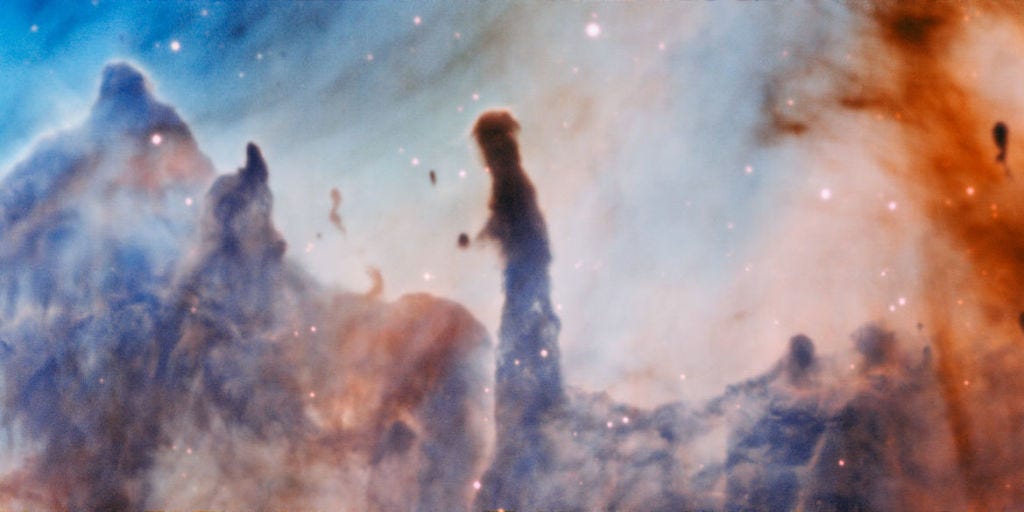
Space has a flair for branding. It gives us “black holes,” “red giants,” “cosmic webs,” and, of course, the famous “Pillars of Creation.” That last name sounds peaceful enough, as if the universe hired a cathedral architect and told them to build something inspirational out of stardust. But look closer and the story gets more dramatic. These towering structures of gas and dust are also galactic pillars of destructioncosmic columns being carved, blasted, and slowly erased by the very stars they help create.
That is the delicious irony of star formation: the nursery eventually gets wrecked by the newborns. Massive young stars flood their surroundings with ultraviolet radiation, stellar winds, and energetic particles. Nearby clouds of hydrogen gas and dust are sculpted into long, finger-like pillars. Inside them, dense knots can collapse under gravity and form new stars. At the same time, the outer layers are heated, ionized, and blown away. In other words, the universe is running a daycare where the toddlers bring flamethrowers.
The phrase “Galactic Pillars of Destruction” points to a real scientific idea, not just a dramatic headline. Astronomers use these pillars to study how stars are born, how massive stars reshape their neighborhoods, and how creation and destruction work as two sides of the same cosmic coin. The best-known example is the Pillars of Creation in the Eagle Nebula, also called Messier 16 or M16. Similar pillar-like structures appear in the Carina Nebula, where researchers have described them as “pillars of destruction” because intense radiation is actively eating them away.
What Are Galactic Pillars?
Galactic pillars are enormous columns of cold interstellar gas and dust found inside star-forming nebulae. They may look solid in photographs, like stone towers rising from a fantasy landscape, but they are not solid rock. They are cloudsdense compared with the surrounding space, but still incredibly thin by Earth standards. Their shapes come from a cosmic tug-of-war between gravity, radiation, and wind.
The basic recipe is simple: start with a giant molecular cloud, add newly formed massive stars, then wait. The hot young stars release ultraviolet light that ionizes nearby gas. They also send out powerful winds that push material outward. The less dense gas gets stripped away first. Denser clumps resist erosion longer, casting shadows behind them. Over time, those protected regions stretch into tall columns or “elephant trunks.” The result is a sculpted nebula that looks artistic enough to hang in a museum and violent enough to make a planet nervous.
The Eagle Nebula and the Famous Pillars of Creation
The Pillars of Creation became world-famous after the Hubble Space Telescope captured them in 1995. Located about 6,500 light-years from Earth in the Eagle Nebula, the pillars are part of an active star-forming region where newborn stars hide inside wispy columns of gas and dust. The leftmost pillar is several light-years tall, which means it is not just “large.” It is “your road trip playlist would quit before you crossed it” large.
Hubble’s visible-light view made the pillars iconic because it showed structure: dark vertical towers, glowing edges, and finger-like tips. Later Hubble observations in infrared light helped astronomers peer through some of the dust. Then the James Webb Space Telescope added a sharper infrared perspective, revealing fresh details about young stars, dusty layers, and glowing features created by stellar outflows. Webb’s Near-Infrared Camera made stars pop through the dust, while its Mid-Infrared Instrument emphasized the thick, cold dust that hides much of the star-making action.
The Pillars of Creation are not peaceful monuments. They are temporary structures. The same radiation that makes their edges glow is slowly wearing them down. In that sense, the famous “creation” label is only half the story. They are also being destroyed in real time, at least on astronomical timescales. For humans, the process feels slow. For the universe, it is just another Tuesday.
Why Scientists Call Them Pillars of Destruction
The term “pillars of destruction” became especially associated with observations of the Carina Nebula, a massive star-forming region about 7,500 light-years away. In the Carina Nebula, huge young stars bombard surrounding clouds with radiation. Observations using advanced instruments such as MUSE on the Very Large Telescope helped show how these stellar forces strip material from pillar surfaces. The process is called photoevaporation.
Photoevaporation happens when energetic radiation heats gas so strongly that it escapes from a cloud into space. Imagine sunlight melting frost from a windshield, except the windshield is a light-year-scale nebular column and the sunlight is ultraviolet radiation from giant stars. The analogy is imperfect, but the drama is accurate.
In star-forming regions, photoevaporation can both reveal and destroy. It uncovers dense pockets where new stars may be forming, but it also removes the raw material needed for future star birth. This is why the pillars are so scientifically valuable. They show astronomers the balance between stellar feedback and gravitational collapse. Feedback is the broad term for the ways stars influence their environmentthrough radiation, winds, jets, and supernova explosions. Without feedback, galaxies would form stars differently. With too much feedback, star formation can be suppressed. The pillars sit right in the messy middle.
Creation and Destruction Are Happening at the Same Time
The most fascinating thing about galactic pillars is that they do not fit neatly into one category. They are not simply star factories. They are not simply ruins. They are both. Inside the dense knots of gas and dust, gravity can pull material inward until a protostar forms. Around the outside, ultraviolet radiation and stellar winds peel layers away. One part of the pillar is building; another part is being demolished. The universe apparently enjoys multitasking.
Astronomers have identified dense globules in the Pillars of Creation called evaporating gaseous globules, often shortened to EGGs. The name is almost too perfect, because some of these little cosmic eggs may contain stars in the making. But the “evaporating” part matters. These globules are exposed to harsh radiation and may not all survive long enough to complete the star-making process. Some may hatch. Others may be scrambled by the cosmic chef.
Young stars also announce themselves with jets and outflows. In Webb images of the Pillars of Creation, bright red, wavy features along pillar edges are linked to energetic ejections from forming stars. These jets slam into surrounding gas and dust, creating glowing shocks. They are signs that star formation is not quiet. A baby star does not simply switch on like a desk lamp. It grows by feeding on surrounding material, spinning, flaring, and blasting material outward along its poles.
What Different Telescopes Reveal
No single telescope tells the whole story. Visible light shows the sculpted beauty of nebulae, but dust blocks much of the view. Infrared light can pass through dust more easily, revealing hidden stars and warm material. X-rays show high-energy stars and hot plasma. When astronomers combine these wavelengths, the pillars become less like a postcard and more like a living weather map of star birth.
Hubble: The Icon Maker
Hubble gave the Pillars of Creation their celebrity status. Its visible-light images revealed the elegant shapes, sharp edges, and glowing rims that made the region instantly recognizable. Hubble also helped show that these pillars are made of cool hydrogen gas and dust, protruding from a larger molecular cloud like stalagmites in a cosmic cavern.
Webb: The Dust Detective
The James Webb Space Telescope changed the view by focusing on infrared light. Webb’s near-infrared observations reveal many young stars that were harder to see before. Its mid-infrared observations highlight dust, giving scientists better data about how much dust is present and what structures are hidden inside. This matters because dust is not just visual clutter. It is one of the ingredients of planets, disks, and future stellar systems.
Chandra: The High-Energy Inspector
NASA’s Chandra X-ray Observatory adds another layer by detecting young stars that shine in X-rays. In the Eagle Nebula, Chandra data helped identify many young stars, although relatively few X-ray sources appear inside the pillars themselves. That detail suggests the region’s star formation history is complex. Some star formation may already have happened, some may still be underway, and some potential star-making material may be disappearing before it can finish the job.
The Carina Nebula: Where the Name Gets Fierce
If the Eagle Nebula gave us the poetic “Pillars of Creation,” the Carina Nebula gives us the more metal-sounding “Pillars of Destruction.” Carina is one of the Milky Way’s great stellar nurseries, packed with massive stars that shine fiercely and live fast. These stars produce intense radiation and winds that carve nearby clouds into dramatic spires, ridges, and columns.
In Carina, the pillars point toward the massive stars shaping them. Their surfaces are being stripped away, and their shapes record the direction and strength of the radiation field. Think of them as cosmic windsocks, except instead of telling you which way the breeze blows, they reveal where the stellar giants are throwing their ultraviolet tantrums.
Carina’s pillars show that massive stars are not passive residents of a nebula. They are environmental engineers. They hollow out cavities, compress gas, trigger new collapse in some places, and halt star formation in others. Their influence can determine how a stellar nursery evolves and how long it remains productive.
Are the Pillars Already Gone?
You may have heard claims that the Pillars of Creation have already been destroyed by a supernova shock wave. The idea came from infrared observations suggesting hot dust nearby might be evidence of a past explosion. Because the Eagle Nebula is thousands of light-years away, we see it as it looked thousands of years ago. If something destroyed the pillars after the light we currently see left the nebula, we would not know yet.
However, the “already destroyed” claim is not settled as a simple fact. Other interpretations suggest that stellar winds and radiation, rather than a supernova shock, may explain the observed dust. The safer conclusion is this: the pillars are definitely being eroded, but whether a sudden destructive event has already finished them off is uncertain. Either way, they are temporary. Their beauty comes with an expiration date written in ultraviolet ink.
Why Galactic Pillars Matter
Galactic pillars matter because they help answer one of astronomy’s biggest questions: how do stars form in real environments? A textbook can describe gravitational collapse, but real nebulae are complicated. They contain turbulence, magnetic fields, shock waves, radiation fronts, and clusters of stars forming at different times. Pillars are natural laboratories where these forces are visible.
They also help scientists understand stellar feedback. Massive stars are rare compared with smaller stars, but they have enormous influence. They can destroy nearby clouds, trigger new star formation by compressing gas, and seed space with heavy elements when they die. The shape of a pillar is like a fossil record of that influence. By studying its structure, motion, chemistry, and radiation, astronomers can reconstruct what is happening in the larger nebula.
There is also a bigger galactic story. Star formation drives the evolution of galaxies. The Milky Way is not a static disk of stars; it is an ecosystem. Gas flows, clouds collapse, stars ignite, feedback reshapes the clouds, and future generations of stars form from enriched material. Galactic pillars are small scenes in that grand cycle, but they are wonderfully photogenic scenes. Science appreciates good lighting too.
Meet the Experience: What It Feels Like to Encounter the Galactic Pillars of Destruction
Experiencing the Galactic Pillars of Destruction is not like visiting a mountain range, unless your hiking boots can handle 6,500 light-years and your water bottle contains a wormhole. For most of us, the encounter happens through images, planetarium shows, documentaries, classroom discussions, and late-night scrolling sessions that begin with “I’ll just look at one NASA photo” and end with “why am I emotionally attached to hydrogen gas?”
The first experience is visual awe. The pillars look familiar and impossible at the same time. They resemble cliffs, smoke, storm clouds, coral, castles, and fingers reaching into space. That familiarity helps the human brain grab onto something wildly nonhuman. We know what towers and clouds look like, so we borrow those categories to understand a nebula. Then the scale arrives and politely ruins our confidence. A single pillar can be light-years tall. The glowing knots are not decorative sparkles; they may be stars in formation. The shadows are not mood lighting; they are evidence of dense material resisting radiation.
The second experience is intellectual whiplash. At first, the pillars seem calm. Then you learn they are being attacked by radiation from young massive stars. Then you learn they are also forming stars inside. Creation and destruction are not separate chapters. They are happening in the same paragraph. That realization changes the image. It stops being a pretty space wallpaper and becomes a process, a moment in a long transformation.
The third experience is humility. These structures have existed for far longer than human civilization, yet they are temporary on cosmic timescales. They remind us that even the universe’s most majestic shapes are passing forms. Mountains erode. Stars die. Nebulae disperse. Even icons fade. But fading is not failure. The material stripped from a pillar does not vanish from the universe; it becomes part of the interstellar medium, available for future clouds, future stars, future planets, and perhaps future beings who will look up and give dramatic names to things they barely understand.
The fourth experience is curiosity. Once you meet the pillars, you start noticing patterns everywhere in astronomy. You see similar sculpting in the Carina Nebula, the Eagle Nebula, and other stellar nurseries. You begin to understand why astronomers study objects in multiple wavelengths. You realize that visible light gives you beauty, infrared gives you hidden structure, and X-rays reveal energetic young stars. The same object becomes many objects depending on how you look at it. That is a useful lesson beyond astronomy: perspective does not merely decorate truth; it reveals different parts of it.
Finally, there is a surprisingly personal experience. The Galactic Pillars of Destruction make destruction feel less like an ending and more like a transition. The pillars are being worn down, yes, but that erosion is part of star formation. The nebula loses one shape and gains another future. It is a cosmic reminder that change can be violent, beautiful, productive, and confusing all at once. The universe, apparently, is not interested in simple labels. It prefers magnificent contradictions.
Conclusion: The Universe Builds by Breaking
The Galactic Pillars of Destruction are among the clearest examples of how the universe creates through conflict. They are made of cold gas and dust, shaped by radiation, carved by stellar winds, and seeded with young stars. In the Eagle Nebula, they became famous as the Pillars of Creation. In the Carina Nebula, similar structures earned the darker title of pillars of destruction. Both names are true.
These cosmic columns teach us that star formation is not gentle. It is dynamic, noisy, and competitive. Gravity gathers material, radiation tears it apart, and somewhere in the middle, stars are born. The pillars will not last forever, but that is exactly why they matter. They capture a temporary stage in the life of a nebulaa moment when the raw ingredients of future suns are still visible before the stellar children kick down the walls of their nursery.
Note: This article is written for web publication in standard American English and is based on established astronomy information from major space-science organizations and observatories. Source links are intentionally not embedded in the article body.