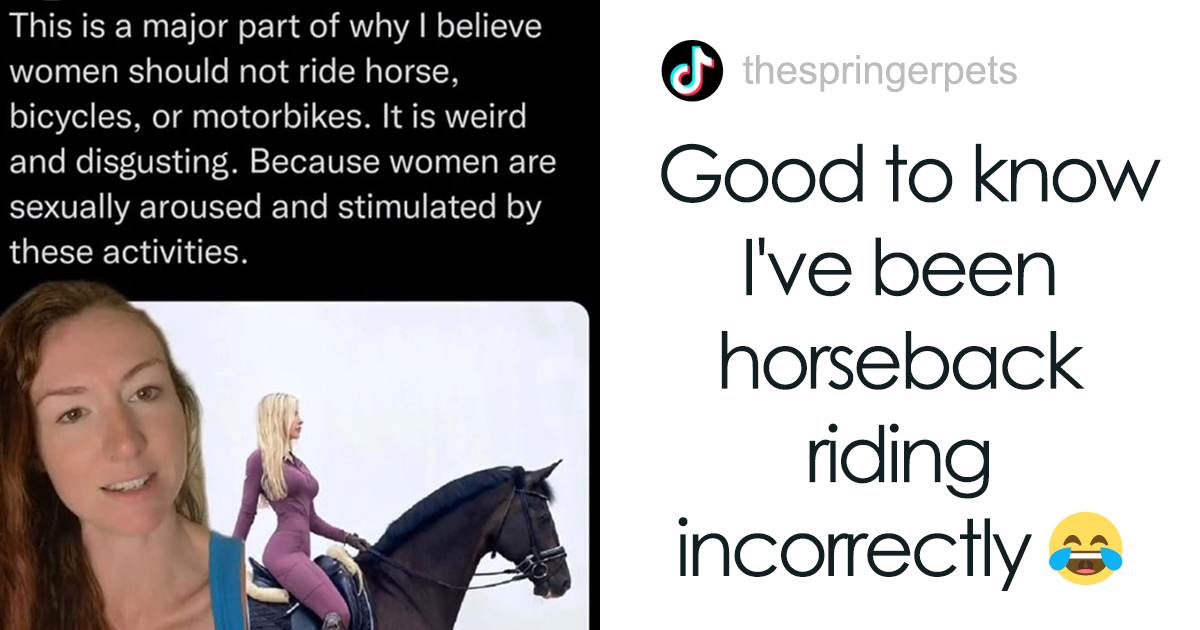
Every so often, the internet opens its front door, sighs deeply, and hands us a take so bizarre that even the group chat needs a group chat. That is exactly what happened when a man behind a hyper-masculine social media account posted a thread arguing that women should not ride horses, bicycles, or motorcycles because, in his view, these activities were sexually arousing. Yes, horses. Not romantic novels. Not candlelit dinners. Horses.
The claim might have vanished into the swamp of strange online opinions, but TikToker April Ajoy, known for using humor to unpack American evangelical culture and purity culture, turned it into a viral roast. Her response worked because it did what the best internet commentary does: it made people laugh first, then realize the joke was sitting on top of a serious problem. Beneath the horse jokes was a familiar old patterntrying to control women’s bodies, movement, hobbies, clothing, pleasure, and independence under the polished label of morality.
This story became popular not simply because the original thread sounded absurd, but because it collided with a much bigger conversation about misogyny, religious shame, bodily autonomy, and the way social media can turn one outrageous statement into a public lesson. It was funny, yes. But like many viral moments, it was funny in the way a smoke alarm is annoying: loud, ridiculous, and probably warning us about something real.
What Happened?
The controversy began when a Twitter thread claimed that women should avoid riding horses, bikes, and motorcycles because these activities could supposedly create sexual stimulation. The writer framed the argument through a purity-focused worldview, suggesting that a woman should remain innocent, modest, and reserved for her husband. The logic then galloped straight off the trail by presenting ordinary physical activities as suspicious, inappropriate, or morally dangerous.
April Ajoy responded on TikTok by highlighting the absurdity of the claim. Her jokes landed because the original post treated a horse like a romantic competitor. The mental image alone was enough to make the internet collectively drop its coffee. A man claiming to represent “alpha” masculinity had somehow made himself sound intimidated by a saddle, a bicycle seat, and possibly the entire transportation industry.
But the TikTok was not only about mocking one bad take. Ajoy connected the thread to a larger purity culture mindset, especially the belief that women’s bodies must be constantly monitored because their choices could threaten male authority. In that framework, even harmless hobbies can be reinterpreted as moral problems. A woman enjoying a ride is no longer exercising, competing, commuting, or bonding with an animal; she is framed as violating an invisible rule created by someone else.
Why The Roast Went Viral
There are three reasons this moment took off online. First, the claim was instantly meme-worthy. A person can write a serious paragraph about horses being a danger to female purity, but the internet will turn that into jokes before the horse has finished blinking. Second, the response was sharp without being confusing. Ajoy did not need a lecture hall; she needed timing, facial expression, and the ability to point out that fear of women riding horses says more about the person making the claim than it does about women.
Third, the conversation touched a nerve. Many people recognized the logic behind the thread, even if they had never heard anyone apply it to horseback riding. Women have been told not to wear certain clothes, not to sit certain ways, not to laugh too loudly, not to travel alone, not to enjoy fitness too much, and not to be too visible in public. The horse thread was extreme, but the structure of the argument was old: if a woman’s body exists in public, someone will try to write rules for it.
The Purity Culture Problem Behind The Joke
Purity culture often teaches that a person’s moral worth is tied to sexual innocence, modest behavior, and strict control over desire. In many American evangelical spaces, this teaching has historically placed extra pressure on girls and women. They are told not only to manage their own behavior but also to prevent men from thinking sexual thoughts. That turns women into walking responsibility departments for everyone else’s imagination.
The horse-riding argument fits that pattern. Instead of treating women as full human beings capable of choosing sports, hobbies, transportation, and recreation, it treats them as risks to be managed. It also assumes that men have the authority to define which normal activities are acceptable for women. That is not protection; it is control wearing a church hat.
The strangest part is that the claim tries to make ordinary movement suspicious. Riding a horse requires balance, posture, coordination, confidence, and communication with a powerful animal. Cycling can be transportation, exercise, sport, or joy. Motorcycling can be a skill-based passion. Reducing all of that to sexual panic is not moral seriousness. It is a failure to understand women, sports, anatomy, and, frankly, weekends.
Horseback Riding Is A Real Sport, Not A Scandal
One reason the claim sounded so ridiculous is that equestrian riding is a demanding athletic discipline. Good riders do not simply sit there like decorative luggage. They use their core, legs, hands, timing, and balance while communicating with an animal that weighs hundreds of pounds and has opinions. Anyone who thinks horseback riding is passive has likely never tried to post a trot for more than five minutes.
At the highest levels, equestrian sport is also notable because men and women compete on unusually equal terms compared with many other Olympic sports. Dressage, eventing, and show jumping require precision, strategy, trust, training, and partnership between horse and rider. The sport is not about gendered panic; it is about discipline.
Health and fitness organizations have also recognized horseback riding as a form of physical activity with potential benefits for cardiovascular health, core strength, muscle strength, stress relief, and emotional well-being. That does not mean every ride is an Olympic workout, but it does mean riding belongs in the category of legitimate physical activity, not forbidden temptation.
Women, Horses, Bikes, And The Long History Of Moral Panic
The funniest part of this modern debate is that it is not actually new. In the late 19th century, bicycles sparked a wave of anxiety because they gave women more freedom of movement. A bicycle allowed a woman to leave the house, travel farther, meet people, exercise, and wear more practical clothing. To many reformers and suffragists, the bicycle symbolized independence. To critics, it looked like social collapse on two wheels.
That fear produced all kinds of dramatic warnings. Some people claimed cycling would harm women’s health, damage their femininity, or encourage improper behavior. The infamous “bicycle face” panic suggested that women who rode bikes might develop an unattractive strained expression. It sounds silly now because it was silly then. But it also reveals an important truth: moral panics often dress themselves as health concerns, religious concerns, or social concerns when the real issue is control.
The horse thread is a descendant of that same anxiety. Whether the object is a bicycle, a horse, a motorcycle, a gym membership, a pair of pants, or a college education, the pattern repeats. When women gain movement, confidence, and independence, someone somewhere invents a reason they should stop.
Why TikTok Became The Perfect Place For The Response
TikTok has become one of the internet’s most powerful engines for commentary because it rewards quick reactions, personality, humor, and emotional clarity. People do not only go there for dancing or recipes anymore. Many users encounter cultural debates, personal essays, political commentary, religious deconstruction, and news-adjacent stories through creators rather than traditional outlets.
That matters because a creator like April Ajoy can translate a strange thread into something more accessible. Instead of writing a dense essay on patriarchal purity norms, she can use comedy to show the contradiction instantly. The audience laughs, shares, comments, and then starts discussing bigger questions: Why are women’s hobbies sexualized? Why are men’s insecurities framed as moral rules? Why do some religious spaces teach shame instead of agency?
Of course, TikTok is not a perfect classroom. Viral platforms can flatten nuance and reward outrage. Still, in this case, humor helped expose a weak argument. The roast did not become popular because people hate horses or religion. It became popular because people recognized the absurdity of policing women’s lives down to how they ride, exercise, and move through the world.
The Internet’s Best Joke Was Also Its Best Argument
The best responses to the thread essentially said: if your relationship is threatened by a horse, the horse is not the problem. That joke works because it reveals insecurity at the center of the argument. A confident worldview does not need to ban women from saddles. A healthy relationship does not require banning bikes. A stable moral system does not collapse because someone enjoys a trail ride.
The “alpha masculinity” branding made the situation even more mockable. Online alpha content often sells certainty, dominance, and control as signs of strength. But the horse thread did the opposite. It made masculinity look fragile, nervous, and weirdly focused on recreational equipment. Real confidence does not need to micromanage someone else’s hobbies. Real faith does not need to turn every activity into a suspicion. Real love does not treat a partner like property.
What This Says About Women’s Bodily Autonomy
The deeper issue is bodily autonomy. Women should be able to decide what sports they play, what transportation they use, what hobbies they enjoy, and what physical activities make them feel strong, calm, skilled, or happy. That is not a radical idea. It is basic adulthood.
Arguments like the horse thread often pretend to be about virtue, but they usually skip the woman’s own perspective. Does she enjoy riding? Does she feel safe? Is she trained? Is she competing? Is she exercising? Is she bonding with an animal? Is she commuting by bike because it is affordable and practical? These questions matter. But controlling arguments do not ask questions; they issue rules.
The internet roasted the thread because it deserved roasting, but the response also reminded readers that women’s freedom is often challenged in small, ridiculous ways before it is challenged in large, serious ones. A joke about horses can point to a much bigger issue: the belief that women’s choices need outside approval.
Lessons From The Viral Moment
1. Absurd Claims Still Deserve Smart Responses
It is tempting to ignore strange internet takes, but sometimes responding to them can be useful. Ajoy’s TikTok did not give the thread credibility; it turned it into an example. By making the logic visible, she helped people see how purity culture can stretch ordinary ideas into unreasonable control.
2. Humor Can Make Serious Criticism Easier To Understand
Comedy is not the opposite of analysis. In this case, comedy was the doorway into analysis. The jokes made people pay attention, but the underlying message was about misogyny, shame, and autonomy.
3. Women’s Movement Has Always Been Political
From bicycles in the 1890s to motorcycles today, women moving freely has often bothered people who prefer them dependent, supervised, or still. That is why a debate about riding can become a debate about freedom.
4. Not Every “Moral” Argument Is Actually Moral
Some arguments use moral language to disguise insecurity. If a rule only applies to women, treats women as property, or defines normal activities as threats, it deserves careful questioning.
Experiences Related To This Topic: When Normal Hobbies Become Someone Else’s Panic
Many women can relate to the basic experience behind this viral story, even if no one has personally told them to avoid horses. The details change, but the message often sounds familiar: don’t do that, don’t wear that, don’t go there, don’t laugh like that, don’t be too comfortable in your own body. A girl joins a dance class and someone calls it immodest. A woman lifts weights and someone says she is becoming too masculine. A teenager rides a motorcycle and suddenly relatives act as if she has joined a biker gang, robbed a bank, and insulted Thanksgiving.
One common experience is having a harmless interest treated as a character flaw. Horseback riding, for example, can be peaceful, challenging, and deeply confidence-building. A rider learns patience because horses do not care about your five-year plan. She learns emotional regulation because nervous energy travels straight down the reins. She learns strength because holding a balanced seat is not as easy as movie cowboys make it look. For many riders, the barn becomes a place of responsibility and calm. They muck stalls, groom horses, carry tack, memorize safety rules, and learn that trust must be earned. Turning that entire experience into a sexual accusation is not only inaccurate; it erases the discipline involved.
Cycling brings similar stories. Many women remember the first time they rode somewhere alone and felt the world open a little. A bike can mean independence before a driver’s license. It can mean a cheaper commute, a clearer mind, or a weekend with friends. Yet women cyclists still face comments about their bodies, their clothing, their safety, or whether they are being “ladylike.” The old panic about women on bicycles may sound antique, but the modern version still appears whenever people act as if female independence needs a warning label.
Motorcycling is another example. Women who ride motorcycles often describe the joy of skill: learning balance, clutch control, road awareness, protective gear, and confidence under pressure. But they may also hear assumptions that motorcycling is reckless, unfeminine, or attention-seeking. The same activity that makes a man look adventurous can make a woman look “too much” in the eyes of people who are uncomfortable with female freedom.
The lesson from these experiences is simple: people often sexualize, moralize, or criticize what they do not want women to control. If a woman enjoys her body as capable rather than decorative, someone may object. If she moves through public space without apology, someone may call it dangerous. If she finds joy outside male approval, someone may label it suspicious.
That is why the TikTok roast felt satisfying. It was not only about one strange thread. It was about every moment when women are asked to shrink ordinary joy into someone else’s comfort zone. Sometimes the best answer is a serious essay. Sometimes it is a boundary. And sometimes, blessedly, it is a joke about a man being jealous of a horse.
Conclusion
The viral story of a man getting roasted after claiming women should not ride horses because it is sexually arousing is absurd on the surface and revealing underneath. The internet laughed because the claim was ridiculous, but the reason it spread so widely is that many people recognized the deeper script: women’s bodies are treated as problems, women’s hobbies are treated as risks, and women’s freedom is treated as something that needs permission.
April Ajoy’s response succeeded because it used humor to expose a serious flaw in that thinking. Horseback riding is a sport, a hobby, a skill, and for many people, a source of health and joy. Cycling and motorcycling are forms of movement, transportation, recreation, and independence. None of them become immoral because someone online has an overactive imagination and a shaky understanding of anatomy.
In the end, the horse won the internet without even logging on. But the larger win belongs to everyone who refuses to let outdated purity rules turn normal human experiences into shame. Women do not need permission to ride horses, bikes, motorcycles, or anything else that is legal, safe, and chosen freely. And if that threatens someone’s version of masculinity, maybe the masculinity needs a helmet.