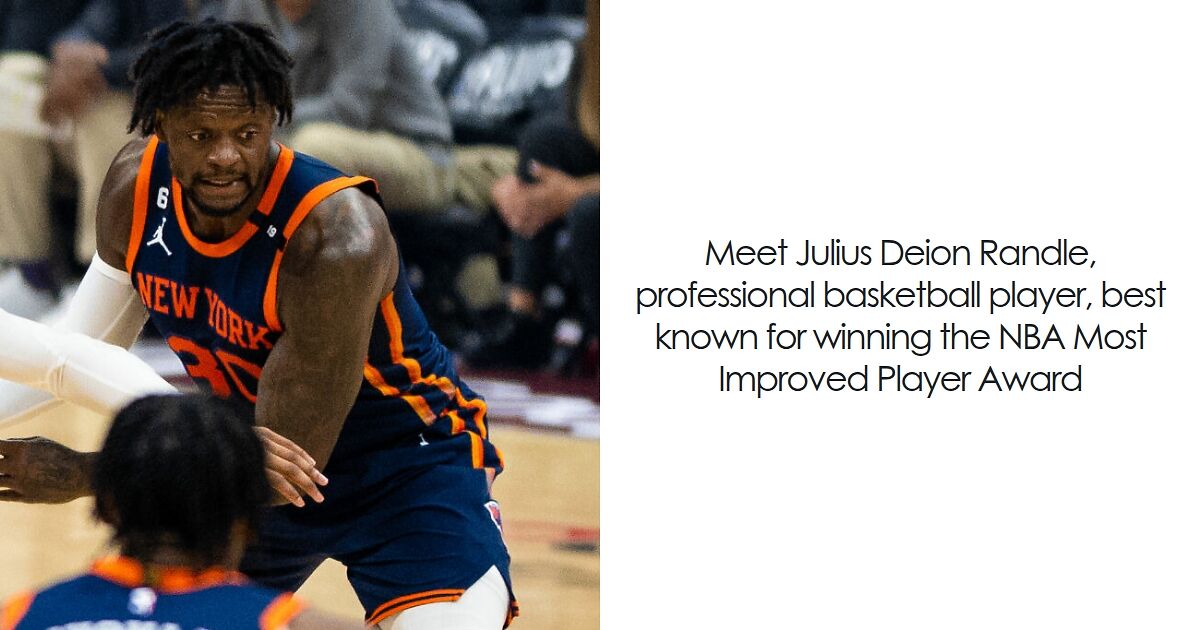
Julius Randle’s basketball career has never followed a quiet, predictable route. It has featured a devastating injury in his first NBA game, a one-season breakout in New Orleans, an All-Star transformation in New York, two eventful years in Minnesota, and yet another major change of address in 2026. Apparently, ordinary career paths are not really his thing.
A powerful left-handed forward with the strength of a center and the passing instincts of a playmaker, Randle has built an NBA résumé filled with rebounds, triple-doubles, individual awards, playoff criticism, comeback seasons, and enough trade headlines to keep sports radio fully employed. His story is not simply about statistics. It is about reinvention, resilience, changing roles, and learning how to remain productive in a league that never stops evolving.
Julius Randle Bio: Quick Facts
- Full name: Julius Deion Randle
- Date of birth: November 29, 1994
- Birthplace: Dallas, Texas
- Height: 6 feet 9 inches
- Listed weight: 250 pounds
- Position: Power forward and small-ball center
- Shooting hand: Left
- College: University of Kentucky
- NBA draft: Seventh overall pick in 2014
- Major honors: Three-time NBA All-Star, two-time All-NBA selection and 2021 NBA Most Improved Player
- Current status: Set to join the Brooklyn Nets through a reported three-team trade pending required league approval as of late June 2026
Early Life and High School Stardom
Born and raised in the Dallas area, Julius Randle developed into one of the most heavily recruited players in the 2013 high school class. He attended Prestonwood Christian Academy in Plano, Texas, where his combination of size, mobility and physical force made him difficult to handle even before he had a professional strength program.
Randle helped Prestonwood Christian win three state championships in four years. As a senior, he averaged an eye-popping 32.5 points and 22.5 rebounds per game. Those are the sort of numbers normally produced by someone playing a basketball video game on the easiest setting.
A fractured foot interrupted his senior season, but Randle returned for the playoffs and helped his school capture another state title. He was named a McDonald’s All-American and ranked among the country’s top prospects. After considering programs including Kansas and Texas, he committed to Kentucky and joined one of the most celebrated recruiting classes in college basketball history.
One Memorable Season at Kentucky
Randle played only one college season, but he made it count. During the 2013–14 campaign, he started all 40 games for Kentucky and led the Wildcats with averages of 15.0 points and 10.4 rebounds. He recorded 24 double-doubles, setting a Kentucky freshman record at the time.
His game was built around strength, balance and relentless activity near the basket. Defenders knew he wanted to attack the paint, yet stopping him was another matter. Randle could absorb contact, clear space with his shoulders and finish through traffic while drawing frequent trips to the free-throw line.
Kentucky entered the NCAA Tournament as a No. 8 seed but defeated Kansas State, previously unbeaten Wichita State, Louisville, Michigan and Wisconsin to reach the national championship game. The Wildcats lost to Connecticut, but Randle earned Final Four All-Tournament recognition and was named a third-team All-American.
After the season, he declared for the 2014 NBA Draft. The Los Angeles Lakers selected him with the seventh overall pick, making him one of the central pieces of the franchise’s rebuilding plans.
NBA Career Journey
Los Angeles Lakers: A Painful Beginning and Patient Development
Randle’s professional career began in the harshest possible way. On October 28, 2014, during his NBA regular-season debut, he fractured his right tibia while driving toward the basket against the Houston Rockets. His rookie season ended after only 14 minutes of playing time.
The injury forced Randle to begin his NBA education from the sideline. He later described becoming an intense student of the game while rehabilitating, watching other teams and studying how experienced players operated. Kobe Bryant encouraged him to treat rehabilitation as the beginning of his comeback rather than an extended invitation to feel sorry for himself.
Randle returned in 2015–16 and averaged 11.3 points and 10.2 rebounds over 81 games. During four seasons with the Lakers, he gradually improved his ballhandling, passing and ability to attack from the perimeter. By 2017–18, he was producing 16.1 points and 8.0 rebounds per game while shooting 55.8 percent from the floor.
Los Angeles eventually renounced his rights while creating salary-cap space in 2018. Randle left without becoming a franchise star, but he had transformed from an injured rookie into a productive, versatile NBA starter.
New Orleans Pelicans: The First Major Breakout
Randle signed a one-year contract with the New Orleans Pelicans before the 2018–19 season. The move gave him more offensive freedom, and he responded with the best statistical year of his career to that point.
In 73 appearances, he averaged 21.4 points, 8.7 rebounds and 3.1 assists while shooting 52.4 percent from the field. He also demonstrated a developing three-point shot and recorded 31 double-doubles. His 45-point performance against Portland in March 2019 established a new career high at the time.
New Orleans also connected Randle with assistant coach Chris Finch, whose offensive ideas later became important when the two reunited in Minnesota. Randle’s Pelicans season proved that he could handle a major scoring role rather than merely collect rebounds and finish opportunities created by others.
New York Knicks: From Question Mark to All-Star
Randle signed with the New York Knicks in July 2019. His first season was productive but uneven, as he averaged 19.5 points and 9.7 rebounds for a team still searching for direction. Turnovers, forced drives and crowded spacing frequently made him an easy target for frustrated fans.
Then came the 2020–21 season, the defining transformation of his career. Randle improved his conditioning, decision-making and outside shooting while taking command of the Knicks’ offense. He averaged 24.1 points, 10.2 rebounds and 6.0 assists, played an NBA-high 37.6 minutes per game and shot 40.1 percent from three-point range.
Randle became the first Knicks player to win the NBA Most Improved Player Award. He also earned his first All-Star selection and a place on the All-NBA Second Team. Behind his all-around production, New York finished 41–31 and returned to the playoffs for the first time since 2013.
The postseason was less flattering. Atlanta’s defense crowded Randle, pressured his handle and held him to inefficient shooting during a five-game first-round defeat. That contrastdominant regular season followed by playoff difficultybecame a recurring topic whenever analysts discussed his career.
After a frustrating 2021–22 campaign, Randle bounced back again in 2022–23. He averaged 25.1 points, 10.0 rebounds and 4.1 assists, made his second All-Star team and earned All-NBA Third Team honors. His signature performance came on March 20, 2023, when he scored a career-high 57 points against Minnesota.
Randle was selected as an All-Star for a third time in 2024, but a dislocated right shoulder ended his season in January. The Knicks initially hoped he could return, yet surgery ultimately kept him out of the playoffs. In September 2024, New York sent Randle and Donte DiVincenzo to Minnesota in the blockbuster trade that brought Karl-Anthony Towns to the Knicks.
Minnesota Timberwolves: Playoff Redemption and Another Trade
Joining Minnesota required Randle to adjust from being New York’s primary frontcourt creator to playing alongside Anthony Edwards and Rudy Gobert. His first Timberwolves regular season included awkward stretches, an adductor injury and ongoing questions about spacing. Even so, he averaged 18.7 points, 7.1 rebounds and 4.7 assists while shooting 48.5 percent from the field.
The 2025 playoffs delivered one of the brightest stretches of his career. Randle attacked mismatches, created offense for teammates and played with greater composure than he had during earlier postseason appearances. Against Golden State, he recorded a 24-point, 10-rebound and 12-assist triple-double in Game 3. He followed it with a playoff career-high 31 points in Game 4 and scored 29 in the series-clinching Game 5.
Minnesota advanced to the Western Conference Finals, and the phrase “Playoff Julius” briefly became a compliment rather than an internet punchline. The Timberwolves were eliminated by Oklahoma City, but Randle had demonstrated that he could be an effective postseason creator when his decisions were quick and his attacks were directed toward the rim.
Minnesota re-signed him in July 2025. During the 2025–26 regular season, he played 79 games and averaged 21.1 points, 6.7 rebounds and 5.0 assists. His scoring efficiency and availability remained valuable, although his rebounding average was lower than during his peak Knicks seasons.
The 2026 playoffs told a different story. Randle averaged 16.0 points across 12 games while shooting about 39 percent from the field and 24 percent from three-point range. Minnesota was eliminated by San Antonio in the second round, reviving familiar questions about his postseason consistency.
On June 23, 2026, reports indicated that Minnesota had agreed to send Randle and the No. 28 draft pick to the Brooklyn Nets in a three-team transaction involving the Chicago Bulls. Brooklyn would receive Randle and Joshua Jefferson, while Minnesota would move down to No. 33 and Chicago would acquire Nic Claxton. At the time of reporting, the transaction still required league approval.
Julius Randle’s Playing Style
Power With Guard Skills
Randle’s physical strength remains the foundation of his game. He uses his wide frame to establish position, protect the ball and move defenders who would prefer not to be moved. He is especially dangerous when attacking downhill from the left side, where his preferred hand and shoulder angle allow him to absorb contact.
Unlike many traditional power forwards, Randle can initiate offense. He brings the ball up the floor, operates in pick-and-roll situations and finds cutters or shooters when defenses collapse. His best seasons have come when he balances scoring aggression with fast, uncomplicated passing.
Inside-Out Scoring
Randle has repeatedly described himself as an inside-out player. His most reliable offense comes from drives, post-ups, transition attacks and finishes around the basket. When defenders retreat, he can make midrange jumpers and three-pointers, although his outside accuracy has varied significantly from season to season.
That volatility affects his postseason results. When jumpers are falling, he forces defenses to guard every section of the floor. When they are not, opponents can crowd the paint, encourage difficult pull-ups and turn his strength into hurried possessions.
Rebounding and Defensive Questions
Randle has been an excellent defensive rebounder throughout much of his career. Securing the ball allows him to begin fast breaks without waiting for a guard, creating transition opportunities before the defense becomes organized.
His defense has been less consistent. He has the size to switch, battle in the post and absorb contact, but his focus and off-ball positioning have sometimes fluctuated. At his best, particularly during Minnesota’s 2025 playoff run, he was active and dependable. At other times, missed rotations and slow closeouts became visible weaknesses.
Major Julius Randle Career Highlights
- Selected seventh overall by the Los Angeles Lakers in the 2014 NBA Draft.
- Recovered from a fractured tibia suffered during his NBA debut.
- Averaged a double-double in his first full NBA season.
- Produced 21.4 points and 8.7 rebounds per game with New Orleans in 2018–19.
- Won the 2020–21 NBA Most Improved Player Award.
- Named an NBA All-Star in 2021, 2023 and 2024.
- Selected to the All-NBA Second Team in 2021.
- Selected to the All-NBA Third Team in 2023.
- Scored a career-high 57 points against Minnesota in March 2023.
- Recorded a playoff triple-double against Golden State in May 2025.
- Scored a playoff career-high 31 points during Minnesota’s 2025 postseason run.
- Helped the Timberwolves reach the 2025 Western Conference Finals.
- Entered the 2026 offseason with career averages of approximately 19.2 points, 8.9 rebounds and 3.9 assists.
Career Experiences and Lessons From Julius Randle’s Journey
Reinvention Is Usually More Important Than a Perfect Beginning
Randle’s career offers a useful reminder that professional success rarely arrives in a straight line. His first NBA appearance ended with a broken leg. His first major contract with New York was initially criticized. His playoff performances have alternated between excellent and deeply frustrating. Yet he has still built a career featuring multiple All-Star selections, two All-NBA teams and more than a decade of high-level production.
The practical lesson is not that every setback automatically creates a heroic comeback. Recovery is slower and less cinematic than that. Randle spent months rebuilding his leg, then several seasons adding ballhandling, passing and perimeter shooting. Improvement happened because he kept developing specific skills instead of waiting for confidence to magically arrive wearing a cape.
Environment Can Change How Talent Is Perceived
Randle looked like a useful but limited forward in Los Angeles. In New Orleans, additional freedom revealed a 20-point scorer. In New York, a structured offense and improved shooting turned him into an All-NBA player. In Minnesota, a reduced role initially created uncertainty, but better spacing and secondary playmaking responsibilities helped produce his finest postseason stretch.
Those experiences demonstrate why evaluating a player only through one team or one season can be misleading. Coaching, teammates, spacing, expectations and roster construction all influence performance. Talent matters, but fit determines how easily that talent can be expressed.
Criticism Can Be Accurate Without Telling the Entire Story
Randle’s playoff struggles are real. Opponents have repeatedly pressured his dribble, crowded his preferred driving lanes and dared him to settle for difficult jump shots. His defensive attention and emotional reactions have also drawn justified criticism.
However, reducing his career to those failures ignores the adaptability that produced the 2025 playoff run. Against Golden State, Randle read double-teams more quickly, attacked smaller defenders and trusted simple passes. He did not suddenly become a different athlete. He used his existing abilities with better timing.
That distinction matters beyond basketball. Criticism is most useful when it identifies a correctable habit rather than declaring a person permanently incapable. Randle’s career has repeatedly shown that the same player can look inefficient in one context and dominant in another.
Consistency Is the Final Challenge
At 31 during the 2026 offseason, Randle is no longer an unfinished prospect. His next phase is about consistency rather than discovery. Brooklyn, assuming the reported trade is approved, may give him a larger offensive role and another opportunity to mentor younger players. The Nets could use his shot creation, rebounding and passing, but they will also need him to make fast decisions and remain engaged defensively.
For Randle, the challenge is clear: preserve the physical advantages that made him successful while simplifying the possessions that have caused problems. Fewer stalled isolations, quicker passes and more direct attacks could extend his effectiveness well into his thirties.
His career experience suggests that another productive chapter is possible. It also suggests that nothing will be boring. Julius Randle has moved from Los Angeles to New Orleans, from Manhattan to Minnesota and potentially back to New York City through Brooklyn. His basketball passport may need extra pages, but every stop has added something to his story.
Conclusion
Julius Randle’s bio and career highlights reveal one of the NBA’s more complicated modern success stories. He has been a lottery pick, an injured rookie, a breakout scorer, a franchise leader, a three-time All-Star, an All-NBA forward and a playoff target. He has also responded to several disappointing seasons with some of his best basketball.
Randle may never fit neatly into a single label. He is too accomplished to be dismissed as merely inconsistent, yet too unpredictable to be treated as automatic. That tension is precisely what makes his career interesting. Through late June 2026, he has accumulated nearly 800 regular-season appearances, career averages near 19 points and nine rebounds, and a résumé that places him among the most productive power forwards of his generation.
His next chapter may unfold in Brooklyn, where a young Nets roster could give him another prominent role. Whether that chapter becomes another reinvention or one final lesson in roster fit, Julius Randle’s career has already established a durable theme: count him out carefully, because he has made a habit of returning with a new answer.