If there is one reliable sign that human creativity is alive and thriving, it is this: someone looked at a slice of bread and thought, “Yes, obviously, that is now a desert.” That someone is Japanese artist Tatsuya Tanaka, the mastermind behind the endlessly charming Miniature Calendar, a daily art project that turns ordinary household objects into tiny theatrical worlds.
And yes, the headline says “seven years,” because that is the milestone that helped send this story flying across the internet. But the real hook is not just the streak. It is the stubbornly delightful idea behind it. Day after day, year after year, Tanaka has taken things most people ignore, a broccoli crown, a toothbrush, a roll of toilet paper, a notebook spiral, and transformed them into scenes that feel funny, clever, nostalgic, and oddly profound all at once.
That is why people do not just scroll past his miniature dioramas. They stop. They grin. They zoom in. They show a friend. Then they start looking at their own kitchen counters like they might be hiding a secret universe.
Who Is the Artist Behind These Tiny Worlds?
Tatsuya Tanaka is a Japanese miniature photographer and “mitate” artist, a creator who reimagines one familiar thing as another through resemblance, context, and visual wit. His long-running project, Miniature Calendar, began in 2011 and has become a global phenomenon because it does something the internet rarely manages to do consistently: it surprises people without shouting at them.
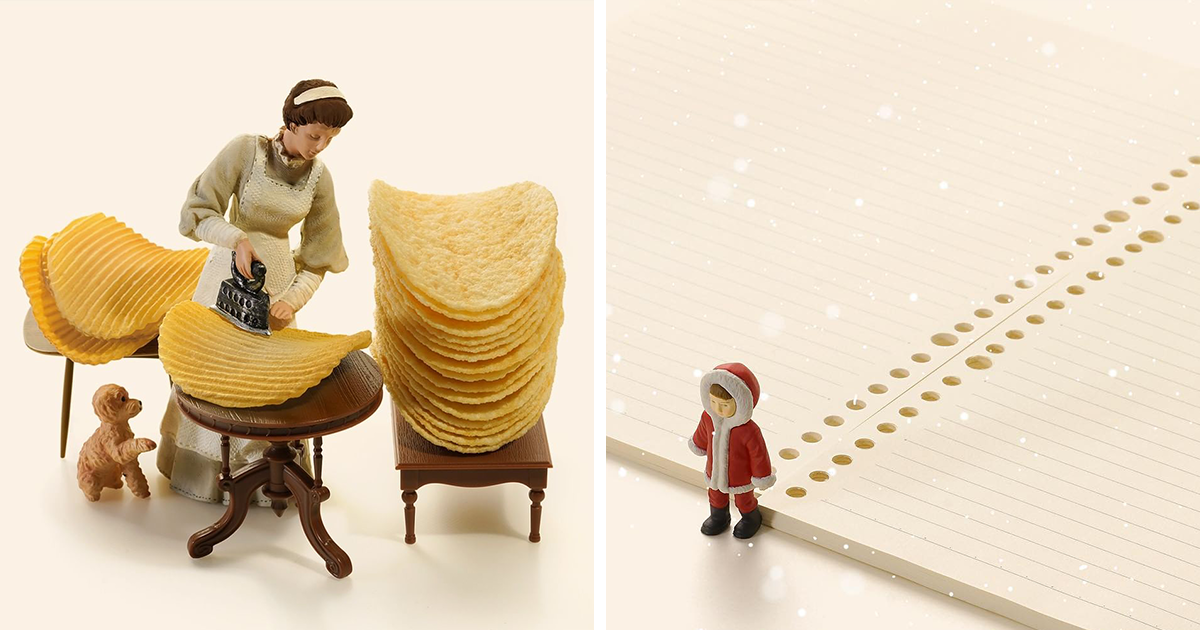
Instead of relying on spectacle for spectacle’s sake, Tanaka works with scale, humor, and recognition. A muffin tray can become a bathhouse. A folded face mask can become a tent. A deck of cards can host a ping-pong tournament. A wallet can feel like architecture. Suddenly, the everyday world stops acting ordinary.
That is the genius of his work. He does not need a giant budget, a dramatic manifesto, or a machine that shoots lasers into the moon. He needs a sharp eye, a sense of play, and the patience to keep showing up. For years. Every single day. Which, frankly, is both inspiring and a little rude to the rest of us who feel productive after answering three emails.
Why These Miniature Dioramas Work So Well
1. They make ordinary objects feel brand new
Most art asks you to look at something extraordinary. Tanaka asks you to look again at something ordinary. That twist is what gives his miniature dioramas such unusual power. He takes familiar objects, food, stationery, kitchen tools, hygiene products, cosmetics, and lets them play a new role. It is a visual pun, but a beautifully staged one.
The effect is immediate. A viewer recognizes the object first, then sees the transformed meaning second. That split-second mental click is deeply satisfying. It is the same pleasure as getting a joke, solving a riddle, or spotting the hidden image in a puzzle. The brain loves a surprise when it arrives wearing a sensible little outfit.
2. They mix humor with craftsmanship
These scenes are funny, but never lazy. That matters. A lot of whimsical art gets by on the idea alone. Tanaka goes further. He composes each image carefully, balances lighting, chooses perspective with intention, and makes sure the figurines and objects feel like they genuinely belong together. The result is not just a gag. It is a fully realized miniature narrative.
That is why his work appeals to both casual social media users and serious art lovers. One group sees a clever joke. The other sees composition, repetition, metaphor, material sensitivity, and control of scale. Both are right.
3. They turn consistency into part of the artwork
Plenty of artists have one great idea. Fewer have one great idea they can renew daily without flattening it into repetition. Tanaka’s discipline is not just admirable, it is part of the art itself. The long streak becomes a performance of imagination. Viewers are not just looking at one miniature diorama. They are looking at evidence of creative endurance.
That daily rhythm also changes how audiences relate to the work. Miniature Calendar does not feel like a closed project. It feels alive. It keeps arriving. It becomes part of people’s routines, the artistic equivalent of a favorite coffee shop, except the coffee shop occasionally turns a spoon into a waterpark.
The Secret Ingredient: “Mitate” and the Joy of Reimagining
One reason Tanaka’s work feels richer than a standard cute miniatures feed is that it is rooted in a deeper artistic idea: mitate, or the act of likening one thing to another. In practice, that means more than visual resemblance. It means inviting the viewer to participate in meaning-making.
Broccoli becomes a forest not because it literally is one, but because the artist nudges us toward a perspective where it can be one. A brush becomes a boat. Popcorn becomes clouds. A leaf becomes a cello. The material remains itself while also becoming something else. That double identity is where the magic lives.
It is playful, but it is not trivial. In a world full of overstimulation, Tanaka’s approach reminds viewers that imagination does not always require escape from reality. Sometimes it requires a closer look at reality. The spoon in your drawer may not actually contain a miniature summer resort, but emotionally? It is making a surprisingly strong case.
Why “45 New Pics” Headlines Keep Going Viral
There is a reason roundup-style headlines about Tanaka’s work keep resurfacing. His art is perfect for galleries. Each image delivers its own quick burst of delight, but together they reveal the scale of the project. One diorama is amusing. Forty-five in a row becomes a statement about imagination, persistence, and the endless creative potential hiding inside daily life.
Gallery posts also mirror the way audiences consume his work. You dip in for one image, then suddenly you are twenty images deep, emotionally invested in tiny workers climbing food, tiny tourists crossing stationery, and tiny musicians performing on objects that really should not have acoustics but somehow do in your heart.
The best part is that the images are memorable without feeling repetitive. Tanaka returns to familiar materials, food, paper products, household items, seasonal references, pop culture nods, but he reframes them constantly. That freshness is why the project has longevity. It is not a gimmick running on fumes. It is a living system of observation and reinterpretation.
Examples That Show Off His Range
What makes Tanaka stand out from other miniature artists is not just that he can build tiny scenes. It is that his scenes can swing between the domestic, the seasonal, the cinematic, and the absurd without losing coherence.
In one mood, he creates landscapes that feel calm and almost poetic: hikers crossing fruit, bikers drifting beneath cherry blossoms, or tiny travelers moving through a world shaped by books and light. In another, he leans into pop culture, referencing beloved films and characters with objects that become part prop, part punchline. Elsewhere, he responds to current events, proving that miniature art can also function as commentary, not just decoration.
During pandemic-era work, for example, ordinary safety items such as masks, thermometers, and toilet paper became the building blocks for scenes of adventure and wit. That was more than clever repurposing. It was a way of translating a tense global moment into something imaginative and shareable without denying the reality behind it.
That flexibility is a huge part of Tanaka’s appeal. His miniature dioramas do not live in a single emotional register. They can be funny, tender, topical, nostalgic, or visually mischievous. They welcome viewers in through charm and then keep them there through invention.
What Creators, Brands, and Everyday Viewers Can Learn From Him
Creativity is often observation before execution
Tanaka’s work looks wildly inventive, but it begins with attention. He notices shapes, textures, echoes, and accidental similarities that other people overlook. That means the first lesson from his art is not “be more original.” It is “pay closer attention.” Originality often arrives wearing the disguise of observation.
Constraints can make ideas better
He works with tiny figures, everyday objects, limited scale, and the pressure of a daily posting rhythm. Those constraints do not choke creativity. They sharpen it. Instead of asking, “What can I make with anything at all?” his project asks, “What can I make with what is already here?” That is a much more useful question for artists, writers, designers, and frankly anyone trying to do creative work without waiting for perfect conditions.
Consistency builds trust with an audience
People return to Tanaka’s work not just because it is good, but because he keeps delivering it. That repeated act of showing up matters. In content terms, it builds anticipation. In artistic terms, it becomes a practice. In human terms, it proves that inspiration is not always a thunderbolt. Sometimes it is a habit with excellent lighting.
More Than Cute: Why the Project Actually Matters
It would be easy to dismiss miniature dioramas as light entertainment, but Tanaka’s project has broader cultural weight than that. It sits at the intersection of photography, design, sculpture, humor, and visual storytelling. It also reflects how people now experience art: across websites, social feeds, books, exhibitions, and repeatable daily rituals.
His success proves there is still enormous appetite for work that is accessible without being shallow. You do not need an art history degree to enjoy a tiny figure skiing down toilet paper or performing music under the glow of book pages. But you can also appreciate the design intelligence, the symbolic layering, and the sheer discipline underneath it.
In that sense, Tanaka’s art does something rare. It respects both the first glance and the second one.
The Experience of Encountering Tanaka’s Tiny Worlds
Looking at Tatsuya Tanaka’s miniature dioramas is a strange, delightful experience because they trigger two reactions at the same time. First, you feel the instant jolt of recognition. You know the object. It is a broccoli floret, a spoon, a roll of tape, a notebook, a slice of bread. Then, almost immediately, that certainty gets hijacked by imagination. The broccoli is now a forest. The spoon is now a pool, a boat, or a park. The bread is no longer lunch. It has become terrain. Your brain does this little double-take, and that mental wobble is half the fun.
There is also something childlike about the experience, but not childish. It revives the part of the mind that once believed the carpet was lava and the couch cushions were mountain ranges. Tanaka’s work gives adults permission to reenter that mode without embarrassment. In fact, it makes that imaginative leap feel smart. The scenes are polished enough to impress you technically, but playful enough to make you feel lighter while viewing them.
Another layer of the experience is how intimate the work feels. Because the materials come from everyday life, the scenes never seem distant or elite. You are not staring at some unreachable fantasy made of rare materials in a sealed-off universe. You are looking at possibility hidden inside things you already own. That can be oddly moving. It suggests that wonder is not located somewhere else, in another city, another budget, another life. It might be sitting in your kitchen drawer next to the scissors.
There is also the pleasure of slowing down. His images reward close looking. At first glance, you see the joke. At second glance, you see the composition. At third glance, you notice the tiny characters, the posture of a figurine, the direction of the light, the way a curve in the object creates a horizon line or a stage. In a fast-scrolling digital culture, that is no small achievement. Tanaka makes people pause long enough to notice details, and that alone feels refreshing.
If you experience his work in a gallery format, or even just in a long online roundup, another feeling emerges: admiration for stamina. One clever image could be luck. Ten could be momentum. Years of daily invention is something else entirely. It starts to feel less like a series of isolated jokes and more like a worldview, a disciplined commitment to finding visual possibility everywhere. That creates an emotional effect beyond amusement. It becomes encouraging. You begin to think, maybe creativity is not reserved for rare genius moments. Maybe it is built by returning to the same practice over and over until your eye learns how to see magic in plain sight.
And perhaps that is the most lasting experience Tanaka offers. His miniature worlds do not just entertain the viewer for a few seconds. They leave behind a shift in perception. After spending time with his work, common objects no longer look entirely obedient. A sponge might be architecture. A pencil sharpener might be industrial machinery. A dessert might be geography. His art stays with you because it changes how you move through ordinary life. Suddenly, the world feels more flexible, more humorous, and far less finished than it did before.
Final Thoughts
“Japanese Artist Has Been Creating Miniature Dioramas Every Day For Seven Years (45 New Pics)” sounds like the setup to a charming internet distraction, and to be fair, it absolutely delivers on charm. But the deeper story is about sustained imagination. Tatsuya Tanaka has built a body of work that proves small-scale art can carry big ideas: attention, humor, discipline, accessibility, and the radical pleasure of seeing familiar things in unfamiliar ways.
His miniature dioramas are not just cute scenes made from household objects. They are reminders that creativity does not always arrive from chasing the extraordinary. Sometimes it comes from noticing that the extraordinary has been loafing around inside the ordinary this whole time, waiting for someone to give it a tiny cast of figurines and a decent camera angle.
That is why people keep sharing his work. And that is why they probably will for a long time yet.