Star Trek has always loved a good conspiracy. Secret admirals. Shadowy intelligence agencies. Romulans hiding inside respectable institutions like they are allergic to normal hobbies. But every now and then, the franchise wanders into a very specific kind of territory: a catastrophic attack, a fearful government response, and the unsettling suggestion that powerful insiders may have allowed, encouraged, or engineered the disaster.
That is where the question comes in: Is Star Trek promoting a 9/11 conspiracy theory again? The short answer is no, not in the literal “here is a documentary narrated by a guy with a corkboard” sense. But the longer answer is more interesting. Modern Star Trek, especially Star Trek: Picard Season 1 and Star Trek Into Darkness, has repeatedly used storylines that resemble the emotional architecture of post-9/11 conspiracy culture: national trauma, security panic, institutional betrayal, secret wars, and the awful possibility that the people promising safety are also manufacturing fear.
That does not make Star Trek a truther pamphlet with warp nacelles. It does, however, make it a franchise that sometimes plays with loaded imagery while wearing oven mitts. The result can be thoughtful political allegory, messy blockbuster paranoia, or both at the same time. In other words: very Star Trek, very 21st century, and very likely to make a fan forum explode faster than a redshirt near a suspicious cave.
Why the 9/11 Comparison Keeps Following Star Trek
The September 11 attacks became one of the defining political and cultural traumas of modern America. In fiction, 9/11 did not only inspire direct stories about terrorism. It reshaped how movies and television depicted fear, surveillance, emergency power, war, and public trust. Science fiction, being science fiction, processed those anxieties through aliens, androids, secret fleets, and dramatic shots of people staring at burning skylines.
Star Trek is especially vulnerable to this kind of reading because the franchise is built around the Federation: a utopian political project that believes reason, pluralism, diplomacy, and ethical restraint can survive the worst parts of history. So when Star Trek tells a story about the Federation panicking after an attack, fans pay attention. The Federation is not just “space government.” It is the show’s moral laboratory. If the lab catches fire, we are supposed to ask who brought the matches.
The Mars Attack in Star Trek: Picard
In Star Trek: Picard, the defining historical wound is the attack on Mars. Synthetic workers, known as synths, suddenly turn on the Utopia Planitia shipyards, destroy the Romulan rescue fleet, and kill tens of thousands of people. The Federation responds by banning synthetic life and abandoning the effort to evacuate Romulans threatened by a supernova. Jean-Luc Picard, disgusted by this moral collapse, resigns from Starfleet.
As political drama, that setup is potent. As 9/11 allegory, it is not exactly hiding in a Jeffries tube. A shocking attack changes public policy overnight. Fear overrides principle. A vulnerable minority becomes the target of suspicion. Institutions that once claimed higher ideals choose security theater over moral courage. Picard, the franchise’s most famous walking conscience, looks at Starfleet and essentially says, “This is not who we are.”
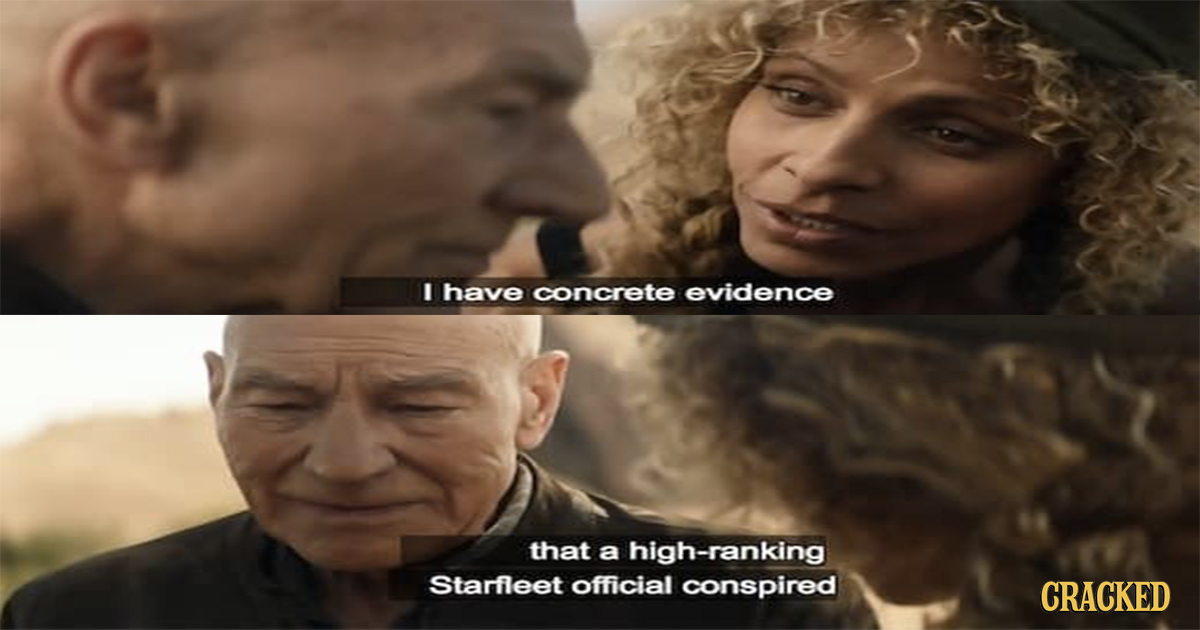
Then the story adds the part that makes eyebrows climb into orbit: the attack was not simply a random malfunction. As the season unfolds, the Zhat Vash, a secret Romulan faction obsessed with destroying artificial life, is revealed to have manipulated events. Commodore Oh, who had infiltrated Starfleet Security, becomes central to the conspiracy. Suddenly, the Mars attack is not just tragedy. It is sabotage, infiltration, and political manipulation.
That Is Where the “Inside Job” Vibe Comes From
The phrase “inside job” is radioactive in real-world discussions of 9/11 because it belongs to a family of conspiracy theories that claim the attacks were secretly permitted or orchestrated by powerful insiders. Those theories have been repeatedly debunked by official investigations, engineering studies, journalists, and historians. But as a fictional device, “the disaster was engineered by a hidden faction inside the system” remains extremely common. It creates suspense. It gives heroes something to uncover. It turns grief into mystery.
The problem is that when a story mirrors the structure of a real conspiracy theory too closely, it can accidentally borrow its emotional charge. Picard is not saying 9/11 was an inside job. It is saying that in the 24th century, a catastrophic attack on Mars was manipulated by secret actors. That is a perfectly valid science-fiction plot. Still, viewers familiar with post-9/11 conspiracy culture can hear the echo, even if the writers are playing in a different sandbox.
Star Trek Into Darkness Did This First, and Louder
The “again” in the title points directly toward Star Trek Into Darkness, the 2013 film directed by J.J. Abrams and written by Roberto Orci, Alex Kurtzman, and Damon Lindelof. That movie is practically a buffet of War on Terror imagery: a terrorist attack on a government facility, a revenge mission, secret weapons, a militarized Starfleet, and an admiral trying to provoke a war with the Klingons.
The film’s villain situation is complicated enough to require a flowchart, several espressos, and possibly a Vulcan legal scholar. John Harrison is revealed to be Khan. Khan is a terrorist, but he has also been exploited by Admiral Marcus. Marcus wants to use the crisis to justify military escalation. Starfleet has built a massive warship in secret. The supposed defenders of civilization have been quietly preparing for conflict while telling everyone to trust the chain of command.
That is not subtle. It is not even wearing a fake mustache. Into Darkness uses conspiracy mechanics to critique militarization, revenge politics, and the way fear can be weaponized after trauma. The movie also dedicated itself to post-9/11 veterans, which made the political subtext even more visible. Some viewers found the allegory bold. Others found it clumsy. A few probably wanted to beam the script directly into a volcano.
The Roberto Orci Factor
Part of the reason Into Darkness gets discussed in this context is Roberto Orci, who has been associated in media commentary with 9/11 conspiracy beliefs. That does not mean every plot point in the film should be treated as an encrypted manifesto. Movies are collaborative, and blockbuster scripts pass through more hands than a cursed Klingon artifact. But authorship matters when viewers interpret themes. If a writer known for conspiracy-friendly comments co-writes a movie about a government-linked terror plot, people are going to notice.
Alex Kurtzman later became a central architect of modern televised Star Trek, including Picard. That connection does not prove a secret agenda. It does explain why fans and critics see a recurring pattern: modern Trek keeps returning to stories where democratic institutions are compromised by fear, militarism, or hidden factions. Sometimes that is great drama. Sometimes it feels like the franchise is one ominous monologue away from selling “wake up, sheeple” mugs.
Is This Actually a Conspiracy Theory?
Here is the key distinction: a conspiracy plot is not the same as promoting a conspiracy theory. Fiction has used conspiracies forever. Shakespeare had political murder plots. Cold War thrillers had double agents. The X-Files had so many secret cabals that the U.S. government in that universe must have had a whole department for filing mysterious hallway conversations.
A conspiracy theory about a real tragedy makes claims about actual victims, perpetrators, evidence, and history. A fictional conspiracy uses secrecy and betrayal as narrative devices. Picard and Into Darkness fall into the second category. They are not presenting real-world 9/11 conspiracy claims as factual. They are using a post-9/11 dramatic grammar: attack, panic, crackdown, hidden manipulation, moral reckoning.
That said, fiction does not exist in a vacuum. If a show repeatedly suggests that public trauma is best understood by looking for hidden insiders, it may reinforce a worldview where official explanations are automatically suspicious. Good storytelling can explore institutional corruption without teaching audiences that every tragedy has a puppet master. The difference is nuance, and nuance is harder to write than “evil admiral did it.”
Star Trek Has Always Distrusted Power
To be fair, Star Trek has long warned against authoritarianism, militarism, and fear-based politics. Deep Space Nine did it brilliantly in “Homefront” and “Paradise Lost,” where Changeling paranoia leads Starfleet officers to consider extreme security measures on Earth. Those episodes aired before 9/11, yet they now feel eerily relevant because they understand a timeless truth: frightened societies can become vulnerable to leaders who promise safety at the cost of liberty.
Enterprise Season 3 also leaned into post-9/11 storytelling with the Xindi arc. Earth is attacked, Captain Archer pursues the enemy into dangerous territory, and the show wrestles with revenge, torture, desperation, and moral compromise. Not every episode hits the target gracefully, but the arc shows Trek trying to process American anxiety in real time.
So when Picard revisits similar territory, it is not coming out of nowhere. The franchise has always asked whether enlightened ideals can survive crisis. That is one of its best questions. The risk comes when the answer becomes too dependent on secret villains. If every moral failure is caused by a hidden cabal, ordinary citizens and institutions get let off the hook too easily.
Why Picard Works Better Than Into Darkness
Star Trek: Picard handles its post-attack allegory with more emotional weight than Into Darkness, partly because television has more room to breathe. The Mars attack is not merely an excuse for spaceship combat. It shapes Picard’s guilt, Raffi’s career, the Federation’s policy, the Romulan refugee crisis, and the status of synthetic life. The tragedy has social consequences, not just explosions.
Most importantly, Picard is less interested in proving that one bad actor ruined paradise and more interested in showing how fear gave bad actors room to operate. The Zhat Vash may have engineered the crisis, but the Federation still chose how to respond. It chose retreat. It chose exclusion. It chose to abandon people who needed help. That is a stronger political point than “surprise, the admiral is evil.”
Jean-Luc Picard’s outrage matters because he does not simply solve the mystery; he condemns the moral surrender that followed it. He is not just angry that Starfleet was deceived. He is angry that Starfleet became so willing to betray its principles once fear made betrayal convenient.
Why the Allegory Still Feels Risky
The risky part is that 9/11 remains a real wound, not just a storytelling template. Nearly 3,000 people were killed in the attacks, and the aftermath reshaped wars, immigration policy, surveillance, public discourse, and the lives of millions. Using similar emotional machinery in entertainment requires care. The closer a fictional disaster gets to 9/11 imagery, the more viewers may ask whether the story is honoring trauma, exploiting it, critiquing it, or accidentally laundering bad ideas through cool starships.
That does not mean writers must avoid allegory. Avoiding allegory would be the least Star Trek thing imaginable. This is the franchise that turned racism, nuclear war, environmental collapse, imperialism, religious conflict, and bioethics into weekly television. The point is not to stop using real-world parallels. The point is to use them intelligently.
The Best Reading: Star Trek Is Warning About Fear
The most generous and probably most accurate reading is that modern Star Trek is not promoting 9/11 conspiracy theories. It is warning about what societies do after trauma. In Into Darkness, fear becomes a tool for militarists. In Picard, fear becomes an excuse for xenophobia and dehumanization. In both cases, the villains benefit from panic, but the real danger is the speed with which institutions abandon their values.
That is a very Trek idea. The franchise has always believed that civilization is not measured by what it says on a sunny day. It is measured by what it does when frightened, wounded, and tempted to become cruel.
Experience Section: Watching Star Trek Through the Shadow of 9/11
For many viewers, watching these stories is a strange experience because they are not simply consuming space opera. They are also recognizing emotional patterns from the news, from history class, from airport security lines, from political speeches, and from two decades of arguments about safety and freedom. The Mars attack in Picard may involve androids and starships, but the emotional rhythm feels familiar: everyone remembers where they were, leaders demand immediate action, a feared group becomes a convenient symbol, and complicated questions get flattened into slogans.
That familiarity can make the story hit harder. When Picard says Starfleet failed, the line lands because viewers have seen real institutions fail under pressure. When Raffi suspects that the official story is incomplete, the audience understands the exhaustion of living in a world where trust has been repeatedly damaged. When synthetic life is banned, the allegory becomes painfully clear: fear often looks for a body to blame.
At the same time, the viewing experience can be uncomfortable. Some fans come to Star Trek for hope, not another reminder that institutions are fragile and leaders can be cowards. They want the Federation to be better than us. That is understandable. The whole appeal of the franchise is that humanity eventually gets its act together, stops fighting over nonsense, and builds a future where people can explore the galaxy in matching pajamas.
But hope without stress-testing is just decoration. The reason Picard still matters is that he represents principles under pressure. He is not inspiring because the world around him is perfect. He is inspiring because he refuses to let imperfection become an excuse. In that sense, Picard uses a post-9/11-style allegory not to promote paranoia, but to ask whether moral courage can survive collective fear.
The experience of revisiting Into Darkness is different. That film is louder, slicker, and much less patient. Its conspiracy plot arrives wrapped in action scenes, mystery-box reveals, and Benedict Cumberbatch glaring like he has personally declared war on adequate lighting. The movie wants to criticize militarized revenge, but it also wants the thrill of militarized spectacle. That tension makes it fascinating and frustrating. It is trying to say “do not become what you fear,” while also making the giant warship look extremely expensive and cool.
For longtime fans, the best way to approach both stories is with two thoughts at once. First, Star Trek is not endorsing real-world conspiracy theories just because it tells stories about fictional conspiracies. Second, the franchise should be careful when it borrows the emotional shape of real trauma. Allegory is powerful because it lets us see our world from a safer distance. But if the distance gets too short, the metaphor can start stepping on toes.
Ultimately, the question is not whether Star Trek should talk about 9/11, conspiracy culture, terrorism, or fear. It absolutely should. The question is whether it can do so while staying true to its best self. At its strongest, Trek does not tell us that every institution is secretly evil. It tells us that institutions are only as ethical as the people brave enough to challenge them. That is a far better message than any conspiracy theory, and it comes with better uniforms.
Conclusion: So, Is Star Trek Doing It Again?
No, Star Trek is not literally promoting a 9/11 conspiracy theory. But yes, it has once again wandered into stories that resemble the logic and mood of post-9/11 conspiracy narratives. Star Trek Into Darkness did it through a secret militarist plot wrapped inside a terrorist revenge thriller. Star Trek: Picard did it through the Mars attack, the synthetic ban, and the revelation that hidden Romulan extremists had infiltrated Starfleet.
The difference is intention and execution. The best version of this theme is not “the official story is always fake.” It is “fear makes societies vulnerable to manipulation.” That is not conspiracy propaganda. That is political caution. And when Star Trek remembers to place human dignity, moral accountability, and uncomfortable self-examination at the center, it can turn even its darkest allegories into something worthy of the franchise.
Still, maybe the next time Starfleet suffers a catastrophic attack, the writers can let it be caused by something simple, like a software update, a bored Q, or one of those admirals who definitely should have failed the background check. The Federation has enough problems without accidentally sounding like a late-night message board with photon torpedoes.