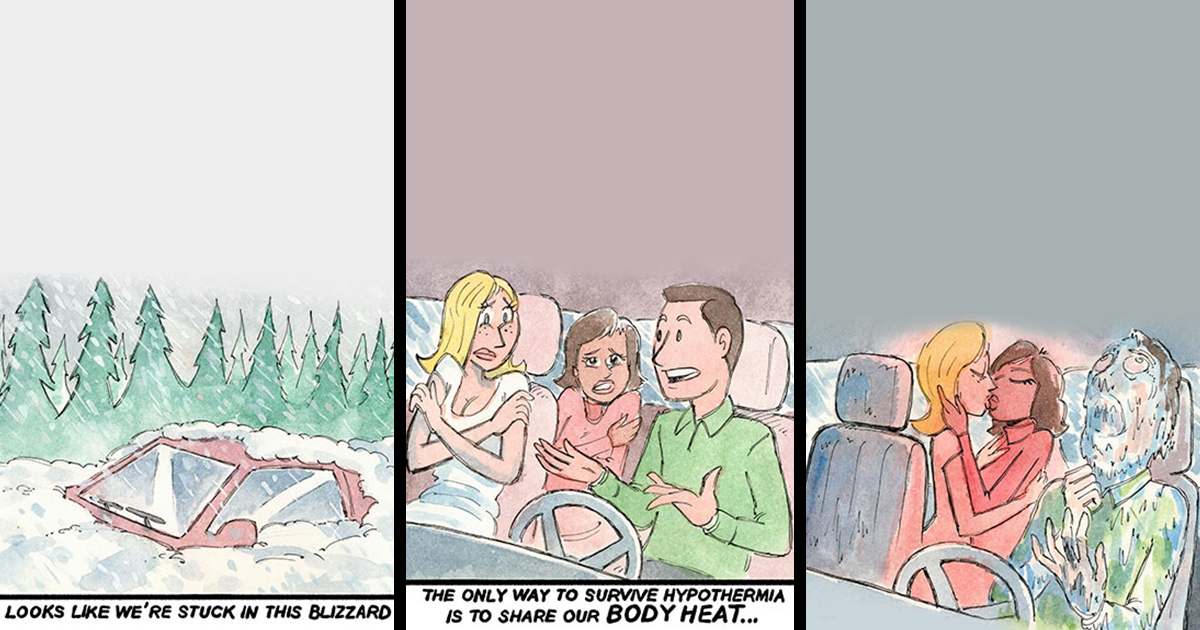
Some comics make you smile. Some comics make you laugh out loud. And then there are dark humor comicsthe tiny illustrated troublemakers that make you laugh, pause, look around to make sure nobody saw your reaction, and then laugh again. That is the strange charm behind “If You Are A Fan Of Dark Humor, You Might Like These 43 Comics,” a collection built for readers who enjoy sharp punchlines, uncomfortable twists, and jokes that arrive wearing a black trench coat and suspiciously cheerful shoes.
At the center of the conversation is Toonhole John, part of the Toonhole webcomic universe, known for funny comics with unexpected endings, clean visual setups, and punchlines that often take a left turn into the weird, morbid, absurd, or brutally honest. These are not gentle newspaper strips about a cat refusing lasagna on a Monday. These are compact comedy grenades. The panels look simple enough, but the final beat often flips the entire scene upside down.
Dark comedy comics work because they combine two things humans are not supposed to mix: discomfort and delight. They take ordinary situationsrelationships, work, family, technology, fairy tales, horror tropes, social awkwardnessand push them into strange territory. When done well, the result is not cruelty for cruelty’s sake. It is a quick, clever reminder that life is ridiculous, people are fragile, and sometimes the best response to chaos is a suspiciously loud laugh.
What Makes Dark Humor Comics So Addictive?
Dark humor, also called black comedy, usually plays with grim, taboo, or unsettling subjects and turns them into comedy through irony, surprise, exaggeration, or absurdity. The keyword here is “turns.” A dark joke is not funny simply because it mentions death, fear, disaster, or human stupidity. That would be like calling a burnt pizza “gourmet” because it technically involved an oven. The joke needs structure, timing, and a smart shift in perspective.
In webcomics, this structure is especially powerful because the reader controls the pace. You move from panel to panel, absorbing the setup, making assumptions, and thenbamthe final frame pulls the rug out from under your emotional furniture. A sweet scene may become sinister. A scary scene may become silly. A moral lesson may suddenly reveal itself as nonsense. The best dark humor comics do not just tell a joke; they trap your expectations in a tiny cartoon mousetrap.
The Power of the Unexpected Ending
One reason Toonhole-style comics land so well is the use of the unexpected ending. A comic may begin with a familiar setup: a doctor talking to a patient, a couple arguing, a monster lurking, a hero preparing to save the day, or a child asking an innocent question. Readers bring their own expectations to these scenes. We think we know the rules. Then the punchline breaks those rules with the confidence of a raccoon stealing a wedding cake.
This is where dark comedy shines. The twist is often not random; it is logical in a cursed little way. The final panel reveals that the character’s problem was worse than expected, that the “hero” misunderstood everything, or that the sweet moment had a terrifying subtext. That mixture of recognition and shock creates the laugh. Your brain says, “Oh no,” and your mouth says, “Ha!” Congratulations, you are now emotionally bilingual.
Why Fans of The Far Side, Calvin and Hobbes, and Looney Tunes May Enjoy These Comics
The appeal of these 43 comics sits in a tradition of smart, offbeat cartooning. Fans of The Far Side understand the joy of a single bizarre idea treated with total seriousness. Fans of Calvin and Hobbes know that imagination can turn ordinary life into an epic battlefield of philosophy, childhood rebellion, and cardboard-box technology. Fans of Looney Tunes recognize the rhythm of visual chaos, exaggerated consequences, and jokes that move faster than common sense can file a complaint.
Toonhole John’s dark comedy comics borrow from that broad tradition without feeling like copies. The style is modern, internet-native, and built for quick reading, but the craft is old-school: strong setup, readable expressions, clear staging, and a punchline that does not politely knock before entering. The humor is often bold, but the cartooning remains accessible. You do not need a graduate degree in existential dread to understand the joke, although it might help with the aftertaste.
The Role of Satire in Dark Humor Webcomics
Many dark humor webcomics are really miniature satire machines. They exaggerate human behavior until its flaws become impossible to ignore. A comic about dating may become a joke about vanity. A comic about technology may become a warning about dependency. A comic about parenting may reveal that adults are often just children with credit scores and back pain.
Satire works best when it exposes something true. That truth does not have to be noble. Sometimes the truth is that people are selfish. Sometimes it is that institutions are absurd. Sometimes it is that every “quick meeting” at work is a haunted house with fluorescent lighting. Dark comics use laughter to sneak these observations past our defenses. We laugh first, then realize the joke may have been pointing at us the whole time. Rude? Yes. Effective? Also yes.
Dark Does Not Mean Lazy
There is a big difference between dark humor and lazy shock humor. Lazy shock humor says something cruel and waits for applause. Good dark humor builds a clever angle around a difficult subject. It creates distance through absurdity, targets a recognizable human weakness, or flips power in a surprising way. The difference matters because audiences are sharper than ever. Readers can usually tell when a comic is being daring and when it is just kicking the nearest emotional trash can.
The strongest dark comedy comics know where the line isand they know that the line moves depending on context, audience, and target. A joke about universal anxiety may feel cathartic. A joke that punches down at vulnerable people may feel cheap. The best cartoonists do not avoid danger completely; they steer it like a shopping cart with one bad wheel and somehow still make it to the punchline.
Why We Laugh at Things We “Shouldn’t” Laugh At
Humor researchers often describe comedy as a collision between violation and safety. Something feels wrong, strange, or inappropriate, but it is presented in a way that feels harmless enough to laugh at. Dark humor lives exactly in that tension. It hands you a violation, then wraps it in distance, exaggeration, cartoon logic, or absurd timing so your brain can process it as play instead of threat.
This helps explain why comics are such a perfect format for dark jokes. Drawings automatically create a layer of distance. A cartoon skeleton, demon, villain, monster, or doomed office worker is not the same as a real person suffering in front of us. The art style makes the situation symbolic. We are not laughing at real tragedy; we are laughing at a compressed, exaggerated version of fear, stupidity, doom, or social weirdness. It is emotional pressure released through a tiny illustrated valve.
What These 43 Comics Offer Readers
A collection of 43 dark humor comics gives readers variety without demanding a huge time commitment. You can scroll through them during a coffee break, between meetings, or while pretending to understand a group chat that has clearly become too powerful. Each comic functions like a small standalone story. Some may be silly. Some may be grim. Some may make you laugh instantly. Others may take two seconds to detonate.
The best part is the range. Dark comedy can include horror parody, social satire, relationship jokes, workplace absurdity, fantasy twists, science-fiction weirdness, and everyday situations that become deeply unwell in the final panel. A strong collection does not repeat one gag formula 43 times. It moves around. It keeps the reader guessing. It lets one comic be ridiculous, another be bleak, and another be so oddly specific that you start wondering whether the artist has been reading your diary. If so, please change the lock.
Specific Examples of Comic Situations That Work
Consider a classic dark-comic setup: a character makes a wish, but the wish is granted too literally. That joke works because it combines fantasy with consequence. Or imagine a monster trying to scare a person, only to discover that modern life has already done a more efficient job. That joke works because it flips horror into social commentary. Another common setup features a cheerful character misunderstanding a horrifying situation, which creates comedy through emotional mismatch.
These examples show why dark humor comics are not just about bleak content. They are about contrast. Cheerful art with grim meaning. Ordinary dialogue with monstrous implications. Big emotions expressed through tiny faces. A good cartoonist understands that the funniest panel may be the quietest onethe deadpan stare after something deeply ridiculous has happened.
How Toonhole John’s Style Fits the Internet Era
Modern webcomics compete for attention in a crowded feed full of videos, memes, screenshots, arguments, ads, and someone’s suspiciously emotional review of an air fryer. To survive, a comic has to communicate fast. Toonhole John’s approach fits this environment because the jokes are visually direct and easy to follow. You do not need to read a long backstory. You enter the scene, understand the premise, and get hit with the twist.
That speed makes dark humor especially shareable. A dark comic can become a tiny social test: “Will my friend laugh at this, or will they quietly reconsider knowing me?” Sharing these comics often creates a community of people who enjoy the same offbeat sensibility. It is less about being gloomy and more about enjoying comedy that refuses to be wholesome on command.
Who Will Love These Dark Comedy Comics?
You will probably enjoy these 43 comics if you like punchlines that are clever, twisted, and slightly rude to your expectations. Fans of dark comedy, absurdist humor, twisted webcomics, funny cartoons with surprise endings, horror comedy, and satirical comics will feel right at home. Readers who love jokes about human nature, failure, mortality, and social nonsense may also find plenty to enjoy.
However, dark humor is not for everyone, and that is perfectly fine. Some people want comedy to feel warm, cozy, and safe, like a blanket that tells puns. Others want comedy to stare into the abyss, make finger guns, and ask whether the abyss validates parking. Neither preference is morally superior. Humor is personal. The important thing is knowing what kind of laugh you are looking for.
Why Dark Humor Can Feel Cathartic
Life is full of things people cannot control: illness, aging, awkward conversations, bad news, bureaucracy, heartbreak, technology updates that move every button for no reason, and the terrifying knowledge that printers can smell fear. Dark humor gives readers a way to look at uncomfortable realities without being swallowed by them.
That does not mean dark comics solve problems. They are not therapy, financial planning, or a substitute for calling your dentist. But they can offer a brief sense of control. When a comic turns fear into a joke, it shrinks the fear for a moment. It says, “Yes, this is awful, but it is also absurd.” That is a surprisingly useful sentence to keep in your mental toolbox.
The Art of Keeping Dark Humor Funny Instead of Mean
For writers, artists, and readers, the big question is not “Can this be joked about?” It is “What is the joke doing?” A smart dark comic usually has a target beyond pain itself. It may target hypocrisy, denial, arrogance, selfishness, corporate nonsense, fairy-tale logic, horror clichés, or the strange ways people pretend everything is fine while metaphorically standing in a burning room.
When dark humor has a point, it feels sharper and more memorable. When it has no point, it can feel like a prank with a drawing attached. The comics that last are usually the ones that combine darkness with intelligence, timing, and a strange little spark of humanity. Even when the punchline is bleak, the craft behind it can feel generous because it gives readers a way to laugh at the mess.
Experience: Reading 43 Dark Humor Comics in One Sitting
Reading a full collection of 43 dark humor comics is a very specific experience. At first, you think you are just going to enjoy a few quick jokes. The first comic gets a grin. The second gets a surprised laugh. By the fifth, you are leaning closer to the screen like a detective investigating a crime scene, except the crime is that someone made you laugh at a skeleton with excellent timing.
The rhythm becomes part of the fun. You start trying to predict the ending, which is always a mistake. Dark comics enjoy punishing confidence. You see a cute setup and think, “This one will be sweet.” No, it will not. You see a horror setup and think, “This one will be scary.” Also no. The monster may be emotionally needy. The victim may be worse. The hero may have misunderstood the entire mission. The joke may not go where you expect because expectation is exactly what the comic has invited over for dinner and then locked in the basement.
After a while, the collection becomes less about individual punchlines and more about a state of mind. You begin to appreciate the craftsmanship behind the chaos. The artist has only a few panels to establish a world, introduce characters, create tension, and then break the tension in a satisfying way. That is harder than it looks. Anyone can draw a shocking final image. Not everyone can make the shock feel earned.
There is also a strange comfort in realizing that other people find this type of humor funny. Dark humor fans are often accused of being gloomy, but the opposite can be true. Many are simply people who know that cheerful denial has limited battery life. They laugh because they notice the cracks. They laugh because pretending life is always tidy feels dishonest. They laugh because a well-timed joke can make the unbearable feel briefly bearable, or at least weird enough to discuss over snacks.
The best way to enjoy these comics is not to over-explain every joke. Let the punchline do its work. If one comic does not land, move on. Humor is a buffet, and nobody is legally required to love the emotional casserole. But when a dark comic does land, it creates a tiny electric moment: surprise, recognition, discomfort, release. That is the addictive loop. That is why readers keep scrolling through one more comic, then five more, then somehow all 43 while their coffee goes cold and their responsibilities gather in the corner like disappointed ghosts.
By the end, you may feel slightly corrupted, oddly refreshed, and more respectful of cartoonists who can turn bleak ideas into sharp little stories. That is the hidden pleasure of dark humor comics. They do not ask you to be cruel. They ask you to admit that the world is strange, people are ridiculous, and sometimes the punchline is waiting exactly where polite society told you not to look.
Conclusion
“If You Are A Fan Of Dark Humor, You Might Like These 43 Comics” is more than a catchy title. It is an invitation into a style of comedy that thrives on surprise, satire, and emotional whiplash. Toonhole John’s work fits perfectly into the world of dark humor comics because it understands that a great punchline does not need to be long; it needs to be sharp. Like the best twisted webcomics, these cartoons take familiar scenes and reveal the absurdity hiding underneath.
For readers who enjoy smart, strange, and slightly wicked comedy, this kind of collection is a treat. It offers quick laughs, memorable twists, and enough uncomfortable truth to keep the humor from feeling disposable. Dark comedy is not everyone’s cup of tea, but for the right audience, it is more like espresso served in a tiny haunted mug: bitter, energizing, and weirdly delightful.