In 1969, most students did not casually open a laptop, tap a tablet, or complain that the school Wi-Fi had the emotional stability of a wet paper bag. Computers were huge, expensive, mysterious machines usually parked in universities, corporations, government labs, or rooms with suspiciously serious air conditioning. Yet IBM was already exploring a question that still drives education technology today: what happens when a computer becomes part of the learning process?
IBM’s 1969 educational computing efforts belonged to a fascinating moment in history. The company had already transformed business computing with the System/360 family, experimented with computer-assisted instruction through the IBM 1500 Instructional System, and watched schools and universities become curious about terminals, time-sharing, programming, and automated lessons. This was not “edtech” in the modern app-store sense. There were no dancing mascots, gamified badges, or cheerful notifications saying, “Great job, you learned fractions!” Instead, there were mainframes, terminals, punched cards, light pens, audio systems, film projectors, and a bold belief that computers could help teachers personalize instruction.
That belief was ambitious, occasionally clunky, and surprisingly modern. IBM’s educational computing story from the late 1960s shows how early engineers, teachers, and researchers tried to solve problems we still recognize: limited teacher time, uneven student progress, expensive technology, and the eternal classroom mystery of why one student masters a concept instantly while another stares at it like it just insulted their lunch.
What “Educational Computing” Meant in 1969
Today, educational computing can mean online courses, coding boot camps, adaptive learning platforms, school management systems, artificial intelligence tutors, or a fifth grader building a volcano simulation in Scratch. In 1969, the phrase usually meant something much more physical and centralized. A school, university, or research center might use a central computer connected to terminals. Students interacted with lessons by typing responses, selecting answers, listening to audio, or using specialized devices such as light pens.
The big idea was computer-assisted instruction, often shortened to CAI. The computer did not replace the teacher. Instead, it presented lessons, asked questions, recorded answers, offered feedback, and sometimes adjusted the next step based on a student’s response. In the 1960s, that was revolutionary. A machine that could deliver individualized practice to multiple students at once sounded almost futuristic, especially when many classrooms still relied on chalkboards, worksheets, textbooks, and the heroic patience of teachers running on coffee and determination.
IBM entered this space from a position of strength. By the late 1960s, IBM was the dominant name in business and institutional computing. Its systems were used for payroll, science, engineering, airline reservations, banking, government work, and university research. Education looked like a natural next frontier. If computers could calculate payroll and guide corporate data processing, perhaps they could also help children practice arithmetic, learn reading skills, study language, or experience lessons that responded to their choices.
The IBM 1500 Instructional System: A Classroom from the Future
No discussion of IBM’s 1969 educational computing makes sense without the IBM 1500 Instructional System. Introduced in 1966, the IBM 1500 was designed specifically for computer-assisted instruction. It was not just a general-purpose computer awkwardly dragged into a classroom like a refrigerator at a poetry reading. It was built as an integrated educational system.
The IBM 1500 typically used an IBM 1130 or IBM 1800 computer as its base and supported multiple student stations. Depending on the configuration, students could interact through a keyboard, cathode-ray tube display, light pen, audio equipment, and even film projection. That combination was remarkable. It meant students were not merely typing commands into a terminal; they could see visual material, hear audio, select answers, and move through structured lessons. In other words, the IBM 1500 was trying to become multimedia education before “multimedia” became a word people used in software boxes at shopping malls.
Stanford University played a major role in early computer-assisted instruction research, especially through the work of Patrick Suppes and colleagues. Early experiments connected elementary students with computer-based lessons in arithmetic, reading, and logic. The goal was not just to show off hardware. Researchers wanted to understand whether computers could deliver practice, track performance, and support learning at scale.
Why the IBM 1500 Mattered
The IBM 1500 mattered because it treated education as a serious computing application. Many early computers were designed for business accounting, scientific calculation, or industrial control. The IBM 1500 asked a different question: can a machine support the act of teaching?
That question required design choices that were unusual for the time. A student station had to be approachable enough for children. The system had to manage many users. Lessons had to be written, stored, delivered, and evaluated. Teachers and researchers needed data about student progress. The machine had to combine hardware, software, and curriculum into one workable experience. That is exactly the same triangle modern edtech companies still wrestle with: device, platform, and content. The triangle has better graphics now, but it still has sharp corners.
The IBM 1500 also showed that educational computing needed more than technical brilliance. It needed funding, training, curriculum development, maintenance, and institutional patience. The system was powerful, but it was expensive and complex. Schools could not simply buy one, plug it into a wall, and announce, “Congratulations, we have personalized learning.” Like many early educational technologies, it proved both visionary and difficult to sustain.
IBM’s 1969 Schools Computer System Unit
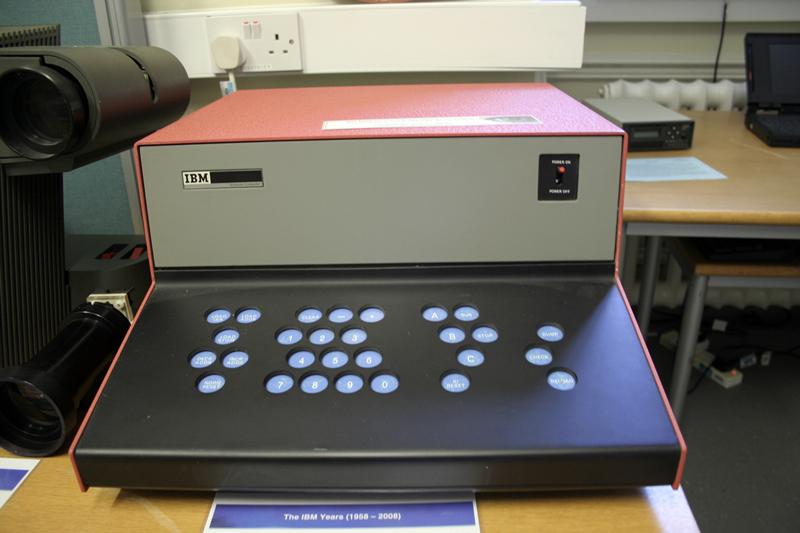
By 1969, IBM was still exploring how computers might enter schools more directly. One lesser-known project was the IBM Schools Computer System Unit, developed in 1969. It did not become a commercial product, but a small number of units were produced and used in pilot school settings. That makes it historically interesting: it shows IBM was not merely thinking about universities or research labs. The company was testing what computing might look like closer to everyday schooling.
This project existed during a time when computers were still rare in K-12 education. A school computer was not a standard classroom tool. It was an event. Students who encountered one were not just learning with technology; they were meeting the future early, probably while the future hummed loudly and required adult supervision.
The 1969 Schools Computer System Unit reflected a broader industry question: could computing be made practical for schools? The barriers were obvious. Computers were expensive. Teachers needed training. Curricula had to be rewritten. Maintenance was not trivial. Even the physical environment mattered. A school needed space, power, and support. In 1969, “the computer lab” was not a room full of slim monitors. It was closer to a controlled technical installation with educational ambitions.
The System/360 Effect on Education
IBM’s System/360, launched in 1964, shaped the environment in which educational computing grew. The System/360 family introduced a compatible architecture across a range of machines, allowing organizations to scale computing without rewriting everything from scratch. For universities and large institutions, that compatibility mattered. It made computing feel less like buying a one-off machine and more like joining a platform.
Educational computing benefited from this platform thinking. Universities needed machines that could serve many departments, not just one research group. A computer might support mathematics in the morning, business data in the afternoon, engineering work at night, and student programming whenever someone could get terminal time. The System/360 helped normalize computing as infrastructure, not just as a specialized scientific instrument.
Infrastructure is not a glamorous word, but it is the hidden hero of educational technology. A brilliant learning program is useless if nobody can access it. A terminal is exciting only if it connects reliably to something that works. By the late 1960s, IBM’s larger computing ecosystem helped institutions imagine computing as a shared resource. That idea opened the door for more educational experimentation.
Time-Sharing: The Secret Sauce of Student Access
One of the most important ideas of the 1960s was time-sharing. Instead of giving one user exclusive access to a computer, time-sharing allowed multiple users to interact with the same central system through terminals. The computer rapidly switched attention among users, creating the experience of simultaneous access.
This mattered enormously for education. Without time-sharing, students often had to submit punched cards and wait for results. That process taught patience, but mostly in the same way traffic jams teach meditation. Interactive computing changed the learning experience. Students could type, run a program, see results, correct errors, and try again. Feedback became faster. Mistakes became part of exploration rather than a delayed punishment delivered by a printer.
Dartmouth College’s time-sharing system and the BASIC programming language, developed in the 1960s, showed how powerful this model could be for students. BASIC was designed to be approachable, and Dartmouth’s system gave non-specialists a way to experience computing directly. IBM’s own time-sharing work and mainframe development fit into the same broader movement: computing was shifting from batch processing toward interactive use.
PLATO, Stanford, and the Competitive Educational Computing Landscape
IBM was not alone. The University of Illinois developed PLATO, one of the most influential computer-assisted instruction systems in history. PLATO began in the early 1960s and eventually became famous for interactive lessons, graphics, messaging, games, and online community features that seemed decades ahead of their time.
Stanford’s CAI research, Dartmouth’s time-sharing culture, and PLATO’s interactive learning environment all formed part of the same educational computing wave. The 1960s were full of experiments asking how computers could teach, tutor, simulate, calculate, communicate, and inspire. IBM’s efforts should be seen within that ecosystem. The company brought industrial scale, hardware expertise, and institutional credibility. Universities brought research questions, classroom access, and a willingness to experiment.
The result was not a single straight path to modern edtech. It was more like a laboratory full of brilliant prototypes, tangled cables, optimistic reports, and occasional budget headaches. Still, many ideas from that period survived: individualized pacing, immediate feedback, interactive exercises, student data tracking, programming literacy, and remote access to computing resources.
How Students Experienced IBM Educational Computing
For a student in the late 1960s, using an IBM educational system could feel radically different from traditional instruction. Instead of waiting for a teacher to grade a worksheet, a student might respond to a prompt and receive quick feedback. Instead of moving through the same page at the same pace as everyone else, the student might encounter a sequence shaped by previous answers. Instead of passively watching a film or listening to a lecture, the student interacted with a machine.
That interaction was not always smooth by today’s standards. The displays were primitive. Audio systems were mechanical. Commands could be unforgiving. Hardware failures were not exactly rare. Nobody was pinching to zoom. Still, the experience had an undeniable magic: the computer noticed what the student did. It responded. It remembered. For many learners, that was a first glimpse of a digital relationship between person and machine.
Teachers also gained something valuable: data. Computer-assisted instruction could record answers, timing, progress, and errors. That information gave researchers and educators a new way to study learning. Instead of relying only on final test scores, they could examine patterns across many interactions. This was an early ancestor of learning analytics, though nobody in 1969 was bragging about dashboards in a conference keynote while holding a branded water bottle.
Why IBM’s Vision Was Ahead of Its Time
IBM’s 1969 educational computing vision was ahead of its time because it anticipated several features of modern digital learning. First, it recognized that computers could support individualized instruction. A student who needed more practice could get it. A student who moved quickly could continue. The machine could help manage repetition without exhausting the teacher.
Second, IBM understood that learning could be interactive. Education was not limited to reading static text. A lesson could ask, respond, correct, and branch. Modern adaptive learning platforms still use this same basic logic, though with far more computing power and a friendlier interface.
Third, IBM saw that educational computing required a full system. Hardware alone was not enough. Software alone was not enough. Curriculum alone was not enough. The pieces had to work together. The IBM 1500’s integration of terminals, displays, audio, input devices, and lesson delivery looks like an early version of the platform approach that defines educational technology today.
Why It Did Not Take Over Every Classroom
If IBM’s educational computing ideas were so advanced, why did they not immediately transform American education? The answer is simple: reality arrived wearing work boots.
Cost was the biggest obstacle. Mainframe and minicomputer-based systems were expensive to buy, install, operate, and maintain. A school district needed more than enthusiasm; it needed serious funding. Hardware also required technical support. Teachers needed training. Lessons had to be created and updated. Educational leaders needed evidence that the investment worked better than less expensive alternatives.
Another challenge was scale. A system that worked in a research setting did not automatically work in every school. Pilot programs often benefit from expert support, motivated staff, and special funding. Everyday classrooms are messier. Schedules shift. Equipment breaks. Budgets shrink. Teachers already have enough to do without becoming part-time systems operators.
Finally, the market was not ready. The personal computer revolution had not yet arrived. Microcomputers in the late 1970s and 1980s would eventually make school computing more affordable and widespread. IBM itself later became a major presence in schools through PCs and related systems. But in 1969, educational computing was still a frontier: exciting, expensive, and not quite domesticated.
Lessons Modern EdTech Can Learn from IBM’s 1969 Experiment
1. Technology Must Serve a Clear Learning Goal
IBM’s educational systems were most meaningful when tied to specific instructional needs, such as arithmetic practice, reading support, language instruction, or logic lessons. The same is true today. Technology should not enter a classroom just because it glows. A tool needs a learning purpose, or it becomes a very expensive distraction with a login screen.
2. Teachers Are Still Central
Computer-assisted instruction did not eliminate the teacher. It changed what the teacher could observe and support. Modern educational platforms should remember this. The best systems amplify teacher judgment rather than pretending a machine can understand every human learning situation on its own.
3. Access Matters as Much as Innovation
In the 1960s, access was limited by hardware cost and institutional resources. Today, access can still be limited by internet quality, device availability, software pricing, language support, and accessibility design. The tools have changed; the equity challenge remains stubbornly familiar.
4. Data Is Useful Only When It Helps Humans
Early CAI systems collected student performance information because educators wanted to understand learning. Today’s platforms collect far more data, but more data is not automatically better. Useful educational data should help teachers guide students, not bury them under charts that look like a weather forecast for algebra anxiety.
The Legacy of IBM’s 1969 Educational Computing
IBM’s 1969 educational computing efforts did not put a computer on every desk. They did something quieter but important: they helped prove that computers could be part of learning. They showed that students could interact with digital lessons, that teachers could use computer-generated performance data, and that educational systems could combine hardware, software, media, and curriculum.
The legacy is visible in many places. Adaptive learning tools echo the branching logic of CAI. Learning management systems reflect the desire to organize instruction digitally. Coding education carries forward the 1960s belief that students should not merely use computers; they should understand them. Online learning continues the time-sharing dream of remote access to powerful computing resources.
In hindsight, IBM’s 1969 work looks both primitive and visionary. Primitive because the machines were large, expensive, and limited by modern standards. Visionary because the core questions were exactly right. How do we personalize learning? How do we give students faster feedback? How do we help teachers see progress? How do we make computing accessible to more people? Those questions still sit at the center of education technology, wearing newer clothes and occasionally asking for a software update.
Experience-Based Reflections on IBM’s 1969 Educational Computing
Looking back at IBM’s 1969 educational computing from a modern perspective feels a little like finding an old family photo and realizing your great-grandparent had surprisingly stylish shoes. The machines were enormous, the interfaces were limited, and the whole setup required planning that would make today’s plug-and-play culture sweat. Yet the educational instincts behind the work were impressively sharp.
One experience that stands out when studying early educational computing is the sense of intentional design. IBM and its research partners were not simply throwing computers into classrooms and hoping magic would leak out. They were trying to build structured learning environments. A student station was not just a terminal; it was a learning point. The keyboard, screen, light pen, audio, and lesson software each had a role. That reminds us that good educational technology starts with design discipline, not novelty.
Another lesson comes from the relationship between students and feedback. Anyone who has learned programming knows the strange emotional journey of typing something, running it, watching it fail, and then discovering that the problem was one tiny symbol hiding in plain sight like a villain in punctuation form. Early interactive computing gave students that loop: attempt, response, correction, retry. In education, that loop is powerful. Students do not just receive knowledge; they test ideas and adjust. IBM’s educational systems helped make that feedback loop part of the learning conversation.
The 1969 context also highlights how exciting shared access must have been. Today, we complain when a page takes three seconds to load. In the late 1960s, a student getting direct interaction with a computer was extraordinary. Time-sharing and terminal-based access made computing feel less like a distant institutional machine and more like something a learner could personally use. That shift matters. Education changes when students stop seeing technology as something locked behind expert doors and start seeing it as a tool they can command.
There is also a practical experience hidden in IBM’s story: innovation always meets maintenance. Early educational computing required money, technicians, lesson authors, teacher training, administrative support, and patience. Modern schools face the same pattern. A new platform may look beautiful in a demo, but real success depends on setup, support, privacy, accessibility, curriculum alignment, and whether teachers can actually use it during a Tuesday afternoon when three students forgot their passwords and one device has achieved spiritual separation from the network.
IBM’s 1969 educational computing also encourages humility. Not every bold project becomes a commercial success. Some experiments are valuable because they reveal what is possible, what is too expensive, what teachers need, and what learners respond to. The IBM Schools Computer System Unit did not become a mass-market classroom machine, but it belongs in the story because it represented exploration. It was a prototype of possibility.
For today’s educators, developers, and school leaders, the experience-based takeaway is simple: the best educational technology is not the flashiest. It is the technology that makes learning more responsive, more accessible, and more human. IBM’s early work reminds us that computers in education have always been about more than machines. They are about attention, feedback, curiosity, and the hope that a student sitting at a terminal might discover not only the right answer, but also a new way of thinking.
Conclusion
IBM’s 1969 educational computing efforts capture a remarkable turning point in the history of learning technology. At a time when computers were still rare, expensive, and intimidating, IBM and its research partners imagined them as tools for students and teachers. The IBM 1500 Instructional System, the Schools Computer System Unit, System/360 infrastructure, time-sharing concepts, and the broader CAI movement all helped shape the path toward modern digital education.
The technology itself has changed dramatically. A smartphone now has more approachable computing power than many institutions could imagine in 1969. But the educational dream remains familiar: give students better feedback, help teachers understand progress, personalize learning, and make knowledge more accessible. IBM’s early classroom computing experiments did not finish that journey. They helped start it.