Note: Body-only HTML, ready for web publishing and copying.
If you have ever looked at a game card and thought, “Easy. I can totally name three pizza toppings,” then immediately forgotten the existence of mushrooms, pepperoni, and basic human language, welcome to 5 Second Rule. This fast-paced party game sounds simple, but the second that timer starts twisting down, your brain suddenly turns into a browser with 47 tabs open and none of them loading.
The good news is that learning how to play 5 Second Rule is wonderfully easy. The better news is that you do not need to be a trivia genius to enjoy it. You just need a category, a timer, a few players, and the courage to blurt out whatever your panicking brain can find in five seconds. That is exactly why the game works so well for family night, parties, classroom icebreakers, road trips, and those gatherings where people say, “Let’s do something fun,” and then stare at each other for ten minutes.
In this guide, you will learn the basic 5 Second Rule game rules, how scoring works, how to settle questionable answers without starting a courtroom drama, and a big set of example questions you can use right away. There is also a bonus section at the end covering real-life play experiences, because the funniest part of this game is not the rules. It is watching confident people absolutely crumble over a card that says, “Name 3 ice cream flavors.”
What Is 5 Second Rule?
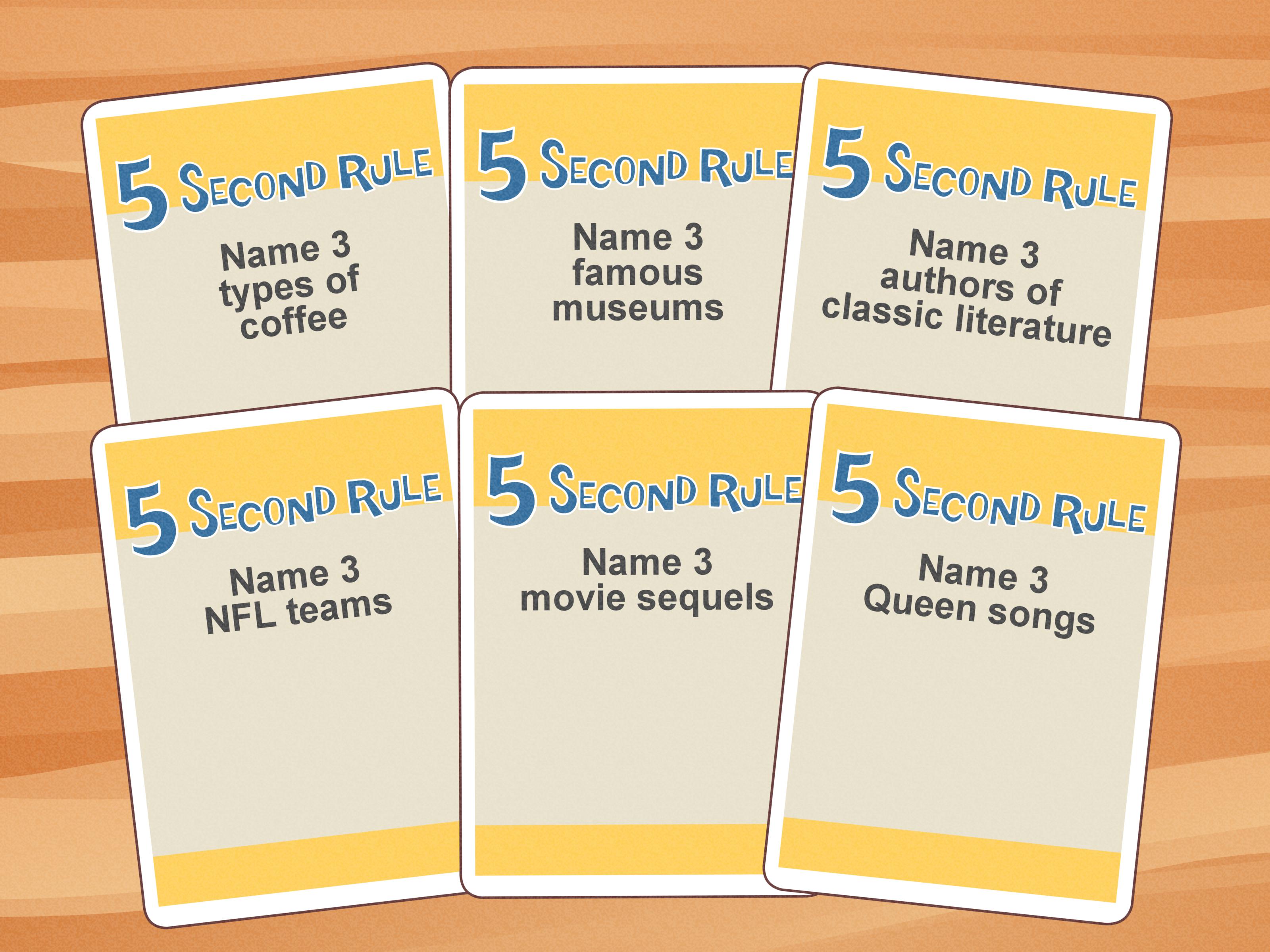
5 Second Rule is a quick-thinking party game built around a very simple challenge: a player hears a prompt that starts with “Name 3…” and has only five seconds to give three answers that fit. Sounds harmless. Sounds doable. Sounds like something you would dominate.
Then the timer flips.
That is the whole magic of the game. Under pressure, even easy categories feel weirdly difficult. You know three dog breeds. Of course you do. But in the heat of the moment, your mouth may produce something like, “Golden Retriever, poodle, and… cat?”
That mix of easy format, fast turns, and accidental nonsense is why the game stays popular. It is not about deep strategy. It is about speed, confidence, and laughing when somebody says “fork, spoon, and toaster” for a question about kitchen tools.
What You Need to Play
The classic version of the game is wonderfully straightforward. Depending on the edition you own, the box may include cards, a twisted five-second timer, and scoring pieces or a simple point system. Some editions are more compact, while 5 Second Rule Jr. uses a board and kid-friendly adjustments.
For a basic game night, you only need:
- A stack of “Name 3” question cards
- A five-second timer
- Three or more players
- A way to track points if your edition does not use a board
No official box? No problem. You can absolutely play a homemade version with a phone timer and your own prompts. The spirit of the game stays the same: hear a category, answer fast, and try not to say anything completely ridiculous. Or do. Sometimes that is the best part.
How to Play 5 Second Rule
1. Choose the first player
Pick one player to start in the hot seat. In many groups, people just go clockwise from there. The person to the left of the hot-seat player reads the card aloud.
2. Read a “Name 3” card
Each card gives a category prompt. For example:
- Name 3 things you take to the beach
- Name 3 breakfast foods
- Name 3 animals that live in water
As soon as the card is read, the timer starts. No stretching. No dramatic inhaling. No “Wait, wait, I know this one.” The clock is already judging you.
3. Answer before time runs out
The player in the hot seat must say three valid answers before the timer ends. If they do, they earn a point or advance, depending on the edition. If they only name one or two answers, or freeze like a statue with stage fright, they do not score on that attempt.
4. If needed, pass the same card to the next player
One of the most fun parts of the classic rules is that the same question can continue to the next player if the first person fails. The catch is that the next player cannot reuse answers that were already said. So if the prompt is “Name 3 famous singers” and someone already said “Taylor Swift” and “Beyoncé,” those are off the table for the next player.
This is where the game gets spicy. A category that seemed easy one second ago suddenly becomes a scavenger hunt through the leftovers in your brain.
5. Keep going until someone scores or the turn ends
In the classic style of play, the question keeps moving around until someone successfully gives three acceptable answers in time. Then that player scores, and a new hot-seat turn begins with a different card.
6. Decide questionable answers as a group
Not every answer is clear-cut. Does “ketchup” count as a vegetable? No. Nice try. Does “Batman” count as a superhero? Absolutely. In most versions of the game, the group decides whether an answer is acceptable. That means the real final boss of 5 Second Rule is often not the timer. It is your friends.
7. Win by scoring the most points
The classic game usually ends after a set number of rounds, and the player with the most points wins. If you are playing a junior or board-based edition, the goal may be to reach the finish first instead. Always check your specific edition, but the core gameplay stays nearly identical.
Quick Rules for 5 Second Rule Jr.
If you are playing with younger kids, the junior version makes things easier and more flexible. Some younger players may be allowed to give only two answers instead of three, and the game often uses a board with pawns. That makes it a great stepping stone for children who like quick games but are not ready for full-speed party-game chaos.
In other words, 5 Second Rule Jr. is like regular 5 Second Rule after it drank a juice box and promised to use indoor voices.
Best House Rules for Family Game Night
Official rules are a great starting point, but many groups make small changes to fit their crowd. These house rules usually work well:
- Team play: Pair younger kids with adults.
- Mercy rule: Let a player restart one round if the card was misread.
- Theme rounds: Use only food, school, sports, or movie prompts for a round.
- No arguing for more than 10 seconds: If the group cannot agree, skip it and keep the fun moving.
- Use a phone timer: Perfect for travel or homemade games.
The best version of the game is the one that keeps people laughing instead of debating whether “brunch” is technically a breakfast food. It is. Relax.
Tips to Win at 5 Second Rule
Yes, luck matters. Yes, panic is real. But there are a few ways to get better.
Think in categories, not details
If the card says “Name 3 fruits,” do not search for the world’s most impressive fruit knowledge. Go for easy wins: apple, banana, orange. This is not the Olympics of originality.
Say answers fast and clearly
Hesitation is the enemy. A simple answer spoken confidently beats a clever answer that arrives one second too late.
Learn common prompt patterns
Many cards use familiar categories like foods, animals, colors, jobs, places, and things you use every day. The more you play, the more your brain starts keeping emergency lists ready to go.
Do not overthink
The player who tries to be perfect often loses to the player who just blurts out three reasonable answers. The timer rewards speed, not elegance.
Common Mistakes New Players Make
- They pause too long before the first answer.
- They try to come up with “good” answers instead of fast answers.
- They repeat an answer someone already used on the same card.
- They argue about technicalities until the room feels like a city council meeting.
- They panic over easy prompts and forget every object they have ever seen.
The fix for all of these is simple: keep the pace brisk, keep the tone light, and remember that a funny wrong answer can be more entertaining than a perfect win.
Example 5 Second Rule Questions
Need practice prompts? Here are some clean, family-friendly 5 Second Rule example questions you can use for parties, classrooms, sleepovers, or homemade game night.
Easy Questions
- Name 3 pizza toppings.
- Name 3 things in a school backpack.
- Name 3 colors in a rainbow.
- Name 3 pets.
- Name 3 breakfast foods.
- Name 3 things you wear in winter.
- Name 3 sports.
- Name 3 vegetables.
- Name 3 things you find in a kitchen.
- Name 3 fruits you can peel.
- Name 3 places people go on vacation.
- Name 3 ice cream flavors.
Funny Party Questions
- Name 3 things you should not say in a job interview.
- Name 3 things that make awful birthday gifts.
- Name 3 excuses for being late.
- Name 3 things you should not put in your pocket.
- Name 3 things you would not want under your bed.
- Name 3 reasons a dog might judge you.
- Name 3 things that should never be sticky.
- Name 3 sounds that make people turn around.
- Name 3 things you should not text by accident.
- Name 3 things that are hard to explain to a grandparent.
- Name 3 bad times for a phone battery to die.
- Name 3 foods that are messy to eat in a car.
Kid-Friendly Questions
- Name 3 animals that live in the ocean.
- Name 3 cartoon characters.
- Name 3 things at a playground.
- Name 3 things that fly.
- Name 3 things you can draw.
- Name 3 things found in a library.
- Name 3 things that are cold.
- Name 3 things you can build with blocks.
- Name 3 jungle animals.
- Name 3 things you use in art class.
- Name 3 words that rhyme with “cat.”
- Name 3 things you can do at recess.
More Challenging Questions
- Name 3 countries in Europe.
- Name 3 instruments in an orchestra.
- Name 3 things people recycle.
- Name 3 jobs that wear uniforms.
- Name 3 things that can melt.
- Name 3 apps people use every day.
- Name 3 characters from fairy tales.
- Name 3 things that come in pairs.
- Name 3 things you might forget on a road trip.
- Name 3 things that are louder than they should be.
- Name 3 things people do before bed.
- Name 3 things that grow in a garden.
How to Make Your Own 5 Second Rule Questions
Making your own prompt cards is easy, and honestly, it can be even funnier than the boxed version because you can tailor the questions to your group.
A good prompt should be:
- Simple enough to understand instantly
- Broad enough to allow several possible answers
- Specific enough to create pressure
- Funny or relatable for your group
Avoid prompts that are too obscure or too academic unless your whole group is into that. “Name 3 18th-century political philosophers” is less party game and more ambush quiz.
Better homemade prompt ideas include categories about food, movies, travel, school, work, hobbies, holidays, and everyday life. The sweet spot is a question that looks easy and becomes hilariously difficult under pressure.
Why 5 Second Rule Works So Well
The brilliance of the game is that it combines low rules complexity with high social energy. People understand it almost instantly, which means you can start playing fast. At the same time, the pressure creates spontaneous comedy. Players do not need to be strategic, artistic, athletic, or especially competitive. They just need to respond.
That makes 5 Second Rule a rare crowd-pleaser. It works for mixed ages, mixed personalities, and mixed energy levels. The loud extrovert loves it because they can perform. The shy player often ends up loving it too because the game gives them a clear task and a quick spotlight rather than a long one.
Experiences With 5 Second Rule: What Actually Happens When You Play
One of the most relatable things about 5 Second Rule is that almost every group has the same emotional journey. At the start, everyone is wildly confident. People look at the box, hear the rules, and say something like, “Only five seconds? That is plenty of time.” This is adorable. It is also wrong.
The first few rounds usually create instant chaos. Somebody gets a very simple prompt like “Name 3 sandwich fillings,” and instead of giving easy answers such as turkey, ham, and cheese, they panic and say “bread… lettuce… plate?” That is when the room realizes this game is not testing knowledge. It is testing how well your brain functions while being stared at by people who want you to fail in a loving, supportive way.
In family settings, the game tends to become funnier with each round because players begin learning each other’s habits. One person always blurts out the first three things that come to mind, whether they fit perfectly or not. Another person freezes, then suddenly delivers three perfect answers in the final half-second like an action hero cutting the correct wire. Kids usually surprise adults by being faster than expected, especially on categories involving cartoons, animals, snacks, or school topics. Adults, meanwhile, often overthink and lose to a nine-year-old who simply says three correct answers without making it weird.
At parties, the best moments usually come from relatable prompts. Questions about bad excuses, awkward situations, travel mistakes, or messy foods tend to get the biggest laughs because everyone immediately understands the category. The pressure makes people say things they did not plan to say, and that is where the memorable moments come from. Not offensive moments. Just gloriously unfiltered ones. It is the kind of game where a player might mean to say “socks, shoes, and jacket” and somehow end up announcing “feet, coat, and sadness.”
Another common experience is discovering that the group itself becomes part of the game. The official prompt may come from a card, but the real entertainment comes from the reactions after the answer. People cheer, debate, laugh, challenge weird logic, and create running jokes that survive long after the game ends. One strange answer can become the quote of the night.
That is also why 5 Second Rule works well for classrooms, youth groups, team-building events, and holiday gatherings. It breaks the ice quickly without demanding deep personal sharing. Players do not need to reveal secrets or perform complicated tasks. They just need to think fast and speak up. In practice, that makes the game easy to teach, easy to replay, and surprisingly good at getting a room energized.
So if you are wondering whether 5 Second Rule is worth pulling out for your next gathering, the answer is yes. Not because every round goes smoothly, but because it absolutely does not. The game shines in those tiny five-second disasters where people know the answer, almost say the answer, and then accidentally invent a new category of nonsense. That is not a flaw. That is the whole charm.
Final Thoughts
If you want a game that is easy to learn, fast to set up, and consistently funny, 5 Second Rule is a strong pick. The rules are simple, the turns are short, and the laughs arrive almost immediately. Whether you are using the official boxed version or a homemade list of prompts, the core formula stays brilliant: hear a category, race the timer, and try not to let your brain leave the building.
And if all else fails, remember the unofficial golden rule of 5 Second Rule: confidence counts, but nonsense travels faster.