Finding your Rashi and Nakshatra can feel a little like opening an ancient cosmic instruction manualexcept the manual is written in Sanskrit, the stars are moving, and your grandmother may already know the answer before you do. In Vedic astrology, your Rashi and Nakshatra are two of the most important birth chart details. They are used for personality insights, naming traditions, compatibility checks, festival rituals, muhurta timing, and good old-fashioned “Why am I like this?” self-reflection.
The good news: you do not need to be a temple priest, Sanskrit scholar, or person who owns seven crystal malas to find them. You mainly need three details: your date of birth, exact time of birth, and place of birth. With those, a reliable Vedic astrology calculator can usually identify your Moon sign, also called Janma Rashi or Chandra Rashi, and your birth star, known as Janma Nakshatra.
This guide explains what Rashi and Nakshatra mean, why they matter, how to calculate them online or manually, what to do if you do not know your exact birth time, and how to avoid the most common mistakes. Consider this your friendly map through the zodiacless confusing than a tax form, more meaningful than a fortune cookie.
What Is Rashi?
In Vedic astrology, Rashi usually refers to the zodiac sign occupied by the Moon at the exact moment of your birth. This is why it is often called Moon sign, Janma Rashi, or Chandra Rashi. “Chandra” means Moon, and “Janma” means birth. So, Janma Rashi is your birth Moon sign.
There are 12 Rashis in Vedic astrology. Each one covers 30 degrees of the 360-degree zodiac. Together, they form the full circle used to map planetary positions in a birth chart.
The 12 Rashis in Vedic Astrology
- Mesha Aries
- Vrishabha Taurus
- Mithuna Gemini
- Karka Cancer
- Simha Leo
- Kanya Virgo
- Tula Libra
- Vrischika Scorpio
- Dhanu Sagittarius
- Makara Capricorn
- Kumbha Aquarius
- Meena Pisces
In Western astrology, people often focus on the Sun sign. In Vedic astrology, the Moon sign is especially important because the Moon is associated with the mind, emotions, instincts, memory, habits, and inner reactions. In plain English, your Rashi says a lot about how your emotional Wi-Fi is wired.
What Is Nakshatra?
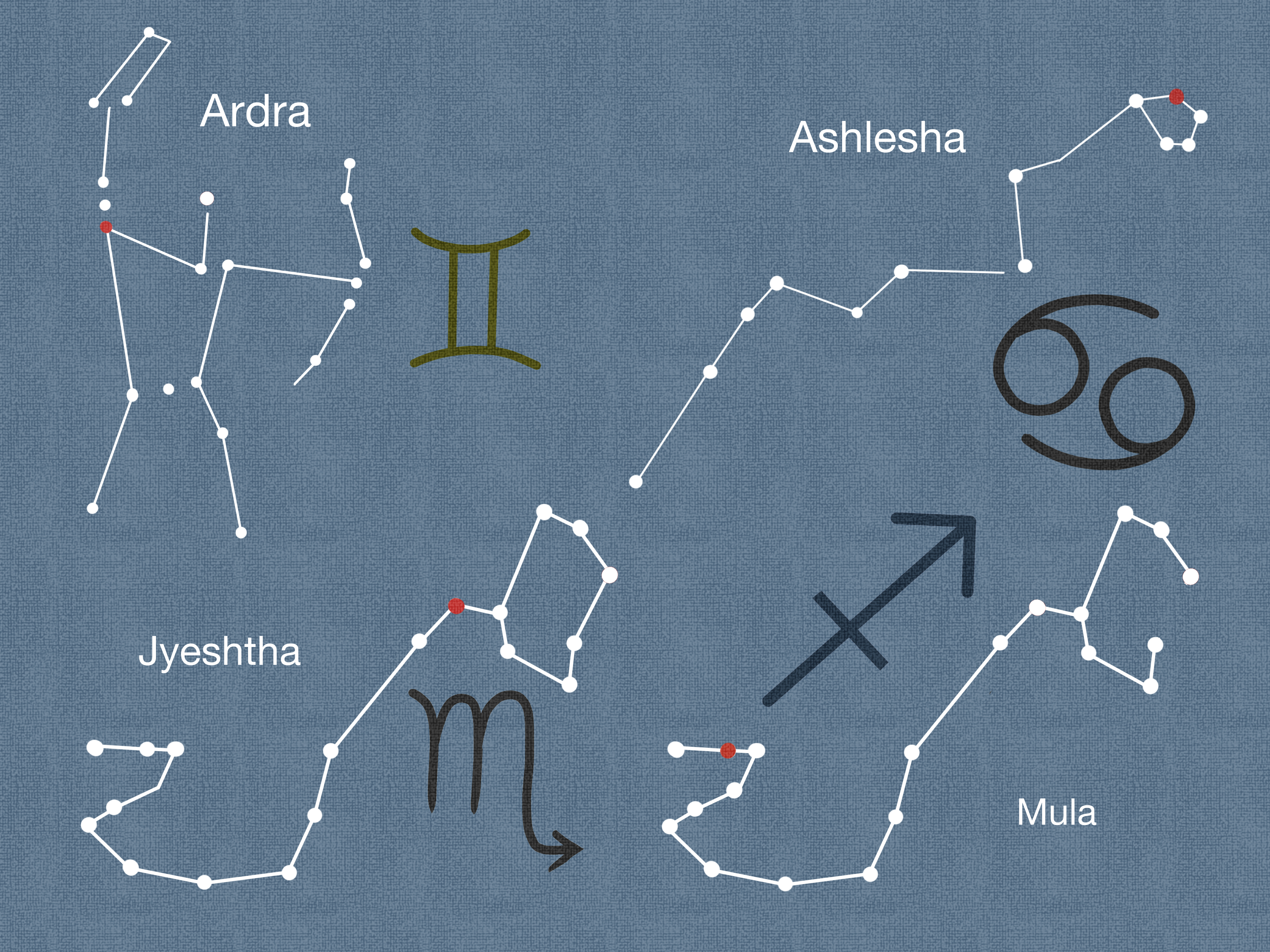
A Nakshatra is a lunar mansion, or a smaller section of the zodiac used in Vedic astrology. While the zodiac is divided into 12 Rashis, it is also divided into 27 Nakshatras. Each Nakshatra covers 13 degrees and 20 minutes of the zodiac.
Your Janma Nakshatra is the Nakshatra where the Moon was placed at the time of your birth. If Rashi is the neighborhood your Moon lives in, Nakshatra is the exact street address. It gives a more detailed layer of interpretation than the Moon sign alone.
The 27 Nakshatras
- Ashwini
- Bharani
- Krittika
- Rohini
- Mrigashira
- Ardra
- Punarvasu
- Pushya
- Ashlesha
- Magha
- Purva Phalguni
- Uttara Phalguni
- Hasta
- Chitra
- Swati
- Vishakha
- Anuradha
- Jyeshtha
- Mula
- Purva Ashadha
- Uttara Ashadha
- Shravana
- Dhanishta
- Shatabhisha
- Purva Bhadrapada
- Uttara Bhadrapada
- Revati
Each Nakshatra is further divided into four parts called Padas. Each Pada covers 3 degrees and 20 minutes. These Padas are used in deeper chart interpretation and are also connected with traditional baby name syllables. That is why, in many Hindu families, a child’s first name may be chosen based on the Nakshatra and Pada at birth. Yes, the stars may have had a say in why your cousin’s name starts with “Cha.”
Rashi vs. Nakshatra: What Is the Difference?
Rashi and Nakshatra are related, but they are not the same thing. Your Rashi is based on the Moon’s position in one of the 12 zodiac signs. Your Nakshatra is based on the Moon’s position in one of the 27 lunar mansions.
Simple Example
Suppose the Moon was in Taurus when you were born. Your Rashi would be Vrishabha Rashi. But Taurus contains parts of different Nakshatras, such as Krittika, Rohini, and Mrigashira. So your Nakshatra might be Rohini, depending on the exact degree of the Moon.
This is why two people can have the same Rashi but different Nakshatras. One Taurus Moon person may be Rohini, another may be Mrigashira. Same broad Moon sign, different lunar flavor. Think vanilla and French vanilla: both are related, but one is definitely trying to sound fancier.
What You Need to Find Your Rashi and Nakshatra
To find your Rashi and Nakshatra accurately, gather these birth details first:
- Date of birth: Day, month, and year.
- Exact time of birth: Ideally from a birth certificate, hospital record, or family record.
- Place of birth: City, state, and country.
- Time zone information: Most calculators handle this automatically, but it matters.
The Moon moves quickly compared with other planets. It travels through the zodiac in about 27.3 days and changes Nakshatra roughly every day. A difference of a few hours can sometimes change the Nakshatra or Pada. In some cases, it can even change the Rashi. This is why exact birth time is more than a tiny detailit is the password to the correct chart.
How to Find Your Rashi and Nakshatra Online
The easiest method is to use a reliable Rashi and Nakshatra calculator or Vedic birth chart calculator. These tools calculate the Moon’s position at your birth and identify your Janma Rashi and Janma Nakshatra.
Step 1: Choose a Vedic Astrology Calculator
Look for a calculator that clearly says it uses Vedic astrology, Hindu astrology, sidereal zodiac, or Lahiri ayanamsa. Many Western astrology calculators use the tropical zodiac, which may produce a different Moon sign. For Vedic results, you want a sidereal calculation.
Step 2: Enter Your Birth Details
Type in your date of birth, exact time of birth, and birthplace. Make sure the time is entered correctly as AM or PM. This sounds obvious, but many cosmic mysteries begin with someone accidentally entering 7:30 PM as 7:30 AM.
Step 3: Check the Moon Sign
After generating the chart, look for the Moon’s sign. This is your Rashi. It may appear as “Moon Sign,” “Chandra Rashi,” “Janma Rashi,” or simply “Rashi.”
Step 4: Check the Birth Star
Next, look for “Nakshatra,” “Birth Star,” “Janma Nakshatra,” or “Moon Nakshatra.” The result may also show the Pada. For example, you might see “Rohini Nakshatra, Pada 2.” That means the Moon was in Rohini and specifically in the second quarter of that Nakshatra.
Step 5: Save the Full Chart
Do not stop at just the Rashi and Nakshatra. Save or screenshot the full birth chart, including Moon degree, ascendant, planetary positions, and ayanamsa. If you later consult an astrologer, this information will help them verify the calculation.
How to Find Your Rashi Manually
Manual calculation is more technical, but understanding the logic helps you trust the result. To find your Rashi manually, you need the Moon’s exact sidereal longitude at birth.
The zodiac is 360 degrees. Each Rashi covers 30 degrees. The signs begin at 0 degrees Aries and continue in order. Here is the basic mapping:
- 0°–30°: Mesha
- 30°–60°: Vrishabha
- 60°–90°: Mithuna
- 90°–120°: Karka
- 120°–150°: Simha
- 150°–180°: Kanya
- 180°–210°: Tula
- 210°–240°: Vrischika
- 240°–270°: Dhanu
- 270°–300°: Makara
- 300°–330°: Kumbha
- 330°–360°: Meena
If the Moon’s sidereal longitude is 47 degrees, it falls between 30 and 60 degrees. That means the Rashi is Vrishabha, or Taurus. If the Moon is at 188 degrees, it falls in Tula, or Libra.
How to Find Your Nakshatra Manually
To calculate your Nakshatra manually, use the Moon’s sidereal longitude and divide it by 13 degrees and 20 minutes. In decimal form, each Nakshatra is about 13.333 degrees.
Manual Nakshatra Example
Let us say the Moon is at 47 degrees of the zodiac. Each Nakshatra covers 13°20′:
- Ashwini: 0°–13°20′
- Bharani: 13°20′–26°40′
- Krittika: 26°40′–40°
- Rohini: 40°–53°20′
Since 47 degrees falls between 40° and 53°20′, the Nakshatra is Rohini. Because Rohini falls within Taurus, the person’s Rashi would be Vrishabha and the Nakshatra would be Rohini.
Finding the Pada
Each Nakshatra has four Padas of 3°20′ each. Rohini begins at 40°. If the Moon is at 47°, it is 7° into Rohini. The first Pada covers 40°–43°20′, the second covers 43°20′–46°40′, and the third covers 46°40′–50°. Therefore, 47° falls in Rohini Pada 3.
This is the kind of calculation that makes people appreciate online calculators. Still, knowing the method helps you spot errors, especially when different websites show slightly different results.
Why Different Calculators May Give Different Results
Sometimes one calculator says you are Pushya Nakshatra while another says Ashlesha. Before you throw your laptop into the spiritual recycling bin, know that this can happen for several reasons.
1. Tropical vs. Sidereal Zodiac
Western astrology usually uses the tropical zodiac. Vedic astrology uses the sidereal zodiac. The two systems are not identical because of precession, the slow shift in Earth’s rotational orientation over time. If you want your Vedic Rashi and Nakshatra, choose a sidereal Vedic calculator.
2. Ayanamsa Differences
Ayanamsa is the adjustment used to convert tropical positions into sidereal positions. Lahiri ayanamsa is widely used in many Vedic astrology calculations, but other ayanamsas exist. A person born near the boundary of a sign or Nakshatra may get different results depending on the ayanamsa.
3. Incorrect Birth Time
An approximate birth time can cause problems. If you were born near the moment the Moon changed Nakshatra, even a small error may change the result. “Around sunrise” may be poetic, but calculators prefer numbers.
4. Daylight Saving Time and Time Zones
Birthplace matters because time zones and daylight saving rules affect the chart. A birth at 2:00 PM in New York is not the same as 2:00 PM in Mumbai. Good calculators adjust for this automatically, but only if you enter the correct city.
What If You Do Not Know Your Birth Time?
If you do not know your exact birth time, do not panic. You still have options, though the result may be less precise.
Use a Noon Chart
Some people enter 12:00 PM as a placeholder to estimate the Moon sign. This may work if the Moon stayed in the same Rashi and Nakshatra all day, but it is not guaranteed. Treat this as a rough estimate, not a final answer.
Check the Moon’s Movement That Day
You can use a Vedic ephemeris or calculator to check whether the Moon changed signs or Nakshatras on your birth date. If the Moon stayed in one Nakshatra for the entire day, your result is likely stable. If it changed, you need a more accurate birth time.
Use Name-Based Rashi Carefully
Some traditions use the first syllable of a person’s name to identify a likely Rashi or Nakshatra. This works best when the name was originally chosen according to Vedic naming customs. If your parents picked your name because it sounded nice, or because a movie star had it, the method may not be reliable.
Consider Birth Time Rectification
An experienced Vedic astrologer may use major life events to estimate your birth time, a process called birth time rectification. This is not instant magic, and it should be done carefully. But it can help when official records are missing.
Why Your Rashi and Nakshatra Matter
Rashi and Nakshatra are used in several traditional and personal contexts. Even if you see astrology as symbolic rather than predictive, these details can offer a structured way to think about temperament, emotional habits, timing, and family traditions.
Personality and Emotional Patterns
Your Moon sign represents emotional style. A Karka Moon may seek safety and connection, while a Dhanu Moon may crave freedom and meaning. The Nakshatra adds nuance. For example, two people with the same Moon sign may express it differently because their Nakshatras differ.
Kundali Matching
In many Hindu marriage traditions, Janma Rashi and Janma Nakshatra are used in compatibility systems such as Ashtakoota matching. These systems compare lunar positions to assess emotional harmony, temperament, and traditional compatibility factors.
Baby Naming
Many families choose baby names based on the Nakshatra Pada. Each Pada is associated with certain starting sounds. The idea is that the name resonates with the child’s birth star. Whether you take this literally or lovingly, it is a meaningful cultural tradition.
Muhurta and Ritual Timing
Nakshatras are also used for choosing auspicious times for ceremonies, travel, business openings, housewarming rituals, and other important events. The logic is that different Nakshatras carry different qualities, making some better suited for certain activities.
Common Mistakes to Avoid
Confusing Sun Sign With Moon Sign
Your Western Sun sign is not the same as your Vedic Rashi. You may be a Leo Sun in Western astrology but have a Capricorn Moon in Vedic astrology. This does not mean one is “wrong.” They are different systems measuring different things.
Ignoring the Birthplace
Never skip the birthplace. The exact location helps determine time zone and planetary positions. “Born somewhere near Chicago” is better than nothing, but the actual city is best.
Using Random Apps Without Checking Settings
Many astrology apps look beautiful but hide their calculation settings. For Vedic Rashi and Nakshatra, check that the app uses the sidereal zodiac and an appropriate ayanamsa.
Assuming Your Name Always Reveals Your Rashi
Name-based Rashi can be useful in traditional contexts, but it is not always accurate. Modern names are often chosen for style, family preference, trendiness, or because everyone agreed the baby “looked like an Aarav.” Birth data is more reliable.
Specific Example: Finding Rashi and Nakshatra
Imagine someone was born on May 10 at 6:30 AM in Los Angeles. To find their Rashi and Nakshatra, they would open a Vedic birth chart calculator, enter the date, time, and city, and generate the chart. The calculator would adjust for time zone and calculate the Moon’s sidereal position.
If the Moon appears in Kanya, their Rashi is Kanya Rashi, or Virgo Moon. If the Moon’s Nakshatra is Hasta, their Janma Nakshatra is Hasta. If the result says Hasta Pada 2, that gives an even more precise subdivision.
The practical takeaway is simple: the calculator does not need your favorite color, relationship status, or whether Mercury retrograde ruined your group chat. It needs accurate birth data.
Personal Experiences and Practical Reflections on Finding Your Rashi and Nakshatra
One of the most interesting things about finding your Rashi and Nakshatra is that it often becomes more than a quick online search. For many people, it turns into a small family investigation. Someone starts by asking, “What time was I born?” and suddenly three relatives are debating hospital memories like they are witnesses in a courtroom drama. One person remembers it was raining. Another remembers eating samosas. Nobody remembers the exact time. This is surprisingly common.
A useful experience is to begin with official records before family memory. Birth certificates, hospital documents, old baby books, and religious ceremony notes may contain the time. In some families, the original horoscope prepared after birth may still be tucked inside a folder, drawer, or steel cupboard that apparently contains every important paper since 1987. If you find it, compare it with a modern calculator. Many traditional charts already include Rashi, Nakshatra, and Pada.
Another common experience is discovering that your Vedic Moon sign differs from the zodiac sign you have always identified with. Someone who spent years saying, “I am such a Gemini” may discover their Janma Rashi is Vrischika, or Scorpio. This can feel confusing at first, but it becomes easier when you understand that Western Sun sign astrology and Vedic Moon-based astrology are using different reference points. You are not losing your old sign. You are adding another layer to the story.
People also notice that Nakshatra descriptions can feel more specific than Rashi descriptions. A Moon sign may describe broad emotional tendencies, while the Nakshatra may feel like a closer look at instincts, motivation, and inner temperament. For example, two people may both have Karka Rashi, but one may have Pushya Nakshatra and another may have Ashlesha Nakshatra. Their emotional worlds may share themes of sensitivity and protection, yet they may express those themes differently.
The process also teaches patience. If your birth time is uncertain, it is better to say, “My probable Nakshatra is…” rather than forcing a final answer. This is especially true if the Moon changed Nakshatra on your birth day. A careful approach is more valuable than a dramatic but inaccurate answer. Astrology, like cooking rice, benefits from timing.
Many people use the discovery as a conversation starter with parents or grandparents. Asking about your birth time may lead to stories about your birth, early childhood, naming ceremony, or family traditions. In that sense, finding your Rashi and Nakshatra is not only about astrology. It can also reconnect you with family memory, cultural practices, and personal identity.
Finally, the best experience comes when you treat Rashi and Nakshatra as tools for reflection rather than rigid labels. Your chart does not replace your choices, effort, education, relationships, or common sense. It can, however, give you language for patterns you already feel. Used wisely, it becomes a mirror, not a cage. And unlike your bathroom mirror, it will not judge your hair in the morning.
Conclusion
Finding your Rashi and Nakshatra is easier than it first appears. Your Rashi is your Vedic Moon sign, determined by the Moon’s position in one of the 12 zodiac signs at birth. Your Nakshatra is your birth star, determined by the Moon’s position in one of the 27 lunar mansions. To calculate both accurately, use your exact birth date, birth time, and birthplace in a reliable Vedic astrology calculator.
If your birth time is unknown, start with official records, family documents, and old horoscopes. If needed, use a noon chart only as an estimate or consult a knowledgeable astrologer for rectification. Most importantly, remember that Rashi and Nakshatra are not meant to trap you in a cosmic box. They are traditional tools for insight, timing, naming, and self-understanding.
Whether you are exploring Vedic astrology for spiritual reasons, cultural connection, marriage matching, baby naming, or simple curiosity, your Rashi and Nakshatra offer a fascinating starting point. The Moon has been inspiring humans for thousands of years. Now, with the right birth details, it can also help you answer one very personal question: “What was the sky saying when I arrived?”