You need to weigh an object, but there is not a scale anywhere in sight. Perhaps you are packing a parcel, measuring materials for a project, checking the weight of a small collectible, or trying to settle an argument about whether a suspiciously heavy paperweight is secretly made of depleted uranium.
Fortunately, a digital scale is only one way to measure weight. With a ruler, string, coins, water, a spring, or a few objects with known masses, you can make a surprisingly useful estimate. Some methods can produce measurements within a few grams, while others provide only a broad range. The best approach depends on the object’s size, shape, material, and the accuracy you actually need.
This guide explains how to find the weight of an object without a scale using practical household methods, straightforward physics, and examples you can reproduce without converting your kitchen into a government laboratory.
First, Understand the Difference Between Mass and Weight
In everyday American English, people use the words mass and weight almost interchangeably. Technically, however, they describe different quantities.
- Mass is the amount of matter in an object. It is commonly measured in grams or kilograms.
- Weight is the force that gravity exerts on that mass. In physics, it is measured in newtons.
The relationship is expressed as weight = mass × gravitational acceleration, or W = mg. Near Earth’s surface, gravitational acceleration is approximately 9.8 meters per second squared. A 1-kilogram object therefore has a gravitational weight of about 9.8 newtons. NIST notes that ordinary trade and household measurements commonly use “weight” when the quantity being determined is technically mass. NASA uses the same W = mg relationship when explaining gravitational force.
Because most readers are trying to find an answer in grams, ounces, or pounds, this article uses “weight” in the familiar household sense.
Choose the Right Method
| Method | Best For | Likely Accuracy |
|---|---|---|
| Homemade equal-arm balance | Small objects and craft materials | Good with reliable reference weights |
| Ruler-and-fulcrum lever | Objects that do not match your reference weights exactly | Good when distances are measured carefully |
| Density and volume calculation | Objects made from one known material | Moderate to good |
| Water displacement | Irregular, waterproof objects | Good for measuring volume |
| Calibrated spring or rubber band | Light objects and repeated comparisons | Moderate |
| Comparison with labeled products | Fast, rough estimates | Low to moderate |
Method 1: Build a Homemade Balance With Coins
A balance does not need a digital display. It only needs a beam, a pivot, and two places to hold objects. When both sides balance at equal distances from the pivot, their masses are approximately equal.
What You Need
- A straight ruler, wooden dowel, or sturdy clothes hanger
- String or thread
- Two identical paper cups, plastic containers, or small bags
- A pencil, marker, triangular block, or another narrow fulcrum
- U.S. coins or other objects with known masses
Useful U.S. Coin Weights
- Penny: approximately 2.500 grams
- Nickel: 5.000 grams
- Dime: 2.268 grams
- Quarter: 5.670 grams
These specifications come from the United States Mint. Coins make convenient reference masses because they are standardized, easy to count, and considerably less likely to spill than a cup of water balanced over your paperwork. Older, dirty, damaged, or heavily worn coins may differ slightly from their official specifications.
How to Make the Balance
- Attach one identical cup or container to each end of the ruler or hanger.
- Make sure both containers hang at equal distances from the center.
- Place the ruler on the fulcrum and adjust it until the empty balance rests level.
- Put the unknown object in one container.
- Add coins to the opposite container until the beam becomes level.
- Add the official masses of the coins.
The U.S. Mint publishes a classroom activity using cups, string, a hanger, and coins to demonstrate this exact comparison principle. Educational balance experiments use known masses on one side and an unknown mass on the other because the same gravitational field acts on both sides.
Example
Suppose a small metal part balances against eight nickels and one penny:
(8 × 5.000 g) + 2.500 g = 42.500 g
The estimated weight of the part is therefore 42.5 grams, or about 1.50 ounces.
How to Improve the Result
Use longer strings of equal length, keep the cups centered, and protect the balance from fans or open windows. Before adding the unknown object, confirm that the empty beam is level. A small piece of tape can be used as a counterweight if one cup is slightly heavier than the other.
For very light objects, the Exploratorium’s microbalance design shows how lightweight cards and a sensitive pivot can detect small differences in mass. The general lesson is simple: reduce friction, reduce the beam’s own weight, and keep the pivot narrow.
Method 2: Use a Ruler as a Lever
An equal-arm balance works beautifully when the unknown object can be matched by a convenient combination of reference weights. When the two sides refuse to balance exactly, use different distances from the fulcrum.
Torque is the turning effect produced by a force. For a simple horizontal lever, torque depends on the force and its perpendicular distance from the pivot. At equilibrium, clockwise and counterclockwise torques are equal.
The useful equation is:
unknown mass × unknown distance = reference mass × reference distance
Rearranged:
unknown mass = (reference mass × reference distance) ÷ unknown distance
Step-by-Step Instructions
- Balance the empty ruler on a pencil and mark the exact pivot point.
- Place or hang the unknown object on one side.
- Place a known reference mass on the other side.
- Move one object inward or outward until the ruler is level.
- Measure each object’s distance from the pivot.
- Use the lever equation to calculate the unknown mass.
Lever Example
A known 150-gram reference mass sits 12 centimeters from the pivot. The unknown object balances 9 centimeters from the pivot.
Unknown mass = (150 g × 12 cm) ÷ 9 cm
Unknown mass = 200 g
This method is especially useful when the unknown object is heavier than your available coins. Moving the heavier object closer to the pivot allows a lighter reference mass to balance it. Physics references note that a torque balance can be used to compare masses because gravitational acceleration appears on both sides of the equation and cancels.
Common Lever Mistakes
Measure from the pivot to the point where each load actually acts, not to the edge of the cup or the nearest convenient ruler mark. The ruler should also be balanced before the loads are added; otherwise, the ruler’s uneven mass becomes an uninvited participant in your calculation.
Method 3: Calculate Weight From Density and Volume
If you know what an object is made from, you may be able to calculate its mass from its volume and the material’s density.
The formula is:
mass = density × volume
Density describes how much mass is packed into a given volume. OpenStax and Purdue University express density as mass divided by volume, which can be rearranged to calculate mass when density and volume are known.
Measure the Volume of a Regularly Shaped Object
Use a ruler or measuring tape and apply the appropriate geometric formula:
- Rectangular object:
length × width × height - Cylinder:
π × radius2 × height - Sphere:
4/3 × π × radius3
When dimensions are measured in centimeters, the resulting volume is in cubic centimeters. One cubic centimeter is equal to one milliliter. USDA measurement tables confirm the equivalence of 1 milliliter and 1 cubic centimeter.
Density Calculation Example
Suppose a small object is known to be solid, nearly pure aluminum and has a measured volume of 18 cubic centimeters. NIST lists the density of aluminum at approximately 2.6989 grams per cubic centimeter.
Mass = 2.6989 g/cm³ × 18 cm³
Mass ≈ 48.6 g
The estimated weight is about 49 grams.
When the Density Method Fails
This method becomes unreliable when the object is hollow, porous, layered, filled with air, made from an unknown alloy, or constructed from several materials. A painted aluminum-looking object might contain steel, plastic, glue, screws, and the hopes and dreams of an overconfident manufacturer.
Material density also varies among alloys, wood species, plastics, and composite products. Use this method only when the object’s composition is reasonably certain.
Method 4: Measure an Irregular Object by Water Displacement
Rocks, bolts, figurines, and other irregular objects are difficult to measure with a ruler. Water displacement provides a practical way to find their volume.
What You Need
- A graduated measuring cup or cylinder
- Water
- A thin thread for lowering the object
- The density of the object’s material
Instructions
- Add water to the measuring container and record the initial volume.
- Submerge the object completely without splashing out water.
- Record the final volume.
- Subtract the initial reading from the final reading.
- Multiply the displaced volume by the material’s density.
For example, if the water rises from 120 milliliters to 138 milliliters, the object has displaced 18 milliliters. Its volume is therefore approximately 18 cubic centimeters. Chemistry laboratory instructions use this method because the volume of the displaced water equals the submerged volume of an irregular solid.
Do not use water displacement on electronics, untreated wood, paper, soluble materials, valuable antiques, or anything that might absorb water. Trapped air bubbles will also make the apparent volume too large.
Method 5: Use Water as a Reference Weight
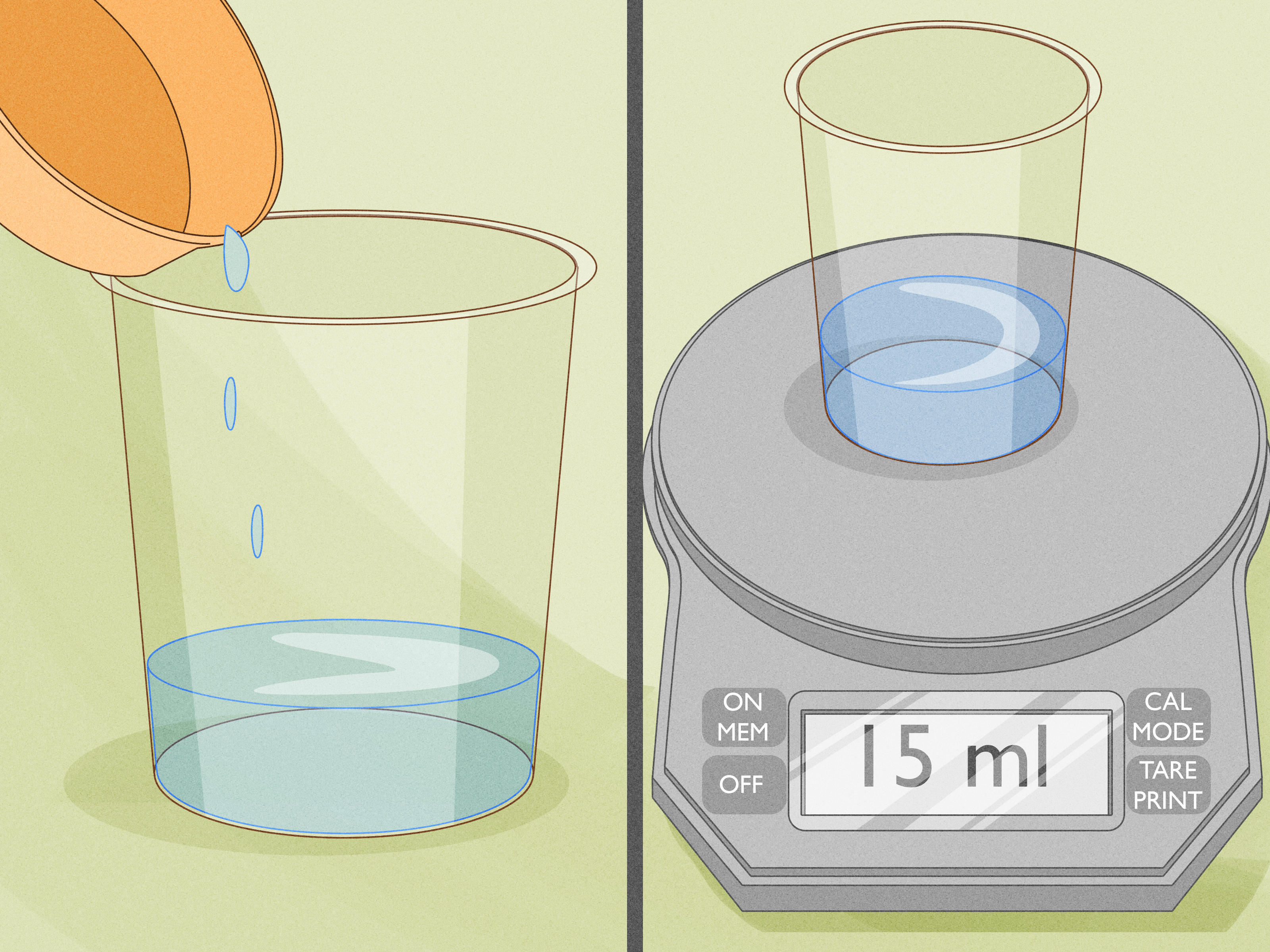
Water is useful not only for displacement but also as a convenient reference mass. Around ordinary room temperatures, its density is close to 1 gram per milliliter. The exact density changes slightly with temperature, but the difference is usually small enough for rough household measurements. USGS data places the density of water near 0.998 grams per cubic centimeter at approximately 70°F.
That means:
- 10 milliliters of water weighs approximately 10 grams.
- 30 milliliters weighs approximately 30 grams.
- 100 milliliters weighs approximately 100 grams.
- 240 milliliters weighs approximately 239 to 240 grams.
You can place measured water in one side of a homemade balance and the unknown object on the other. Add or remove water until the beam becomes level. Remember to use identical containers so their empty masses cancel.
For convenient kitchen measurements, FDA labeling guidance treats 1 teaspoon as 5 milliliters, 1 tablespoon as 15 milliliters, 1 fluid ounce as 30 milliliters, and 1 cup as 240 milliliters. Actual household spoons can vary, so marked measuring cups, syringes, or graduated containers are better.
Method 6: Calibrate a Spring or Rubber Band
A spring scale works because an applied load stretches a spring. Within its elastic range, the extension of a suitable spring is approximately proportional to the applied force. This relationship is known as Hooke’s law. OpenStax describes laboratory exercises in which known loads are used to determine a spring’s force constant.
How to Make a Simple Version
- Hang a spring vertically from a secure support.
- Mark its unloaded position beside a ruler.
- Hang a known mass and measure the extension.
- Repeat with several known masses to create calibration marks.
- Hang the unknown object and compare its extension with the calibration.
Example
Three nickels have a combined official mass of 15 grams. Suppose they stretch a spring by 6 millimeters. An unknown object stretches the same spring by 14 millimeters.
Unknown mass = 15 g × (14 mm ÷ 6 mm)
Unknown mass = 35 g
This calculation assumes the spring remains in its linear elastic range. Rubber bands are less predictable because their behavior changes with age, temperature, previous stretching, and the length of time the load hangs. Calibrate immediately before measuring the unknown object and do not overload the material.
Method 7: Compare the Object With Labeled Products
When you need only a rough estimate, compare the object with products whose net weights are printed on their packaging. Examples include unopened food packages, hardware, exercise weights, or sealed containers.
Hold the unknown object in one hand and the reference item in the other, then switch hands. Human judgment is not especially precise, but repeated comparisons can help you decide whether an object is closer to 4 ounces, 8 ounces, 1 pound, or 2 pounds.
For a better result, place the objects on opposite ends of a ruler-and-fulcrum lever. A labeled 16-ounce package provides a much more useful reference when the lever, rather than your biceps, decides which side is heavier. NIST gives the exact avoirdupois conversion of 1 ounce as 28.349523125 grams.
How Accurate Can These Methods Be?
A carefully built coin balance or ruler lever may estimate a small object’s mass within a few percent. Density calculations can also work well when the material is pure and the volume measurement is accurate. Spring and hand-comparison methods usually produce wider uncertainty.
Accuracy is affected by:
- Friction at the pivot
- Unequal containers or strings
- Incorrect coin or reference masses
- Poor ruler alignment
- Air bubbles during water displacement
- Uncertain material density
- Rounding and unit-conversion errors
- Stretching a spring beyond its elastic range
Repeat the measurement at least three times. If the answers are close, calculate their average. If they differ wildly, something is moving, rubbing, absorbing water, stretching unevenly, or plotting against you.
When Not to Rely on an Improvised Measurement
Homemade methods are useful for science projects, crafts, packing estimates, cooking experiments, and curiosity. They should not replace a certified scale when the measurement affects safety, health, money, or legal compliance.
Use an appropriate calibrated instrument for:
- Medication doses
- Commercial sales by weight
- Precious metals or gemstones
- Aircraft, vehicle, or structural load calculations
- Scientific work requiring traceable accuracy
- Shipping charges when a carrier enforces strict limits
NIST’s laboratory guidance emphasizes that accurate mass measurement depends on calibrated reference standards and controlled comparison procedures. A pencil-and-ruler balance is wonderfully clever, but it is not going to receive a calibration certificate and a respectful nod from a metrologist.
Practical Experiences and Lessons From Weighing Objects Without a Scale
The most common real-world experience with homemade weighing methods is that the first attempt rarely balances perfectly. Cups hang at slightly different heights, a ruler has more paint on one end, string knots slip, and coins roll into corners. These problems do not mean the basic method has failed. They mean the setup needs to be tested before the unknown object is introduced.
A useful habit is to begin with a known-versus-known trial. Place four nickels on each side of a homemade balance. Both sides should level out because each set has a nominal mass of 20 grams. If the beam tilts, adjust the cup positions, string lengths, or empty balance point. This small test catches errors that would otherwise be blamed on the mystery object.
Another practical lesson is that longer beams often provide clearer results. On a short ruler, adding one small coin may produce only a subtle movement. On a longer, lightweight beam, the same mass difference creates a more visible change in angle. However, a longer beam also flexes more easily, so there is a trade-off. A rigid wooden strip usually behaves better than thin cardboard, which tends to sag dramatically and behave as though it has been asked to work overtime.
Coins are convenient for objects weighing less than a few hundred grams, but counting dozens of them becomes tedious. Water makes a flexible alternative. A graduated container lets you add reference mass in small increments, and 1 milliliter of room-temperature water is close to 1 gram. The important practical detail is to use identical containers. Weighing an unknown object against 100 milliliters of water is not helpful if the water sits in a heavy glass jar while the object sits in a paper cup.
Water displacement produces another familiar surprise: tiny air bubbles matter. Rough stones, screws, and textured objects often trap bubbles when submerged. Those bubbles increase the measured displacement and make the calculated volume too large. Lowering the object slowly, tilting it, and gently tapping the container can release trapped air. Reading the water level at eye height also prevents parallax errors caused by looking down at the markings.
The density method is most satisfying when the object is genuinely made from one material. It is much less successful with household products. A “metal” flashlight might contain aluminum, steel, copper, plastic, batteries, empty space, and a heroic amount of adhesive. Calculating its mass using aluminum density would produce a number, but not necessarily a useful one. Experience teaches that density calculations belong to simple solids, not complicated assemblies.
Spring measurements require patience as well. A new spring may return to its starting length consistently, while a rubber band may continue stretching after the object is attached. Record the extension after the same waiting period for every load, such as five seconds. Calibrating with several known weights is better than relying on a single point because it reveals whether the extension remains proportional.
The lever method is often the best all-around solution. It can handle an object that is much heavier than the available reference mass, and it does not require the two loads to be equal. The biggest practical mistake is measuring from the end of the ruler rather than from the pivot. Marking the pivot clearly and measuring to the center of each hanging load prevents this error.
Finally, expectations matter. An improvised setup can tell you that an object weighs roughly 200 grams, not that it weighs exactly 201.347 grams. Reporting too many decimal places does not create accuracy; it merely gives uncertainty a fancy hat. Round the result to a level supported by the method, repeat the test, and describe it as an estimate.
Conclusion
The easiest way to find the weight of an object without a scale is usually to compare it with known masses on a homemade balance. U.S. coins, measured water, and labeled products make convenient references. A ruler lever extends the method to heavier objects, while density and water displacement can estimate the mass of solid objects with known compositions. A calibrated spring offers another useful option for light loads.
No single method works for every object. Choose the approach that matches the object’s material, size, and required accuracy. Test the setup with known weights, repeat the measurement, and resist the temptation to report laboratory-level precision from equipment assembled with a pencil, tape, and two yogurt cups.