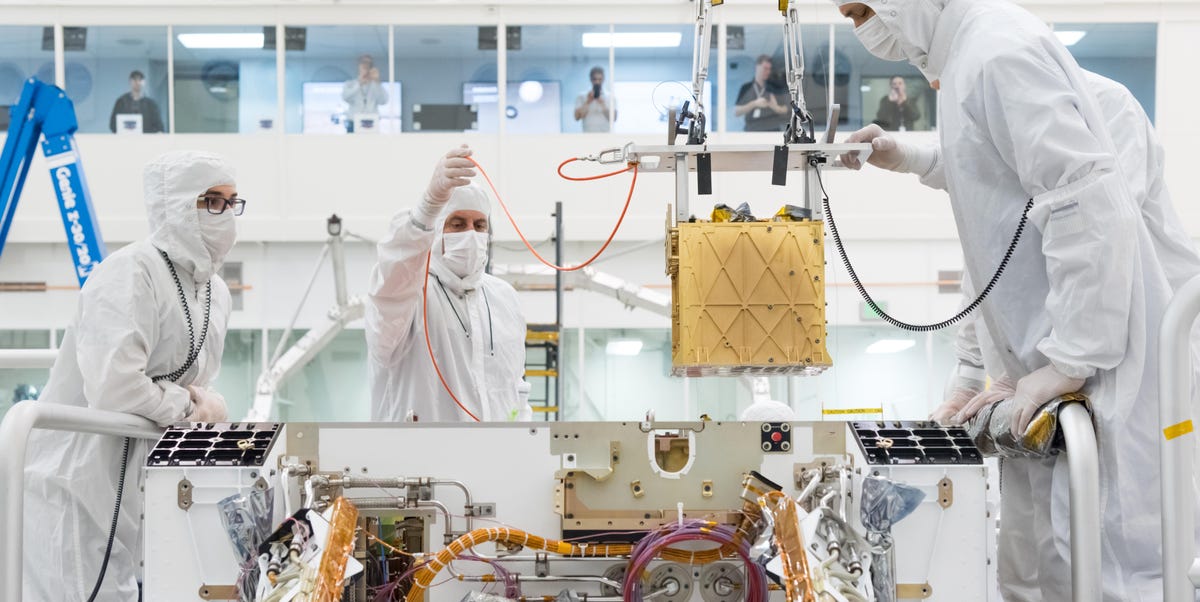
Mars has never been an easy neighbor. It is cold, dry, dusty, and about as welcoming as a hotel that forgot the roof, the oxygen, and most of the heat. Yet tucked inside NASA’s Perseverance rover was a small gold box with a very big personality: MOXIE, short for the Mars Oxygen In-Situ Resource Utilization Experiment. Its job sounded almost like science fiction written by a practical engineer: take the carbon dioxide-rich Martian atmosphere and turn part of it into oxygen.
That may not sound dramatic at first. After all, MOXIE did not fill a swimming pool with breathable air or turn Mars into a second Earth overnight. It produced oxygen in grams, not tons. But the achievement matters because it proved something enormous: future explorers may not have to bring every breath, every pound of oxidizer, and every emergency supply from Earth. They may be able to make some of what they need on Mars itself.
That single idea could change the future of Mars exploration. MOXIE did not terraform the Red Planet, but it opened the door to something more realistic and more useful: living off the land, one carefully engineered oxygen molecule at a time.
What Is NASA’s MOXIE?
MOXIE stands for Mars Oxygen In-Situ Resource Utilization Experiment. The phrase “in-situ resource utilization,” often shortened to ISRU, simply means using resources that already exist at the destination. On Mars, one of the most abundant resources is carbon dioxide. The Martian atmosphere is extremely thin compared with Earth’s, but it is made mostly of CO2, which gives engineers something to work with.
MOXIE traveled to Mars aboard NASA’s Perseverance rover, which landed in Jezero Crater in February 2021. Perseverance’s main mission involves exploring ancient rocks, searching for signs of past microbial life, and collecting samples for possible future return to Earth. But MOXIE had a different mission. It was there to answer a practical question: can a machine make usable oxygen on Mars?
The answer, after multiple successful runs, was yes. MOXIE extracted oxygen from the Martian atmosphere 16 times during its mission. NASA reported that it produced a total of 122 grams of oxygen, with its most efficient performance reaching about 12 grams per hour at 98% purity or better. That is not enough to support a city, a base, or even a very demanding houseplant, but it is more than enough to prove the technology works.
How MOXIE Made Oxygen on Mars
MOXIE worked by pulling in Martian air, filtering it, compressing it, and heating it to very high temperatures. Inside the instrument, a solid oxide electrolysis process split carbon dioxide molecules into oxygen and carbon monoxide. The oxygen was measured for purity, and the carbon monoxide byproduct was released back into the Martian atmosphere.
The process is not magic, although it certainly has magic-adjacent vibes. Carbon dioxide contains one carbon atom and two oxygen atoms. MOXIE’s job was to separate those atoms and collect oxygen in a useful form. To do that, it had to operate under harsh conditions, including Mars’ low pressure, temperature swings, dust, and limited power available from the rover.
That last detail is important. MOXIE was not designed to be a full-scale oxygen factory. It was a compact technology demonstration, roughly the size of a small appliance, riding inside a rover already packed with scientific instruments. Its success was less about volume and more about reliability. It showed that oxygen production could happen on Mars, not just in a clean laboratory on Earth where every cable behaves and nobody has to worry about a planet-wide dust storm.
Why Oxygen on Mars Matters So Much
When most people hear “oxygen on Mars,” they immediately think of breathing. That is fair. Breathing is famously popular among humans. Astronauts living on Mars would need oxygen for life support inside habitats, suits, rovers, and emergency systems. But the bigger oxygen demand may come from rockets.
Rocket fuel needs an oxidizer to burn. On Earth, rockets carry both fuel and oxidizer because there is not enough atmospheric oxygen at high altitude to support combustion. On Mars, any rocket launching from the surface would also need oxidizer. For a crewed Mars mission, oxygen for propulsion could outweigh oxygen for breathing by a huge margin.
This is where MOXIE becomes a game changer. If future missions can manufacture oxygen on Mars before astronauts arrive, they could reduce the amount of material launched from Earth. That matters because launching mass into space is expensive, difficult, and unforgiving. Every pound saved on Earth can reshape mission design, lower costs, and make return trips more realistic.
MOXIE and the Dream of a Mars Return Ticket
Getting to Mars is hard. Getting back may be even harder. A human mission cannot simply land on Mars, take selfies beside a dusty rock, and hope the return vehicle has enough “good vibes” to launch home. The ascent vehicle needs propellant, life support, power, navigation, and reliable systems that work after months or years on another planet.
MOXIE’s greatest contribution may be its role in making the return trip more practical. A scaled-up oxygen plant could be sent to Mars ahead of the crew. It could run for months, filling tanks with oxygen for a Mars ascent vehicle. By the time astronauts arrive, the return oxidizer would already be waiting. That changes the mission from “bring everything” to “bring the tools to make what matters most.”
This approach also gives mission planners more confidence. Instead of betting the lives of astronauts on untested resource production, NASA can build a step-by-step path: demonstrate small-scale oxygen production, scale up the system, test long-duration operations, store oxygen safely, and finally integrate the technology into crewed exploration plans.
Could MOXIE Help Humans Live on Mars?
MOXIE alone will not build a Mars colony. It will not inflate habitats, grow potatoes, fix broken valves, or convince dust to stop getting into everything. But it could become part of a larger survival system.
A future Mars base would likely need several resource technologies working together. Oxygen production could support breathing and rocket oxidizer. Water ice could be mined for drinking water, radiation shielding, agriculture, and hydrogen. Carbon dioxide from the atmosphere could be used in chemical processes, including fuel production. Solar panels or nuclear power systems could supply energy. Robots could prepare landing zones, bury cables, move supplies, and perform inspections before humans ever step out of a lander.
MOXIE fits into this bigger picture by proving that Mars is not just a place to visit. It is a place with usable materials. That shift is enormous. Exploration becomes more sustainable when astronauts can use local resources instead of depending entirely on cargo ships launched from Earth.
What MOXIE Does Not Mean
It is tempting to hear “oxygen on Mars” and imagine blue skies, green valleys, and people jogging without helmets. Sadly, Mars is not signing up for a makeover show anytime soon. MOXIE does not mean NASA is about to terraform Mars. It does not mean the planet will become breathable in the near future. It also does not mean humans can walk around outside without pressure suits.
Mars has a thin atmosphere, low temperatures, high radiation exposure, and no global magnetic field like Earth’s. Turning it into an Earth-like planet would require changes far beyond what MOXIE demonstrated. The more realistic near-term goal is not to change the whole planet, but to change how humans operate there.
In other words, MOXIE could help create small islands of habitability: bases, habitats, oxygen plants, fuel depots, and research stations. Mars itself may remain harsh, but human systems on Mars could become more independent, resilient, and capable.
Why MOXIE’s Success Was Bigger Than Its Size
MOXIE’s total oxygen output was modest, but technology demonstrations are not judged only by size. The first airplane flight did not cross an ocean. The first computer did not fit in a pocket. The first Mars oxygen generator did not need to fill a rocket tank. It needed to prove the principle under real Martian conditions.
That is exactly what it did. MOXIE operated during different times of day and under changing Martian environmental conditions. It proved that the system could start, heat up, produce oxygen, measure results, and shut down. Each run gave engineers data about performance, durability, thermal behavior, and future design requirements.
For future missions, that data is gold. Engineers can use it to design larger oxygen production systems with better efficiency, stronger components, improved dust handling, and longer operating lifetimes. MOXIE was not the factory. It was the proof that the factory is worth building.
How a Future Mars Oxygen Plant Might Work
A future MOXIE-inspired system would likely be much larger than the original experiment. Instead of producing oxygen in grams per hour, it would need to produce kilograms per hour or operate continuously for long periods. It would also need tanks, compressors, thermal controls, power systems, sensors, backup parts, and autonomous software.
One possible mission design would send an oxygen plant to Mars before the crew leaves Earth. After landing, the plant would begin processing atmospheric carbon dioxide and storing oxygen. Mission controllers would monitor production from Earth, but because communication delays can range from several minutes to more than 20 minutes one way, the system would need a high level of autonomy.
That means the oxygen plant must handle problems on its own: clogged filters, temperature changes, power fluctuations, leaks, pressure issues, and unexpected shutdowns. If a future crew’s ride home depends on oxygen made on Mars, “try turning it off and on again” will not be a comforting maintenance strategy.
The Bigger Impact: From Exploration to Infrastructure
MOXIE represents a shift from exploration as a series of heroic visits to exploration as infrastructure building. Early Mars missions will still be bold and risky, but the long-term goal is to create systems that make repeated missions easier. Oxygen production is one of those systems.
Think of it like the difference between camping and building a town. A camper carries supplies. A town develops water, power, roads, storage, repair shops, and communication networks. MOXIE points toward the town-building phase of Mars exploration. It suggests a future where robots prepare resources, astronauts use them, and each mission leaves behind useful infrastructure for the next one.
This could also reshape science. If astronauts can stay longer and travel farther, they can drill deeper, examine more landscapes, study ancient lakebeds, search lava tubes, and investigate whether Mars ever hosted life. More oxygen does not just mean more breathing. It can mean more mobility, more safety, and more time to do serious science.
Challenges Before MOXIE Can Change Mars Forever
MOXIE’s success was impressive, but scaling it up will not be simple. A full-scale oxygen plant would need reliable power. Solar energy is possible, but Mars dust can reduce sunlight, and dust storms can last for weeks. Nuclear power may offer steadier output, but it brings its own engineering, political, and logistical challenges.
Storage is another major issue. Oxygen for rockets may need to be stored as a cryogenic liquid, which requires extremely cold temperatures and careful insulation. Leaks, boil-off, pressure management, and long-duration tank reliability all become mission-critical concerns.
There is also the issue of maintenance. On Earth, industrial equipment has technicians, spare parts, forklifts, coffee breaks, and someone named Dave who knows which valve “always acts weird.” On Mars, maintenance must be planned with brutal precision. A future oxygen plant may need modular parts that robots can replace before humans arrive.
Finally, engineers must consider planetary protection and ethics. Human activity on Mars should avoid contaminating scientifically valuable environments, especially places that might preserve signs of ancient life. Using Martian resources is exciting, but it must be done carefully and responsibly.
Could MOXIE Technology Help Earth?
MOXIE was designed for Mars, not as a climate solution for Earth. Earth’s atmosphere is very different from Mars’, and removing carbon dioxide from Earth’s atmosphere at climate-relevant scales is a separate challenge. Still, MOXIE contributes to broader engineering knowledge about electrochemical systems, resource efficiency, autonomous operation, and high-temperature oxygen production.
Space technologies often create unexpected benefits. The direct purpose of MOXIE is Mars exploration, but the lessons learned from building compact, reliable, resource-processing machines may influence future systems in remote environments, extreme industries, and closed-loop life support. Even when a technology does not transfer directly, the engineering discipline behind it can inspire better tools elsewhere.
How MOXIE Could Change Mars Forever
MOXIE could change Mars forever not by changing the planet’s atmosphere, but by changing humanity’s relationship with the planet. Before MOXIE, oxygen production on Mars was a strong idea supported by laboratory testing. After MOXIE, it became a demonstrated capability on the Martian surface.
That difference matters. It transforms Mars from a destination that must be supplied entirely from Earth into a destination where some resources can be produced locally. It gives future mission planners a foundation for building oxygen plants, fuel systems, and more independent habitats. It also gives the public a simple, powerful story: we made oxygen on another planet.
For a species that has spent most of its history looking up at Mars as a red dot in the night sky, that is not a small achievement. It is a preview of a future where Mars missions become less like stunts and more like sustained exploration. MOXIE may be small, but its legacy could be enormous.
Experience Section: Imagining Life After MOXIE on Mars
Picture the first crew arriving at a Mars base that has been quietly preparing for them for months. Long before their spacecraft entered the Martian atmosphere, robotic systems landed near the site. Solar arrays unfolded. A compact nuclear unit hummed to life. Storage tanks chilled and waited. Most importantly, an oxygen plant descended from MOXIE’s family tree began pulling in thin Martian air and turning carbon dioxide into oxygen.
For the astronauts, that changes the emotional experience of landing. Mars is still dangerous, of course. The planet is not rolling out a welcome mat. But instead of arriving at a completely empty desert, the crew arrives at a place where machines have already done useful work. Oxygen tanks are partially filled. Life support reserves are stronger. The ascent vehicle has a better chance of being ready when needed. The base feels less like a campsite and more like the beginning of a foothold.
Imagine stepping into a habitat and seeing a display marked “local oxygen production.” That number would be more than a technical readout. It would be a psychological anchor. Every gram of oxygen made on Mars would represent less dependence on Earth and more confidence in the mission. Astronauts would still respect the danger, but they would also feel the difference between visiting a hostile world and learning how to work with it.
Daily routines would reflect that shift. Engineers might check oxygen production the way sailors once checked wind and water. Scientists planning field trips would factor in rover oxygen reserves. Mission controllers on Earth would study performance graphs, looking for signs of dust buildup, temperature stress, or declining efficiency. A good production day might feel strangely satisfying, like watching a garden growexcept the garden is a high-temperature electrochemical system on another planet, which is admittedly less charming but far more useful for rocket launches.
There would also be a cultural change. The first time humans drink water processed from Martian ice, breathe oxygen made from Martian air, or launch using propellant partly produced on Mars, exploration becomes personal in a new way. Mars stops being only a destination and becomes a partner in survival. Not a friendly partner, exactly. More like a grumpy coworker who provides essential materials if you bring the right equipment and follow the procedure precisely.
For people watching from Earth, MOXIE’s legacy could make Mars feel closer. The idea that humans can make oxygen on another world is easy to understand and hard to forget. It gives future missions a practical storyline: we are not just planting flags; we are learning how to stay, work, return, and go back again. That is how permanent change beginsnot with one giant leap, but with one machine proving that the next giant leap can bring its own air supply.
Conclusion
NASA’s MOXIE experiment may be remembered as one of the most important small machines ever sent to Mars. It did not make enough oxygen to support a crew, and it certainly did not make Mars breathable. What it did was more subtle and more powerful: it proved that oxygen can be produced from the Martian atmosphere using equipment on the surface.
That success could influence how future astronauts breathe, travel, launch, and live on Mars. A larger version of MOXIE could help produce rocket oxidizer, support habitats, reduce launch mass from Earth, and make human missions safer and more sustainable. Mars will remain harsh, dusty, and deeply inconvenient. But thanks to MOXIE, it may no longer be a place where every useful molecule must be imported from home.
Note: This article is based on publicly available NASA, JPL, MIT, and peer-reviewed scientific information about MOXIE, rewritten in original language for web publication.