Note: This article is written for web publication and is based on publicly available information from Heliogen, U.S. energy agencies, industry reporting, public company filings, and concentrated solar thermal research sources. External source links are intentionally omitted as requested.
Introduction: Turning Sunlight Into Industrial Muscle
Solar energy usually brings rooftop panels to mind: tidy black rectangles quietly turning sunlight into electricity while birds judge the installation from a nearby gutter. Heliogen, however, takes a more dramatic route. Instead of simply converting sunlight into electricity with photovoltaic panels, Heliogen uses mirrors, artificial intelligence, computer vision, and thermal energy storage to concentrate sunlight into extremely high-temperature heat. Think of it as teaching a field of mirrors to behave like a disciplined orchestra, with the sun as conductor and industrial heat as the final symphony.
The core idea behind Heliogen is simple but powerful: many industries do not just need electricity; they need heat. Cement, steel, mining, petrochemicals, food processing, hydrogen production, and data center power systems all rely on large amounts of energy. Traditionally, much of that heat has come from fossil fuels such as coal, natural gas, or petroleum-based fuels. Heliogen’s technology aims to replace part of that fossil-fuel heat with concentrated solar thermal energy.
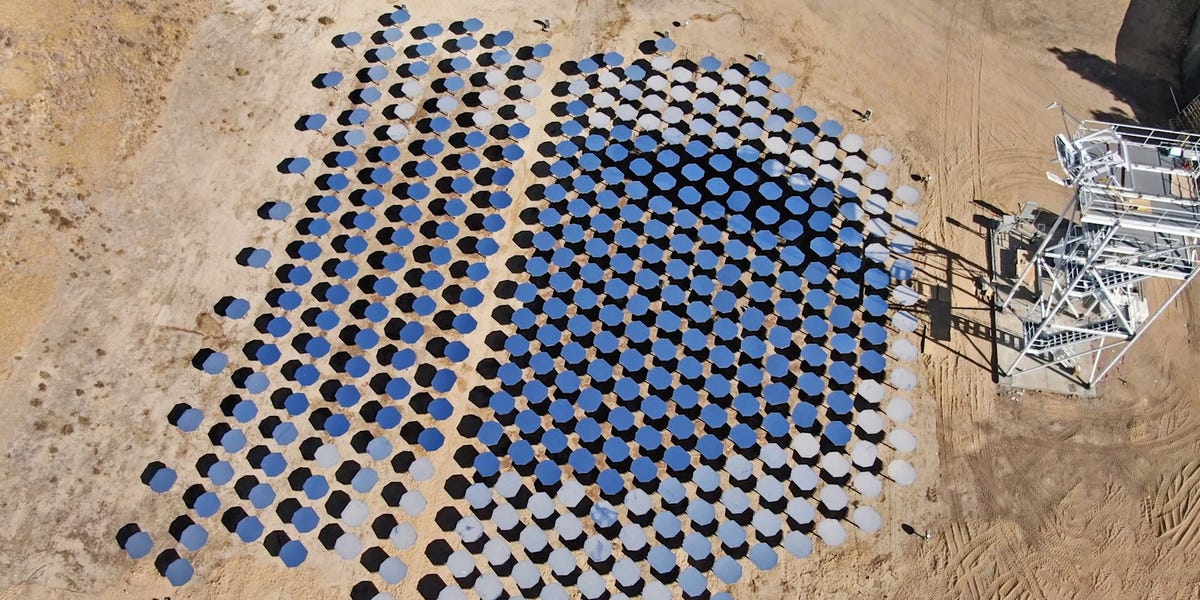
In practical terms, Heliogen builds systems that use computer-guided mirrors, called heliostats, to reflect sunlight onto a receiver at the top of a tower. That receiver absorbs the concentrated sunlight and turns it into high-temperature thermal energy. The heat can be used directly, stored for later, converted into steam, used to generate electricity, or integrated with hydrogen production systems. The result is not just “solar power” in the familiar sense, but solar heat on demand.
What Is Heliogen?
Heliogen is a renewable energy technology company originally based in Pasadena, California. It became widely known after announcing that its concentrated solar thermal system had achieved temperatures above 1,000 degrees Celsius, a level hot enough for many heavy industrial processes. The company was founded by entrepreneur Bill Gross, known for Idealab, and attracted attention because of its ambition to decarbonize industrial heat, one of the toughest corners of the climate challenge.
Unlike standard solar panels, Heliogen’s system is not designed only to generate electricity during daylight hours. Its larger mission is to provide low-carbon heat, steam, power, and potentially green hydrogen for customers that need energy around the clock. In 2025, Heliogen was acquired by Zeo Energy, bringing its long-duration thermal storage and concentrated solar expertise into a broader clean energy platform focused on residential, commercial, industrial, and utility-scale markets.
That business context matters because the technology sits at the intersection of two urgent energy problems. First, industry needs cleaner heat. Second, grids and large energy users need reliable clean power that can last beyond the sunny hours of the day. Heliogen’s answer is to collect sunlight as heat and store that heat in materials that can release energy later. In other words, it tries to bottle sunshine without needing an actual bottle, which is probably for the best.
How Heliogen Works: The Big Picture
At a high level, Heliogen’s system works in four main steps. First, a field of mirrors tracks the sun and reflects sunlight toward a central target. Second, artificial intelligence and computer vision help aim those mirrors with high precision. Third, a receiver absorbs the concentrated sunlight and converts it into high-temperature heat. Fourth, that heat is either used immediately or stored for dispatch when customers need it.
This process is known as concentrated solar thermal technology, or concentrating solar power when the heat is ultimately used to produce electricity. Heliogen often emphasizes the thermal side because many industrial customers need heat more than electrons. A cement plant, for example, does not simply want power for office lights and conveyor belts. It needs intense heat for chemical transformation. That is where Heliogen’s approach becomes especially interesting.
Step 1: Heliostats Capture and Redirect Sunlight
The first major component is the heliostat field. A heliostat is a mirror system that moves throughout the day to follow the sun and reflect light toward a fixed point. In Heliogen’s case, that point is typically a receiver on a tower. One heliostat is useful; thousands of them working together can produce serious thermal energy.
Traditional heliostat fields can be expensive and complex. Heliogen’s approach focuses on smaller, modular, computer-controlled mirrors that can be installed, calibrated, cleaned, and maintained more efficiently. The mirrors must be accurate because even a tiny misalignment can scatter valuable sunlight away from the receiver. Multiply that small error across an entire field, and suddenly your solar orchestra sounds like everyone is playing a different song.
Heliogen’s heliostats are designed to reduce optical error and simplify installation. The company has also explored automation and robotics for field deployment and maintenance. That matters because heliostats are a major cost driver in concentrated solar thermal projects. If the mirrors can become cheaper, easier to install, and more accurate, the entire system becomes more competitive.
Step 2: AI and Computer Vision Keep the Mirrors on Target
The signature feature of Heliogen’s technology is its use of artificial intelligence and computer vision. Instead of treating the mirror field as a static mechanical system, Heliogen uses software to continuously observe and adjust the heliostats. Cameras and algorithms detect where reflected light is landing, compare that position with the desired target, and correct the mirror angles.
This is important because the sun moves constantly, weather conditions shift, mirrors can drift slightly, and field conditions are never perfect. Human operators cannot manually babysit thousands of mirrors all day. Heliogen’s software acts like a tireless coach, telling each mirror, “A little left, a little higher, no, not there, perfect.”
By improving alignment, computer vision helps concentrate more sunlight onto the receiver. Better concentration means higher temperatures, greater efficiency, and more useful heat. Heliogen’s high-temperature breakthrough was tied directly to this precision-control strategy. The company’s software makes it possible to push concentrated solar heat into temperature ranges that are more relevant for industrial processes.
Step 3: The Receiver Converts Light Into Heat
Once sunlight is focused onto the receiver, the energy becomes heat. The receiver is the business end of the system: it absorbs concentrated solar radiation and transfers that energy into a working medium. Depending on the design, that medium might be water and steam, molten salt, solid particles, or another heat-transfer material.
Heliogen has worked with several receiver concepts. A direct steam generating receiver heats pressurized water in tubes to create steam. This steam can go directly to an industrial process, charge a storage system, or drive a turbine. A molten salt receiver heats liquid salt that can be stored in insulated tanks and later used to produce steam and electricity. A particle receiver heats solid materials such as ceramic particles, which can reach higher temperatures and store heat in insulated silos.
The particle receiver is especially important for next-generation concentrated solar systems. Solid particles can absorb high heat, tolerate elevated temperatures, and move through a system in a controlled flow. In Heliogen’s work on advanced projects such as Capella, particle technology was central to pushing concentrated solar toward higher-temperature, dispatchable applications.
Step 4: Thermal Energy Storage Makes Solar Dispatchable
One of the biggest challenges with renewable energy is timing. The sun is generous, but it is not available for night shifts. Photovoltaic solar panels generate electricity when sunlight is available, and batteries can store some of that power. Heliogen’s strategy is different: store heat instead of electricity.
Thermal energy storage can use materials such as steam accumulators, molten salt, ceramic particles, or other solid media. These materials absorb heat during sunny hours and release it later. That stored heat can then produce steam, support industrial processes, or generate electricity after sunset or during cloudy periods.
This is why Heliogen’s system is often discussed in connection with long-duration energy storage. Batteries are excellent for many uses, especially short-duration grid balancing, but industrial facilities often need many hours of steady energy. Thermal storage can be a practical tool when the final demand is heat or when stored heat can be converted into electricity through a power block.
What Can Heliogen’s Heat Be Used For?
Heliogen’s technology is not a one-trick solar pony. Its concentrated thermal energy can support several applications, depending on the temperature, system design, and customer need.
Industrial Process Heat
Industrial heat is one of the most important applications. Cement, steel, chemicals, mining, and refining require high temperatures. Many of these sectors are difficult to electrify directly because their processes were built around combustion. Heliogen’s technology aims to replace some combustion-based heat with solar thermal heat.
In cement production, for example, heat is used to process raw materials and drive chemical reactions. Solar thermal systems could help reduce fuel-related emissions, although they do not automatically eliminate all cement emissions because some carbon dioxide comes from the chemistry of limestone itself. That distinction is important. Heliogen can attack the heat problem, but full decarbonization of cement may also require carbon capture, alternative materials, and process innovation.
Steam for Industrial Facilities
Many factories do not need exotic temperatures; they need reliable steam. Steam is used in food processing, paper manufacturing, chemical production, enhanced oil recovery, district heating, and many other applications. Heliogen’s direct steam generation approach can deliver solar-produced steam to customers, reducing natural gas use when conditions are favorable.
Steam may sound old-fashioned, but it remains one of industry’s favorite workhorses. It moves heat efficiently, can be controlled precisely, and already fits into many plant designs. By producing steam from sunlight, Heliogen can potentially lower emissions without requiring every customer to rebuild an entire facility from scratch.
Electricity Generation
Heliogen’s stored heat can also be converted into electricity. In a typical thermal power setup, heat creates steam or drives another working fluid, which spins a turbine connected to a generator. This is the same basic concept used in coal, gas, nuclear, and traditional concentrated solar power plants. The difference is the heat source.
Heliogen has also highlighted advanced power blocks such as supercritical carbon dioxide cycles. Supercritical CO2 power systems can be compact and efficient, especially at higher temperatures. If commercialized successfully, they could help concentrated solar thermal plants generate electricity with a smaller footprint and potentially lower water use than conventional steam cycles.
Green Hydrogen
Another possible application is green hydrogen. Hydrogen can be produced by splitting water, usually through electrolysis. Solid oxide electrolyzers can use steam and high-temperature heat to reduce the amount of electricity required for the process. Heliogen’s solar thermal heat could provide part of that energy input.
The company has also discussed longer-term possibilities involving very high temperatures for thermochemical fuel production. These pathways are technically challenging, but they show why high-temperature solar heat is exciting. If sunlight can replace fossil combustion not only for heat but also for fuel production, the climate impact could be substantial.
Why Heliogen Uses AI Instead of Ordinary Mirror Control
Concentrated solar power is not new. Solar towers and heliostat fields have operated for decades. What makes Heliogen’s approach distinctive is its software-heavy method for improving accuracy and reducing costs. In older systems, heliostat calibration could be labor-intensive and less adaptive. Heliogen’s computer vision approach allows the system to measure performance continuously and make corrections in real time.
This matters because concentrated solar thermal systems depend on optical precision. If mirrors do not point correctly, the receiver gets less heat. Lower heat means lower efficiency and less useful output. With AI-assisted control, the system can optimize mirror aiming as conditions change. That makes the heliostat field smarter, more responsive, and potentially easier to scale.
The software also helps with safety and receiver management. Concentrated sunlight is powerful. Too much flux in one spot can damage equipment, while too little reduces performance. Smart control systems can distribute energy across the receiver and manage operating conditions. In plain English, the software keeps the solar magnifying glass from becoming a very expensive oops.
Heliogen and Thermal Storage: The Secret Sauce
If the mirrors are the eyes and the receiver is the furnace, thermal storage is the pantry. It lets the system save energy for later. This is especially useful for customers that need heat or power when the sun is not shining. Industrial operations do not politely pause at sunset. Data centers, factories, and chemical plants tend to prefer energy schedules that do not depend on whether a cloud is feeling dramatic.
Thermal storage can be cheaper than storing electricity in some long-duration applications because the storage material may be simple and abundant. Molten salt has been used in solar thermal plants for years. Solid particles, rocks, ceramics, and other media are being studied and deployed because they can withstand high temperatures and may be relatively inexpensive.
Heliogen’s storage approach supports dispatchable clean energy. “Dispatchable” means energy can be delivered when needed, not only when generated. This is the key difference between sunshine as a raw resource and solar energy as a dependable industrial product.
Where Heliogen Fits in the Clean Energy Landscape
Heliogen does not compete only with solar panels. It competes with natural gas boilers, industrial furnaces, batteries, geothermal systems, hydrogen, carbon capture, and other clean heat solutions. Its best opportunities are likely in places with strong direct sunlight, high heat demand, land availability, and customers motivated to cut emissions.
Good candidate markets include the U.S. Southwest, parts of Mexico, the Middle East, Australia, North Africa, and other sunny industrial regions. The technology becomes more attractive when customers need long-duration energy, face high fuel costs, have decarbonization goals, or require resilient power for mission-critical operations.
Recent market interest has also shifted toward data centers. Artificial intelligence and cloud computing are driving huge electricity demand. While data centers primarily need power rather than industrial heat, Heliogen’s long-duration solar thermal storage could contribute to firm low-carbon electricity when paired with power generation equipment and, where necessary, hybrid systems.
Challenges Heliogen Must Solve
As promising as the technology is, Heliogen faces real challenges. Concentrated solar thermal plants require land, high sunlight, careful engineering, and upfront capital. They are more complex than installing standard photovoltaic panels. Mirrors must stay clean, receivers must survive harsh thermal conditions, and storage systems must operate reliably for years.
Cost is another major hurdle. Heliogen’s Capella demonstration project, developed with Woodside Energy and support from the U.S. Department of Energy, advanced important engineering work but did not proceed to construction after cost escalation. That outcome highlights the central challenge for next-generation energy systems: clever technology must also become bankable, buildable, and affordable.
Commercial scaling will depend on reducing heliostat costs, improving receiver durability, proving storage economics, streamlining permitting, and securing customers willing to adopt newer clean energy systems. Heliogen’s acquisition by Zeo Energy may help by giving the technology a new commercial platform, but execution will determine whether the system becomes widely deployed or remains a fascinating chapter in the clean-tech laboratory.
Why Heliogen Still Matters
Heliogen matters because industrial heat matters. A large share of global energy use is consumed not as electricity but as heat. Solar panels and wind turbines are essential, but they do not solve every energy problem by themselves. Heavy industry needs solutions that can deliver high-temperature energy, reliability, storage, and integration with existing processes.
Heliogen’s work also shows how software can improve old physical technologies. Mirrors, towers, steam, and heat storage are not new. But combining them with AI, computer vision, robotics, and advanced materials creates new possibilities. The clean energy transition will not be won by one technology. It will be won by a toolbox, and Heliogen is trying to add a very bright, very hot tool to that box.
Real-World Example: A Solar Thermal System for a Factory
Imagine a factory in a sunny region that uses natural gas to produce steam for daily operations. A Heliogen-style system could be installed nearby. During the day, heliostats reflect sunlight to a tower receiver. The receiver produces heat, which creates steam for immediate use. Extra heat charges a thermal storage system. Later, when clouds pass or evening arrives, stored thermal energy continues producing steam.
The factory still may keep a backup boiler for reliability, especially during early deployments. But every hour of solar steam reduces fossil fuel use, emissions, and exposure to fuel price volatility. Over time, as storage improves and systems scale, the solar share of the factory’s energy demand could increase.
This kind of hybrid approach is practical because industrial customers rarely want an all-or-nothing gamble. They want cleaner energy, but they also want operations to run. Heliogen’s technology is attractive when it can fit into that reality: reduce emissions without asking the customer to leap blindfolded into a pool labeled “experimental infrastructure.”
Added Experience Section: What Working With Heliogen-Style Technology Feels Like
For anyone trying to understand how Heliogen works from a practical perspective, it helps to stop thinking of it as a single machine and start thinking of it as an energy ecosystem. A photovoltaic panel is relatively quiet and self-contained. A Heliogen-style concentrated solar thermal plant is more like a living mechanical landscape. The mirrors move. The software watches. The receiver heats. The storage system charges and discharges. Operators monitor temperatures, flow rates, weather conditions, and customer demand. It is solar energy with a control room personality.
One of the most interesting experiences related to this topic is seeing how sunlight becomes something industrial. Sunlight usually feels soft and ordinary. It warms your face, fades patio furniture, and gives houseplants unrealistic confidence. But when thousands of mirrors focus that same sunlight onto a receiver, it becomes intense enough to replace fuel-fired heat in serious applications. That transformation is the emotional “aha” moment of concentrated solar thermal technology.
Another practical lesson is that precision matters more than people expect. A casual observer might assume the mirrors simply point toward the tower. In reality, each mirror must aim at a precise spot while accounting for its location, the sun’s angle, optical imperfections, wind, temperature, and receiver conditions. The field behaves like a giant mathematical problem that updates every second. This is where Heliogen’s computer vision and AI become more than buzzwords. They are the difference between “a lot of shiny hardware” and “a controlled thermal energy system.”
From an engineering experience standpoint, storage is often the most underrated part. The mirror field gets the glamour shots, but storage determines usefulness. Customers do not buy sunshine; they buy dependable energy. A plant manager wants to know whether steam will be available when the production line needs it. A data center operator wants confidence that power will remain stable. Thermal storage turns daytime solar collection into a more flexible product.
The business experience is equally important. Clean energy projects live or die by economics, permitting, reliability, finance, and customer trust. Heliogen’s Capella project showed that even technically impressive systems can face cost escalation. That does not make the technology unimportant; it makes the commercialization path clearer. Future projects must simplify designs, use proven components where possible, and match the right customers with the right use cases.
For writers, investors, engineers, and energy buyers studying Heliogen, the best takeaway is balance. The technology is neither magic nor hype. It is an advanced version of a proven principle: concentrate sunlight to make heat. What makes Heliogen distinctive is the attempt to modernize that principle with AI control, modular heliostats, thermal storage, and industrial integration. The promise is real, but so are the engineering and financial challenges. In clean energy, that combination is not unusual. It is practically the dress code.
The most useful way to describe Heliogen is this: it is a company trying to make solar energy behave less like weather and more like infrastructure. That means collecting sunlight when nature provides it, storing energy in practical thermal materials, and delivering heat or power when industry needs it. If that model can be scaled affordably, Heliogen’s technology could play a meaningful role in decarbonizing some of the hardest parts of the economy.
Conclusion: Heliogen Turns Mirrors Into a Clean Heat Engine
Heliogen works by using AI-guided heliostats to concentrate sunlight onto a tower receiver, creating high-temperature heat that can be used for steam, industrial processes, electricity generation, thermal storage, and potentially hydrogen production. Its technology stands out because it combines concentrated solar thermal engineering with computer vision, automation, and long-duration storage.
The promise is especially strong for industries that need clean, reliable heat rather than just renewable electricity. The challenge is proving that the system can be built, financed, and operated at competitive cost. Heliogen’s story is therefore both inspiring and realistic: a bold clean-tech idea meeting the tough practical world of industrial energy.
If solar panels are the friendly neighborhood version of solar energy, Heliogen is the heavy-duty industrial cousin wearing safety glasses and carrying a thermal storage blueprint. It does not merely ask, “How do we make electricity from sunlight?” It asks a more difficult and potentially more important question: “How do we make sunlight work like fuel?”