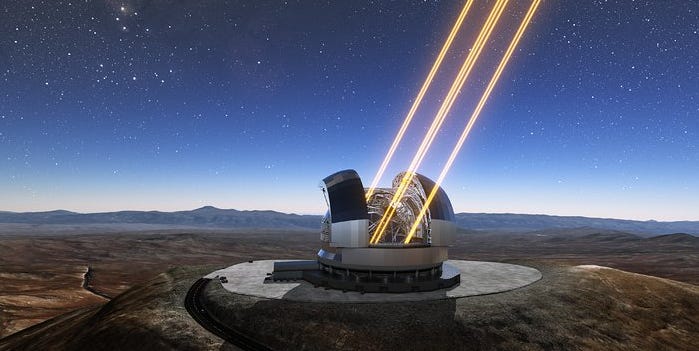
High in Chile’s Atacama Desert, on a mountain called Cerro Armazones, one of the most ambitious astronomy projects on Earth is taking shape. Its name is refreshingly honest: the Extremely Large Telescope, or ELT. No poetic nickname. No shy branding. Just a giant scientific machine looking at the universe and saying, “Yes, I brought the big mirror.”
The Extremely Large Telescope construction is under way in Chile because few places on Earth offer such dry air, dark skies, high altitude, and stable observing conditions. When completed, the ELT is expected to become the world’s largest optical and near-infrared telescope, with a 39-meter primary mirror made from hundreds of precisely controlled segments. It is designed to study exoplanets, black holes, the first galaxies, dark matter, dark energy, and the cosmic questions that make humans stare at the ceiling at 2 a.m.
Built by the European Southern Observatory, the ELT is not just another observatory. It is a new class of ground-based telescope. Think of it as a skyscraper-sized eye, a mountain-top engineering puzzle, and a time machine with better optics than anything your uncle bought during a Black Friday “space hobby” phase.
Why Chile Became the Home of the Extremely Large Telescope
Chile is already one of the world capitals of astronomy. The Atacama Desert is famous for its clear, dry atmosphere and limited light pollution. For optical and infrared astronomy, water vapor is a bit like fog on a windshield. The less of it, the better. The Atacama gives astronomers what they crave: long stretches of cloudless nights, thin air, and a sky that looks like someone forgot to install the brightness limiter.
Cerro Armazones, the ELT’s site, rises more than 3,000 meters above sea level and sits near ESO’s Paranal Observatory, home of the Very Large Telescope. That nearby scientific infrastructure matters. Building a telescope of this size in the middle of a remote desert is not like assembling patio furniture. You need roads, power, technical facilities, logistics, safety systems, and teams who know how to work in a place where the landscape is stunning but not exactly handing out free coffee.
The location also gives the ELT access to the southern sky, including rich regions of the Milky Way, the Magellanic Clouds, and many targets that northern observatories cannot see as well. In astronomy, geography is destiny. Put the telescope in the wrong place, and even the finest mirror becomes a very expensive bucket for bad seeing.
How Big Is the ELT, Really?
The ELT’s primary mirror will be about 39 meters across. That number sounds impressive, but it becomes truly wild when compared with familiar telescopes. The Hubble Space Telescope has a 2.4-meter mirror. The James Webb Space Telescope has a 6.5-meter mirror. The ELT will not go to space, but on Earth it will gather an enormous amount of light thanks to its massive surface area.
The main mirror, known as M1, will not be one single piece of glass. That would be wonderfully dramatic and completely impractical. Instead, it will be made of 798 hexagonal mirror segments, each carefully polished, coated, installed, and aligned so they behave like one continuous mirror. Each segment must be positioned with nanometer-level precision. For perspective, a nanometer is so tiny that even dust looks like a boulder with an attitude problem.
This segmented design is one of the keys to modern giant telescopes. Large mirrors collect more light, which allows astronomers to observe faint and distant objects. But large single-piece mirrors become heavy, hard to manufacture, and difficult to transport. Segments solve the problem, provided you can control them with absurd precision. The ELT’s mirror system will use sensors and actuators to keep the surface aligned as the telescope moves, temperatures shift, and gravity gently tries to ruin everyone’s day.
The Dome: A Building That Moves Like a Machine
The telescope’s dome is nearly as impressive as the instrument itself. The ELT enclosure is designed to protect the telescope from the harsh desert environment while allowing it to observe the sky through massive doors. This dome is not a simple roof. It is a rotating, engineered shell with ventilation, seismic protection, thermal control, and huge moving components that must operate reliably in a remote high-altitude location.
During construction, ESO has shown the dome taking shape as a towering structure on Cerro Armazones. Its doors, cladding, steel frame, and internal systems are all part of the same mission: protect the optics, reduce turbulence, and help the telescope maintain the stable conditions needed for sharp images. A normal building keeps rain off your head. The ELT dome must help preserve the performance of a mirror system sensitive enough to study worlds orbiting other stars. No pressure.
What Makes the ELT Scientifically Powerful?
The Extremely Large Telescope is designed for visible and infrared light. This makes it especially useful for studying cool stars, young planets, dusty star-forming regions, distant galaxies, and objects whose light has been stretched by the expansion of the universe. Infrared astronomy is also essential for looking through cosmic dust, which often hides the most interesting neighborhoods in space.
1. Exoplanets and the Search for Earth-Like Worlds
One of the ELT’s headline missions is the study of exoplanets. Astronomers have already discovered thousands of planets beyond our solar system, but most are known indirectly. The ELT could help scientists image some planets directly and analyze their atmospheres. That means looking for chemical fingerprints such as water vapor, carbon dioxide, methane, or oxygen-related features, depending on the planet and its star.
This does not mean the ELT will snap a beach selfie of an alien civilization. Science is exciting, not a movie trailer. But it may help identify planets that are rocky, temperate, and potentially capable of supporting conditions associated with life. That is a huge step. The difference between “there is a planet there” and “we can study what its atmosphere is made of” is like the difference between seeing a restaurant from across town and reading the menu.
2. The First Galaxies and Cosmic History
The ELT will also study the early universe. Because light takes time to travel, looking far into space means looking back in time. The most distant galaxies show us what the universe was like when it was young. With its huge mirror and advanced instruments, the ELT should help astronomers study faint galaxies that formed billions of years ago.
These observations may reveal how the first stars and galaxies assembled, how chemical elements spread through space, and how cosmic structures grew from tiny early fluctuations into the enormous galaxy clusters we see today. In other words, the ELT will help answer the universe’s version of “So, how did you get started?”
3. Black Holes, Galactic Centers, and Extreme Gravity
The ELT is expected to examine supermassive black holes in galactic centers with remarkable detail. Black holes are not visible directly, but their gravity affects nearby stars and gas. By watching stars move around galactic centers, astronomers can test gravity in extreme environments.
Our own Milky Way contains a supermassive black hole called Sagittarius A*. Existing telescopes have already tracked stars whipping around it at incredible speeds. A telescope as powerful as the ELT could sharpen those observations and help test whether Einstein’s theory of general relativity continues to hold up under some of the most intense gravitational conditions available to science.
Adaptive Optics: How the ELT Fights Earth’s Atmosphere
Ground-based telescopes have one big enemy: the atmosphere. It is wonderful for breathing, less wonderful for crisp astronomical images. Air turbulence bends and blurs incoming light, making stars twinkle. Twinkling is romantic in poetry, but for astronomers it is basically the atmosphere photobombing the data.
The ELT uses adaptive optics to correct this distortion. The system measures atmospheric turbulence and adjusts mirrors in real time to compensate. The telescope’s five-mirror design includes adaptive elements that can reshape the light path with incredible speed and accuracy. This is how the ELT aims to produce extremely sharp images from the ground.
Adaptive optics is one reason giant ground-based telescopes remain essential even in the age of space observatories. Space telescopes avoid atmospheric blur, but they are limited by launch size, cost, and repair difficulty. Ground-based telescopes can be much larger and upgraded over time. The ELT combines huge light-gathering power with sophisticated correction systems, giving scientists a tool that complements space missions rather than replacing them.
The Instruments: Where Raw Light Becomes Science
A telescope mirror gathers light, but instruments turn that light into discoveries. The ELT’s planned instrument suite includes advanced cameras, spectrographs, and adaptive optics systems. Instruments such as MICADO, HARMONI, METIS, MORFEO, ANDES, and MOSAIC are designed for different scientific jobs, from high-resolution imaging to spectroscopy of faint galaxies and exoplanet atmospheres.
Spectroscopy deserves special attention. It breaks light into its component wavelengths, like a cosmic barcode. From that barcode, astronomers can infer temperature, composition, motion, magnetic fields, and more. If imaging tells us what something looks like, spectroscopy tells us what it is saying. The ELT’s spectrographs will be crucial for studying everything from distant galaxies to the atmospheres of planets around nearby stars.
Why Construction Is So Complicated
Building the ELT is difficult because almost every part of the project sits at the edge of what is practical. The site is remote. The dome is huge. The mirror is segmented. The instruments are complex. The telescope must move smoothly despite weighing thousands of tons. Its components must survive desert dust, temperature swings, earthquakes, and the ordinary chaos of large-scale engineering.
Even the mirror segment process is a major industrial achievement. Hundreds of blanks must be produced, shaped, polished, coated, transported, installed, tested, and maintained. Spare segments are also necessary because mirrors need recoating over time. The ELT is not a one-and-done machine. It is a long-term observatory expected to operate for decades, which means maintainability matters as much as first light.
In a sense, the construction project is already a scientific achievement. Before the ELT discovers anything in deep space, engineers must solve problems right here on Earth. They must make a giant structure behave with the precision of a laboratory instrument. That is a little like asking an elephant to perform calligraphy during an earthquake drill.
How the ELT Fits Into the New Age of Astronomy
The ELT will join a powerful global ecosystem of observatories. Space telescopes such as James Webb and Hubble observe above the atmosphere. Survey telescopes scan huge areas of sky. Radio observatories study cold gas, black holes, and cosmic microwave signals. The ELT will bring deep, sharp optical and infrared follow-up power to this network.
For example, a survey telescope may discover a strange transient event, such as a supernova, tidal disruption event, or unusual asteroid. The ELT could then examine that object in detail. A space telescope may identify a promising exoplanet, while the ELT may help study its atmosphere from the ground. Astronomy increasingly works like a team sport, except the teammates are giant machines on mountains, in orbit, and across continents.
This cooperation will be especially important as astronomy enters a data-rich era. Scientists are not struggling to find interesting objects; they are drowning in them. The ELT’s value will come from its ability to zoom in, gather faint light, and reveal physical details that smaller telescopes cannot reach.
Dark Skies Are Part of the Technology
The ELT’s success depends not only on mirrors and software but also on protecting the sky around it. Light pollution, dust, vibrations, and industrial activity can affect astronomical observations. That is why the Atacama’s dark-sky environment is treated as a scientific resource.
Modern observatories require careful planning with governments, local communities, environmental groups, and industry. Chile’s role is central here. The country is not merely hosting telescopes; it is helping shape the future of global astronomy. Protecting these observing sites is similar to protecting a national park, except the “wildlife” includes photons that have traveled for billions of years and would really prefer not to be drowned out by poorly aimed lights.
What Happens When the ELT Sees First Light?
“First light” is the moment a telescope receives its first astronomical image. For the ELT, technical first light is planned near the end of this decade, followed by scientific operations after commissioning. But first light is not the finish line. It is more like turning the key in a race car after years of building the engine.
After first light, teams will calibrate systems, test instruments, refine operations, and gradually move from engineering checks to scientific programs. The first images may be spectacular, but the real value will unfold over years. Major observatories often make their biggest discoveries after scientists learn how to use them in ways the original planners only partly imagined.
Examples of Questions the ELT Could Help Answer
The ELT could contribute to some of astronomy’s most important questions. Are there Earth-like planets with atmospheres around nearby stars? How did the first galaxies form? How do black holes influence galaxy evolution? What are dark matter and dark energy doing to the structure and expansion of the universe? How do stars and planetary systems form inside dusty nurseries?
Each of these questions requires light: more light, sharper light, and cleaner data. That is the heart of the ELT project. It is not big for the sake of being big. It is big because the universe is faint, distant, and not especially interested in making itself easy to study.
Experiences Related to the Extremely Large Telescope Construction in Chile
Following the construction of the Extremely Large Telescope feels different from reading about a completed scientific facility. A finished telescope can look inevitable, as if humanity simply ordered it from a catalog labeled “Cosmic Wonder Machines.” Watching the ELT rise in the Atacama Desert reveals the opposite. It shows how much patience, coordination, and stubborn optimism are required before a single galaxy is observed.
One of the most striking experiences is realizing that astronomy is not only about quiet nights and elegant equations. It is also about cranes, steel, transport schedules, concrete, safety checks, mirror handling, and people working in harsh conditions. The romance of the stars is real, but it arrives wearing a hard hat. The ELT construction site reminds us that every future discovery begins as a practical problem: how to move a giant door, how to align a mirror segment, how to keep dust away, how to maintain precision when the surrounding world is hot, dry, windy, and occasionally seismic.
For science fans, there is also a special thrill in seeing a project move from renderings to reality. Early artist impressions of the ELT looked almost unreal, like science fiction architecture placed on a desert mountain. Now the dome is physically there, the road is there, the technical facilities are there, and mirror segments are moving through production and preparation. The project has crossed the emotional line from “wouldn’t that be amazing?” to “this is actually happening.”
Another experience connected with the ELT is perspective. The telescope is huge by human standards, yet from satellite views or distant desert photographs, it can look tiny against the landscape. That contrast is oddly humbling. We build enormous machines to study the universe, and the universe calmly reminds us that even our enormous machines are small. Still, that smallness is not discouraging. It is the point. Human curiosity may be physically small, but it has a remarkable habit of building tools that extend the mind far beyond the body.
There is also something inspiring about international cooperation. The ELT is a European-led project in Chile, built with contributions from companies, universities, engineers, scientists, and local partners across many countries. Modern astronomy often depends on this kind of collaboration. No single person can build a 39-meter telescope. No single lab can produce every component. No single nation owns the night sky. The ELT is a reminder that some questions are too large for small thinking.
For readers, students, and amateur astronomers, the ELT construction offers a useful lesson: science is slow until it suddenly looks fast. Years of design, review, manufacturing, and civil engineering may pass without a dramatic headline. Then, one day, a dome door moves, a mirror segment arrives, or a structure appears on a mountain, and the scale of the achievement becomes visible. Progress in science often looks like this. It is not always fireworks. Sometimes it is a checklist, completed carefully, in the correct order, by people who know the universe will still be there when the bolts are tightened.
The ELT also changes how we imagine the future of discovery. When it begins science operations, today’s students may become tomorrow’s researchers using its data. A teenager reading about the telescope now could end up studying exoplanet atmospheres, galaxy formation, or black hole physics with ELT observations later. That is the quiet magic of big scientific infrastructure: it creates opportunities for people who have not yet chosen their questions.
In the end, the experience of following the Extremely Large Telescope construction is a mixture of awe and impatience. Awe, because the engineering is almost unbelievable. Impatience, because everyone wants the first images yesterday. But a telescope designed to study billions of years of cosmic history deserves a little time to get ready. The universe waited 13.8 billion years for us to build better eyes. We can probably wait a few more construction seasons.
Conclusion: A Giant Eye for a Deeper Universe
The Extremely Large Telescope construction is under way in Chile, and its significance reaches far beyond one mountain in the Atacama Desert. With a 39-meter segmented mirror, advanced adaptive optics, a massive protective dome, and a powerful suite of instruments, the ELT is designed to push ground-based astronomy into a new era.
Its future discoveries may reshape what we know about exoplanets, early galaxies, black holes, and the hidden structure of the cosmos. Yet the project is already teaching us something important: big science is built step by step, segment by segment, by people willing to turn impossible-sounding ideas into working machines.
When the ELT finally opens its eye to the sky, it will not simply look farther. It will help humanity look better. And in astronomy, better vision has a funny habit of changing everything.