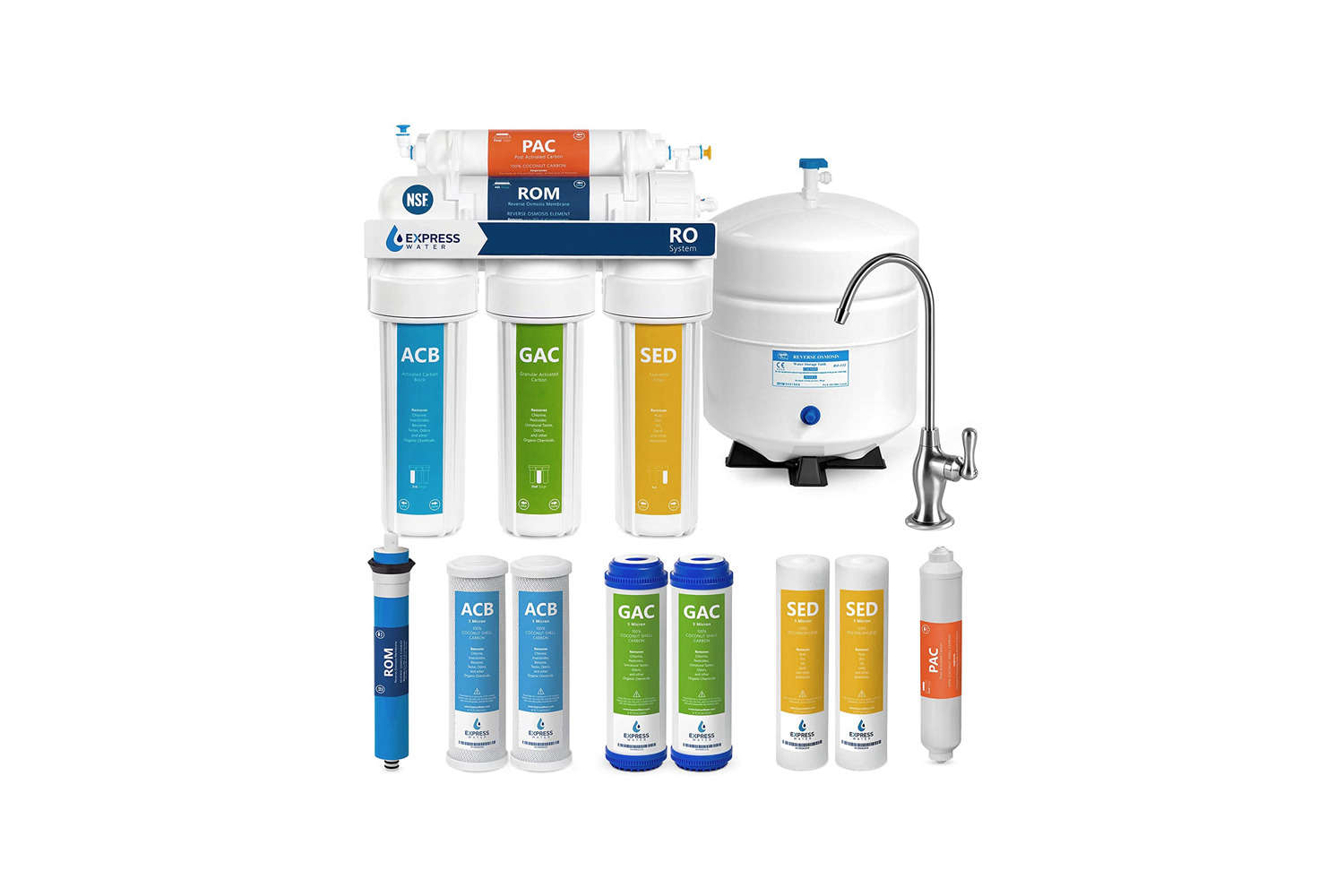
The Express Water Reverse Osmosis Water Filtration System is designed for households that want more than a pitcher filter but are not interested in turning the kitchen into a miniature municipal treatment plant. Installed beneath the sink, it combines multiple filters, a reverse osmosis membrane, a storage tank, and a dedicated faucet to produce filtered water for drinking, cooking, coffee, ice, and the occasional houseplant with expensive taste.
The best-known model in the lineup is the Express Water RO5DX, a traditional five-stage, tank-based system rated to produce up to 50 gallons per day under suitable operating conditions. It is promoted as an affordable, do-it-yourself-friendly alternative to premium tankless systems. However, its value depends on more than the number of filters printed on the box. Water pressure, cabinet space, maintenance, certification, wastewater production, and the contaminants actually present in your tap water all deserve a closer look.
What Is the Express Water Reverse Osmosis System?
The Express Water RO5DX is a point-of-use water treatment system. It treats water delivered through its dedicated faucet rather than filtering every faucet, shower, and appliance in the house. The standard package includes the filtration assembly, reverse osmosis membrane, pressurized storage tank, faucet, feed-water adapter, drain connection, tubing, filter wrench, and leak-stop valve.
Express Water and major retailers list the RO5DX as a five-stage, NSF-certified reverse osmosis system with a nominal production capacity of 50 gallons per day. The company says its reverse osmosis systems can reduce up to 99.99% of numerous impurities and total dissolved solids. Such percentages are maximum claims under specified conditions, not a promise that every contaminant in every home will be reduced by exactly the same amount.
The basic configuration uses a storage tank because reverse osmosis purification is relatively slow. Water is produced gradually, stored under pressure, and then delivered when the faucet is opened. This arrangement provides better short-term flow than waiting for the membrane to process each glass in real time.
How the Five-Stage Filtration Process Works
Calling a system “five-stage” may sound as though water must complete five heroic trials before earning a place in your glass. In reality, each stage performs a different job, and the early filters help protect the more delicate reverse osmosis membrane.
Stage 1: Sediment Filtration
The first cartridge captures larger particles such as dirt, rust, sand, and pipe debris. Sediment filtration is important because particles can clog carbon media, restrict water flow, and shorten membrane life. Homes with older plumbing or private wells may place especially heavy demands on this stage.
Stage 2: Granular Activated Carbon
Water next passes through a granular activated carbon, or GAC, cartridge. Activated carbon adsorbs chlorine and many taste- and odor-causing compounds. Removing chlorine before the membrane is also important because prolonged chlorine exposure can damage many thin-film composite reverse osmosis membranes.
Stage 3: Carbon Block Filtration
A denser carbon block provides additional treatment for chlorine, odors, tastes, and certain organic compounds while catching smaller particles that made it through the earlier stages. Think of it as the detail-oriented member of the carbon department.
Stage 4: Reverse Osmosis Membrane
The membrane is the central treatment stage. Household water pressure forces water through a semipermeable barrier, separating treated water from a concentrated reject stream that flows to the drain. According to the CDC, reverse osmosis can reduce many dissolved substances, including lead, copper, chromium, chloride, and sodium, while potentially lowering arsenic, fluoride, nitrate, sulfate, calcium, and magnesium. Reduction varies by system, contaminant, operating conditions, and certified performance claim.
Stage 5: Inline Post-Carbon Filter
Before stored water reaches the faucet, it passes through an inline post-carbon filter. This final “polishing” stage helps improve flavor and remove odors that might develop while water sits in the storage tank. The Express Water manual identifies sediment, GAC, carbon block, membrane, and inline post-carbon cartridges as the system’s five primary treatment components.
What Contaminants Can It Reduce?
A properly selected reverse osmosis system can reduce a broader range of contaminants than a basic carbon pitcher. Depending on the model’s verified claims, this may include total dissolved solids, lead, arsenic, fluoride, nitrate, chromium, sodium, certain volatile organic compounds, PFAS, and other substances.
The EPA notes that point-of-use reverse osmosis systems can potentially reduce contaminants such as lead, arsenic, PFAS, volatile organic compounds, bacteria, and viruses. However, the agency also emphasizes certification and model-specific claims. A system should not be chosen merely because “reverse osmosis” appears in large letters on the package.
NSF/ANSI 58 is the principal American standard for point-of-use reverse osmosis drinking water systems. Certification can address material safety, structural integrity, total dissolved solids reduction, efficiency, recovery, and specific contaminant-reduction claims. Buyers should check the current certification listing for the exact model and contaminant they care about rather than assuming that one certification mark covers every substance known to chemistry.
Testing your water first is the smarter approach. Municipal customers can review their utility’s annual water-quality report, while private-well owners should use an appropriately certified laboratory. Penn State Extension and the University of Minnesota Extension both recommend matching treatment equipment to confirmed water-quality problems rather than purchasing equipment based on taste, appearance, or an alarming advertisement alone.
Installation: Friendly, but Not Tool-Free
Express Water preassembles much of the filtration unit and uses color-coded tubing to make connections easier to follow. Red, white, black, yellow, and blue lines connect the feed-water valve, leak-stop device, filter assembly, drain, tank, and faucet. This reduces guesswork, although it does not eliminate the need to read the manualan activity traditionally attempted five minutes after something begins leaking.
The installation normally requires connecting the system to the cold-water supply, mounting or positioning the filters, installing a drain saddle, connecting the storage tank, and adding the dedicated faucet. A suitable faucet hole may already exist where a soap dispenser once lived. Otherwise, drilling may be necessary, and countertop material determines whether the task is routine or a good reason to call a professional.
Water Pressure Requirements
The manufacturer specifies incoming pressure between 40 and 80 psi. Pressure below 40 psi may require a booster pump, while pressure above 80 psi may require a regulator. Low pressure reduces production and may increase drain flow; excessively high pressure can stress fittings and housings. The manual also warns against using the system on microbiologically unsafe water or water of unknown quality without adequate disinfection before or after treatment.
Leak Protection
The included leak-stop valve sits low in the cabinet. Its replaceable absorbent pad expands when exposed to water and mechanically closes the incoming supply. This is a useful feature, but it does not excuse careless installation. Every fitting should be inspected after pressurization, again during the first week, and periodically thereafter. Independent reviewers have praised the added leak protection while also noting that any under-sink plumbing system can cause damage if a fitting, tank, or tube fails.
Initial Flushing
Do not install the system five minutes before hosting a dinner party. The manual recommends an initial startup and flushing process lasting roughly 8 to 12 hours. Several full tanks must be produced and discarded to flush carbon fines and prepare the filters. Water should not be connected to a refrigerator until this process is complete because loose carbon particles may clog refrigerator components.
Everyday Performance and Water Taste
The RO5DX is rated for up to 50 gallons per day, but that figure is a membrane rating rather than a promise that 50 gallons will be waiting in the tank every morning. Actual production depends on water pressure, temperature, dissolved-solids concentration, membrane condition, and tank backpressure. Cold water and low pressure generally reduce production.
For ordinary drinking and cooking, the storage tank should cover the needs of many small and medium households. Filling several large stockpots in rapid succession may empty the tank, after which flow slows while new water is produced. Families with unusually high demand may prefer a 100-gallon-per-day configuration, a larger tank, or a high-output tankless system.
Independent household testing by The Spruce named the RO5DX a strong value choice. Testers highlighted its color-coded installation, included replacement filters, and clean-tasting water, while criticizing the amount of tubing, under-sink space required, and relatively high wastewater production.
Reverse osmosis removes many dissolved minerals along with unwanted contaminants. Some people love the light, neutral taste; others describe it as slightly flat. The basic RO5DX does not include a remineralization stage. Shoppers who prefer a mineral taste or higher finished-water pH can consider an Express Water alkaline model or add a compatible remineralization cartridge.
Maintenance Requirements and Filter Life
This system is not a “buy it, install it, forget its birthday” appliance. The Express Water manual recommends replacing the sediment, GAC, and carbon block prefilters approximately every six months. It recommends replacing the reverse osmosis membrane and inline post-carbon filter about once a year. Actual service life may be shorter when incoming water contains heavy sediment, chlorine, hardness, iron, or unusually high dissolved solids.
The RO5DX does not have a smart faucet or electronic filter-life indicator. Owners must track replacements with a calendar, phone reminder, or label attached inside the cabinet. Waiting until water tastes strange is not an ideal maintenance plan, because exhausted filters may lose performance before the change becomes obvious.
Maintenance also includes cleaning the filter housings, inspecting O-rings, checking tubing, sanitizing the system as appropriate, and watching for pressure or flow changes. Consumer Reports notes that reverse osmosis systems require periodic sanitation and cartridge replacement and may demand more upkeep than simpler under-sink carbon filters.
Very hard water can scale the membrane and shorten its useful life. A water softener or other pretreatment may be appropriate when hardness is severe. Well water containing iron, manganese, hydrogen sulfide, or microorganisms may also require treatment before the RO system. Reverse osmosis is an excellent polishing technology, but it is not a magical white box that makes every untreated water source safe by itself.
How Much Water Does the System Waste?
Reverse osmosis produces both filtered water and a concentrated reject stream. The Express Water manual describes a typical discharge range of approximately one to three gallons for every gallon of drinking water produced, depending on pressure, temperature, and incoming water quality. In one independent home test, The Spruce observed closer to four units of drain water for each unit of purified water. Real-world results therefore vary considerably.
This is the system’s most important drawback. Newer tankless models can achieve more efficient recovery ratios, although they generally cost more and require electricity. The EPA WaterSense program now identifies qualifying point-of-use reverse osmosis systems designed to reduce unnecessary reject water, making efficiency worth checking when comparing models.
Reject water should never be consumed. Where plumbing codes and installation conditions permit, some households route it to nonpotable uses such as cleaning or irrigation. Any reuse arrangement must avoid cross-connections, flooding, contamination, and damage to salt-sensitive plants.
Advantages of the Express Water RO5DX
- Broad treatment capability: Reverse osmosis and carbon filtration can address many dissolved contaminants, tastes, and odors.
- Strong value positioning: The system provides conventional multistage RO treatment without the premium price of many smart or tankless models.
- Color-coded installation: Clearly identified tubing makes the plumbing layout easier to understand.
- Storage tank: Treated water is ready for normal drinking and cooking demands.
- Leak-stop valve: The mechanical shutoff provides an additional layer of cabinet protection.
- No electricity in the standard setup: Normal household water pressure powers the basic system unless an optional pump, ultraviolet stage, or other powered accessory is added.
- Upgradeable design: Compatible alkaline, ultraviolet, deionization, refrigerator, pump, and additional tank options are available for certain applications.
Disadvantages to Consider
- Reject water: The traditional tank-based design may send several gallons to the drain for every gallon purified.
- Cabinet space: Three vertical housings, tubing, and a storage tank consume substantial under-sink room.
- Routine maintenance: Multiple cartridges, O-rings, housings, and connections require attention.
- No filter-life display: Replacement dates must be tracked manually.
- Slow production: Once the tank is depleted, users must wait for the membrane to replenish it.
- No standard remineralization: People who prefer mineral-rich or alkaline water need another stage or a different model.
- Installation may require drilling: Adding the faucet and drain connection can be intimidating on stone, porcelain, or specialty sinks.
Who Should Buy This Reverse Osmosis System?
The Express Water RO5DX makes the most sense for homeowners who have confirmed contaminants that reverse osmosis can reduce, want a dedicated drinking-water faucet, have adequate cabinet space, and are comfortable following a maintenance schedule. It is especially appealing to value-conscious buyers who prefer standard-size filter housings and a conventional design that can be serviced without an app or proprietary electronic control panel.
It may not be ideal for renters who cannot modify plumbing, homes with extremely low pressure, kitchens with cramped cabinets, or environmentally focused shoppers who prioritize the lowest possible reject-water ratio. A certified carbon filter may be sufficient when the only concern is chlorine taste or odor. A tankless RO system may be better when space, fast production, and water efficiency matter more than initial cost.
For untreated private-well water, the system should be selected only after laboratory testing and professional evaluation of sediment, hardness, iron, manganese, nitrate, arsenic, microorganisms, and other local concerns.
A Realistic Owner Experience With the Express Water RO5DX
The following experience is a realistic composite based on manufacturer instructions, professional guidance, retailer feedback, and independent household testing. It is not presented as personal laboratory testing.
The experience begins with cabinet archaeology. Cleaning products, grocery bags, forgotten sponges, and a vase nobody remembers buying must leave the premises. The filtration assembly itself looks manageable, but the tank changes the spatial equation. A careful owner places every component in the cabinet before drilling anything, checks whether the garbage disposal blocks the faucet route, and confirms that the tank valve will remain accessible.
Installation feels easier once the colored tubes are laid out. Red goes to the feed line, black to the drain, yellow to the tank, and blue to the faucet. The instructions are considerably friendlier than a box containing fifteen identical transparent hoses. Even so, installing the drain saddle and dedicated faucet requires patience. The most stressful moment is usually drillingnot because the hole is technically complex, but because countertops are expensive and power tools have no emotional intelligence.
After the connections are complete, the owner slowly opens the water supply and checks every fitting with a dry paper towel. This catches tiny droplets more reliably than staring at the system and hoping it respects the kitchen. The leak-stop pad is placed at the lowest point in the cabinet, where escaped water would reach it quickly. The system is then checked again after pressure builds.
The first evening is mostly waiting. Water initially enters the system slowly, and the tank requires hours to fill. Each startup tank is drained according to the manual. A little black or gray carbon dust may appear during early flushing, and trapped air can make the water look temporarily cloudy. By the following day, the system is ready for normal use.
The first noticeable difference is often taste. Chlorine odor is reduced, and water may seem cleaner, lighter, or more neutral. Coffee can taste less harsh because the water no longer contributes as many competing flavors. Ice cubes may look clearer, although perfectly transparent restaurant-style ice requires controlled freezing and cannot be credited entirely to the filter. Pasta, soup, and pet bowls soon join the list of uses because the dedicated faucet is more convenient than repeatedly filling a pitcher.
Daily operation is quiet. The system may produce a faint water-flow sound while the tank refills, and water can be heard entering the drain. Once the storage tank is full, the automatic shutoff should stop production. A continuously running drain line may indicate low pressure, an improperly pressurized tank, a failed shutoff component, or an installation problem that needs troubleshooting.
Cabinet space remains the most obvious compromise. The tank and hoses turn the area beneath the sink into organized plumbing territory rather than generous storage. Good tube routing helps, as does securing loose lines so they do not snag on cleaning bottles. The filters should remain accessible because every six months the cabinet must once again become a small maintenance workshop.
Filter replacement is messy but manageable. The water supply and tank valve are closed, faucet pressure is released, and a bucket catches water from the housings. The cartridges are replaced in the correct order, O-rings are inspected and seated, and the housings are tightened without attempting to set a world record. After flushing and checking for leaks, normal service returns.
Over time, the most satisfied owner is not necessarily the person who expected miraculous “pure water.” It is the person who tested the incoming supply, understood what the system was designed to reduce, accepted the maintenance and reject-water tradeoffs, and wanted dependable filtered water at a dedicated faucet. In that setting, the Express Water RO5DX behaves less like a flashy gadget and more like a practical kitchen appliancewhich is usually the better compliment.
Final Verdict
The Express Water Reverse Osmosis Water Filtration System offers an appealing combination of multistage treatment, accessible replacement filters, color-coded plumbing, leak protection, and tank-based convenience. The RO5DX is particularly competitive for buyers seeking a traditional five-stage under-sink system without paying for electronic monitoring or a high-output tankless design.
Its limitations are equally clear. It occupies cabinet space, requires scheduled cartridge changes, produces reject water, and depends heavily on suitable pressure and correct installation. The 50-gallon-per-day rating should be treated as a laboratory-based capacity, not an estimate of instant faucet delivery.
Most importantly, choose the system for your waternot because reverse osmosis sounds impressively scientific. Review a current water-quality report or laboratory test, identify the contaminants that matter, and confirm that the exact model carries appropriate third-party reduction claims. Done properly, the Express Water RO5DX can provide convenient, clean-tasting water for years. Done carelessly, it becomes an elaborate cabinet tenant with a very expensive drinking straw.