Drew Barrymore has never been the sort of talk-show host who hides behind a polished desk and a stack of cue cards. She leans in, laughs loudly, cries freely, and occasionally turns a celebrity interview into something that feels more like a heartfelt conversation in a friend’s living room. During a special makeup-free episode of The Drew Barrymore Show, however, she took that openness a dramatic step furtherand Pamela Anderson’s reaction said everything.
While discussing beauty, aging, and the freedom of appearing as one’s natural self, Barrymore made a candid statement about perimenopause and hair thinning. Then she demonstrated exactly what she meant by removing her clip-in hair extensions on camera. Anderson, who had already inspired the host and Valerie Bertinelli to go makeup-free, looked genuinely surprised before enthusiastically cheering her on. The extensions came out, the audience erupted, and a daytime-TV beauty conversation suddenly became a small rebellion with excellent studio lighting.
What Drew Barrymore Actually Said and Did
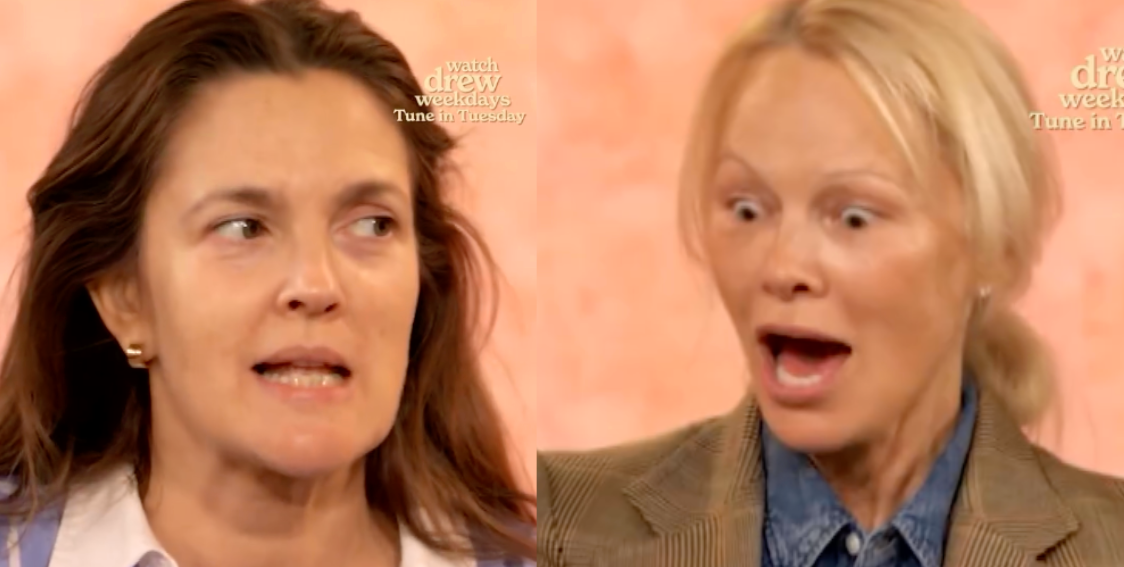
The headline-making exchange aired as part of the show’s “Bare Is Beautiful” episode on October 22, 2024. Anderson appeared to promote her plant-based cookbook, I Love You: Recipes from the Heart, while joining Barrymore and Bertinelli for a broader discussion about self-acceptance. The host, her guests, and the studio audience participated without their usual television makeup, creating an unusual visual for national daytime programming.
As Anderson explained how liberating her minimalist beauty era had become, Barrymore paused and said, “If we’re really going to be honest here.” She then spoke about hair loss as one of the less glamorous realities associated with perimenopause. Rather than merely describing the issue, she reached into her hair and pulled out her clip-in extensions. One moment she had camera-ready volume; the next, the secret was sitting in her hand like a backstage employee who had just been publicly introduced.
Anderson’s surprise was warm rather than uncomfortable. She exclaimed that the moment was wonderful and encouraged Barrymore to continue. The audience applauded, and the mood became celebratory. What could have felt like an awkward reveal instead became a shared joke, a confession, and a statement about how much invisible work often goes into creating “effortless” celebrity beauty.
Why Pamela Anderson Was the Perfect Guest for the Moment
Anderson’s presence gave Barrymore’s gesture greater meaning. For decades, the former Baywatch star was associated with highly constructed glamour: platinum hair, smoky eyes, sculpted brows, glossy lips, and a bombshell image that became part of 1990s pop culture. Her more recent public appearances have deliberately moved in the opposite direction.
Anderson began attracting attention for appearing with little or no makeup during Paris Fashion Week in September 2023. She later explained that the decision was not initially planned as a campaign. She simply did not want to spend hours in a makeup chair or feel as though she were competing with the designer clothes she was wearing. What began as a practical, personal choice grew into a widely discussed message about self-acceptance and aging.
Her shift also carried emotional history. Anderson has said that the death of her longtime makeup artist, Alexis Vogel, in 2019 influenced her decision to step away from her old beauty routine. Rather than recreating a signature look without the friend who helped shape it, Anderson increasingly embraced a simpler presentation. She has described the change as freeing, experimental, and a little rebelliousnot a commandment that everyone must throw away mascara before breakfast.
That distinction matters. Anderson was not arguing that makeup is dishonest or that glamorous women are somehow less authentic. Her point was about choice. After spending years being styled, photographed, marketed, and interpreted by other people, she wanted to decide how her own face would enter a room. Barrymore’s extension reveal echoed that same idea: the freedom did not come from looking one particular way; it came from no longer pretending the choice was effortless or mandatory.
The Real Shock Was Seeing the Beauty Machinery
Television viewers understand, in theory, that celebrities use professional styling. Yet the machinery usually remains off camera. Makeup is applied before the interview. Extensions are blended into natural hair. Lighting is adjusted. Skin is powdered. Wardrobes are steamed. Then the finished person walks onto the set looking as though she simply woke up luminous, hydrated, and accompanied by a wind machine.
Barrymore interrupted that illusion. By physically removing the extensions, she showed that the thick, polished hair viewers saw was partly constructed. Beauty publications covering the segment noted that wigs and extensions are common but often overlooked components of celebrity styling. That omission can make ordinary viewers wonder why their own hair does not resemble a star’s, even after buying the shampoo, mask, serum, oil, brush, supplement, and suspiciously expensive pillowcase.
The reveal worked because it was concrete. A general speech about unrealistic standards can feel familiar. Watching a famous host pull out the hidden pieces creating those standards is harder to dismiss. Barrymore did not merely say, “Television beauty is constructed.” She held part of the construction in her hand.
Drew Barrymore’s Perimenopause Comment Added Another Layer
Barrymore connected her extension use to hair thinning during perimenopause, the transitional period before menopause. Perimenopause commonly begins in the 40s, although timing and symptoms vary widely. Hormonal fluctuations can produce changes in menstrual cycles, sleep, temperature regulation, mood, and other aspects of health. Hair thinning can also become more noticeable in midlife, although it has many possible causes and should not automatically be blamed on hormones.
The American Academy of Dermatology notes that female pattern hair loss often begins in midlife and becomes more common after menopause, suggesting that hormones may play a role. It can appear as a widening part or reduced overall density. Dermatologists also emphasize that accurate diagnosis matters because nutritional deficiencies, stress, illness, medications, thyroid problems, genetics, and several scalp conditions can contribute to shedding or thinning.
Barrymore’s statement was daring because women’s midlife symptoms are still frequently treated as private embarrassments. Hot flashes may be joked about, but hair loss is often hidden beneath strategic styling, fibers, toppers, wigs, or extensions. By discussing it without shame, Barrymore turned a beauty secret into a health conversation. She did not present herself as a medical expert; she presented herself as a woman saying, essentially, “This is happening, and I am not going to act as though it makes me defective.”
That message can be reassuring, but it should not discourage anyone from seeking care. Sudden, severe, patchy, painful, or persistent hair loss deserves evaluation by a qualified healthcare professional or dermatologist. Acceptance and treatment are not enemies. A person can love herself exactly as she is and still book an appointment to find out why the shower drain has become alarmingly ambitious.
Why the Exchange Resonated With Viewers
It Replaced Perfection With Transparency
Celebrity culture often sells the final image without disclosing the scaffolding. Barrymore’s gesture made the scaffolding visible. That transparency can reduce the gap between the viewer and the celebritynot because their lives suddenly become identical, but because the comparison becomes more honest.
It Showed Women Supporting Rather Than Judging One Another
Anderson did not react by suggesting Barrymore looked better before or after removing the extensions. She responded with excitement. Bertinelli also participated in the makeup-free conversation, telling Barrymore that she looked like her beautiful self. The emotional center of the segment was not “Who is prettiest without help?” It was “How does it feel when we stop grading one another for a moment?”
It Challenged Age-Related Double Standards
Male celebrities are often allowed to wrinkle, gray, thin, and soften while still being described as distinguished. Women in the same age range are frequently expected to look naturalbut not tired; youthfulbut not surgically altered; polishedbut not high-maintenance. This is less a beauty standard than an obstacle course designed by someone who enjoys watching contestants trip over contradictory instructions.
Anderson and Barrymore did not solve ageism in one daytime segment. What they did was create a visible alternative: women in their late 40s, 50s, and 60s discussing physical change without presenting aging as a personal failure. Vogue and other publications have placed Anderson’s makeup-free appearances within a broader movement of women in entertainment speaking more openly about aging on their own terms.
Natural Beauty Should Not Become Another Rule
There is a trap hiding inside every beauty trend. A movement that begins with freedom can quickly become a new obligation. First women are told they must wear makeup to look professional. Then they may be told that wearing makeup means they lack confidence. Either message replaces personal choice with public judgment.
The most useful interpretation of the Barrymore-Anderson exchange is not that extensions, cosmetics, injectables, hair color, or elaborate styling are bad. Anderson herself has described her approach as personal rather than prescriptive, and her public looks have not always followed a rigid no-makeup rule. The meaningful part is that neither woman treated enhancement as something that must be denied.
A woman can enjoy red lipstick and still be authentic. She can wear extensions because they are fun, because thinning hair bothers her, because a role requires them, or because Tuesday needed drama. She can also remove them on television. Agency is the point. The product is optional.
Experiences That Help Explain Why the Moment Felt So Personal
The First Makeup-Free Workday
Consider the person who has worn foundation to work every day for ten years. One morning, she is running late and decides to skip it. Nothing dramatic happens. The building does not evacuate. Her coworkers continue discussing deadlines and broken printers. Yet she may spend the first hour feeling strangely exposed because the routine was not only cosmetic; it had become emotional armor. Barrymore and Anderson’s segment captured that mixture of vulnerability and relief. Removing something familiar can feel more intimate than adding something bold.
The Hair Appointment That Changes the Conversation
Another common experience begins in a salon chair. A client mentions that her ponytail feels thinner, expecting the stylist to offer a volumizing product. Instead, the conversation becomes a frank exchange about postpartum shedding, stress, menopause, genetics, or illness. Suddenly, a private worry becomes a shared human experience. That does not diagnose the cause, but it reduces shame and may encourage a medical evaluation. Barrymore’s on-air admission functioned similarly on a larger scale: it gave viewers language for something many had been quietly noticing.
The Family Photo Nobody Wants Retouched
Imagine several generations gathering for a family portrait. Someone asks the photographer to soften every line, erase every spot, whiten every tooth, and generally make the family look as though it was assembled by a luxury candle company. Then a grandmother objects. She likes the lines around her eyes because they came from laughing. Her refusal changes how everyone sees the picture. The point is not that retouching is immoral; it is that visible age can carry meaning. Anderson’s bare face and Barrymore’s natural hair invited viewers to recognize biography where advertising often sees flaws.
The Compliment That Finally Lands
People often reject compliments when they feel those compliments apply only to a polished version of themselves. “You look beautiful” may be answered with a joke about concealer, lighting, or a carefully chosen angle. But when Bertinelli affirmed Barrymore after the makeup came off, the compliment had a different quality. It was directed toward the person rather than the production. Many viewers know how powerful that can feel: being seen on an ordinary day, without the usual defenses, and discovering that affection did not disappear with the mascara.
The Decision to Keep the Options Open
The most realistic experience may be inconsistency. Someone goes makeup-free on Monday, wears a full glamorous look on Friday, uses extensions for a wedding, and leaves her hair untouched during vacation. That is not hypocrisy. It is freedom behaving normally. Anderson’s minimalist era and Barrymore’s candid reveal resonate most when they are understood as options rather than commandments. The lesson is not to throw away the beauty bag. It is to make sure the beauty bag belongs to youand that you can close it, open it, or forget it in the bathroom without believing your worth changed.
Conclusion
Drew Barrymore left Pamela Anderson in delighted shock not through a cruel remark or manufactured feud, but through an unusually honest act. She acknowledged hair thinning during perimenopause, removed her extensions, and exposed a piece of television’s beauty machinery in real time. Anderson’s enthusiastic response transformed the reveal from a confession into a celebration.
The moment mattered because it offered something more useful than perfection: context. It reminded viewers that celebrity beauty is often supported by products, professionals, and carefully hidden techniques. It also showed that discussing aging does not have to sound tragic, and choosing a natural look does not require rejecting glamour forever. Sometimes empowerment is a bare face. Sometimes it is a full face. Sometimes it is holding your clip-in extensions in the air while Pamela Anderson cheers you on.
Editor’s note: This article analyzes the “Bare Is Beautiful” episode broadcast on October 22, 2024, and contemporaneous reporting about the exchange. Medical information is general and is not a substitute for professional diagnosis or treatment.