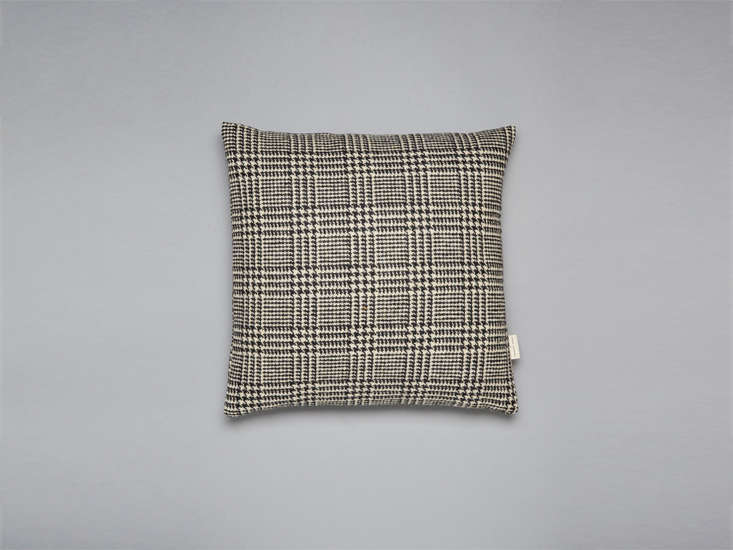
A great cushion should do more than occupy the suspiciously empty corner of a sofa. It should add texture, support the room’s color story, survive the occasional coffee scare, and make guests wonder whether you secretly hired an interior designer. The Donegal Tweed Glencheck Cushion accomplishes that balancing act by combining Irish textile heritage with a disciplined checked pattern and an easy-to-style square shape.
The original cushion was sold by 31 Chapel Lane and made from 100% handwoven Irish wool in an exclusive Glencheck Donegal tweed. It included a duck-feather insert, measured approximately 18 by 18 inches, and was made in Ireland. Remodelista now identifies the product as discontinued, so it is best understood as a design reference and a benchmark for finding comparable heritage wool cushions.
What Is the Donegal Tweed Glencheck Cushion?
At first glance, it is a square decorative pillow with a classic check. Look closer, however, and the design becomes more interesting. The cover combines the irregular character of Donegal tweed with the orderliness of a Glen check. One brings movement and natural variation; the other supplies structure. It is the textile equivalent of someone who owns muddy hiking boots but also alphabetizes the spice rack.
The archived product specification lists four defining features: a 45-by-45-centimeter cover, equivalent to roughly 18 by 18 inches; 100% handwoven Irish wool; a duck-feather insert; and dry-clean or spot-clean care. Its standard square size makes it practical for sofas, armchairs, benches, window seats, and layered bed arrangements.
Why Donegal Tweed Gives the Cushion Character
A Textile Connected to County Donegal
Donegal tweed is closely associated with County Donegal in northwestern Ireland. Traditional examples are known for woolen surfaces enlivened by small flecks of color. Regional makers often connect these tones to the Atlantic coastline, mountains, hills, fields, and changing skies surrounding their workshops.
These flecks prevent the fabric from appearing completely flat. A gray tweed might contain tiny notes of cream, charcoal, rust, green, or blue. From across the room, it may look neutral. Up close, the individual colors become visible, giving the cushion depth without turning it into a loud statement piece.
Traditional Skills in a Contemporary Home
Donegal’s weaving tradition has been passed through generations, but modern makers also use careful color planning, quality control, and updated production methods. Companies such as Donegal Yarns and Molloy & Sons describe local spinning, dyeing, weaving, and finishing as important parts of authentic Donegal textile production.
That combination of tradition and modern usefulness makes the fabric suitable for today’s interiors. A Donegal tweed cushion can live comfortably beside a linen sofa, an oak coffee table, a black metal lamp, or a minimalist bookshelf. It carries a craft story without requiring the room to resemble a historical exhibit.
Understanding the Glencheck Pattern
Glen check, commonly called Glen plaid, is formed by intersecting bands that create groups of small and larger checks. The pattern is traditionally associated with Scotland and takes its name from the Glenurquhart valley. It later became closely connected with Prince of Wales style through its use in tailored clothing.
On a cushion, Glencheck retains some of that tailored confidence without making the sofa look as though it is preparing for a board meeting. The pattern works particularly well in interiors because it can function as both a graphic design and a near-neutral.
From a distance, a restrained Glencheck may appear softly blended. At close range, the grid becomes more obvious. This dual personality allows it to sit beside solid linen, leather, velvet, bouclé, herringbone, and even floral prints when the color palette is controlled. Interior-design publications frequently recommend mixing texture, varying pattern intensity, and repeating at least one color when combining pillows.
Why the Cushion’s Design Works
The 18-Inch Size Is Easy to Use
An 18-inch cushion is large enough to register visually but compact enough to layer. On a regular sofa, it can sit in front of a 20- or 22-inch solid pillow. On an accent chair, it can work alone. On a bed, it can bridge the space between larger sleeping pillows and a smaller lumbar cushion.
The Spruce identifies 18 inches as one of the common square throw-pillow dimensions and recommends scaling cushion sizes to the furniture. Large sectionals can support bigger pillows, while loveseats and compact chairs usually benefit from smaller arrangements.
Wool Adds Quiet Texture
Texture can make a neutral room feel intentional rather than unfinished. Architectural Digest recommends varying materials even when the color palette stays consistent, while House Beautiful highlights wool as a useful contrast against smoother surfaces such as linen.
This is where a Donegal tweed cushion earns its place. It can enliven beige, cream, gray, navy, olive, or brown upholstery without forcing the homeowner to redesign the entire room because one pillow suddenly developed celebrity ambitions.
The Feather Insert Creates a Relaxed Shape
The archived cushion included a duck-feather insert, which produces a softer and more adaptable silhouette than rigid foam. Feather-filled pillows can be reshaped, plumped, leaned against, or given a modest center indentation. They also require regular fluffing after use.
Current designers remain divided over the famous “pillow chop.” Some favor a tailored center crease, while others prefer a natural, unchopped slouch. With a handwoven wool cover, the relaxed option often complements the fabric’s informal character.
How to Style a Donegal Tweed Glencheck Cushion
Use It as the Main Pattern on a Neutral Sofa
Place the Glencheck cushion beside one larger solid pillow in oatmeal, charcoal, forest green, camel, or navy. Add a small lumbar cushion when the sofa is deep enough to remain comfortable. The check supplies structure, the solid gives the eye a place to rest, and the lumbar adds a contrasting shape.
For a long sofa, an odd-numbered arrangement can feel natural: two cushions at each end and one lumbar in the center. For a compact loveseat, use fewer pieces so the furniture remains available for its traditional purposesitting. Design guidance supports varying pillow dimensions and shapes while keeping the overall arrangement proportional to the seating.
Pair It With Leather and Warm Wood
A Glencheck wool cushion looks particularly convincing against cognac leather, dark brown leather, walnut, oak, or aged brass. These materials share a warm, natural visual language without making the room feel overly themed.
Add a cream throw, a moss-green pillow, or a small amount of rust or mustard. The result can feel collected and comfortable rather than suspiciously similar to the waiting room of an expensive country club.
Use It to Soften a Modern Interior
In a contemporary room, use the cushion as a counterpoint to clean lines. A low-profile sofa, pale walls, black lighting, and simple wood furniture can benefit from one textile with visible weave and history.
Apartment Therapy has demonstrated that plaid can work in interiors ranging from English country to distinctly modern spaces. The key is treating it as a flexible geometric pattern rather than automatically surrounding it with rustic accessories.
Create a Layered Bedroom
Place the cushion in front of two Euro shams or a row of sleeping pillows. Combine it with a washed-linen duvet, a wool blanket, or a quilt in a related neutral. Better Homes & Gardens and House Beautiful both illustrate how plaid and mixed textures can create a cozy, vintage-aware bedroom without requiring perfectly matched bedding.
Mix Patterns With a Clear Hierarchy
A Glencheck pillow can live beside stripes, florals, herringbone, or small geometric prints, but each pattern should have a different role. Let Glencheck act as the medium-scale grid, choose a softer or smaller secondary motif, and repeat at least one color across both fabrics.
When several bright colors are involved, keep the pattern scale relatively consistent. When using multiple pattern sizes, simplify the palette. Architectural Digest recommends these kinds of visual controls to prevent mixed cushions from appearing random.
Best Color Pairings
Cream and Oatmeal
Warm pale neutrals highlight the tweed’s colored flecks and create a calm, natural scheme. This pairing works well with light oak, linen upholstery, woven baskets, and off-white walls.
Charcoal and Black
Darker accents sharpen the grid and give the cushion a more contemporary direction. Try it with black-framed artwork, dark metal lighting, or charcoal upholstery.
Forest Green and Olive
Green complements the landscape-inspired colors commonly associated with Donegal textiles. It also provides enough depth to make gray, beige, or brown wool look richer.
Cognac, Rust, and Mustard
Warm earth tones make the cushion feel especially inviting during fall and winter. Use them sparingly unless your goal is to make October a permanent resident.
Navy and Faded Blue
Blue creates a quieter coastal direction. Pair the cushion with faded denim tones, navy linen, or blue-gray paint rather than filling the room with anchors, ropes, and decorative boats.
Plaid cushions are a relatively low-commitment way to experiment with pattern because they can be moved or changed more easily than upholstered furniture. Better Homes & Gardens specifically recommends throw pillows as an accessible starting point for decorating with plaid.
How to Find a Comparable Cushion
Because the original 31 Chapel Lane cushion has been discontinued, shoppers should focus on its defining qualities rather than searching only for an identical label. A strong alternative should clearly disclose its fiber content, place of production, weaving method, dimensions, closure, insert, and care instructions.
Terms such as “tweed look,” “Donegal-inspired,” and “Donegal-style” do not necessarily indicate that a fabric was produced in County Donegal. When provenance matters, look for named Irish mills, weaving studios, or makers that explain where the yarn was spun, dyed, and woven. Donegal producers emphasize that local expertise and production are central to the identity of authentic regional tweed.
- Check the fiber: Look for a clearly stated wool percentage rather than phrases such as “wool feel.”
- Verify the origin: “Made in Ireland” is helpful, while a named Donegal mill or weaver offers stronger provenance.
- Inspect both sides: Some cushions use tweed front and back; others pair it with linen or cotton.
- Confirm the filling: Feather creates a relaxed shape, while synthetic fill may suit allergy-sensitive households.
- Measure the furniture: An 18-inch square is versatile, but oversized sofas may need larger supporting pillows.
- Read the care instructions: A removable cover is not automatically machine washable.
Care and Maintenance
Routine Cleaning
Always begin with the manufacturer’s care label. The archived Donegal Tweed Glencheck Cushion was labeled for dry cleaning or spot cleaning only. For ordinary maintenance, shake and rotate the cushion, plump the feather filling, and remove dust with a soft upholstery brush or low-suction vacuum attachment.
Handling Spills
Blot spills promptly with a clean, absorbent cloth. Do not scrub, because friction can roughen the wool and push liquid farther into the weave. Test any treatment on a hidden area before applying it to the visible surface.
Woolmark notes that wool is naturally resistant to staining, odors, and creasing, but it still recommends fiber-appropriate cleaning and a mild, neutral wool detergent when washing is permitted. For the original cushion, professional cleaning remains the safer option for serious stains.
Pilling and Storage
Small pills may appear where wool repeatedly rubs against clothing or furniture. Remove them carefully with a suitable fabric comb rather than pulling them by hand. Keep the cushion away from prolonged direct sunlight to reduce uneven fading, and store it clean and dry in breathable protection. Woolmark defines pilling as the development of small fuzzy balls on a wool surface and recommends careful maintenance to extend a product’s useful life.
Advantages and Tradeoffs
| Advantages | Tradeoffs |
|---|---|
| Distinctive handwoven texture | Natural variation may be visible |
| Classic, versatile Glencheck pattern | Needs restraint around competing checks |
| Natural wool construction | May pill in high-friction areas |
| Relaxed feather-filled profile | Requires regular plumping |
| Strong craft and provenance story | Authentic examples can be expensive |
| Flexible 18-inch size | May look small alone on a sectional |
Experiences With a Donegal Tweed Glencheck Cushion
The following is a practical ownership-style analysis rather than a claim of personal possession of the discontinued original.
The First Impression
A cushion like this usually makes a stronger impression in person than in a flat product image. From several feet away, the Glencheck appears orderly and tailored. Move closer and the wool weave, colored flecks, and small irregularities begin to emerge. The cushion does not dominate the room, but it rewards attention.
The handwoven surface is likely to feel firmer and more textured than velvet, cotton sateen, or brushed microfiber. That does not make it uncomfortable; it simply changes its best use. It is better suited to supporting the lower back, resting beneath an elbow, or sitting behind a softer pillow than serving as something to press against your face during a three-hour nap.
Living With the Feather Insert
The feather insert gives the cushion a pleasant weight and allows it to settle naturally into furniture. It does not sit stiffly on top of the sofa like an employee who arrived early for an interview.
After someone leans against it, the cushion will probably appear compressed. A quick shake and a few firm pats should restore the corners. This becomes a small household ritualless demanding than caring for a fiddle-leaf fig and considerably less dramatic when forgotten.
Feather fill also makes the styling flexible. Leave the cushion unchopped for a relaxed reading corner, or create a restrained center indentation on a neatly arranged bed. Designers remain divided over pillow chopping, so neither approach should be treated as constitutional law.
How It Performs Through the Seasons
Donegal tweed feels especially natural during fall and winter because wool, checks, deep colors, warm woods, and layered blankets all communicate comfort. The cushion can remain useful in spring, however. Place it beside white linen, faded blue, light green, or a pale cotton throw and it becomes less “country lodge” and more “quietly collected.”
Decorating publications frequently describe pillows as flexible seasonal accents. Changing the surrounding textiles can therefore refresh the room without placing the wool cushion in storage for half the year.
How It Changes Different Rooms
On a cream sofa, the cushion adds definition. On cognac leather, it reinforces warmth and heritage. On a gray sectional, it prevents the scheme from feeling too corporate. On a bed, it acts like punctuation at the end of a long sentence of white bedding. On a wooden bench, it softens both the seat and the visual hardness of the furniture.
The most successful arrangement may also be the simplest. One Glencheck cushion beside one solid wool or linen pillow can appear more sophisticated than a crowded lineup of competing plaids. This follows a common decorating principle: control the palette, vary the texture, and allow one pattern to lead.
Daily Maintenance
The cushion is not exceptionally demanding, but it is not as carefree as a machine-washable cotton cover. Crumbs should be brushed away, spills should be blotted quickly, and the filling needs occasional reshaping. Pet claws, sticky fingers, and glasses of red wine deserve a respectful amount of distance.
With time, slight softening and surface change may make the wool appear more lived-in. People who expect permanent showroom crispness could find this frustrating. Those who appreciate natural materials may regard it as part of the charm. Regular rotation, gentle surface care, and professional cleaning when necessary should help preserve the cushion. Woolmark recommends infrequent, careful cleaning and notes wool’s natural resistance to stains, odors, and creasing.
The Overall Experience
The strongest reason to choose a Donegal Tweed Glencheck Cushion is not that it is the cheapest, softest, or easiest decorative pillow available. It is that it combines function with identity. It supports the body, completes a seating arrangement, introduces a controlled pattern, and carries a textile story that mass-printed decor rarely matches.
It is best suited to buyers who appreciate craftsmanship, subtle irregularity, and household objects that become more familiar rather than more disposable with age.
Conclusion
The Donegal Tweed Glencheck Cushion demonstrates why materials matter. Its handwoven Irish wool provides texture, the Glencheck pattern supplies order, and the feather insert creates a relaxed silhouette. Although the archived 31 Chapel Lane version is discontinued, its construction remains a useful benchmark for evaluating an authentic Donegal tweed cushion or well-made Irish wool pillow.
For the best result, use the cushion as a leading accent rather than one pattern among ten. Pair it with solid colors, natural materials, and a few repeated tones. Care for it gently, accept that wool has a personality, and remember that a cushion with character occasionally needs fluffingmuch like the rest of us.