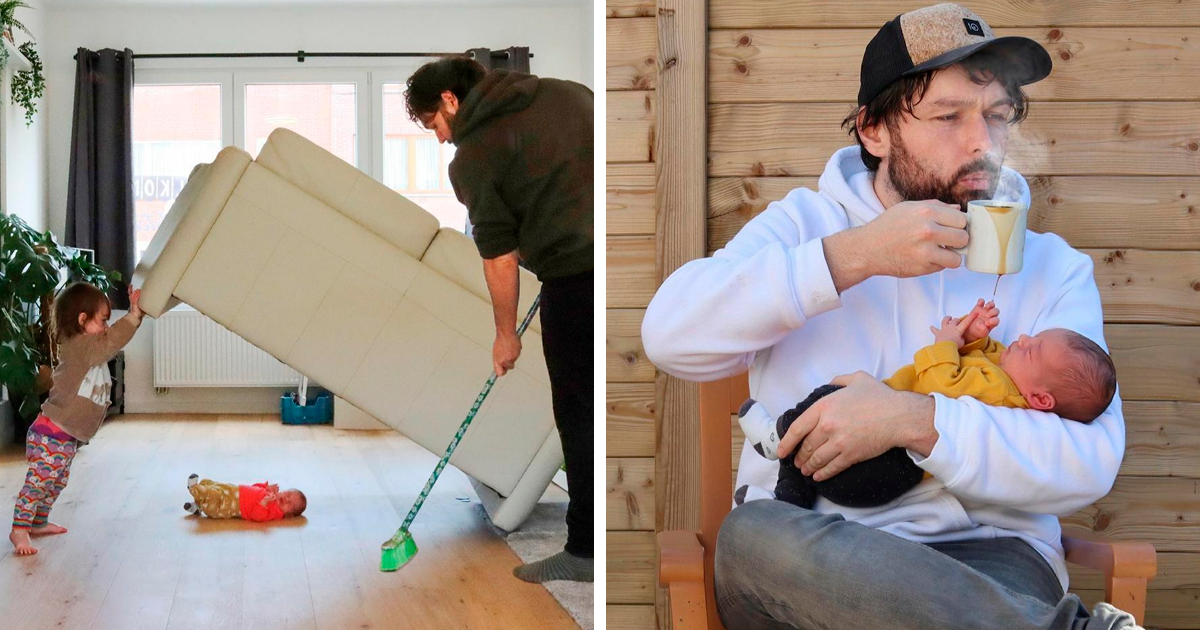
When a fine, most dads send a thumbs-up emoji. Kenny Deuss sends photographic “proof” that the baby has joined a motorcycle gang, climbed onto a roof, or taken over heavy machinery. The scenes look alarming for approximately half a secondthen the Photoshop joke lands, and ordinary childcare becomes a miniature action movie.
The Most Chaotic “Everything Is Fine” Update on the Internet
There are several acceptable replies to the message, “Are the babies okay?” You can write, “Yes.” You can send a peaceful picture of nap time. You can provide a detailed report covering snacks, diapers, and the suspicious silence coming from the toy room.
Or, if you are Belgian dad Kenny Deuss, you can send an image of your child apparently floating away with balloons while you look in the opposite direction.
That wonderfully unhelpful approach became the foundation of On Adventure With Dad, a photo project in which Deuss transforms normal moments with his daughters into cinematic scenes of hilariously irresponsible parenting. The pictures appear to place the children in impossible or dangerous situations, but the danger is digital. The photographs are carefully staged and edited, and Deuss has repeatedly emphasized that the children are safe during production. p>The result is a collection of funny dad photos that work on two levels. First comes the tiny jolt of panic: “Why is that baby operating an excavator?” Then comes the relief: “Oh, right. Photoshopand a father with entirely too many ideas.”
How a Routine Check-In Became a Viral Parenting Series
The running joke began after Deuss and his girlfriend welcomed their first daughter, Alix. When he was home with the baby, his girlfriend would check in and ask whether everything was all right. Instead of sending a conventional update, he created a surreal image of the infant sitting in an astronaut suit beside the road, apparently hitchhiking to the moon.
Her reaction mixed laughter, confusion, and a reasonable amount of parental quality control. She quickly understood that the image was a joke, but she also checked that it had been made safely. The gag became a tradition, and the pictures eventually moved from private messages to social media, where strangers discovered that watching a fictional baby crisis is much more enjoyable when the crisis has excellent lighting.
Then Baby Number Two Joined the Cast
When the couple’s second daughter, Aster, arrived, the project gained another performer and many more possibilities. One child can appear to cause trouble. Two children can establish a full criminal organization before lunch.
Deuss has said that everyday life inspires many of his concepts. A walk, a household chore, a toy, a skateboard, or a random location can become the seed of a visual punchline. He learned Photoshop as a teenager and later refreshed and expanded those skills while developing the series. The technical work matters, but the strongest images are powered by a very simple idea: take a familiar parenting situation and push it into absurdity. ection>
What Makes the 30 New Pics So Funny?
The comedy is not merely “baby plus danger.” Each photograph is built like a short joke with a setup, a visual surprise, and a recognizable piece of family life underneath it. The images feel exaggerated, but the emotions behind them are real: parental worry, toddler confidence, exhausted multitasking, sibling teamwork, and the universal suspicion that children begin planning household domination the moment adults leave the room.
1. Everyday Tasks Become Blockbuster Stunts
A simple outing can turn into a skateboard jump, a bicycle stunt, a rooftop rescue, or a trek through outer space. A quiet street becomes a movie set. A stroller becomes an adventure vehicle. A child’s plastic tricycle can create a traffic jam that suggests city planners have finally surrendered.
This contrast is essential. The original scene is usually ordinary enough to be recognizable, while the finished version is wildly disproportionate. It is the parenting equivalent of using a marching band to announce that someone found a clean pacifier.
2. The Babies Always Look Suspiciously Calm
Another reason the pictures work is the children’s expressions. Adults in action films usually scream when dangling over a canyon. Babies often respond with the emotional intensity of someone considering a cracker.
That calmness makes the edited chaos even funnier. Whether a child appears trapped in a vending machine, carried off by a seagull, lifted by construction equipment, or involved in an ATM heist, the tiny star frequently looks ready for snack time. The joke is not that the child understands the entire scenario. The joke is that the child appears to understand it better than the adults.
3. Dad Is Usually the Least Reliable Person in the Frame
Deuss often casts himself as the “clumsy dad” stereotype: distracted, overconfident, or hilariously unprepared. In one style of scene, he is comfortable while the child appears caught in a ridiculous predicament. In another, he seems to be participating enthusiastically in the bad idea.
The self-mockery keeps the project warm rather than smug. He is not presenting himself as a perfect parent with a spotless house and a color-coded snack system. He is playing the fictional character of a father who might solve childcare with duct tape, gravity, and one questionable online tutorial.
Behind the Photoshop: The Real Work Is Play
Although the final images are polished, the project depends on cooperation, patience, and timing. Young children do not report to a set, study a storyboard, and promise to hit their marks before the afternoon nap. They may pose beautifully. They may also decide that the prop is now a hat, the camera is offensive, and the production should be replaced by applesauce.
Deuss has explained that he tries to make the shoots enjoyable for his daughters. That approach matters because a playful session invites participation, while a rigid one turns a family hobby into unpaid overtime for toddlers. p>Child-development guidance supports the broader value of this kind of engaged play. The American Academy of Pediatrics describes play with parents and peers as important for developing healthy brains, bodies, and social bonds. The CDC also recommends active play, imitation, conversation, praise, and responsive interaction as practical ways to build positive relationships with infants and toddlers.
The Joke Is Digital, but the Connection Is Real
Before the editing begins, father and child still have to share a real moment. Someone chooses the location. Someone makes a funny face. Dad gets down to the child’s level. The child reacts, points, laughs, wanders away, returns, and accidentally invents a better pose.
Harvard’s Center on the Developing Child calls these responsive back-and-forth exchanges “serve and return” interactions. They help support early language, social development, and healthy brain architecture. A systematic review of father-child play likewise found that fathers’ play can make meaningful contributions to children’s development, although the quality and context of the interaction matter more than any single activity. ection>
Why Parents Everywhere Recognize the Joke
The series travels well because it begins with a familiar message: “How are the kids?” That question may be casual, but it carries an entire backpack of parental concerns. Did they eat? Did they nap? Is the house still structurally attached to the foundation? Why has nobody replied for seven minutes?
The photos turn that anxiety into shared humor. Instead of dismissing the checking parent as overly worried, the joke acknowledges the worry and then inflates it into fantasy. Yes, the children are fine. No, they have not actually taken the car. The image simply shows what the nervous imagination was already preparing to believe.
Shared laughter can also serve a relationship function. Research on couples has found associations between shared laughter, closeness, perceived support, and relationship quality. That does not mean one edited baby photo can repair every disagreement, but it does help explain why a recurring private joke can become a small ritual that makes stressful family logistics feel lighter. ection>
Funny Parenting Content Still Needs Real Boundaries
The pictures are entertaining because viewers understand that the scenarios are fake and the children were not placed in genuine danger. That boundary is the whole contract. A joke stops being funny when a child is frightened, humiliated, physically unsafe, or pressured to perform.
Parents creating similar content should begin with safety rather than special effects. Build the image from separate photographs. Use stable surfaces, age-appropriate props, close supervision, and short sessions. Never recreate the apparent stunt in real life merely because editing feels inconvenient. The baby does not need to be near a moving vehicle, power tool, rooftop edge, grill, deep water, or large animal. Photoshop is cheaper than an emergency room and generally has better undo options.
Remember the Child’s Digital Footprint
There is also a privacy question. The American Academy of Pediatrics advises parents to think carefully about “sharenting,” including whether a post reveals a child’s location, personal details, embarrassing content, or material the child may later wish had remained private. Its guidance recommends reviewing identifying details, privacy settings, audience, and the child’s growing ability to express preferences about being photographed or posted. p>A good family photo project can remain funny without making the child the butt of the joke. The safest formula is simple: laugh with the child, protect the child, and remember that online applause is temporary while a digital footprint may not be.
Thirty Pictures, One Surprisingly Sweet Story
At first glance, the collection is a parade of fictional parenting disasters. Look longer, and it becomes a record of a father spending time with his daughters, sharing his creative interests, and turning routine childcare into a family mythology.
The astronaut suit, the balloons, the skateboard, the vending machine, the seagull, and the construction equipment are the visible jokes. The quieter story is repetition: another Tuesday, another check-in, another idea, another hour spent making something together. Childhood changes quickly, and the series preserves not only how the girls looked but also the playful atmosphere surrounding them.
That may be why the pictures have endured beyond the first viral moment. The editing earns attention, but affection gives the images staying power. Plenty of people can learn to cut a subject from one layer and place it into another. Far fewer can make the finished picture feel like a family inside joke that the rest of the internet has been invited to enjoy.