Justin Timberlake intended to give Nashville concertgoers a gravity-defying performance of “Mirrors.” Instead, a tightly positioned safety harness created a reflection he probably did not expect millions of strangers to examine.
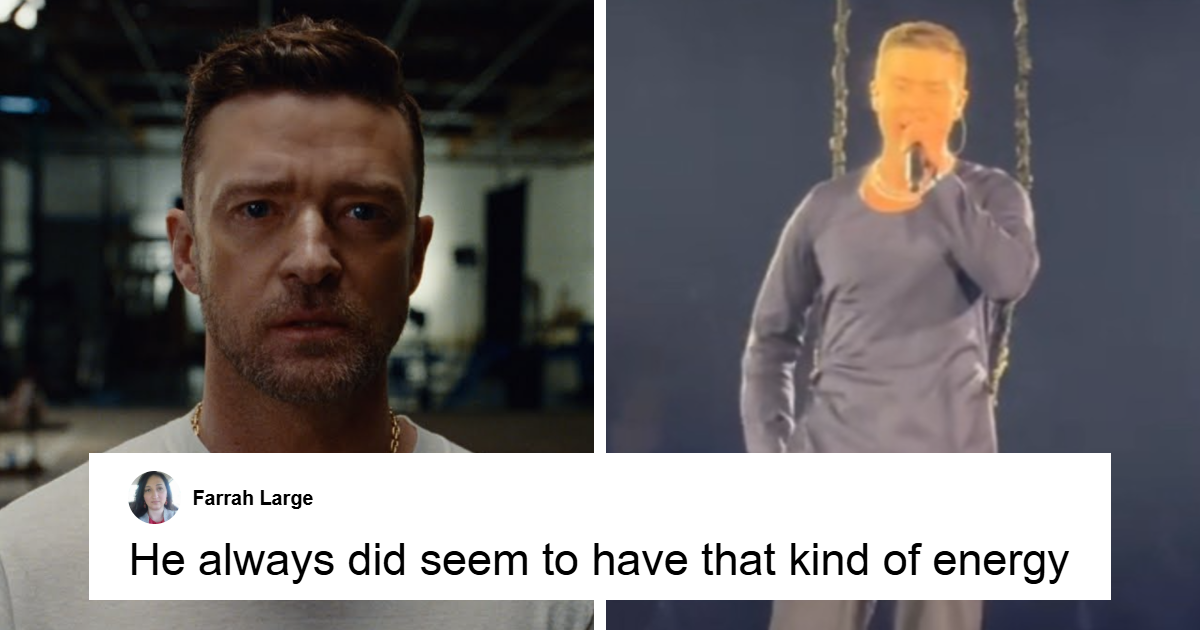
During the December 12, 2024, stop of Timberlake’s Forget Tomorrow World Tour at Bridgestone Arena, the singer was secured to an elaborate moving platform above the audience. His cropped black shirt shifted while the harness pressed against his pants, drawing attention to the outline of his groin. A fan recorded the moment, uploaded it to TikTok, and allowed the internet to perform its favorite trick: turning three awkward seconds into an international conference on someone else’s body.
The clip attracted millions of views, while comment sections filled with puns, jokes, unsolicited anatomical theories, and the especially merciless phrase “bringing micro back.” Timberlake did not publicly explain the incident at the time, but a noticeably longer shirt appeared at a later performance. In celebrity crisis management, apparently, hems can speak louder than press releases.
What Happened During Justin Timberlake’s Nashville Concert?
The viral Justin Timberlake wardrobe malfunction occurred while he was performing “Mirrors,” one of the climactic numbers in his arena show. For this portion of the concert, Timberlake was attached to a safety harness and positioned on a giant illuminated platform that moved above the crowd.
Bridgestone Arena’s event listing confirms that the Nashville concert took place on December 12, 2024. The production itself was no modest singer-and-a-microphone affair. Industry coverage of the Forget Tomorrow World Tour described an LED “floating stage” designed to let Timberlake perform over the audience, creating a dramatic visual finale. More than one million tickets had reportedly been sold during the tour’s early expansion, making the production one of the year’s most prominent pop outings.
While Timberlake was being secured, the harness tightened around his waist and upper thighs. Because his shirt did not extend far below the belt line, the equipment altered the fit of his pants and emphasized an area that was not supposed to become the evening’s supporting act.
In the fan video, Timberlake appeared to notice the problem. He repeatedly pulled down the bottom of his shirt, but the fabric was too short to provide much coverage once the harness was fully positioned. He continued singing and completed the performance without stopping the show. People and E! News both reported that the awkward moment occurred during “Mirrors” and involved the harness used for the suspended portion of the performance.
How a Few Seconds Became a Viral Spectacle
A wardrobe issue that might once have been noticed only by fans in the nearest seats can now be filmed in high definition, cropped vertically, replayed in slow motion, captioned with a punchline, and delivered to millions of phones before the performer reaches the next city.
The first major reports counted roughly 5.5 million views on the fan-captured video. Within days, later coverage placed the total above 11 million. Those changing numbers illustrate how quickly short-form entertainment spreads: an ordinary concert clip becomes a meme, the meme attracts reaction videos, and the reactions send viewers back to the original.
TMZ, Page Six, the New York Post, AOL, and Bored Panda were among the outlets that documented the surge in attention. Many of the reactions focused not simply on the clothing failure but on speculation about Timberlake’s anatomy. One commenter joked that he was “bringing micro back,” twisting the title of his 2006 hit “SexyBack.” Another widely repeated remark argued that he did not have a single song requiring that particular harness.
The jokes were short, easy to understand, and attached to a celebrity whom audiences already knew. That combination is premium fuel for social media. Nobody needed to understand concert engineering, costume construction, or the mechanics of a safety harness. They only needed four seconds of video and sufficient confidence to become an internet urologist.
The Harness Created the VisualNot a Reliable Measurement
Despite the certainty displayed in some comments, the footage revealed little about Timberlake’s body. A performance harness is designed to distribute weight and prevent a fall. It can compress clothing, pull fabric into unusual positions, flatten one area, exaggerate another, and create outlines that change with posture.
Stage lighting added another layer of distortion. Bright illumination, dark fabric, shadows, camera zoom, and the angle from the audience can all alter what appears on a phone screen. Drawing serious conclusions about anatomy from a compressed costume is like estimating someone’s height from a funhouse mirror. The image may be memorable, but the measurement is nonsense.
The Internet’s “Wardrobe Malfunction” Irony
The phrase “wardrobe malfunction” carries unusual historical baggage whenever Timberlake is involved. It became part of popular culture following the 2004 Super Bowl halftime show, when Timberlake removed part of Janet Jackson’s costume and briefly exposed her breast during their performance.
Timberlake used the phrase while apologizing for the incident. Although both performers were involved, the backlash was not distributed equally. Jackson experienced intense scrutiny, professional consequences, and years of debate about how race, gender, and the entertainment industry influenced the response. Timberlake continued enjoying considerable commercial success.
Time later reported that Timberlake described the Super Bowl incident as a mistake caused by miscommunication. Vanity Fair’s discussion of the documentary Malfunction: The Dressing Down of Janet Jackson emphasized how a fraction of a second reshaped Jackson’s public image and raised questions that remained disputed years later.
That history gave the Nashville mishap an unavoidable layer of irony. The man forever linked to the phrase was now experiencing a clothing-related viral spectacle himself. Some observers treated it as pop-culture karma. Others simply enjoyed the wordplay. Yet the comparison also exposed an important difference: Timberlake was mocked, but Jackson’s incident generated moral panic, regulatory controversy, and lasting career damage.
A few days of jokes about a harness are not equivalent to what Jackson endured. The parallel is interesting, but the consequences were dramatically different.
Justin Timberlake’s Longer Shirt Becomes the Quiet Response
Timberlake did not immediately release a statement about the Nashville video. There was no carefully worded apology, no interview explaining the physics of waist straps, and no social-media post asking everyone to kindly look elsewhere.
Instead, fans noticed a practical change during his December 20 concert in Kansas City. When it was time for the suspended “Mirrors” performance, Timberlake appeared in a longer black shirt that extended over his pelvis. The garment also included side openings that allowed it to sit around the harness without bunching as dramatically.
People, E! News, TMZ, Us Weekly, Yahoo Entertainment, and the New York Post all covered the apparent adjustment. Although Timberlake never confirmed that the longer shirt was a direct response, the timing and added coverage made the reason fairly easy to infer.
It was a sensible solution. Rather than feeding the viral cycle with an emotional statement, the production team fixed the clothing problem and continued the tour. Sometimes effective reputation management is not a 12-paragraph Notes app confession. Sometimes it is simply six more inches of fabric.
When Humor Crosses Into Body-Shaming
Celebrity mishaps invite jokes. Timberlake’s visible attempt to pull down a shirt that refused to cooperate was undeniably awkward, and the coincidence involving his history with the term “wardrobe malfunction” made the story unusually tempting.
However, much of the reaction moved beyond teasing the costume and into ridiculing a private body part. That distinction matters.
People generally recognize that mocking a woman’s breasts, weight, skin, or body shape can be degrading. Similar comments about men are often dismissed as harmless because men are expected to laugh, shrug, and demonstrate that they are confident enough not to care. The subject changes, but the underlying behavior remains appearance-based humiliation.
Pew Research Center has found that physical appearance is a recurring reason people report being targeted by online harassment. Its research also identifies offensive name-calling and purposeful embarrassment as common forms of digital abuse, with social media serving as the most frequent venue.
Timberlake is a wealthy, globally recognized entertainer with professional publicity support. He is not as vulnerable as an ordinary person suddenly mocked by millions. Even so, celebrity status does not transform every physical feature into public property.
It is possible to laugh at the engineering failure without pretending that genital-size jokes are sophisticated social commentary. The harness was badly paired with the shirt. That is funny. Acting as though a blurry outline determines someone’s masculinity is simply middle-school bullying with faster Wi-Fi.
Why Concert Wardrobe Failures Happen
Tour costumes must accomplish several jobs simultaneously. They need to look good under powerful lights, remain recognizable from distant seats, accommodate choreography, survive sweat, work with microphones and in-ear equipment, and avoid interfering with safety systems.
A garment that looks perfect while a performer stands normally may behave differently when pulled against a harness. The shirt can ride upward, the waistband can shift, and straps can create tension in places that costume designers did not anticipate.
Timberlake’s floating platform was an ambitious production feature rather than a simple stage lift. Pollstar later reported that the touring system used a custom-designed winch and a large video platform engineered to move with extremely high accuracy. Complex machinery may operate exactly as designed while still exposing a weakness in the clothing layered over its safety equipment.
Camera Phones Change the Testing Process
Wardrobe teams once tested costumes mainly from the audience’s natural viewpoint. Modern shows must also account for dozens of smartphone angles, telephoto lenses, slow-motion playback, digital sharpening, and screenshots taken at the least flattering possible moment.
A dark outfit may look polished to the naked eye but reveal unexpected contours when filmed under an LED spotlight. A shirt that provides coverage while standing may fail when the performer leans backward. A strap concealed from the front may become obvious from a side balcony.
That means costume rehearsals should be recorded from multiple audience positions. Wardrobe teams need to review not only how the outfit moves but also how phone cameras interpret it. The audience is no longer merely watching the show. It is creating thousands of alternate broadcasts.
What the Viral Moment Says About Celebrity Culture
The Justin Timberlake bulge video became popular partly because it punctured the control associated with a major arena tour. Pop concerts are carefully designed environments in which choreography, lighting, video, clothing, and machinery work together to create an almost superhuman image.
Then one strap lands in the wrong place, and the illusion disappears.
Audiences are fascinated by such moments because they make celebrities seem ordinary. The performer who has rehearsed every move suddenly looks like anyone else fighting with an inconvenient piece of clothing. That flash of vulnerability can be funny, relatable, and even charming.
The trouble begins when viewers treat vulnerability as permission for cruelty. Social platforms reward the fastest and sharpest joke, not the fairest interpretation. A restrained observation rarely travels as far as a humiliating nickname. Outrage and mockery generate replies, and replies generate distribution.
Consequently, the harshest comment can become more visible than the original event. The person who recorded Timberlake captured a minor wardrobe problem. The internet turned it into a referendum on his body because ridicule offered more engagement than a technical explanation.
Related Experiences: Lessons for Performers, Fans, and Production Crews
Anyone who has worn unfamiliar formal clothing, safety equipment, a dance costume, or even an inconveniently fitted pair of pants can recognize the basic experience behind the incident. Clothing behaves differently once a person starts moving. Something comfortable in a dressing room may become restrictive after ten minutes of dancing, sitting, climbing, or sweating.
For performers, the most uncomfortable part may not be the malfunction itself. Professionals are trained to continue. The difficult moment often arrives later, when they discover that someone filmed the problem and millions of strangers are replaying it. Onstage embarrassment lasts seconds; online embarrassment can be searchable for years.
This makes preparation important, but it also makes emotional resilience essential. A performer cannot control every camera, comment, or screenshot. The most practical response is usually to identify the fix, avoid giving malicious jokes unnecessary oxygen, and return attention to the work. Timberlake’s apparent shirt adjustment followed that pattern.
Wardrobe and production teams can learn from the same experience. Harness-compatible clothing should be tested under realistic tension, not merely placed over equipment during a stationary fitting. The performer should rehearse the full sequence while singing, turning, leaning, and reaching. Crew members should film the rehearsal from below, from the side, and with strong lighting.
Backup garments should also be ready. A second shirt with a longer hem, reinforced seams, or different fabric can prevent a minor problem from repeating across dozens of shows. The replacement must remain functional: simply adding fabric is not enough if it tangles with safety equipment.
Fans have a different decision to make. Recording a memorable concert moment is normal, and public performances are routinely photographed. Yet posting a person’s embarrassing physical outline with a degrading caption is not the only available choice. A fan can share the spectacle of the moving stage, the vocals, the crowd’s reaction, or Timberlake’s ability to continue performing without turning his body into the punchline.
Media outlets also shape the experience. Reporting that a celebrity wardrobe malfunction went viral is legitimate entertainment news. Repeating every cruel comment can amplify the most demeaning part of the conversation. Responsible coverage can describe the jokes, explain why the clip spread, and still distinguish between humor and body-shaming.
For ordinary social-media users, this incident offers a useful pause-before-posting exercise. Imagine that the person in the clip is a coworker, friend, or relative rather than a millionaire pop star. Would the joke still seem harmless? Would you upload the zoomed-in video? Would you tag the person and invite strangers to inspect it?
Celebrity culture encourages viewers to forget that public figures experience embarrassment like everyone else. Fame may provide thicker armor, but it does not remove basic dignity. The best online humor punches at absurd situations, bad designs, or the chaos of live entertainment. It does not need to reduce a person to one body part.
Conclusion: The Harness Lost, but the Show Continued
Justin Timberlake’s Nashville wardrobe malfunction was a perfect viral storm: a famous performer, an ambitious floating stage, a poorly covered harness, a recognizable song, and an audience equipped with high-resolution phones.
The moment was awkward, but it was not catastrophic. Timberlake continued performing, the clip generated millions of views, and a longer shirt appeared at a later concert. The production problem was corrected without a dramatic public response.
The online reaction, however, revealed something broader. Social media can convert harmless embarrassment into mass body-shaming before anyone stops to ask whether the joke is fairor whether a safety harness might simply make clothing look strange.
The cleverest conclusion is not that Timberlake was “bringing micro back.” It is that even a multimillion-dollar tour can be defeated by an ambitious strap and an insufficient hemline. Live entertainment remains live, humans remain human, and somewhere in the touring wardrobe department, the extra-long shirts have probably earned permanent job security.