A late-night request for menstrual pads should have been a five-minute errand. Instead, it became a full relationship audit, complete with embarrassment, anger, silent treatment, and one boyfriend discovering that a package of absorbent cotton apparently had the power to challenge his entire identity.
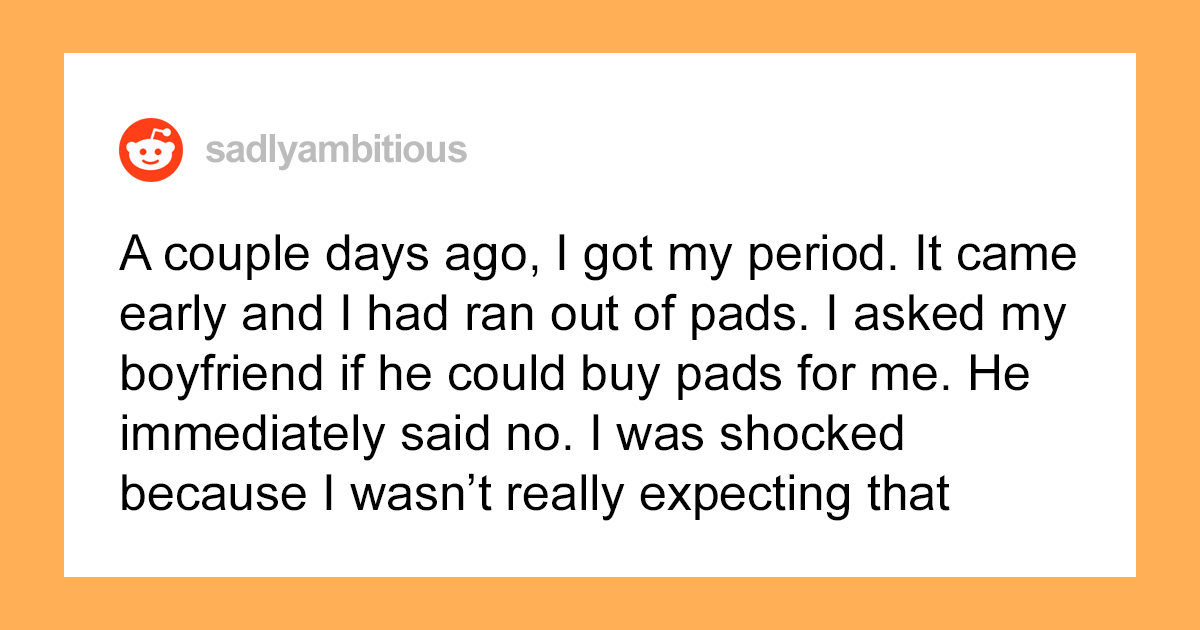
The incident began with an anonymous woman asking her boyfriend to buy pads after her period arrived early. According to her account, she was bleeding heavily, had no supplies left, and worried that leaving the house would mean bleeding through her clothes. Her boyfriend refused because he did not want a cashier or other shoppers to see him carrying menstrual products. When she described his reaction as childish and called his masculinity fragile, he became angry and left.
On the surface, this was an argument about a drugstore purchase. Underneath, it raised much larger questions about period stigma, gender stereotypes, empathy, emotional maturity, and what partners owe each other when one of them needs practical help.
What Happened During the Pad Dispute?
The woman, who described herself as 23, said she had been dating her 24-year-old boyfriend for two years and had recently moved in with him. When her period unexpectedly started, she asked him to visit a nearby store and buy pads. He reportedly worried that the cashier would judge him or assume the products were for him.
She suggested using self-checkout, but that did not solve his deeper concern: he was afraid that simply being seen with pads would make strangers question his gender. His explanation included an anti-transgender remark, turning an already immature refusal into evidence of broader prejudice.
After he stormed out, she improvised with toilet paper, put on dark clothing and a long cardigan, and went to the store herself. In an update, she said he later insisted she could have temporarily “held it in,” revealing a basic misunderstanding of menstruation. She ultimately ended the relationship after their follow-up conversation exposed incompatible attitudes about caregiving, childbirth and transgender people. Because the story came from an anonymous social media account, its details cannot be independently verified, but the conflict reflects attitudes that appear in many real conversations about periods.
Why Refusing to Buy Pads Is Not a Small Issue
Menstruation is the shedding of blood and tissue from the lining of the uterus. Unlike urination, menstrual flow cannot simply be paused until a more convenient time. Pads are ordinary health and hygiene products designed to absorb that flow, just as bandages absorb blood from a cut.
That makes the girlfriend’s request both reasonable and urgent. She was not asking him to wrestle a bear, perform surgery or explain why every streaming service suddenly costs more. She was asking him to carry a package from a shelf to a checkout counter.
Partners do not have to fulfill every request immediately, and everyone is allowed to experience awkward feelings. The important distinction is between feeling embarrassed and allowing that embarrassment to leave someone you love without basic supplies. Emotional discomfort may explain a reaction, but it does not automatically excuse the behavior that follows.
The Real Question Was Whether He Would Show Up
Small emergencies often reveal more about a relationship than carefully planned romantic gestures. Flowers on an anniversary are lovely, but reliability is measured when somebody is sick, stranded, frightened, bleeding or otherwise having a terrible Tuesday.
Relationship research emphasizes “turning toward” a partner’s bids for attention, assistance and emotional connection. A request for pads was also a request for reassurance: “I am uncomfortable and vulnerable. Can I depend on you?” Refusing because strangers might form an imaginary opinion communicated that protecting his image mattered more than meeting her immediate need.
How Period Stigma Turns a Normal Errand Into a Crisis
Period stigma describes the shame, secrecy and discrimination attached to menstruation. It appears when people whisper the word “period,” hide pads inside their sleeves, joke that an upset woman must be menstruating or act as though unopened menstrual products are radioactive artifacts from a forbidden temple.
Health educators note that speaking about menstruation only through euphemisms and embarrassed jokes reinforces the idea that it is dirty or inappropriate. Normalization begins when people discuss periods accurately, provide menstrual supplies openly and stop treating routine reproductive health as a source of humiliation.
This stigma has consequences beyond awkward shopping trips. A U.S. study of college-aged women found that some students had been unable to afford needed menstrual products, with period poverty associated with worse mental health outcomes. Access to pads and tampons is therefore not merely a matter of convenience; it affects dignity, participation in school or work, and psychological well-being.
Education that includes boys and men can help dismantle the taboo. UNICEF USA has emphasized that communities are better able to challenge menstrual stigma when boys, parents and community leaders participate rather than treating menstruation as secret information available only to girls. Surveys from menstrual-health organizations also suggest that many boys and young men want to help reduce period shame when they receive accurate information and permission to discuss it.
Was This Really Fragile Masculinity?
Masculinity itself is not the problem. Confidence, courage, responsibility and resilience can be healthy qualities. Fragile masculinity emerges when a man feels that ordinary behavior might make him appear insufficiently masculine and then overreacts to defend his status.
In this case, the boyfriend was not merely unfamiliar with pad brands. Plenty of people have stood in the menstrual-care aisle staring at labels such as “regular,” “overnight,” “ultra thin” and “maximum” as though decoding a satellite transmission. Confusion would have been understandable. His objection was that carrying the package could change how strangers perceived him.
Psychological guidance on boys and men warns that rigid expectations involving emotional restriction, extreme self-reliance and fear of appearing feminine can interfere with healthy relationships. More constructive models of masculinity emphasize respect, emotional awareness, intimacy, flexibility and responsible care for others.
A secure man can buy pads without believing the purchase alters his gender, sexuality or social value. In fact, helping a partner despite mild awkwardness demonstrates confidence. The strongest person in the pharmacy is rarely the one terrified of aisle seven.
Did Calling Him Fragile Make the Argument Worse?
Calling someone fragile during a heated argument is unlikely to make that person suddenly respond, “Excellent observation. I shall now begin a thoughtful examination of my gender conditioning.” Labels can trigger defensiveness, particularly when laughter has already made someone feel embarrassed.
A calmer statement might have been more productive: “I feel abandoned because you are prioritizing strangers’ opinions over my health and comfort.” Healthy conflict communication generally focuses on the specific behavior, its impact and the change being requested. Repair attempts, listening and a willingness to accept influence can help couples move through disagreements without turning every conflict into a courtroom drama.
However, imperfect wording does not make both actions equivalent. Her comment may have been sharp, but his refusal left her without necessary products. He then reportedly stormed out, ignored her and showed little interest in understanding her physical situation. Criticizing the delivery should not erase the underlying issue.
The later conversation mattered even more. A healthy partner might admit feeling embarrassed, apologize and learn. Instead, he allegedly doubled down, claimed menstrual blood could be controlled voluntarily and dismissed the possibility that someone might need help after childbirth. The problem was no longer a single shopping trip. It was a pattern of ignorance, contempt and unwillingness to provide care.
Relationship Red Flags Revealed by the Incident
He Put Imaginary Strangers Above His Partner
No cashier was known to have mocked him. No shopper had challenged him. He created a hypothetical audience, imagined its judgment and allowed that fantasy to outweigh his girlfriend’s real discomfort.
He Responded to Correction With Withdrawal
Taking a brief pause during an argument can be healthy when someone communicates that they need time to calm down. Storming out and then ignoring a partner as punishment is different. It leaves the conflict unresolved and can pressure the other person to apologize simply to restore contact.
He Was Unwilling to Learn Basic Biology
People are not born knowing how menstrual cycles or menstrual products work. Ignorance can be corrected. The red flag is refusing accurate information because accepting it would require admitting a mistake.
His Attitude Raised Questions About Future Caregiving
Long-term relationships may involve pregnancy, recovery from surgery, disability, illness, aging and unpleasant bodily functions. Someone who cannot tolerate carrying a clean package of pads may struggle when caregiving becomes more demanding.
What a Supportive Boyfriend Would Have Done
A supportive response could have been remarkably simple: ask which product she needed, request a photo of the package and go to the store. If the exact item was unavailable, he could call or send pictures of alternatives.
Pads vary by absorbency, length, thickness and whether they have wings. Planned Parenthood and Cleveland Clinic explain that lighter products may be suitable for mild flow, while larger or overnight pads provide more coverage for heavier bleeding. The goal is to choose a product that keeps the wearer comfortable and allows normal daily activities.
A practical shopping checklist would include:
- The preferred brand or a clear photo of the package.
- The absorbency level, such as regular, heavy or overnight.
- Whether the pads should have wings.
- The preferred length or size.
- Whether unscented products are required.
When uncertain, buying two reasonable options is usually better than returning empty-handed with a speech about the collapse of modern manhood.
How Couples Can Discuss Menstrual Shame Constructively
People sometimes inherit embarrassment from families, schools, religious communities, peers or media. That history can be acknowledged without allowing it to control the relationship.
The embarrassed partner can say, “I was taught that periods were private, so buying pads makes me uncomfortable. I know the feeling is irrational, and I do not want it to stop me from helping you.” That statement takes responsibility while opening the door to learning.
The menstruating partner can explain what products are needed, why the request may be urgent and what support feels helpful. Both people should avoid turning embarrassment into ridicule or turning ignorance into a permanent character defense.
The standard is not instant perfection. It is a willingness to listen, improve and choose care over ego.
Experiences and Lessons Related to Buying Pads for a Partner
Public discussions about this dispute produced many stories showing that embarrassment and helpfulness can coexist. Some men admitted that they felt awkward the first time they entered the menstrual-product aisle. They still completed the purchase because their partner, daughter, sister or friend needed assistance. The feeling was temporary; the act of support was what mattered.
The Confused but Determined Shopper
One common experience involves a boyfriend receiving instructions that sound simple until he sees an entire wall of nearly identical packages. He calls from the aisle, sends six photos and asks whether “overnight” means the pads can only be purchased after sunset.
This person may be confused, but he is participating. He wants to get the choice right. The phone calls may be mildly chaotic, yet they communicate effort and concern. Product knowledge can be learned in one shopping trip; willingness cannot be forced nearly as easily.
The Father Who Keeps the Packaging
Another frequently shared strategy is keeping a photograph or piece of the old package so a father or partner can match the correct brand and absorbency. Packaging changes can still cause confusion, but the system demonstrates preparation rather than avoidance.
For households with teenagers, keeping several kinds of pads in an accessible bathroom cabinet can make menstruation feel ordinary. It also ensures that guests or family members do not have to make an emergency request while attempting to conceal a perfectly normal bodily function.
The Partner Who Creates a Period Emergency Kit
Some couples keep a small kit containing pads, pain relievers approved for the user, spare underwear, cleansing wipes and a disposable bag. A partner may store another pad in a backpack or vehicle, subject to the product’s storage instructions.
This is not an extravagant romantic gesture. It is the menstrual equivalent of carrying tissues or an umbrella. Yet the preparation can make a partner feel seen because it recognizes a recurring need without shame.
The Shopper Who Buys the Wrong Product
Support does not always arrive with perfect accuracy. A well-intentioned person might confuse pads with liners, buy scented products when unscented ones were requested or return with a package large enough to survive a biblical flood.
Unless the mistake resulted from refusing to listen, it can become a funny shared story rather than a relationship crisis. The difference is attitude. “I tried, show me what to get next time” builds trust. “This is embarrassing and therefore your problem” destroys it.
The Moment That Reveals Long-Term Compatibility
A menstrual-product request may seem too ordinary to influence a relationship’s future, but ordinary moments are where compatibility lives. Couples eventually face stomach viruses, medication pickups, fertility issues, pregnancy complications, injuries and aging parents. Love cannot survive on attractive vacation photos alone; sometimes it must enter a pharmacy and ask an employee where the extra-long pads with wings are located.
Someone does not need to understand every physical experience personally to respond with respect. Empathy is the ability to recognize another person’s reality without making that reality compete against one’s pride.
The most encouraging experiences are rarely about fearless shoppers. They are about people who feel uncertain, ask questions and help anyway. Courage is not the absence of awkwardness. Sometimes it is carrying a bright package of pads to the checkout while remembering that the cashier has seen approximately ten thousand stranger purchases and will forget this one before the receipt finishes printing.
Final Takeaway
The viral boyfriend-pad dispute was never only about menstrual products. It was about whether one partner could put another person’s immediate need above his fear of social judgment.
The girlfriend’s “fragile masculinity” comment was confrontational, and a behavior-focused statement might have encouraged a better conversation. Nevertheless, the boyfriend’s reported refusal, misinformation, prejudice and lack of empathy were the central problems. His reaction transformed an easy act of care into evidence that their values were fundamentally incompatible.
Buying pads does not reduce anyone’s masculinity. Refusing to help a vulnerable partner because a cashier might notice the purchase does, however, reveal insecurity. Healthy confidence is not threatened by menstrual products. It picks up the correct absorbency, remembers the wings and asks whether anything else is needed.
Note: This article analyzes an anonymous, self-reported social media story that cannot be independently verified. It uses the incident as a broader discussion of menstrual stigma, gender expectations, caregiving and healthy relationship communication.