For more than two decades, commercial aviation has followed a slightly embarrassing rule: airplanes may become more connected, more efficient, and better at serving tiny pretzels, but they are not allowed to become dramatically faster. Since Concorde retired in 2003, passengers crossing the Atlantic have traveled at roughly the same cruising speeds their parents did.
Boom Supersonic wants to change that. Its experimental XB-1 aircraft was never intended to carry vacationers, serve sparkling wine, or squeeze a roller bag into an overhead bin. It was built to answer a more important question: Can a private company design, manufacture, and safely fly a modern civil supersonic jet?
On January 28, 2025, XB-1 supplied Boom’s preferred answer by breaking the sound barrier over California’s Mojave Desert. It repeated the achievement on February 10, reaching Mach 1.18 before completing its 13-flight test program. The flights made XB-1 the first independently developed civil supersonic jet to exceed Mach 1 and the first American-built civil aircraft to do so in decades.
That accomplishment was meaningful, but it was not a boarding announcement for next Tuesday’s flight to London. XB-1 was a technology demonstrator. Boom must now transfer its lessons to Overture, a much larger passenger aircraft that still needs engines, extensive testing, regulatory certification, manufacturing scale, airline acceptance, and an economic model capable of surviving outside a PowerPoint presentation.
What Is Boom’s XB-1?
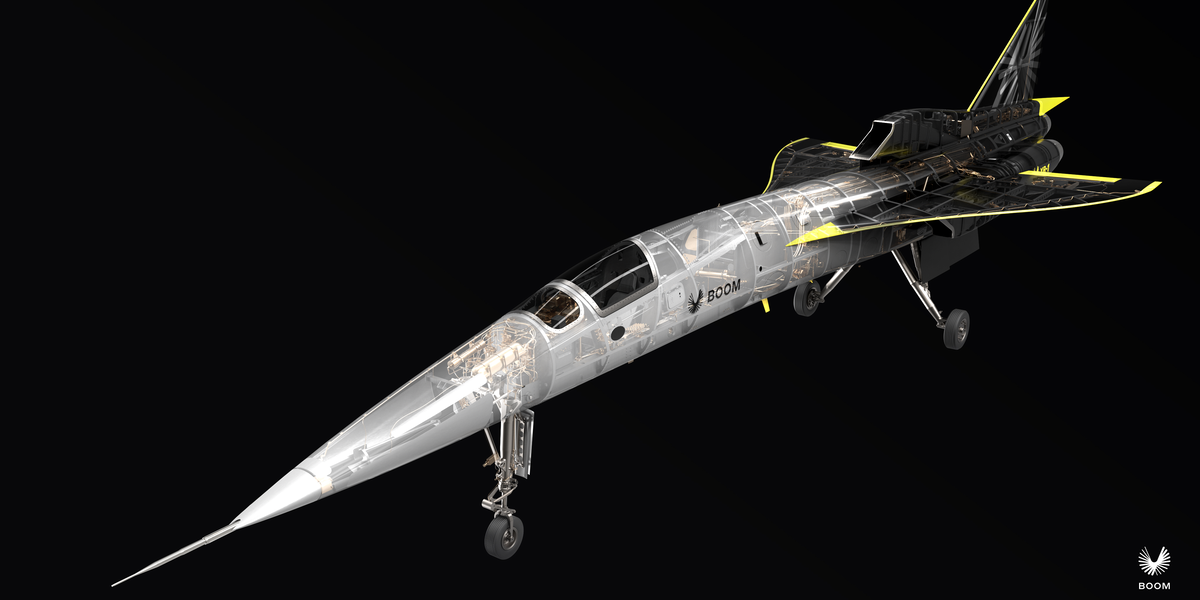
XB-1 was a slender, single-seat test aircraft designed to explore the materials, aerodynamics, flight-control systems, manufacturing methods, and operational procedures needed for future supersonic airliners.
The aircraft was powered by three General Electric J85 turbojet engines, a proven engine family historically used in military aircraft. XB-1 was therefore not a miniature Overture with the future airliner’s planned propulsion system. Instead, it functioned as a flying laboratory that allowed Boom to test supersonic concepts without first building a full-size passenger jet costing billions of dollars.
Technology Hidden Beneath the Shiny Exterior
XB-1 incorporated carbon-fiber composite structures, digitally augmented flight controls, specialized supersonic engine inlets, and a camera-based vision system that helped the pilot see the runway despite the aircraft’s long nose.
That last feature is especially important. Concorde used its famous movable “droop nose” to improve visibility during takeoff and landing. Boom replaced the mechanical nose movement with cameras and cockpit displays. It is the aerospace equivalent of replacing a complicated folding map with navigation softwareprovided the software has been engineered to standards considerably higher than “my phone normally works.”
XB-1 also allowed Boom’s engineers to compare real flight behavior with wind-tunnel results and computer simulations. Supersonic airflow creates shock waves, heating, pressure changes, and stability challenges that cannot be fully understood by admiring a beautiful rendering. Eventually, metal and composite materials must meet actual air moving very quickly.
How XB-1 Reached the Sound Barrier
XB-1 made its first flight from Mojave Air and Space Port on March 22, 2024. Boom then expanded the aircraft’s flight envelope gradually, testing landing gear, handling characteristics, stability systems, higher altitudes, and increasingly fast speeds.
This methodical approach matters because test pilots do not simply point an experimental aircraft toward the horizon and push every lever forward. Each flight generates data that engineers review before approving the next step. The process can appear slow from the outside, but “boringly careful” is a highly desirable personality trait when an aircraft is approaching Mach 1.
During its first supersonic mission on January 28, 2025, chief test pilot Tristan “Geppetto” Brandenburg accelerated XB-1 through the sound barrier several times. On its second and final supersonic flight, the aircraft reached Mach 1.18, a maximum airspeed reported by Boom as 772 mph, and climbed to 36,514 feet during a 41-minute mission.
NASA also worked with Boom to capture schlieren imagery of XB-1’s shock waves. Schlieren photography visualizes changes in air density that are normally invisible, making the pressure waves around a supersonic aircraft appear almost like ripples around a boat. The images gave engineers another way to compare predicted airflow with real-world behavior.
What XB-1 Provedand What It Did Not
The most important achievement of XB-1 was organizational as much as aerodynamic. Boom demonstrated that its team could design an experimental aircraft, build it, obtain authorization to test it, operate a disciplined flight program, and safely pass through Mach 1.
The project also produced practical experience in composite manufacturing, high-speed flight controls, inlet performance, cockpit visibility, flight-test procedures, and atmospheric prediction. These lessons can influence Overture even though the passenger jet will be considerably larger and differently configured.
However, XB-1 did not prove that Overture will be profitable, environmentally sustainable, affordable to operate, easy to certify, or ready on Boom’s preferred schedule. It did not test the Symphony engine being developed for Overture, carry passengers, demonstrate airline-style reliability, or complete thousands of pressurization and service cycles.
In other words, XB-1 showed that Boom can climb the first serious mountain. Overture is the rest of the mountain range.
Overture Is the Aircraft Boom Really Wants to Sell
Boom’s commercial ambition is Overture, a four-engine supersonic airliner planned to carry approximately 64 to 80 passengers in an all-premium cabin. The company targets a cruise speed of Mach 1.7 over water, a cruising altitude near 60,000 feet, and a range of roughly 4,250 nautical miles.
At those speeds, trips such as New York to London could take about three and a half hours rather than seven or eight. San Francisco to Tokyo could become a same-day business trip for travelers possessing heroic resistance to jet lag.
Boom says Overture could serve more than 600 global routes and offer fares comparable to present-day business-class tickets. That positioning is significant. The aircraft is not being pitched as mass transportation for every traveler. It is designed to compete for passengers who already pay a premium for comfort, schedule flexibility, and time savings.
Airlines Have Expressed Serious Interest
Boom reports a combined order book of 130 orders, options, and preorders involving United Airlines, American Airlines, and Japan Airlines. United agreed to purchase 15 aircraft if Overture meets its safety, operating, and sustainability requirements, with options for 35 more. American placed a deposit on 20 aircraft and secured options for another 40. Japan Airlines has maintained a strategic partnership that includes options for up to 20 aircraft.
These agreements give Boom commercial credibility, but they are not the same as 130 completed aircraft sales with guaranteed delivery dates. Airline commitments commonly contain technical, financial, certification, and performance conditions. The customers are interested, but Overture must still earn its place on the ramp.
The Symphony Engine May Be Boom’s Hardest Test
A supersonic airliner requires more than a sleek fuselage. It needs engines capable of producing strong takeoff thrust, operating efficiently during supersonic cruise, complying with airport noise requirements, achieving airline-grade reliability, and remaining maintainable over decades of service.
After Boom and Rolls-Royce ended an earlier engine-development arrangement, Boom announced Symphony, a purpose-built medium-bypass turbofan. The engine is intended to support supersonic cruise without relying on the fuel-hungry afterburners used by Concorde during portions of its operation.
Boom is pursuing a vertically integrated approach, designing and building the engine with assistance from specialist partners. The company says an ignition test has demonstrated flame stability and that a fully operational engine-core prototype test is planned during 2026. It has also established an engine-testing site at Colorado Air and Space Port.
This is ambitious. Developing a clean-sheet commercial engine is one of aerospace engineering’s most expensive and unforgiving assignments. An engine must perform correctly not once, but repeatedly, in heat, cold, rain, crosswinds, turbulence, high-altitude cruise, airport congestion, and the occasional encounter with a bird that has ignored the flight plan.
Until Symphony runs as a complete engine and advances through certification testing, Overture’s schedule remains highly dependent on a propulsion system that is still being created.
Boom Is Preparing to Manufacture Overture
Boom completed construction of its Overture Superfactory at Piedmont Triad International Airport in Greensboro, North Carolina, in 2024. The first planned assembly line is designed for up to 33 aircraft annually. A proposed second line could increase total capacity to 66 aircraft per year.
The building is an important commitment because aerospace factories require specialized tooling, quality-control systems, trained technicians, supplier coordination, and extensive documentation. Completing the structure, however, is different from operating a mature production line. Boom must install equipment, finalize manufacturing procedures, secure certified parts, build its workforce, and manage a global network of suppliers.
Aircraft manufacturing has repeatedly taught the industry that increasing production can expose problems hidden during prototype construction. A team may lovingly hand-build one beautiful aircraft. Producing dozens on schedule, with identical quality and controlled costs, is where aviation becomes less romance and more industrial choreography.
Can Supersonic Flight Become Quiet Enough?
Sonic booms helped restrict Concorde mainly to routes over oceans. In the United States, civil aircraft have historically been prohibited from routine supersonic operation over land because their shock waves could create disruptive noise at the surface.
Boom has demonstrated an operational technique it calls Boomless Cruise. The concept relies on a phenomenon known as Mach cutoff. Under suitable atmospheric conditions, an aircraft flying at the correct altitude and speed can produce shock waves that refract upward before reaching the ground.
Boom says Overture could use real-time atmospheric information and automated flight controls to fly as fast as approximately Mach 1.3 over land without an audible boom reaching people below. This is not the same as eliminating shock waves or shaping the aircraft to produce a permanently quiet sonic signature. Its effectiveness depends on altitude, temperature, wind, and other atmospheric conditions.
U.S. Regulations Are Beginning to Change
In July 2026, the FAA published a proposed rule that would replace the blanket speed-based prohibition with an interim noise-based framework. Under the proposal, supersonic operations could be authorized when predicted sonic-boom overpressure at the surface remains below 0.11 pounds per square foot and the operator demonstrates compliance through approved technology or procedures.
The proposal is not a universal permission slip, and it was not yet a final rule when published. Nevertheless, it represents a major policy shift: regulators are considering whether aircraft should be judged by the noise that reaches the ground rather than by speed alone.
NASA’s X-59 program is tackling the problem from another direction. The experimental aircraft is shaped to transform the traditional boom into a quieter thump. X-59 first exceeded Mach 1 on June 5, 2026, and NASA plans to collect community-response data that can help regulators develop future noise standards. Boom’s atmospheric Mach-cutoff strategy and NASA’s low-boom aircraft design are different approaches, but both could expand the practical route network for commercial supersonic travel.
The Environmental Argument Will Not Disappear
Boom says Overture and Symphony are being designed to operate with up to 100% sustainable aviation fuel, commonly called SAF. Depending on its feedstock and production process, SAF can reduce lifecycle carbon emissions compared with conventional petroleum jet fuel.
However, compatibility with SAF does not guarantee that enough low-carbon fuel will exist at an affordable price. SAF remains scarce relative to total aviation demand, and different fuel pathways provide widely varying environmental benefits.
Supersonic aircraft also require substantially more energy per passenger than conventional jets because they must overcome greater aerodynamic drag while carrying fewer people. Researchers have raised concerns about carbon dioxide, nitrogen oxides, water vapor, soot, and other emissions released at high cruising altitudes.
An analysis by the International Council on Clean Transportation estimated that large-scale Overture deliveries through 2050 could consume a significant share of aviation’s remaining carbon budget, even under an aggressive SAF scenario. Boom disputes the idea that high-speed aviation is inherently incompatible with sustainability and argues that modern aerodynamics, efficient engines, SAF, and reduced contrail formation at higher altitudes can improve the picture.
The final answer will depend on real engine performance, actual fuel consumption, the source and availability of SAF, aircraft utilization, and the number of Overtures eventually built. Physics, unfortunately, does not accept optimistic press releases as a substitute for fuel-burn data.
Can Boom Avoid Concorde’s Fate?
Concorde remains one of history’s most recognizable aircraft. It crossed the Atlantic at roughly twice the speed of sound and served passengers for more than 25 years. It was also expensive to operate, restricted to a limited number of routes, noisy around airports, and accessible mainly to wealthy travelers.
The aircraft’s retirement followed a combination of economic pressures, aging equipment, costly maintenance, reduced premium demand after the September 11 attacks, and the consequences of the fatal Air France crash in 2000. Concorde proved that commercial supersonic flight was technically possible, but it did not create a broadly scalable market.
Boom hopes to improve the formula with digital engineering, composite materials, modern avionics, non-afterburning engines, a larger international travel market, and an aircraft sized for premium demand. Overture does not need to replace every conventional jet. It needs enough high-value routes and enough passengers willing to pay for time.
Success will require dependable engines, predictable maintenance costs, acceptable airport noise, reliable access to fuel, regulatory approval, and airline economics that work through both prosperous years and recessions. Supersonic glamour attracts attention. Dispatch reliability pays the bills.
A Traveler’s-Eye Experience: What the Supersonic Comeback Could Feel Like
Imagine arriving at Newark in the morning for a flight to London. The airport experience may look surprisingly familiar. There would still be security lines, boarding groups, gate changes, and at least one passenger reorganizing an entire suitcase directly in front of the boarding door.
The difference would begin with the aircraft. Overture’s long, narrow fuselage and sculpted wing would look unlike the widebody jets parked nearby. With only 64 to 80 passengers in an all-premium configuration, boarding could be faster and less chaotic. Instead of hundreds of people funneling through multiple cabin zones, the experience might resemble a large international business-class cabin occupying the entire airplane.
After takeoff, Overture would initially fly below the speed of sound. Passengers probably would not experience a dramatic movie-style surge when the aircraft accelerated. Supersonic cruise is not a roller-coaster launch. Inside a pressurized cabin, the transition through Mach 1 could feel ordinary unless the crew announced it or the entertainment display showed the changing speed.
That may be the strangest part of the experience: something historically extraordinary could feel physically routine. A screen might display Mach 1.2, then Mach 1.5 and Mach 1.7, while a passenger answers email, watches a movie, or wonders why the person across the aisle has removed both shoes.
At a planned cruise altitude near 60,000 feet, the sky above could appear darker than it does from a conventional airliner. The curvature of the horizon might become slightly more noticeable under clear conditions. Large windows and camera-fed displays could make the high-altitude view an important part of the cabin experience rather than scenery passengers notice only after lifting the window shade.
The real luxury would be time. A morning departure from the United States could arrive in London with much of the day still available. A traveler might attend an afternoon meeting, eat dinner locally, and avoid sacrificing an entire waking day to transportation. For business passengers, performers, athletes, government officials, and travelers facing urgent family events, those saved hours could have value far beyond a wider seat or another glass of champagne.
There would also be compromises. Overture’s narrow cabin is unlikely to provide the spacious private suites found on the largest long-haul aircraft. Smaller passenger capacity could limit scheduling frequency. Ticket prices would probably remain beyond the reach of many leisure travelers, particularly during the aircraft’s first years of operation.
Weather could affect whether the aircraft uses its fastest planned overland cruise technique. Airport congestion would not disappear simply because the airplane can fly at Mach 1.7. A supersonic jet can cross an ocean quickly and still spend 25 minutes waiting for an available gate, proving once again that aviation’s greatest opponent may be airport logistics rather than air resistance.
The experience would therefore be less like teleportation and more like compressing geography. Cities separated by an exhausting overnight journey could become reachable within a productive part of the day. Weekend travel could extend farther. International collaboration could become easier for people able to afford the fare.
Watching XB-1 complete its flights offered a smaller version of that feeling. The aircraft did not carry passengers, but it transformed supersonic travel from nostalgic conversation into visible hardware. It taxied, climbed, accelerated, crossed Mach 1, landed safely, and then did it again. For aviation enthusiasts, the milestone was exciting precisely because it was tangible. After years of renderings and promises, an actual aircraft finally made the appropriate boomeven when people on the ground did not hear one.
Conclusion
XB-1 has given Boom Supersonic something every ambitious aerospace company desperately needs: proof that it can turn engineering drawings into a functioning supersonic aircraft. The demonstrator safely broke the sound barrier, generated valuable flight data, and renewed public interest in faster commercial travel.
Yet Overture remains the true test. Boom must finish Symphony, construct and fly full-size aircraft, satisfy regulators, demonstrate acceptable noise and emissions, establish scalable production, and convince airlines that speed can generate sustainable profits.
XB-1 did not guarantee the return of supersonic passenger service. It made that return more believable. In an industry where projects are often measured in decades, billions of dollars, and mountains of certification paperwork, believable is no small achievement.
Note: XB-1 completed its flight-test program and has been retired. Overture and Symphony remain under development, and specifications, certification dates, delivery schedules, fares, routes, and performance targets may change as testing progresses.