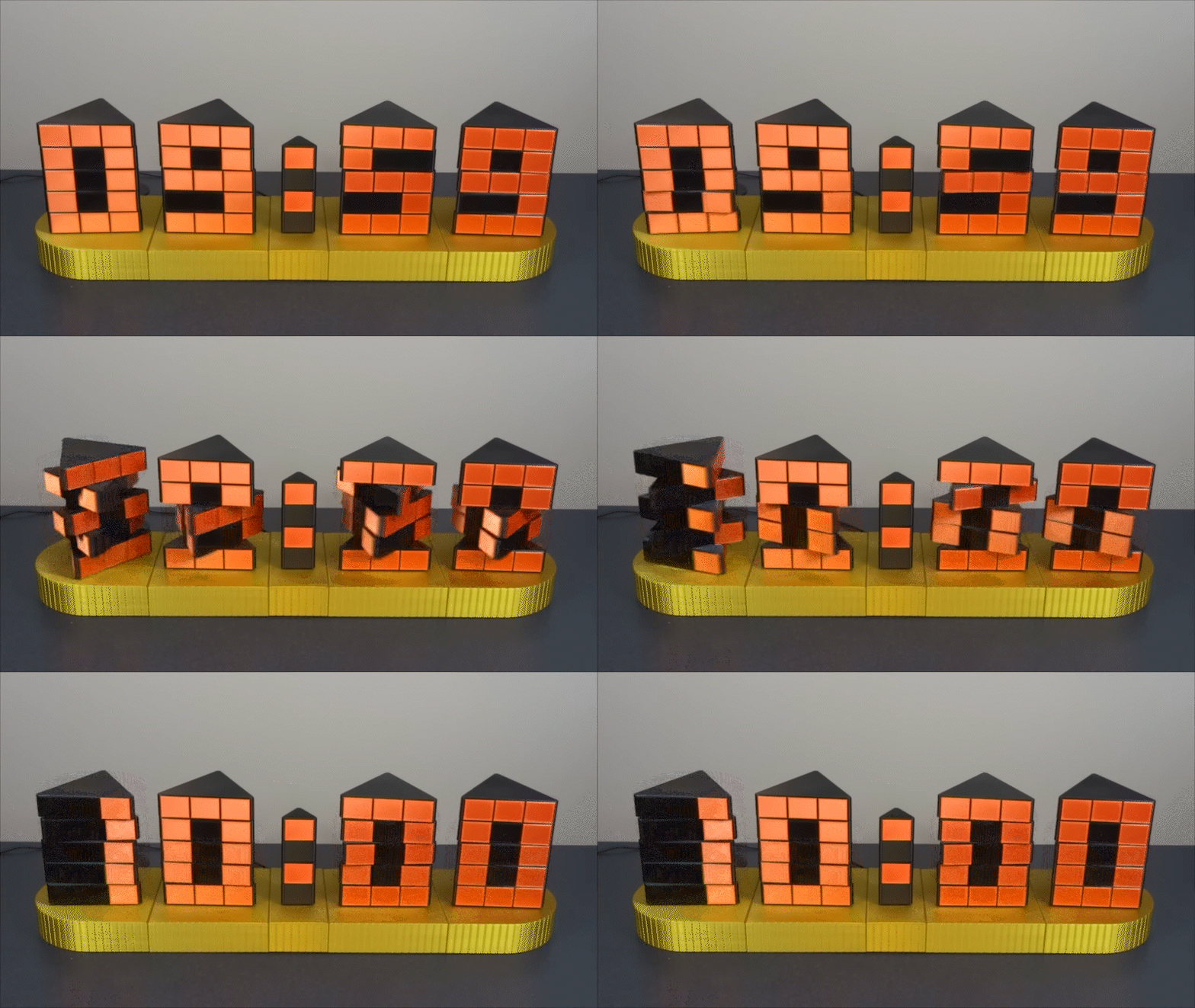
Some clocks politely tell time. Others whisper it. The Time Twister 5 practically performs it with a tiny mechanical ballet, twisting its 3D-printed layers into digits while making an ordinary minute change feel like a miniature engineering show. If your current clock just sits on the wall looking smug, this one may give it an identity crisis.
Created by Hans Andersson, the Time Twister 5 is a mechanical digital clock that displays time using rotating layers rather than LEDs, LCD screens, or old-school flip panels. It looks digital from across the room, but the magic is entirely physical. Each digit is built from stacked sections that rotate into place, revealing the correct face to form numbers from 0 to 9. The result is part clock, part kinetic sculpture, part maker masterpiece.
The phrase “latest Time Twister” refers to the fifth version in Andersson’s long-running Time Twister clock series. Earlier versions relied heavily on LEGO Mindstorms mechanisms, motors, and clever mechanical linkages. Time Twister 5 moves the concept into a more refined maker era with 3D-printed parts, micro servo motors, an Arduino Mega controller, and a DS3231 real-time clock module. In other words, it is the kind of project that makes engineers nod respectfully and casual viewers say, “Wait, did the numbers just twist themselves?”
What Is the Time Twister 5?
The Time Twister 5 is a 3D-printed electromechanical digital clock. Instead of lighting up pixels, it forms digits by rotating small mechanical layers. Each digit is made from five vertical layers, and each layer can turn to show one of three faces. Those faces contain carefully arranged color patterns that combine to create readable numerals.
At a glance, the clock resembles a large four-digit digital display. Look closer, though, and you realize the numbers are not electronic graphics. They are physical shapes. Every time the clock changes, the layers rotate in coordinated motion, like a tiny stage crew changing scenery between acts.
The official design measures about 84 centimeters long, 21 centimeters wide, and 24 centimeters high, making it more of a statement object than a discreet bedside clock. This is not the thing you buy because you need to know whether you are late for school, work, or that one meeting you secretly hoped would be canceled. You build or admire it because it turns timekeeping into theater.
How the Time Twister Works
The genius of Time Twister 5 lies in its display system. Most digital clocks use seven-segment displays, dot matrices, or screens. Time Twister 5 borrows the readability of a digital clock but replaces electronic light with mechanical transformation.
Twisting Layers Create the Digits
Each digit is composed of multiple layers that rotate independently. Every layer is shaped like a triangular form with three visible faces. By turning the correct layers to the correct side, the clock forms the patterns needed for every numeral from 0 through 9.
This is why the clock feels so mesmerizing. A normal clock changes instantly. Time Twister 5 reveals change. You see the process. You watch the number becoming itself. It is the difference between receiving a text message and seeing a letterpress machine stamp ink into paper.
Micro Servos Add the Motion
Each layer is powered by a micro servo motor. Servos are popular in hobby robotics because they can rotate to specific positions rather than simply spin continuously. That makes them ideal for a clock where the display must land precisely on the right face every time.
Precision matters. If a layer stops slightly off angle, the digit could look crooked, unclear, or like it had too much coffee. Time Twister 5 depends on reliable servo positioning so that every visible layer lines up cleanly with the others.
The Arduino Mega Acts as the Brain
The clock uses an Arduino Mega to coordinate the motion. The Mega is a strong choice for projects that need many input and output pins, which makes sense for a clock controlling multiple servos across four digits. It has far more I/O capacity than smaller Arduino boards, giving the project room to manage the mechanical display without turning the wiring into a spaghetti-themed escape room.
The DS3231 Keeps Time Accurate
Behind the theatrical twisting is a practical timekeeper: the DS3231 real-time clock module. This component helps the clock maintain accurate time even when the main controller is busy handling movement. Real-time clock modules are especially useful in projects where timing matters and where relying only on a microcontroller’s internal timing could lead to drift.
That combinationArduino Mega for control, DS3231 for timekeeping, micro servos for motion, and 3D-printed parts for structureturns the Time Twister 5 into a beautiful example of modern DIY engineering.
Why This Clock Feels So Mesmerizing
The Time Twister 5 is captivating because it slows down something we usually ignore. Most of us glance at clocks dozens of times a day without thinking about them. Time is information, not an event. But when the Time Twister changes digits, a minute becomes visible movement.
Imagine watching the clock shift from 07:59 to 08:00. On a normal screen, the digits simply refresh. On Time Twister 5, multiple layers rotate together, turning yesterday’s arrangement into the next moment. The mechanical motion gives the passage of time a physical personality. It is oddly satisfying, like watching gears mesh perfectly or seeing a row of dominoes fall exactly as planned.
This is where the clock crosses from gadget into kinetic art. Kinetic art uses motion as part of the experience. The Time Twister 5 does not merely display time; it performs time. The movement is not decoration added after the fact. It is the method, the message, and the fun.
The Evolution of the Time Twister Series
Hans Andersson has explored several mechanical clock concepts over the years. Earlier Time Twister models used LEGO-based mechanisms, including LEGO Mindstorms bricks, motors, belts, rotating sections, and clever linkages. Those earlier versions already showed the heart of the idea: a digital clock does not need a digital display.
Time Twister 4, for example, used a matrix of cubes that could be pushed out to form the time. Other versions used rotating sections or chained segments to create digits in inventive ways. These projects were not just clocks; they were experiments in mechanical logic.
Time Twister 5 feels like a natural upgrade. By using 3D-printed parts, Andersson gains more control over shape, color, tolerances, and aesthetics. LEGO is wonderfully flexible, but 3D printing allows custom geometry. That matters when every layer must rotate smoothly, align properly, and look good while doing it.
The move from LEGO to 3D printing also reflects a larger trend in the maker world. Affordable 3D printers, accessible microcontrollers, and open-source electronics have made it possible for independent creators to build objects that once would have required a workshop, a machine shop, or a suspiciously generous uncle with industrial equipment.
Design Analysis: Why the Time Twister 5 Works So Well
The best thing about the Time Twister 5 is that it does not overcomplicate the user experience. Yes, the mechanism is complex. Yes, the internals involve calibration, motors, gears, printed parts, wiring, and code. But the viewer only sees a clean, readable clock with delightful motion.
It Balances Complexity and Clarity
A mechanical display can easily become too clever for its own good. If viewers cannot read the time quickly, the object becomes more puzzle than clock. Time Twister 5 avoids that problem by preserving the familiar four-digit format. You do not need a manual to understand what it says. The innovation is in how it says it.
It Makes Hidden Engineering Visible
Many modern devices hide their mechanisms. Smartphones, smart speakers, and digital clocks are sealed rectangles of mystery. Time Twister 5 does the opposite. It invites you to notice motion, timing, and transformation. The clock becomes more interesting precisely because you can sense the engineering behind it.
It Has Personality
There is humor in a clock that goes to this much trouble to show four digits. A cheap digital clock can do the same basic job for a few dollars, but that is not the point. Time Twister 5 is like a barista drawing latte art: technically unnecessary, emotionally excellent.
What Makers Can Learn From the Time Twister
For makers, the Time Twister 5 is more than a cool clock. It is a masterclass in designing physical interfaces. The project shows how familiar information can feel fresh when presented through movement, material, and timing.
One lesson is modular thinking. Each digit works as a repeated unit, which makes the overall system easier to understand. Another lesson is mechanical economy. The clock uses a limited number of faces and layers to produce many visual outcomes. That is elegant design: doing more with less.
The project also highlights the importance of calibration. A 3D-printed mechanical clock is not just about printing parts and plugging in motors. The pieces must align, the servos must be positioned correctly, and the software must know how to move each layer. In maker projects, the last 10 percent often takes 50 percent of the patience. Time Twister 5 is a friendly reminder that “almost works” is not the same as “works beautifully.”
Why Mechanical Clocks Still Matter in a Digital World
We live in a world where every phone, laptop, microwave, car dashboard, and suspiciously judgmental smartwatch already knows the time. So why build a mechanical digital clock at all?
Because clocks have never been only about time. They are cultural objects. They organize daily life, decorate homes, express taste, and show what technology can do. From sundials and tower clocks to atomic clocks and smartwatches, timekeeping has always reflected the tools and imagination of its era.
The Time Twister 5 belongs to a modern category of timepieces that value experience as much as accuracy. It is not trying to outperform atomic time standards. It is trying to make time visible, tactile, and delightful. That is a worthy goal. Accuracy tells you when to leave. Design makes you want to look.
Experience Section: Watching Time Twist in Real Life
The first thing you notice about the Time Twister 5 is that it changes your relationship with waiting. Normally, waiting for a minute to pass is about as exciting as watching a progress bar crawl from 97 percent to 98 percent. But with this clock, you start anticipating the next minute because the transition itself is the reward.
Picture it on a desk, shelf, workshop bench, or studio wall. At first, it looks like a bold digital clock with chunky sculptural digits. Then the minute changes. A layer turns. Another follows. Several small movements happen in quick, synchronized rhythm. The digits rearrange themselves, and suddenly the room feels like it has a tiny robot stage manager.
The experience is especially satisfying because the motion has purpose. This is not movement for movement’s sake. Every twist contributes to a readable result. When the clock shifts from one number to another, you can almost feel the logic happening in front of you. It is mechanical problem-solving made visible.
There is also a calming quality to it. The motion is brief, structured, and predictable. Unlike a phone notification, it does not demand your attention with panic energy. It simply performs a small transformation and returns to stillness. In a workspace, that rhythm could become a pleasant marker of time passing without feeling disruptive.
For anyone who enjoys DIY electronics, the clock also creates a second layer of appreciation. You are not just seeing a number change; you are imagining the servos receiving commands, the gears transferring motion, the printed parts rotating into alignment, and the real-time clock quietly keeping everything honest. The object becomes a conversation between software and material.
In a classroom or maker space, Time Twister 5 would be a fantastic demonstration piece. Students could learn about mechanical design, microcontrollers, servo control, timekeeping modules, 3D printing tolerances, and user interface design from one object. Better yet, they would learn that engineering can be playful. A clock does not need to be boring just because it is useful.
In a home, the Time Twister 5 would likely become the kind of object guests ask about immediately. It has that rare “what am I looking at?” quality. The answer starts simple“It’s a clock”but then becomes more interesting: “The digits are made by rotating 3D-printed layers with servos.” At that point, someone will probably lean closer, wait for the next minute, and say something deeply technical like, “Whoa.”
The best experience, though, is the slow realization that the Time Twister 5 makes time feel less invisible. We often treat minutes as disposable units, rushing through them, losing them, spending them without noticing. This clock gives each minute a tiny entrance. It reminds you that time is not just a number in the corner of a screen. It is motion, change, rhythm, and design.
That is why the Time Twister 5 is mesmerizing. It does not merely answer the question “What time is it?” It asks a better one: “Would you like to watch time become visible?” And honestly, yes. Yes, we would.
Conclusion: A Clock That Turns Time Into a Show
The Time Twister 5 proves that even the most familiar object can become fascinating when redesigned with imagination. By combining 3D printing, Arduino control, micro servos, precise timekeeping, and kinetic design, Hans Andersson has created a clock that feels both technical and poetic.
It is practical enough to tell the time, but its real value is emotional. It brings curiosity back to an everyday action. It gives viewers a reason to pause, watch, and appreciate the hidden choreography behind a simple number change.
In a world full of glowing rectangles, the Time Twister 5 stands out because it moves with purpose. It is a digital clock with a mechanical soul, a maker project with gallery appeal, and a reminder that good design can turn even one passing minute into a small moment of wonder.