The U.S. Air Force has offered its clearest official look yet at the B-21 Raider, releasing remarkable photos of the secretive stealth bomber receiving fuel from a KC-135 Stratotanker. The images reveal more of the aircraft’s smooth upper surface, recessed engine areas, dorsal refueling receptacle, sharply tapered rear profile, and test equipmentwithout giving away the classified magic that makes the Raider difficult to detect.
That balance is very much the B-21 story: show enough to demonstrate progress, but not enough to hand curious observers a technical instruction manual. Still, these new photographs are far more than glamorous aviation portraits. They document a crucial flight-test milestone and provide fresh evidence that America’s next-generation bomber is moving steadily from prototype to operational weapon system.
What the New B-21 Raider Photos Show
Released by the Air Force on April 14, 2026, the photographs show a B-21 Raider flying beneath and behind a KC-135 Stratotanker during aerial refueling tests near Edwards Air Force Base in California. One image appears to have been taken from the tanker and offers an unusually clear overhead view of the bomber.
Until this release, most official B-21 photography had shown the aircraft from the front, below, or at a carefully controlled angle. The overhead shot changes the perspective. Viewers can now see the Raider’s compact flying-wing shape in greater detail, including its blended leading edge, upper-surface markings, deeply integrated engine inlets, refueling receptacle, and streamlined tail area.
A Cleaner Flying-Wing Profile
The B-21 resembles its larger predecessor, the B-2 Spirit, but the new images highlight several visible differences. The Raider appears smaller and has a cleaner, more angular planform. Its rear edge narrows toward a central point rather than using the more pronounced sawtooth or scalloped arrangement associated with the B-2.
That does not mean the public can calculate the B-21’s radar cross-section from a photograph and a strong cup of coffee. Important information about its materials, internal structure, sensors, engine installation, electronic warfare systems, and low-observable treatments remains classified. The photos show geometry, not the entire stealth recipe.
The First Clear Look at the Upper Surface
The overhead photograph gives aviation specialists a better view of the Raider’s upper fuselage and dorsal aerial refueling connection. The doors around the refueling receptacle appear designed to close flush with the surrounding surface, helping preserve the aircraft’s smooth exterior when the system is not in use.
Walkway markings and other small service indicators are also visible. These seemingly ordinary details matter because they offer clues about how maintainers will safely access the aircraft. Stealth bombers may look like visitors from another galaxy, but someone still has to inspect panels, service systems, and avoid stepping where a very expensive “do not step” label politely says not to.
Flight-Test Equipment Is Still Visible
The aircraft shown is identified by aviation analysts as AF-0001, the first B-21 flight-test aircraft. It carries temporary instrumentation used to gather aerodynamic and performance data. A probe extends from the lower forward section, while a trailing cone system helps measure airflow and pressure with great accuracy.
Such equipment is normal during developmental testing. Engineers need independent measurements to compare real-world behavior with computer models and simulator predictions. Once testing is complete, production aircraft will not ordinarily fly around looking as though they have brought laboratory equipment on a road trip.
Why Aerial Refueling Is a Major B-21 Milestone
Aerial refueling is fundamental to the B-21 Raider’s global strike mission. The aircraft is designed for long-range operations, but even an efficient bomber benefits from the ability to take on fuel without landing. Tanker support can extend mission endurance, provide more routing options, and reduce reliance on bases close to a contested region.
Refueling a stealth bomber is not simply a matter of putting two airplanes in approximately the same ZIP code. The tanker and receiver must maintain precise positions while traveling at hundreds of miles per hour. The KC-135’s boom operator guides the refueling boom into the B-21’s receptacle while both crews manage turbulence, speed, altitude, fuel transfer, and safety procedures.
Testing also examines whether the bomber remains stable in the tanker’s wake, whether fuel flows correctly under different conditions, and whether the refueling system performs reliably across its intended operating envelope. Engineers will analyze loads, vibration, handling qualities, communications, and emergency procedures.
The Air Force has described the B-21 as the most fuel-efficient bomber it has built. Greater efficiency should reducebut not eliminatedemand on aerial refueling aircraft. That distinction is important. The Raider is designed to make tanker support more flexible, not magically turn fuel into an optional lifestyle choice.
What Is the B-21 Raider?
The Northrop Grumman B-21 Raider is a long-range, penetrating stealth bomber being developed for the U.S. Air Force. It will be capable of carrying conventional and nuclear weapons and is intended to operate in highly contested environments protected by advanced air-defense systems.
The Air Force plans to build a future bomber force centered on the B-21 and the modernized B-52 Stratofortress. The Raider will incrementally replace the B-1B Lancer and B-2 Spirit, both of which have delivered important capabilities but are costly to sustain as they age.
A Bomber Designed as Part of a Network
The B-21 is not meant to operate as a lone silver-screen hero flying into danger while dramatic music plays. It is one component of a larger long-range strike family of systems that may include intelligence, surveillance, reconnaissance, communications, electronic attack, space-based support, and other joint-force capabilities.
Resilient networking should allow the aircraft to share information and contribute to a broader operational picture. Public descriptions have also emphasized data-driven command-and-control systems, although specific sensors, communications methods, and mission-system capabilities remain protected.
Open Architecture for Future Upgrades
One of the Raider’s most important features may be its open systems architecture. In practical terms, the aircraft is being designed so that new software, sensors, communications tools, and weapons can be integrated without redesigning the entire platform every time technology changes.
This modular approach could reduce integration risk and help the B-21 remain relevant for decades. Threats evolve, computers improve, and yesterday’s cutting-edge processor eventually becomes something a teenager would describe as “adorably slow.” A bomber expected to serve well into the future needs room to grow.
From Secret Development to Public Flight Testing
The Air Force awarded Northrop Grumman the B-21 engineering and manufacturing development contract in October 2015. The aircraft remained largely hidden during design and construction, with the public relying on a small number of artist renderings.
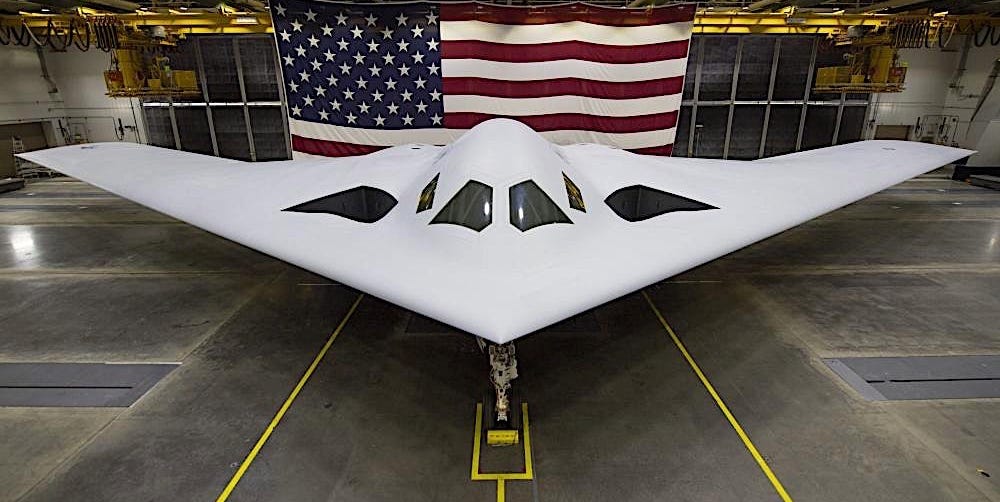
That changed on December 2, 2022, when the first Raider was unveiled at Northrop Grumman’s facility at Air Force Plant 42 in Palmdale, California. The ceremony provided a carefully controlled front view of the bomber, emphasizing its curved leading edge, small cockpit windows, and light gray finish.
The aircraft’s first flight followed in November 2023, taking it from Palmdale to Edwards Air Force Base. Edwards is the center of the B-21 flight-test campaign, where Air Force and Northrop Grumman teams evaluate ground operations, taxi performance, handling qualities, mission systems, weapons integration, sustainment procedures, and other capabilities.
A Second Test Aircraft Expands the Campaign
A second B-21 test aircraft arrived at Edwards in September 2025. Adding another airplane allows the team to conduct more work in parallel. One aircraft can support performance and airworthiness testing while another concentrates on mission systems, weapons, sustainment, or integration tasks.
This is particularly valuable because flight testing is rarely a straight line from “takeoff” to “everything works perfectly.” Data must be collected, analyzed, compared with predictions, and used to refine hardware or software. Having more than one test aircraft reduces bottlenecks and increases the number of useful test hours available.
Operational Pilots Are Joining B-21 Testing Earlier
In June 2026, Edwards Air Force Base announced another notable milestone: an operational test pilot had flown the B-21 with a developmental test pilot sharing the cockpit. According to the Air Force, bringing operational and developmental testers together this early represents a significant change from older acquisition practices.
Developmental testing generally asks whether an aircraft performs safely and meets technical requirements. Operational testing asks whether real crews can use it effectively, reliably, and survivably in realistic mission conditions. Historically, those phases were more separated, sometimes allowing usability problems to emerge late in a program.
Combining the two perspectives earlier should help engineers receive practical feedback before production and training processes become difficult to change. A design can be technically brilliant and still annoy the people who must operate it at 3 a.m. while wearing gloves. Early operational input helps catch that sort of problem before it becomes a very expensive tradition.
B-21 Production Is Accelerating
The Raider is unusual because production-representative test aircraft are being built with processes intended for operational bombers. This approach is meant to reduce the gap between development and manufacturing. Lessons discovered on the production line can inform testing, while test results can flow back into later aircraft.
In February 2026, the Department of the Air Force announced an agreement with Northrop Grumman to expand B-21 production capacity. Officials said the program had delivered aircraft on schedule in 2025 and remained on track to place aircraft at Ellsworth Air Force Base in 2027.
The Air Force has publicly stated that it plans to acquire at least 100 B-21s. The final fleet size may depend on budgets, strategic requirements, production capacity, aircraft availability, and future decisions by Congress and defense leaders.
Ellsworth Air Force Base in South Dakota will be the first main operating base and will host the formal training unit. Whiteman Air Force Base in Missouri and Dyess Air Force Base in Texas have also been selected as future B-21 locations. Construction is underway or planned to provide hangars, maintenance facilities, simulators, operations buildings, security infrastructure, and other support.
What the Photos Do Not Reveal
New B-21 Raider photos naturally encourage close inspection. Enthusiasts zoom in on engine areas, panel lines, windows, markings, and control surfaces as though the right combination of pixels will unlock every classified secret. It will not.
The Air Force carefully reviews official photographs before release. Some images may also be altered for security reasons. Dimensions, range, payload, speed, radar signature, sensor performance, defensive systems, communications capabilities, weapons configurations, and operational tactics remain partly or completely classified.
Claims based solely on visible features should therefore be treated cautiously. A shape that appears simple may conceal complex internal structures, specialized coatings, embedded antennas, cooling systems, or electronic equipment. Likewise, the absence of a visible component does not prove the capability is absent; it may be internal, retractable, blended into the skin, or simply hidden by the viewing angle.
The responsible conclusion is less dramatic but more accurate: the images reveal meaningful design details while intentionally preserving the capabilities most valuable to potential adversaries.
Why the B-21 Raider Matters
The strategic purpose of the Raider is deterrence. A bomber that can survive advanced defenses, travel long distances, receive fuel in flight, carry different weapons, and adapt through software or hardware upgrades creates uncertainty for an opponent. That uncertainty can discourage aggression by making it harder to protect critical targets or predict how the United States might respond.
The B-21 will also provide visible assurance to U.S. allies and partners. Bombers can be deployed, exercised, repositioned, or recalled, giving national leaders signaling options that differ from permanently based forces or ballistic missiles.
At the same time, the Raider is not invulnerable, nor does any aircraft operate independently of tankers, intelligence systems, communications networks, maintenance teams, weapons stockpiles, trained crews, and secure bases. Its effectiveness will depend on the complete operational ecosystem surrounding it.
Experience: How to Examine New B-21 Photos Like an Informed Aviation Observer
Studying newly released B-21 Raider photographs can be surprisingly absorbing. At first glance, the aircraft looks almost too simplea gray flying wing with few obvious protrusions. Spend several minutes comparing angles, however, and subtle differences begin to emerge. The experience is less like spotting features on a conventional airplane and more like examining a carefully shaped piece of modern sculpture that happens to fly.
Start With the Official Caption
The best viewing experience begins with the image caption, not an enthusiastic social-media post written entirely in capital letters. Official captions may identify the aircraft, location, activity, photographer, date, participating units, and whether the image was altered for security. These details establish what is genuinely known.
For the April 2026 release, the critical confirmed fact is that a B-21 conducted aerial refueling with a KC-135. The images document a real test milestone. Everything beyond that should be separated into visible observation, informed interpretation, and unsupported speculation.
Compare the Raider With the B-2 Carefully
Placing photographs of the B-21 and B-2 side by side makes the Raider’s design easier to appreciate. Both are flying-wing stealth bombers, but their outlines are not identical. Look at the trailing edge, engine inlet treatment, cockpit shape, proportions, and apparent surface transitions.
A useful experience is to describe only what can be seen before trying to explain why it exists. For example, “the B-21’s rear profile appears to converge toward a central point” is an observation. “That shape definitely reduces radar returns by a specific percentage” is a claim that cannot be verified from the photograph.
Look for Temporary Test Hardware
Prototype and test aircraft often carry instruments that will not appear on operational examples. The B-21 photos show equipment used to collect precise flight data. Recognizing these additions prevents viewers from mistaking a temporary probe or trailing cone for a permanent combat feature.
This is also a reminder that flight testing is a scientific process. Every maneuver produces measurements. Engineers compare those measurements with digital models, investigate differences, update software, inspect components, and gradually expand the aircraft’s approved flight envelope. The glamorous photograph represents thousands of less glamorous hours spent reviewing data.
Notice the Human System Around the Aircraft
The refueling images are not only about the bomber. They also show the importance of the KC-135 crew, boom operator, flight-test engineers, maintainers, airspace coordinators, safety teams, data analysts, and range personnel. A successful contact between tanker and bomber is a team achievement involving two aircraft and numerous people on the ground.
That broader perspective makes the photos more interesting. Instead of seeing a mysterious gray triangle, viewers can recognize a developing weapon system passing through one of many demanding steps toward operational service.
Enjoy the Mystery Without Inventing Answers
Part of the B-21’s appeal is that much of it remains unknown. That mystery encourages curiosity, but it also creates ideal conditions for exaggerated claims. A blurry shadow becomes a revolutionary sensor. A panel line becomes a secret weapon bay. Before long, someone has discovered three engines, artificial intelligence, and a coffee maker from twelve pixels.
The more rewarding approach is disciplined curiosity. Appreciate what the Air Force has chosen to reveal, compare it with earlier imagery, follow verified program milestones, and accept that the most sensitive details are intentionally unavailable. In this case, not knowing everything is not a failure of observation. It is evidence that the security process is doing its job.
The new B-21 Raider photos therefore offer two experiences at once. They are visually striking records of an advanced aircraft in flight, and they are lessons in how modern military programs communicate progress without disclosing operational advantages. The result is a rare glimpsenot a complete blueprintof the bomber expected to shape American long-range airpower for decades.
Conclusion
The latest B-21 Raider photos provide the most revealing official view yet of the Air Force’s next-generation stealth bomber. Its successful aerial refueling with a KC-135 demonstrates progress in a capability essential for long-range missions, while the overhead imagery highlights the aircraft’s refined flying-wing shape, upper-surface features, refueling system, and temporary test equipment.
More important than any individual panel or curve is the program’s broader momentum. Two test aircraft are supporting an expanding campaign, operational pilots are becoming involved earlier, production capacity is increasing, and Ellsworth Air Force Base is preparing to receive aircraft in 2027.
Plenty about the Raider remains classified, as it should. Nevertheless, each verified milestone brings the bomber closer to its planned role as the survivable, adaptable centerpiece of the future U.S. bomber force. For now, the photographs give aviation followers something rare: a clearer view of the B-21 without making the aircraft itself much less mysterious.