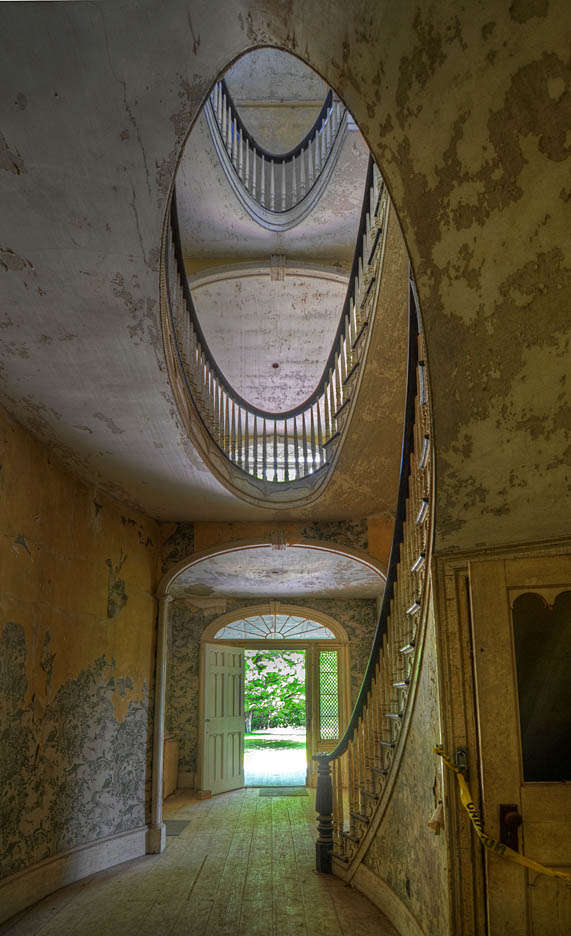
Some houses politely sit in the background. Others clear their throat, adjust their very dramatic veranda, and steal the entire scene. The Dr. Oliver Bronson House in Hudson, New York, belongs to the second group. It is not merely an old mansion with photogenic bones; it is a rare survivor of American Romantic-Picturesque architecture, a Hudson Valley landmark, a restoration challenge, andthanks to The Bourne Legacya quiet movie star with better architectural posture than most Hollywood celebrities.
The phrase “A Romantic Legacy Re-Bourne” works because the story has two kinds of romance. First, there is the nineteenth-century romance of landscape, proportion, shadow, imagination, and architecture designed to stir the soul. Second, there is the modern romance of rescue: preservationists looking at a neglected historic house and saying, “No, this beauty is not done yet.” Add a famous film cameo, and suddenly a forgotten estate becomes a cultural conversation piece. Not bad for a house that spent decades hidden in plain sight.
This article explores the history, design, cinematic appeal, and restoration significance of the Dr. Oliver Bronson House. It also looks at why Americans remain fascinated by old houses that seem to hold secrets in their staircases, fireplaces, and peeling paint. Spoiler: it is not only nostalgia. It is also craftsmanship, landscape, memory, and the delicious thrill of seeing something almost lost come back to life.
The House Behind the Legacy
The Dr. Oliver Bronson House, also known as the Plumb-Bronson House, began as a Federal-style residence built in the early nineteenth century for Hudson merchant Samuel Plumb. Federal architecture was the architectural equivalent of a well-tailored navy blazer: balanced, refined, symmetrical, and confident without yelling across the room. The original house had the dignity of its period, but its later transformation gave it the poetic character that makes it famous today.
When Dr. Oliver Bronson acquired the property, the house entered its most important design chapter. Architect Alexander Jackson Davis, one of the leading American architects of the nineteenth century, reshaped the home in two major campaigns during the 1830s and 1840s. Davis did not simply tack on decoration like someone panic-buying throw pillows before guests arrive. He reimagined the house as a Romantic-Picturesque estate connected to the surrounding Hudson River landscape.
The result was one of the earliest surviving examples of Davis’s Hudson River Bracketed style. Extended eaves, decorative brackets, verandas, asymmetrical effects, and a carefully staged relationship with the view helped turn a Federal residence into a full architectural mood. The house became less of a box and more of a conversation between building, hillside, river, mountain, and imagination.
What Makes Romantic-Picturesque Architecture So Compelling?
To understand the Bronson House, it helps to understand the Romantic-Picturesque idea. In simple terms, this style wanted buildings to feel emotionally alive within their landscapes. A house was not just shelter. It was a frame for views, a companion to trees, a silhouette against the sky, and occasionally a theatrical overachiever in the best possible way.
The Hudson Valley was the perfect stage for this philosophy. In the nineteenth century, painters associated with the Hudson River School celebrated the region’s mountains, rivers, light, and vast atmospheric drama. Their paintings invited Americans to see nature as spiritually charged and nationally meaningful. Architecture in this setting often tried to do something similar: not dominate the landscape, but heighten the experience of it.
Alexander Jackson Davis understood that a country house could be more than a respectable pile of bricks. It could choreograph movement. A visitor might approach along a drive, catch glimpses of a veranda, enter through a refined doorway, climb a staircase, and then discover views of the Catskills and Hudson River like a reward for good architectural behavior.
The Brackets Were Not Just Decorative
Those famous brackets under the eaves were not random wooden accessories. In the Hudson River Bracketed mode, they helped create shadow, rhythm, and visual depth. They made the roofline feel animated. They gave the house a sense of craft. They also made the building look comfortably settled in its site, as though it had grown there after reading several tasteful landscape essays.
The Bronson House’s architectural power comes from this layered character. You can still sense the Federal house beneath the Picturesque additions. That blend gives the building its charm: disciplined bones wearing a romantic coat.
From Landmark to Hidden Treasure
Historic houses often suffer not because nobody loves them, but because the wrong century happens to them. The Bronson House’s twentieth-century story was complicated. The estate became associated with institutional use, and the house eventually fell into long neglect. For years, it sat on state-owned land, largely out of public view. Its architecture was nationally significant, but its visibility was limited. That is a tough combination. Even a masterpiece can struggle when it is tucked away like a family heirloom in a shoebox labeled “miscellaneous.”
Preservation advocates recognized the building’s importance and worked to document, protect, and restore it. The house became listed on the National Register of Historic Places and later received National Historic Landmark recognition. That designation matters because it confirms that the house is not just locally charming; it is nationally important to the story of American architecture.
Restoration, however, is never as simple as waving a historically accurate magic wand. Old buildings have opinions. Roofs leak, plaster fails, wood decays, and structural issues arrive with the confidence of unpaid bills. Saving a place like the Bronson House requires research, money, patience, skilled craftspeople, and a tolerance for surprises. The reward is enormous: a rare architectural survivor gets a second life.
The Bourne Legacy Connection
For many modern viewers, the Dr. Oliver Bronson House became familiar through the 2012 film The Bourne Legacy. In the movie, the house stands in for the residence of Dr. Marta Shearing, played by Rachel Weisz. Jeremy Renner’s Aaron Cross may be the action hero, but design lovers know the house has the superior entrance.
Film scouts were drawn to the building because it looked authentic in a way that cannot be manufactured quickly. Its proportions, worn surfaces, tall windows, and dramatic staircase offered the kind of atmosphere that makes production designers quietly whisper, “Yes, this is the one.” Yet because of the fragile condition of the actual structure, much of the interior action was recreated on sets. This is common in filmmaking: real places provide inspiration and exterior authenticity, while sets provide safety, control, and the ability to make movie chaos without injuring a National Historic Landmark’s feelings.
The film connection gave the house a new audience. People who might not normally search for nineteenth-century American architecture suddenly wondered, “What is that amazing old house?” That curiosity matters. Pop culture can serve as a gateway to preservation. A two-second exterior shot may lead someone to learn about Davis, the Hudson River School, Federal architecture, or the slow heroism of restoration.
Why the Dr. Oliver Bronson House Still Feels Modern
Oddly enough, one reason the Bronson House feels fresh today is that it resists disposable design. Its appeal does not depend on a trend cycle. There is no need to ask whether brackets are “in” this season. The house works because it was designed around proportion, craft, site, light, and experience. Those things age better than novelty.
Modern homeowners and designers can learn a lot from it. The house shows how architecture can respond to landscape instead of ignoring it. It proves that transitional spacesporches, verandas, halls, stairs, and landingscan be as emotionally important as formal rooms. It reminds us that details are not clutter when they have purpose. And it suggests that a home can be dramatic without becoming ridiculous, which is a public service in an era of oversized everything.
Lesson One: Design for the View
The Bronson House belongs to its setting. The Hudson River and Catskill Mountains are not background decoration; they are part of the design logic. Today, that lesson applies to any home, whether it overlooks mountains, a garden, a city street, or a suspiciously determined squirrel on the fence. Good design notices what is outside and uses it.
Lesson Two: Let Materials Tell the Truth
Old woodwork, plaster, masonry, and hand-shaped details carry evidence of human labor. Restoration does not always mean making everything look brand-new. Sometimes the goal is to stabilize, reveal, and respect the passage of time. A historic house should not be forced to wear the architectural equivalent of heavy stage makeup.
Lesson Three: Romance Needs Structure
Romantic architecture can look dreamy, but the best examples are highly disciplined. The Bronson House is not charming by accident. Its romance depends on careful massing, detail, and spatial sequence. The same principle applies to writing, gardens, interiors, and dinner parties: whimsy is better when someone remembered the chairs.
The Preservation Story: A Different Kind of Heroism
In action movies, rescue often arrives with engines roaring. In preservation, rescue may arrive with grant applications, archival research, scaffolding, roof stabilization, and a committee meeting where someone has very strong feelings about lime mortar. It is less explosive, but arguably more impressive.
The campaign to save the Dr. Oliver Bronson House reflects a broader American preservation challenge. Many historic places are admired only after they are threatened. The work of organizations, historians, architects, donors, and local advocates ensures that significant buildings are not reduced to “You should have seen it back when…” stories.
Preservation also benefits communities. Historic buildings create identity. They help towns remember their layered past. They attract cultural tourism. They provide educational opportunities. They also remind people that beauty is not a luxury item; it is part of civic life. A restored landmark can become a classroom, a gathering point, a research subject, and a source of local pride.
Why Old Houses Capture the Imagination
Old houses have a strange power over us. We see a staircase and imagine footsteps. We see a fireplace and imagine winter conversations. We see peeling paint and, instead of running responsibly in the other direction, we lean closer. This is either love or a very expensive diagnosis.
The Bronson House captures the imagination because it contains visible layers: early American ambition, Romantic design theory, Hudson Valley art history, institutional neglect, preservation advocacy, and Hollywood rediscovery. That is a lot for one house to carry, but historic buildings are excellent multitaskers.
Its story also satisfies a deep desire for continuity. In a culture obsessed with updates, upgrades, and version numbers, a historic house says, “Slow down. Some things are worth repairing.” That message feels increasingly valuable. Restoration is not about freezing the past. It is about giving the past a responsible future.
Experiences Inspired by “A Romantic Legacy Re-Bourne”
Spending time with the story of the Dr. Oliver Bronson House changes the way you look at old buildings. After learning about it, even a modest porch starts to seem like a philosophical statement. A bracket becomes a small act of drama. A staircase becomes more than a way to get upstairs; it becomes a vertical invitation. Suddenly, architecture is not just something you pass on the way to coffee. It is the coffeerich, layered, and capable of making you slightly overexcited.
The experience most closely connected to this topic is the feeling of discovering that a building has lived multiple lives. Many people have had this moment while traveling through older American towns: you turn a corner, see a weathered structure, and sense that it has survived more chapters than the average family group chat. The Bronson House intensifies that feeling. It began as a refined Federal residence, became a Romantic-Picturesque villa, slipped into institutional obscurity, attracted preservationists, and then appeared on film. That is not a timeline; that is a comeback tour.
For design lovers, the house encourages a slower kind of looking. Instead of asking, “Is this room fashionable?” you start asking better questions. How does the building meet the land? Where does the light enter? What details repeat? What did the architect want visitors to feel? This kind of attention makes everyday spaces more interesting. A hallway stops being wasted space. A window becomes a composition. A porch becomes a threshold between public and private life. Congratulations, you are now the person at dinner explaining eave brackets. Use this power gently.
For homeowners, the Bronson House offers a practical emotional lesson: do not erase character too quickly. Not every old feature is sacred, and some old wiring deserves immediate retirement, preferably with a small ceremony. But original woodwork, sensible proportions, durable materials, and human-scale details can give a home warmth that new finishes often tryand failto imitate. The point is not to live in a museum. The point is to let a home’s best qualities continue speaking.
For travelers, the story adds depth to a Hudson Valley visit. The region is already rich with art, river views, historic houses, antique shops, and bakeries that make self-control seem like an unreasonable lifestyle choice. Knowing the Bronson House story gives the landscape another layer. You can understand why nineteenth-century artists and architects saw the valley as more than scenery. They saw it as a place where nature, culture, and national identity could meet.
And for anyone who has ever loved a neglected place, “A Romantic Legacy Re-Bourne” feels personal. It is about believing that beauty can be recovered. It is about seeing value under dust. It is about refusing to confuse damage with defeat. That idea applies far beyond architecture. Gardens, neighborhoods, traditions, creative projects, and even personal dreams sometimes need restoration. They do not always need to be replaced. Sometimes they need patience, care, and someone stubborn enough to say, “There is still life here.”
Conclusion: The Legacy That Came Back Into View
The Dr. Oliver Bronson House is more than a beautiful old building with a cinematic résumé. It is a rare architectural document, a Hudson Valley treasure, and a reminder that design can carry emotion across centuries. Its Romantic-Picturesque character connects American architecture to landscape painting, cultural ambition, and the nineteenth-century search for a national aesthetic. Its restoration story connects it to modern questions about memory, stewardship, and what communities choose to save.
That is why “A Romantic Legacy Re-Bourne” is such a fitting title. The house was born in one era, transformed in another, nearly forgotten in a later one, and rediscovered by preservationists, filmmakers, and architecture lovers. Its legacy has not simply survived. It has re-emerged, bracket by bracket, view by view, story by story.
In the end, the Bronson House proves that romance in architecture is not about sentimentality. It is about vision. It is about making a place where structure, landscape, history, and imagination can meet. And if a Hollywood action hero happens to run through the frame along the way, well, that is just the house being generous with its spotlight.