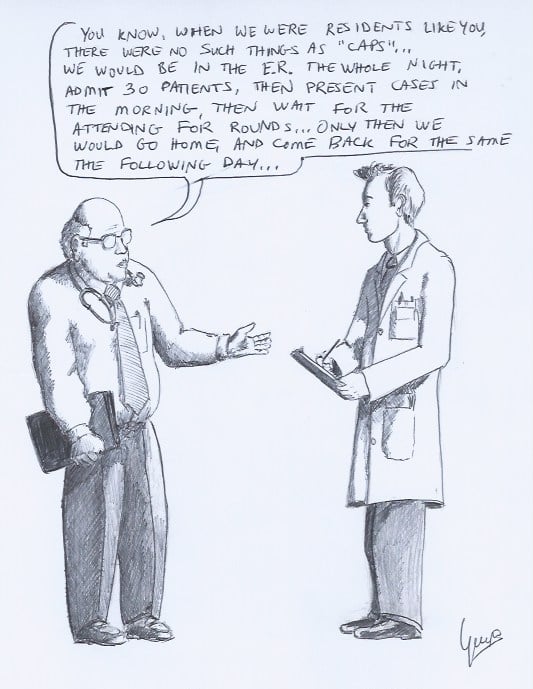
Medicine has always had a strange relationship with toughness. On one hand, patients absolutely want doctors who can stay calm in chaos, think clearly under pressure, and keep going when the night is long and the coffee has become more philosophy than beverage. On the other hand, the profession has spent decades treating unnecessary strain like a character-building exercise. Somewhere along the way, “committed” started looking suspiciously like “chronically depleted.”
That is why one of the most important questions in modern health care is not simply whether physicians are tough. Of course many of them are. The better question is this: How much is tough enough? How much pressure helps a doctor grow, and how much pressure just grinds down good judgment, empathy, attention, and health? That question matters not only for doctors, but also for patients, hospitals, medical schools, and frankly anyone who would prefer their physician to be alert, humane, and not charting with one eye open at 11:47 p.m.
Recent U.S. research and reporting suggest this is not a small issue. National findings still show burnout affecting a large share of physicians, even though rates have improved from the pandemic peak. At the same time, organizations across the country continue to identify the same culprits: administrative overload, staffing gaps, long or unpredictable hours, electronic inbox burden, harassment, moral distress, and too little control over the workday. In plain English, doctors are not drowning because caring is hard. They are drowning because caring is hard plus the job now comes with a second job made of clicks, forms, messages, and system friction.
Why this question matters now
The old mythology of medicine says a good physician absorbs pressure silently. The modern reality says silence is expensive. When doctors are pushed past reasonable limits, they are more likely to feel emotionally exhausted, detached, and dissatisfied with their work. Some reduce their hours. Some leave certain practice settings. Some leave medicine entirely. And when that happens, patients do not receive faster appointments, more thoughtful visits, or magically improved continuity of care. They get a thinner workforce trying to carry a thicker load.
That matters even more because the United States is already dealing with a projected physician shortage in the years ahead. If the country is short on doctors and the doctors it does have are operating inside systems that waste their time and energy, then toughness becomes a terrible workforce strategy. You cannot solve scarcity by squeezing the remaining people harder and hoping they turn into titanium.
This is also a patient-care question. A physician can be resilient and still be worn down by repeated interruptions, endless documentation, clunky technology, and unrelenting inbox volume. There is a difference between the meaningful difficulty of medical care and the pointless difficulty of badly designed work. The first can be noble. The second is just expensive misery dressed up as professionalism.
What “tough enough” should actually mean
Tough enough to handle complexity
Physicians do need a strong tolerance for uncertainty, grief, responsibility, and high-stakes decision-making. They need to have difficult conversations, carry bad news with grace, recover after complications, and function when the answer is not obvious. Medicine is not customer service with a stethoscope. It is demanding work, and some amount of emotional and intellectual toughness comes with the territory.
Not so tough that pain becomes policy
Where the culture goes wrong is when it treats every burden as equally legitimate. Taking care of a critically ill patient is part of the job. Fighting with prior authorization rules for the third time this week is not a sacred rite. Being present for a family in crisis is part of the job. Spending two extra hours after dinner answering portal messages that should have been triaged better is not a noble test of grit. A doctor who is asked to endure both without limit is not being made stronger. That doctor is being asked to subsidize system failure with personal stamina.
So, tough enough should mean this: strong enough to meet the real human demands of medicine, but not expected to absorb avoidable institutional dysfunction as if it were a virtue. If a physician must constantly borrow from sleep, family life, attention span, or emotional health just to keep the machine running, the system has already crossed the line.
The signs that “tough enough” has become “too much”
One warning sign is when physicians no longer feel tired from caring, but tired from everything around caring. Many doctors describe the worst part of the day not as the patient with multiple conditions, but as the inbox avalanche, the duplicated documentation, the staffing gaps, the after-hours charting, and the sense that the most expensive person in the room is doing work that better systems could prevent or redistribute.
Another warning sign is depersonalization. This is the moment when a doctor who once felt deeply connected to patients starts to feel emotionally flat, impatient, or oddly distant. That does not necessarily mean the physician has become uncaring. Often, it means the physician is overextended. When the workload keeps expanding, the mind starts protecting itself by going numb. It is a survival response, not a personality flaw.
A third sign is when physicians begin to reduce effort just to preserve basic functioning. Maybe they cut back on hours, avoid leadership roles, leave primary care, switch practice environments, or decide not to pursue a path they once loved. Sometimes the decision is wise. Sometimes it is heartbreaking. Either way, it is often less about weakness than about the simple math of depletion.
Why burnout is not just an individual problem
One of the most important shifts in the national conversation is the growing recognition that physician distress is not merely a self-care issue. Yes, sleep, exercise, peer support, boundaries, therapy, and recovery matter. But they matter inside a broader work environment. Telling physicians to be more resilient while leaving the workload, staffing, and technology problems untouched is the professional equivalent of handing someone an umbrella in a hurricane and calling it strategic planning.
That is why many U.S. organizations now frame physician well-being as a systems issue. Administrative burden, poor workflow design, insufficient support staff, lack of schedule control, workplace harassment, and weak organizational communication all shape how much strain physicians can carry safely. Some researchers and leaders also use the term moral injury to describe what happens when clinicians are forced to work in ways that conflict with their professional values. That distinction matters. Burnout can sound like a doctor failed to cope. Moral injury suggests the environment itself may be violating the mission of care.
And honestly, that lands closer to the lived experience of many physicians. Plenty of doctors are not saying, “I cannot handle sick people.” They are saying, “I cannot keep practicing in a system that pulls me away from patients, asks me to do too much clerical work, and then calls the problem resilience.” Those are very different statements.
The patient side of the question
Patients should care about this question because the best care usually comes from physicians who are both clinically sharp and emotionally available. Research and clinical leaders alike have emphasized that warmth and competence are not enemies. In fact, patients often see empathy as part of competence. A rushed, depleted physician may still be technically capable, but the care experience changes when there is no margin left for listening, nuance, or calm explanation.
That does not mean patients should feel guilty for needing care. Not at all. It means the system should be built so physicians can care well without paying for it with their own collapse. When a doctor is “tough enough” in a healthy sense, patients benefit. Visits feel more focused. Communication improves. Trust grows. Follow-up is cleaner. Decisions are better. Nobody wants their doctor operating on fumes and institutional sarcasm.
What physicians and organizations should be asking instead
Questions physicians can ask themselves
A better version of toughness begins with more honest questions:
- Am I tired because the work is meaningful and demanding, or because the system is chaotic and wasteful?
- Do I still have enough reserve to be present with patients, or am I mostly surviving the day?
- Is my current pace sustainable for a month, a year, or five years?
- Am I carrying tasks that should be redesigned, delegated, automated, or eliminated?
Questions leaders should ask
Hospital and practice leaders should ask harder questions too:
- How much work are physicians doing outside scheduled hours?
- How much inbox, documentation, and prior authorization work could be reduced?
- Are staffing levels forcing physicians to do work below or beside their training?
- Do physicians feel safe seeking mental health support without stigma?
- Are we measuring burnout and then actually changing workflows, or just admiring the survey results?
That last one is especially important. A well-being survey without operational follow-through is just a more sophisticated way to disappoint people.
What helps when the answer is “this is too much”
The good news is that the solutions are not mysterious. National experts increasingly point to practical, organization-level changes that make a real difference: workflow redesign, better team-based care, improved staffing, protected recovery time, stronger peer support, and smarter technology implementation.
Team-based care matters because physicians should not be the universal backup plan for every broken process. Better distribution of tasks can preserve physician attention for diagnosis, judgment, communication, and complex decision-making. Workflow redesign matters because a badly built day creates constant cognitive drag. Even small reductions in friction can return meaningful time and mental space.
Technology also cuts both ways. Electronic health records and portal messages have become major sources of burden, especially after hours. But some tools, including newer ambient AI scribes, show potential to reduce documentation time and mental load when implemented thoughtfully. That said, technology should be a helper, not a shiny new supervisor. If an AI tool saves ten minutes but creates twenty minutes of editing, congratulations, you have invented modern disappointment.
Support culture matters too. Peer support after difficult events, counseling access, leadership that listens, and a workplace that does not punish vulnerability all make it easier for physicians to get help before distress hardens into burnout, depression, or withdrawal. The strongest culture in medicine is not one where nobody struggles. It is one where struggle is recognized early and addressed intelligently.
So, how much is tough enough?
Here is the simplest answer: tough enough is the amount of strain a physician can carry without losing the ability to care well, think clearly, recover adequately, and remain human. Once the job starts consuming empathy, sleep, judgment, relationships, or integrity at a routine pace, the profession is no longer asking for resilience. It is asking for damage tolerance.
And damage tolerance is a terrible design principle for health care.
The question “How much is tough enough?” should not be asked as a dare. It should be asked as a quality standard. The best physicians are not the ones who suffer silently the longest. They are the ones who can keep showing up with skill, compassion, and steadiness because the work around them is designed to support excellent care rather than erode it.
Medicine will always be hard. It should not also be needlessly punishing. There is a difference between building strong doctors and breaking good ones. Health care in America would do well to learn it faster.
Experience from the field: what this question looks like in real life
To understand the issue more clearly, it helps to picture what “tough enough” looks like in everyday practice. Consider the internist who genuinely loves diagnostic puzzles, knows her patients well, and does not mind a full clinic schedule. What wears her down is not the medicine itself. It is the extra two hours each night spent closing charts, answering portal messages, and correcting documentation quirks that seem to multiply like gremlins after sunset. She is not asking for an easier profession. She is asking for a profession where the hard part is the patient care, not the electronic scavenger hunt after dinner.
Or think about a resident who expects long shifts and intense learning curves. Residency has never been a spa retreat, and no one signed up expecting scented candles and free afternoons. But there is a difference between rigorous training and chronic depletion. When the resident starts forgetting basic details, snapping at colleagues, and surviving on vending-machine diplomacy, the question is no longer whether training is challenging enough. It is whether the challenge has crossed into a zone where learning, safety, and mental health begin to erode together.
Then there is the emergency physician who can handle crisis after crisis without blinking. Trauma, resuscitations, impossible choices, grieving families, packed waiting rooms, and a waiting room that somehow keeps reproducing people like a plot twist in a medical thriller that is the job. But what pushes the strain too far is a system with inadequate staffing, boarding patients for hours, aggressive behavior from visitors, and not enough time to recover between emotionally brutal shifts. This physician is not lacking grit. This physician is being asked to substitute personal endurance for operational capacity.
A primary care doctor offers another version of the same story. The office visit may last 15 or 20 minutes, but the care episode stretches far beyond the room: refill requests, paperwork, lab reviews, referrals, insurance rules, patient messages, and care coordination that spills into evenings and weekends. The doctor still wants to be thoughtful and warm with every patient. But after enough overload, warmth begins to feel like another task squeezed into a shrinking container. The danger is not that the physician stops caring. The danger is that caring begins to cost too much to perform at the same depth every hour of every day.
Across these experiences, one pattern keeps repeating: physicians usually tolerate the meaningful difficulty of medicine better than outsiders assume. What they struggle with is the accumulation of avoidable friction. They can handle responsibility. They can handle uncertainty. They can handle sorrow. What becomes corrosive is when every meaningful demand is stacked on top of administrative drag, poor workflow, staff shortages, and the quiet cultural expectation that good doctors should absorb all of it with a polite face and a functioning password.
That is why the question matters so much. “How much is tough enough?” is not a soft question. It is a serious operational and ethical question. It asks whether we want a medical culture built on excellence and sustainability, or one built on hidden exhaustion with a professional smile pasted over the top. The answer will shape not only how physicians live, but also how patients are cared for.