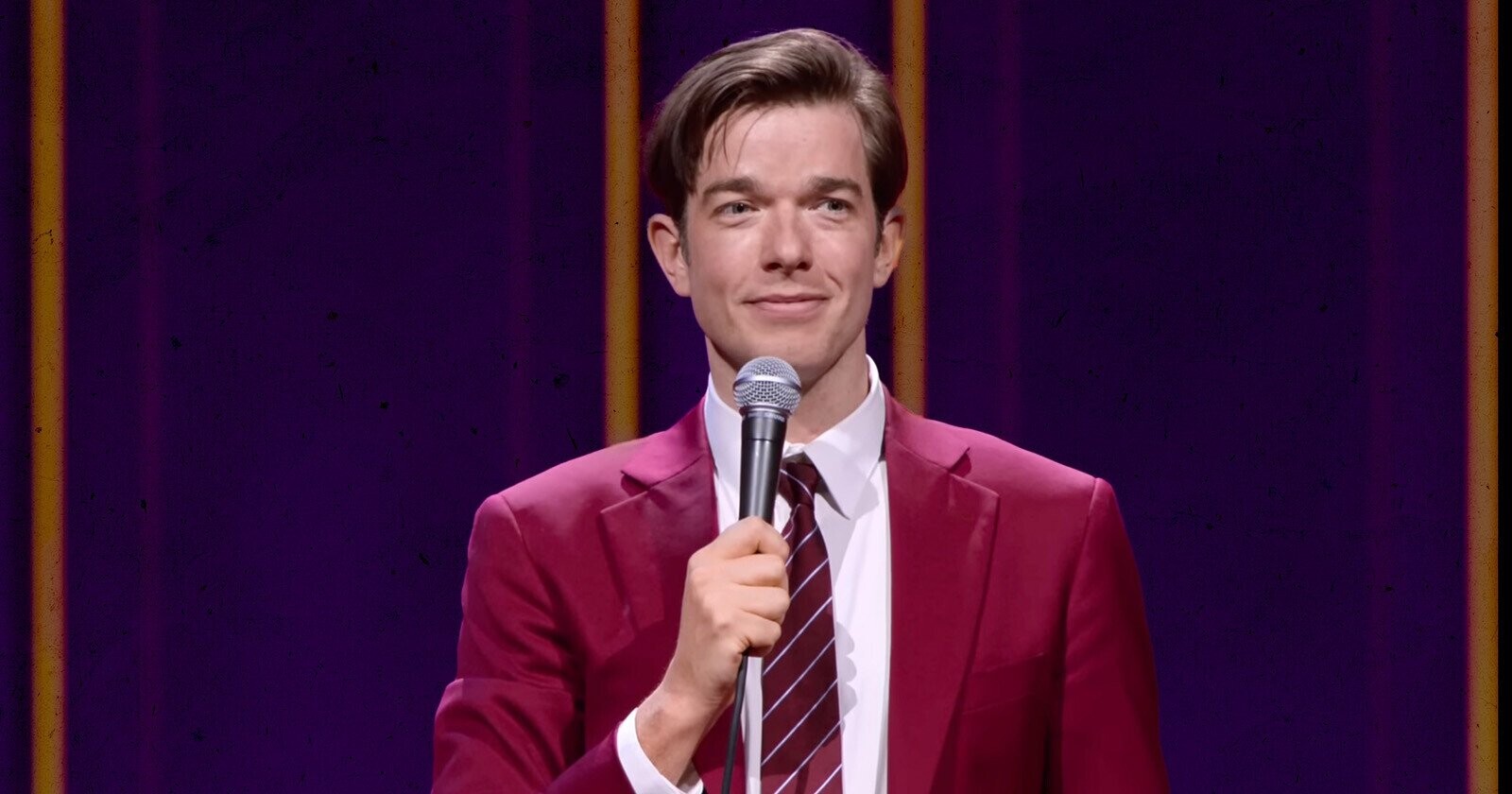
For years, John Mulaney seemed like the rare comedian who could walk into a room, describe a childhood misunderstandild trust that man to watch my luggage.” His suits were crisp. His delivery was theatrical. His persona suggested a precocious choirboy who had accidentally wandered into adulthood and found the whole arrangement suspicious.
Then came John Mulaney: Baby J, the 2023 Netflix stand-up special that takes that carefully polished image, places it on a table, and begins unscrewing it piece by piece.
The result is not simply a comeback special, a recovery story, or a celebrity confession wrapped in punchlines. Baby J is an argument about the strange prison created when audiences decide they know a performer. Mulaney returns from addiction treatment and intense public scrutiny without asking viewers to restore his old image. Instead, he seems determined to make that image unusable.
His declaration that “likability is a jail” becomes the special’s unofficial thesis. The escape plan involves ego, addiction, humiliation, celebrity, rehab, desperate schemes, and one extremely awkward relationship with his own reputation. Somehow, it is also very funny.
‘Baby J’ Begins by Removing the Victory Lap
Released by Netflix on April 25, 2023, Baby J was filmed at Boston Symphony Hall and directed by Alex Timbers. Unlike the grand entrances associated with some of Mulaney’s earlier specials, this one gets moving with little ceremonial buildup. He is already there, already talking, as though the audience has walked into a conversation that started without them.
That choice matters.
Earlier versions of John Mulaney arrived with the confidence of a performer whose persona was already understood. The clean suit, old-fashioned cadence, hyper-specific observations, and boyish expression formed a dependable comic package. Baby J enters after that package has been ripped open by real life.
Mulaney had publicly entered treatment for substance addiction following an intervention in December 2020. His private life subsequently became entertainment-news material, and audiences who had formed a cozy relationship with his stage persona began debating the “real” man behind it.
Baby J does not politely resolve that debate. It makes fun of the desire to have it resolved.
The Old John Mulaney Persona Was Always More Complicated Than It Looked
Mulaney had discussed drinking and drug use in comedy long before Baby J. The difference was presentation. Earlier stories often benefited from the comic contrast between dangerous behavior and the person telling the story. He looked, as his jokes repeatedly suggested, spectacularly unsuited to chaos.
The audience could hear about reckless behavior while still enjoying the reassuring idea that the tidy man holding the microphone had safely become someone else.
Baby J removes that comforting distance.
Here, addiction is not presented as an amusing chapter from a distant past. Mulaney describes behavior that is manipulative, obsessive, arrogant, and sometimes ridiculous enough to sound like a caper written by a criminal whose greatest enemy is basic planning.
A Less Flattering Main Character
One of the special’s boldest moves is that Mulaney does not cast himself as the sympathetic hero of his own intervention. He remembers the event through the warped perspective of someone who was angry at the people trying to help him.
The intervention itself included close friends and fellow comedians, some participating remotely because it occurred during the pandemic. In another performer’s hands, the scene might become a solemn centerpiece designed to extract sympathy.
Mulaney instead focuses on absurd details, bruised vanity, and his irritation at being confronted. He turns the gap between the seriousness of the situation and his own self-centered reactions into the joke.
That approach is revealing without becoming straightforward confession. He gives the audience ugly information, but he still controls the rhythm, framing, timing, and punchlines. The mess is real; the storytelling architecture remains immaculate.
John Mulaney Escapes Likability Jail by Making Himself the Villain
Celebrity likability creates an unusual problem. The more an entertainer seems relatable, the more audiences may begin treating relatability as a contract.
A comedian tells stories about marriage, anxiety, family, pets, travel, or childhood. Viewers spend years listening. Eventually, some begin to feel less like customers and more like unofficial relatives with strong opinions about the comedian’s life choices.
Mulaney understands that trap. Baby J attacks it by refusing to audition for forgiveness.
He talks about schemes to obtain drugs. He describes manipulating circumstances and pursuing increasingly desperate solutions. One story involves buying an expensive watch on credit so it could be converted into cash. Other sequences involve doctors, prescriptions, and the complicated logistics of maintaining an addiction while pretending everything is under control.
The jokes work because Mulaney does not present these stories as proof that he was secretly cool, dangerous, or tragically glamorous. His addicted self often comes across as frantic, vain, and embarrassingly inefficient.
This is the liberation at the center of Baby J: he no longer needs to remain the audience’s favorite imaginary best friend.
Being Unlikable Can Be Its Own Performance
There is, however, a clever paradox. Announcing that you no longer care about being liked can become an extremely effective way to become more likable.
Mulaney knows this.
That tension explains why critics reached different conclusions about how vulnerable Baby J really is. Some saw a bracing demolition of his old persona. Others noted that he remains highly controlled, revealing selected parts of his life while leaving other subjects mostly outside the frame.
Both readings can be true.
Baby J is candid, but it is not uncontrolled. It is personal, but it is not a diary. The audience receives carefully constructed stories about addiction, intervention, treatment, ego, and recovery. Mulaney decides where the spotlight goes and where it does not.
That is not a flaw. It is stand-up comedy.
A microphone is not a courtroom witness stand, and a comedy special is not a demand for total disclosure. Mulaney’s achievement is making the tension between revelation and performance part of the show itself.
The Rehab Material Refuses Easy Inspiration
Many recovery narratives follow a familiar shape: collapse, revelation, treatment, transformation, uplifting music, sunset.
Baby J is suspicious of that structure.
Mulaney certainly expresses gratitude toward the people who intervened and helped save his life. Yet he refuses to portray treatment as a magical personality replacement program. He remains needy, competitive, status-conscious, and desperate for attention.
One of the funniest recurring ideas is that even in rehab, a place where celebrity should be irrelevant compared with survival, part of him still wants to be recognized.
That admission is funny because it is so petty.
It is also central to the special’s honesty. Recovery does not require a person to become a completely different human being with inspirational lighting. The same ego may still be there. The same need for attention may remain. The difference is what happens next.
Mulaney does not tell the audience, “I suffered, therefore I became wise.” His message is closer to: “I suffered, survived, and unfortunately remain myself.”
That is a much better setup for comedy.
The GQ Interview Becomes the Perfect Closing Evidence
One of Baby J’s most effective sequences involves a real interview Mulaney gave shortly before his intervention. He later said he did not remember giving it.
Instead of merely describing that strange artifact from his past, he revisits his own comments and lets the earlier version of John Mulaney become material for the current one.
It is an inspired device because the old interview functions almost like evidence discovered at a crime scene. The person who gave those answers and the person reading them onstage are technically the same man, yet the distance between them feels enormous.
The sequence also captures the central question of celebrity persona. How much can anyone truly know about a performer from an interview, a stand-up set, or a carefully produced public appearance?
Apparently, not enough to know when the performer himself may barely remember the conversation.
Why the Comedy Still Feels Like Classic John Mulaney
Despite its darker subject matter, Baby J does not abandon the qualities that made Mulaney one of the most distinctive American stand-up comedians of his generation.
His stories remain meticulously organized. A tiny detail introduced early may return much later with additional comic force. His vocal performance still matters as much as the words. Characters receive distinct rhythms and attitudes. Embarrassment becomes theater.
He can make a logistical problem sound like an epic military campaign and a humiliating memory sound like a Broadway monologue performed by a man who has misplaced both his dignity and the receipt.
The subject has changed. The machinery has not.
Dark Material Without the Mandatory Serious Face
A weaker special might constantly remind viewers that addiction is serious. Baby J understands that the subject is already serious. Mulaney does not need to underline it every five minutes.
Instead, he lets comedy emerge from denial, vanity, desperation, and social absurdity. The darkest material is often funny precisely because the consequences are not being denied.
That balance is difficult. Too much emotional distance and the material becomes evasive. Too much solemn explanation and the stand-up begins to resemble a conference keynote with better tailoring.
Mulaney largely stays on the wire.
‘Baby J’ Is Also a Story About Audience Ownership
The public reaction surrounding Mulaney’s personal life exposed something larger than one comedian’s reputation. Modern fandom encourages audiences to build complete personalities from fragments.
Fans watch specials. They listen to podcasts. They read profiles. They see clips and interviews. After enough exposure, familiarity begins impersonating intimacy.
Then reality changes.
The celebrity makes choices that do not match the character assembled in the viewer’s head. Suddenly, people feel deceived by a person who never actually promised to live according to their private script.
Baby J pushes back against that dynamic without pretending Mulaney is above caring what people think. In fact, the special repeatedly suggests the opposite. He wants attention. He notices status. He thinks about reputation.
The freedom does not come from becoming indifferent. It comes from turning the problem into material.
A Reputation Different From Beforeand a Better Comic Tension
The special’s self-mockery about having a newly complicated reputation is more than a joke about scandal. It represents a change in Mulaney’s relationship with his audience.
Before, much of the comedy benefited from the contrast between a polished exterior and hints of disorder underneath. In Baby J, the disorder is no longer hidden. The new tension comes from watching an extraordinarily polished storyteller describe how spectacularly unpolished his life became.
That contradiction gives the special its energy.
The old persona has not disappeared. You can still hear the theatrical cadence and see the precise stagecraft. But now the suit contains a character the audience is no longer encouraged to mistake for innocence.
Critical Reception and the Legacy of ‘Baby J’
Baby J received strong critical attention, although reviewers disagreed about the exact nature of its vulnerability. Some praised its destruction of Mulaney’s lovable public persona and its willingness to show a more selfish, unpleasant version of the comedian. Others argued that the special remained guarded despite its confessional material.
That debate may be part of why the special has lasted as more than a celebrity-recovery document.
It asks what audiences really want when they demand authenticity. Do they want the truth, or do they want a version of the truth that makes them feel closer to the performer?
Mulaney offers neither complete access nor a return to his old image. He offers jokes.
The industry recognition followed. Baby J earned major awards attention, including an Emmy for Mulaney’s writing and a Critics Choice Award for the special. Those honors were fitting for a performance whose most impressive achievement is structural: Mulaney takes a period of personal chaos and turns it into an unusually controlled comedy hour.
Experiencing ‘Baby J’: What It Feels Like to Watch a Familiar Comic Become Unfamiliar
For longtime John Mulaney fans, watching Baby J can be a strangely disorienting experience. You recognize the voice immediately. The rhythms are familiar. The posture, pacing, and elaborate storytelling feel like returning to a favorite restaurant.
Then the menu announces that tonight’s special is catastrophic self-destruction.
The viewing experience depends partly on how much history you bring with you. Someone discovering Mulaney for the first time may simply see an exceptionally skilled comedian telling dark stories about addiction and rehabilitation. A longtime viewer experiences an additional layer: the special keeps colliding with memories of the earlier persona.
That contrast creates a productive discomfort.
The Laugh That Arrives a Second Late
Some of the funniest moments in Baby J create a small delay between comprehension and laughter. A story begins with a detail that sounds alarming. Then Mulaney changes the angle, emphasizing his vanity or ridiculous logic, and the audience suddenly sees the comic mechanism.
You laugh, then briefly remember what the story is actually about.
That rhythm feels different from the lighter observational pleasure of many earlier routines. The laughter often comes with an aftertaste. It is not guilt exactly. It is awareness.
You are watching someone turn dangerous behavior into entertainment after surviving it.
The special never completely resolves that tension, and it is stronger because it does not try.
The Experience of Losing the Imaginary Friend
Another interesting experience is realizing how easily a stand-up persona can feel like a friendship.
Mulaney’s earlier comedy was especially good at creating that illusion. His stories felt detailed enough to be personal but polished enough to remain comfortable. Fans could repeat favorite bits and feel as though they understood the person who created them.
Baby J walks into that imagined friendship and rearranges the furniture.
The comedian onstage is still charming, but he is openly explaining that charm can coexist with selfishness, deception, desperation, and addiction. The experience can be oddly liberating for the viewer as well. You no longer need the performer to be the imaginary person you created.
You can simply watch him work.
Why Rewatching the Special Changes It
On a first viewing, the biographical revelations naturally attract attention. The intervention, rehab stories, drug-seeking behavior, and forgotten interview are major narrative events.
On a second viewing, the craftsmanship becomes easier to see.
You notice how carefully Mulaney manages audience sympathy. Just when a story risks becoming too tragic, he redirects attention toward his own absurdity. Just when his self-criticism risks becoming performatively noble, he introduces another detail that makes him look worse.
The emotional temperature is constantly adjusted.
That control is one reason Baby J rewards repeat viewing. Beneath the apparent confession is an intricate act of comic engineering.
A Useful Experience for Anyone Interested in Modern Celebrity
The special is also worth experiencing as a case study in how celebrity has changed. Social media, streaming, podcasts, entertainment reporting, and fan communities have made public figures seem permanently available for interpretation.
A performer’s personal crisis no longer stays separate from the work. It becomes context, discourse, memes, arguments, headlines, and eventually material for the next project.
Mulaney does not escape that machine. He feeds it a version of the story on his own terms.
That may be the most important freedom he finds in Baby J. He cannot control every public opinion. He cannot return to the exact reputation he had before. He cannot make audiences forget what they know.
But he can decide how to walk onto a stage and talk about it.
Conclusion: Freedom Is Funnier Than Image Repair
John Mulaney: Baby J works because it refuses to behave like a traditional reputation-repair campaign. Mulaney does not return to the stage asking the audience to certify him as a good person. He does something more interesting: he makes the need for that certification part of the joke.
The special breaks apart the assumption that a likable performer must remain likable in every imaginable context. It exposes the strange bargain between celebrity and fandom, where charm can become an expectation and familiarity can masquerade as ownership.
Most importantly, Baby J proves that Mulaney’s greatest strength was never innocence. It was storytelling.
The clean-cut image may have helped audiences discover him, but the precision, timing, character work, language, and ability to build comic narratives are what made the career durable. Once the image cracked, the comedian remained.
In that sense, escaping “likability jail” does not mean John Mulaney has stopped being likable. That would be almost impossible while he is this funny. It means likability is no longer the entire assignment.
And for a performer whose life became far messier than his old stage persona could contain, that is not merely a comeback. It is a larger room.
Note: This article is an original critical synthesis based on established reporting, official program information, major U.S. reviews, interviews, and awards coverage concerning John Mulaney: Baby J. It does not reproduce any source article or review.