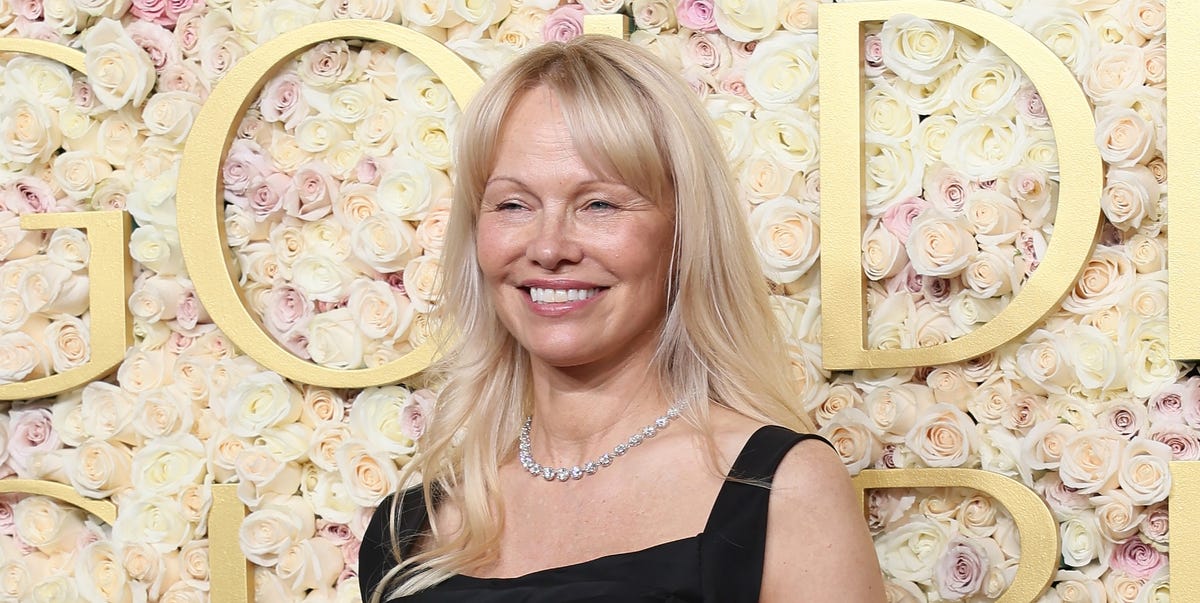
Pamela Anderson arrived at the 2025 Golden Globes with more than a prestigious nomination. Shpport had played a surprisingly important role in her acclaimed return to dramatic acting. Their elegant mother-son appearance captured a career full-circle moment built on family loyalty, artistic reinvention, natural beauty, and one movie script that nearly never reached Anderson at all.
A Golden Globes Date With a Meaningful Backstory
Pamela Anderson did not walk into the 2025 Golden Globes alone. The actress brought her eldest son, Brandon Thomas Lee, as her date to the ceremony held on January 5, 2025, at the Beverly Hilton in Beverly Hills, California. On a carpet overflowing with couture, diamonds, dramatic poses, and enough hairspray to challenge local air-quality regulations, their appearance felt refreshingly personal.
Anderson was attending as a nominee for Best Performance by a Female Actor in a Motion Picture Drama for her work in The Last Showgirl. It was her first Golden Globe nomination, turning an already glamorous evening into an important milestone in a career that has often been discussed more for celebrity mythology than acting ability. Brandon, dressed in a traditional black tuxedo, white shirt, and black bow tie, coordinated neatly with his mother’s all-black ensemble. e choice of date was not merely sentimental. Brandon had been closely connected to the project responsible for his mother’s nomination. He helped ensure that the screenplay for The Last Showgirl reached Anderson after her former representative reportedly rejected it without showing it to her. Brandon also served as an executive producer on the film. In other words, he was not just there to hold a purse, locate the correct ballroom, or politely nod through industry conversations. He had helped open the door to the entire evening.
Pamela Anderson’s Elegant, Makeup-Free Golden Globes Look
Anderson wore a sleeveless black Oscar de la Renta gown paired with long opera gloves. Custom Pandora jewelry added the sparkle, including a lab-grown diamond choker and pieces reportedly featuring more than 225 diamonds. The styling was classic, restrained, and glamorous without looking as though the dress had entered the room several minutes before its owner.
Her most discussed beauty decision, however, involved what she did not wear. Anderson continued her public embrace of makeup-free appearances, arriving with a bare face, softly styled blonde hair, and a fringe she said she had cut herself. She also revealed that she had prepared without a professional stylist or traditional glam team.
For a major awards ceremony, this was almost rebellious in its simplicity. Hollywood red carpets generally operate on the assumption that every eyelash requires a committee meeting. Anderson instead presented an image that appeared polished but recognizably human. Her outfit acknowledged the formality of the occasion, while her natural beauty approach communicated that she did not need to reconstruct herself to deserve a place in the room. hy Her Natural Beauty Choice Mattered
Anderson’s makeup-free era began receiving widespread attention in 2023. She has explained that the decision became part of a broader process of stripping away an image that had followed her for decades. The choice was not presented as a campaign against cosmetics. It was about allowing herself to appear without the pressure to perform a perfected version of Pamela Anderson every time a camera appeared.
That distinction matters. Cosmetics can be creative, joyful, and empowering. So can leaving them in the bathroom cabinet while attending one of Hollywood’s biggest events. Anderson’s approach offered another option: glamour without disguise, elegance without visual overengineering, and confidence without pretending that faces are manufactured with factory-standard symmetry.
Why Brandon Thomas Lee Was the Perfect Guest
The mother-son appearance becomes more meaningful when viewed through the complicated history of The Last Showgirl. Director Gia Coppola wanted Anderson for the lead role after seeing the Netflix documentary Pamela, a Love Story, which Brandon had produced. Coppola sent the screenplay to Anderson’s representative, but the project was reportedly declined within an hour without Anderson being told about it.
Coppola then reached Brandon through mutual connections. He knew exactly where his mother was: at home in Canada, gardening and living far from Hollywood’s usual machinery. He brought her the screenplay, and Anderson recognized an opportunity unlike the lightweight or highly sexualized roles she had frequently been offered.
That sequence of events reads like a movie-industry parable. An established gatekeeper dismissed the opportunity. A filmmaker refused to give up. A son carried the material past the gate. A performer who had been underestimated for years finally received a role worthy of her emotional range. Then mother and son stood together at the Golden Globes because of it. Hollywood occasionally writes a satisfying plot without hiring anyone to rewrite the third act. randon’s Role Behind the Scenes
Brandon was already more than a familiar celebrity son. As a producer of Pamela, a Love Story, he had helped his mother reclaim control over her public narrative. The documentary allowed Anderson to tell her own story rather than letting years of tabloid coverage, unauthorized dramatizations, and recycled cultural assumptions speak for her.
His executive-producer credit on The Last Showgirl continued that collaboration. Following the Golden Globes, Brandon publicly expressed how proud he was of his mother and emphasized what the independent production accomplished with limited resources and a short shooting schedule. Reports noted that the film was completed in only 18 days, making its awards recognition especially impressive. n>
What The Last Showgirl Is About
Directed by Gia Coppola and written by Kate Gersten, The Last Showgirl centers on Shelly, a veteran Las Vegas performer whose long-running revue is abruptly scheduled to close. After devoting decades to the show, Shelly must confront an uncomfortable question: What remains when the identity that shaped your adult life suddenly disappears?
Anderson’s character is proud of the traditional showgirl culture she represents, even as newer forms of entertainment make that culture appear outdated. Shelly is not simply losing a paycheck. She is losing a stage, a community, a routine, and the story she has told herself about the sacrifices she made.
The film also explores her strained relationship with her adult daughter. Shelly’s career came with personal costs, and losing the show forces her to examine choices she had previously protected with sequins, optimism, and determined denial. The supporting cast includes Jamie Lee Curtis, Dave Bautista, Kiernan Shipka, Brenda Song, and Billie Lourd. Role That Mirrored Anderson’s Own Public Journey
The connection between Anderson and Shelly was difficult to miss. Both women had been admired as visual symbols while their inner lives received less attention. Both were associated with an entertainment era that audiences could celebrate nostalgically while treating the women themselves as disposable. Both faced the challenge of asking who they might become after the familiar spotlight changed direction.
Anderson did not need to imitate Shelly’s vulnerability from a safe distance. She understood the emotional territory. Her performance drew strength from the tension between being seen everywhere and being understood almost nowhere.
Critics frequently described her work as tender, raw, vulnerable, and career-changing. Some argued that calling the film a comeback did not fully capture what had happened. A comeback implies returning to an established artistic position. The Last Showgirl instead allowed Anderson to reveal a dramatic ability that mainstream Hollywood had rarely bothered to test. n>
A Nomination That Challenged Old Assumptions
Anderson rose to international fame through modeling and television, most notably through Baywatch. Her public image became so dominant that it frequently overshadowed her work, personality, and ambitions. The entertainment industry was happy to benefit from her fame while keeping her trapped inside a narrow category.
The Golden Globe nomination complicated that narrative. It did not erase the past or magically repair every missed opportunity. It did demonstrate that a performer can be misunderstood for decades and still surprise an industry that thought it had already placed her in the correct filing cabinet.
Her nomination also arrived during an awards season filled with established dramatic stars. Anderson competed alongside Angelina Jolie for Maria, Nicole Kidman for Babygirl, Tilda Swinton for The Room Next Door, Fernanda Torres for I’m Still Here, and Kate Winslet for Lee. Fernanda Torres ultimately won the category, but Anderson’s inclusion was itself widely considered one of the season’s most notable developments. e recognition did not end with the Golden Globes. Anderson later received a Screen Actors Guild Award nomination for her leading performance. Those honors strengthened the argument that The Last Showgirl was not simply a nostalgic casting stunt. Industry voters were responding to the work.
The Mother-Son Moment Was Bigger Than Red-Carpet Fashion
Celebrity family appearances can sometimes feel carefully engineered, right down to coordinated clothing and supposedly spontaneous smiles performed within range of twelve cameras. Anderson and Brandon’s appearance carried more emotional weight because their professional and personal journeys were connected.
Brandon had advocated for his mother when a representative failed to recognize her potential. Anderson had trusted him with the telling of her life story and with the project that reshaped her acting career. The Golden Globes carpet became a public acknowledgment of that partnership.
The moment also reversed a familiar parent-child dynamic. Parents usually spend years driving children to auditions, sporting events, school performances, and activities with alarming amounts of equipment. Here, an adult son accompanied his mother to celebrate the result of a new artistic chapter he had helped make possible.
Photographs showed them smiling, posing together, and looking relaxed in coordinated black outfits. Brandon was not drawing attention away from the nominee. He was helping frame the evening for what it was: a family victory, even without a trophy. n>
Why Pamela Anderson’s Reinvention Resonated
Hollywood loves reinvention, although it occasionally behaves as though women must complete theirs before an invisible expiration date. Anderson’s awards-season success pushed against that assumption. She did not become interesting because she suddenly transformed into someone else. She became interesting because the industry finally gave her space to show qualities that had been present all along.
Her recent journey included a Broadway debut as Roxie Hart in Chicago, the publication of her memoir Love, Pamela, the documentary Pamela, a Love Story, and her work in The Last Showgirl. Together, these projects allowed her to participate in shaping her own narrative rather than remaining a supporting character in stories told about her.
The Golden Globes appearance reflected that change visually. The black gown communicated classic movie-star elegance. The bare face communicated self-possession. Brandon’s presence communicated family continuity. The nomination communicated professional recognition. Nothing about the moment felt accidental, even though the movie script itself had reached her through a remarkably unlikely route. n>
Experience-Based Reflections: What This Golden Globes Moment Can Teach Families
There is a recognizable human experience beneath the designer clothing and awards-season excitement. Many adults eventually reach a moment when they can support a parent in a new way. The relationship stops being defined entirely by childhood roles. Advice begins traveling in both directions. Children become collaborators, protectors, problem-solvers, and sometimes the people who remind their parents that an overlooked dream is still worth pursuing.
Brandon’s involvement illustrates the value of having someone close enough to understand both your abilities and your disappointments. A representative may evaluate an opportunity through budgets, marketability, scheduling, or familiar industry assumptions. A family member may see the person behind the résumé. Brandon apparently understood that his mother was hungry for meaningful work, even when the people hired to represent her did not.
This experience is not limited to Hollywood. It can happen when an adult child encourages a parent to apply for a new job, return to school, exhibit artwork, start a business, travel alone, or finally use the musical instrument gathering dust in the corner. Sometimes the most powerful support is not a grand speech. It is placing the right opportunity in front of someone and saying, “Read this before deciding you are finished.”
There is also a lesson in choosing the person who makes an important event feel emotionally safe. Awards ceremonies are glamorous on television, but for nominees they can involve scrutiny, nerves, interviews, comparisons, and the possibility of losing in front of millions of viewers. Bringing a trusted family member can transform the evening from a professional test into a shared experience.
The same principle applies to ordinary milestones. A graduation, medical appointment, difficult presentation, first day at a new job, court appearance, or major celebration can feel more manageable when the person beside you understands what the moment cost. The best companion is not always the most famous, fashionable, or strategically useful person available. It is often the person who knew what happened before the applause began.
Anderson and Brandon’s appearance also shows why recognition should not be measured only by winning. Fernanda Torres deservedly received the Golden Globe, but Anderson still left the ceremony with a historic nomination, renewed critical respect, and her son’s pride. Experiences like these can hold value independent of the final envelope.
That perspective matters in families where achievement is easily reduced to results. A child does not need to win the championship for the season to matter. A parent does not need to receive the promotion for the interview to represent progress. Showing up, being considered, and entering a room that once seemed inaccessible can be victories of their own.
Finally, the mother-son moment demonstrates the long-term impact of believing in someone after the wider world has settled on a smaller version of them. Public opinion can become rigid. Families, at their best, leave room for revision. They remember that people are not finished products. A former television icon can deliver an acclaimed dramatic performance. A son once protected by his mother can later protect her opportunity. A red carpet can become less about being photographed and more about honoring the person who helped you arrive.
Conclusion: Pamela Anderson’s Real Golden Globes Victory
Pamela Anderson did not win her category at the 2025 Golden Globes, but the evening still represented a remarkable achievement. She arrived as a first-time nominee for a performance that challenged decades of assumptions about her career. She wore a sophisticated black gown, embraced her natural appearance, and walked beside the son who had helped place the career-changing screenplay in her hands.
The result was more than a fashionable family outing. It was a full-circle story about advocacy, reinvention, and being recognized after years of being underestimated. Brandon Thomas Lee looked proud to accompany his mother, and Anderson looked comfortable occupying a space she had earned through vulnerable, disciplined work.
Hollywood may always love a sparkling comeback narrative. This one was better. It was about a woman moving forward on her own terms, supported by a son who saw what others had missed.