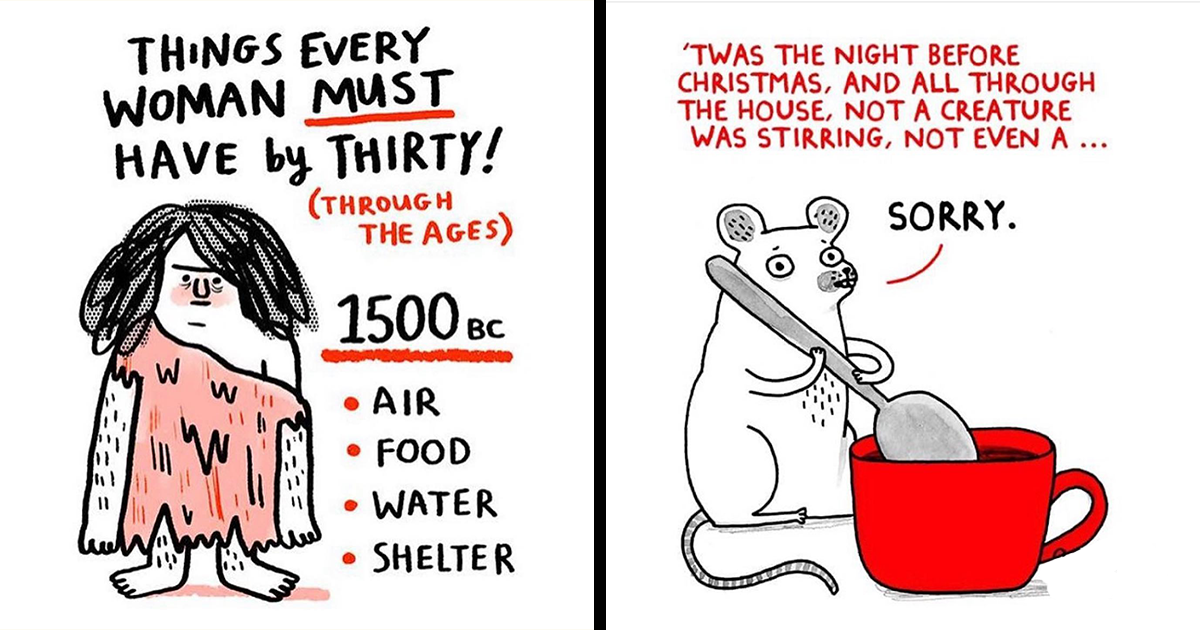
Anxiety has a remarkable talent for turning ordinary moments into low-budget psychological thrillers. An unexpected phone call becomes a crisis. Resting feels irresponsible. A single mildly negative comment can overpower a stadium full of compliments. British illustrator Gemma Correll captures these experiences in witty mental health comics that are simple, painfully recognizable, and often funny enough to make readers snort into their coffee.
In this collection of 30 comics, Correll explores depression, anxiety, overthinking, creative paralysis, social discomfort, and the exhausting pressure to appear productive. Her drawings do not pretend that mental illness can be defeated with a cheerful slogan and a scented candle. Instead, they show how humor can make difficult emotions easier to recognize, discuss, and share.
Meet Gemma Correll, the Artist Behind the Comics
Gemma Correll is a British cartoonist, illustrator, and author known for transforming personal worries into compact visual jokes. Originally from England and now based in Southern California, she has developed a recognizable style built from expressive characters, handwritten dialogue, bold lines, limited colors, and the occasional pug acting as an emotional support potato.
Correll studied graphic design and illustration at the Norwich School of Art and Design. Over the years, her work has appeared in books, editorial publications, exhibitions, merchandise, and animated projects. Her bibliography includes humorous titles about anxiety, puns, cats, dogs, and the beautifully chaotic business of being alive.
Her best-known comics frequently focus on anxiety and depression because those subjects come from lived experience rather than an attempt to chase a trending wellness topic. She has spoken openly about struggling with mental illness from a young age and about using drawing to understand experiences that can otherwise feel shapeless or impossible to explain.
A Simple Style With a Complicated Emotional Core
Correll’s characters may look deceptively uncomplicated, but the ideas behind them are not. A few lines can communicate embarrassment, exhaustion, panic, loneliness, and reluctant self-awareness. Her restricted visual language helps the emotional message arrive quickly. Readers do not need a gallery guide, a philosophy degree, or a tiny pair of opera glasses.
The jokes also work because Correll is exceptionally good at identifying the precise moment when reasonable concern mutates into anxious nonsense. She does not merely draw someone worrying. She draws the internal logic of worrythe strange rules, imaginary disasters, and impossible standards that can feel completely convincing from inside an anxious mind.
What the 30 Witty Mental Health Comics Explore
The collection covers familiar problems without reducing every emotional struggle to the same generic sad face. Some comics examine depression and low motivation, while others focus on social anxiety, self-criticism, phone calls, holiday stress, productivity guilt, and the pressure to think positively at all times.
The Endless Argument Between Rest and Productivity
One especially relatable comic presents a familiar cycle: a person tries to work but realizes she needs rest. When she attempts to rest, she remembers all the work she should be doing. Her proposed compromise is to accomplish neither task and then criticize herself for it.
It is funny because the logic is absurd, yet the experience is common. Anxiety can make relaxation feel like negligence, while exhaustion makes concentration difficult. The result is not productive work or restorative rest. It is several hours of emotional buffering accompanied by intense awareness of the clock.
Correll exposes the trap without offering a suspiciously perfect morning routine. There is no command to wake at 4:30 a.m., drink celery foam, and become a millionaire before breakfast. The comic simply names the pattern, allowing readers to recognize it with less shame.
When an Unexpected Phone Call Feels Like a Horror Movie
Another comic frames an incoming phone call as a terrifying event. The central question is not who is calling or why. It is why this reckless individual did not send a text like a civilized person.
For someone with social anxiety, a phone call can feel demanding because it provides no preparation time. There is no opportunity to edit a response, search for the correct information, or spend 17 minutes deciding whether “Sounds good!” contains too much enthusiasm. The phone rings, and immediate human behavior is expected. Outrageous.
The joke communicates something that might otherwise sound trivial to people who do not share the experience. Through exaggeration, Correll makes the emotional reality visible without claiming that every reluctance to answer a phone indicates a disorder.
Festive Anxiety Comes With Decorative Lights
In one minimalist image, ordinary anxiety appears as a large scribbled knot surrounding a character’s head. Festive anxiety is represented by the same knot decorated with colorful lights. Nothing has actually become calmer; the distress has merely received seasonal accessories.
The comic neatly challenges the expectation that holidays automatically produce happiness. Celebrations can bring financial pressure, disrupted routines, travel, family tension, social obligations, grief, sensory overload, and the demand to appear delighted about all of it. Anxiety does not politely leave because someone placed cinnamon sticks near a candle.
By turning festive stress into a visual gag, Correll validates people who find supposedly joyful occasions emotionally complicated.
Why One Negative Comment Can Defeat Ten Compliments
Correll also depicts a character surrounded by positive remarks. She appears unmoved until one negative statement arrives. Suddenly, that single criticism becomes absolute proof that she is a failure.
This comic illustrates the brain’s tendency to give disproportionate attention to threatening or negative information. It also captures how anxiety and low self-esteem can distort interpretation. Praise may be dismissed as politeness, while criticism is treated as a notarized statement from the Supreme Court of Personal Worth.
The humor does not deny the pain of criticism. It reveals the unfair scoring system operating in the background.
The Myth of the Inspired, Depressed Artist
One of the collection’s sharpest comics compares the romantic myth of the suffering artist with reality. In the fantasy, emotional pain fuels passionate creativity. In reality, depression may leave the artist staring at a blank canvas without the energy or inspiration to begin.
This distinction matters. Popular culture often presents mental illness as mysterious creative fertilizer, particularly when discussing writers, musicians, and visual artists. Correll rejects that romanticization. Suffering may become material for art later, but during a depressive episode it can interfere with concentration, energy, motivation, sleep, decision-making, and pleasure.
Her point is not that meaningful art cannot emerge from difficult experiences. It is that mental illness is not a magical employee who arrives with brilliant concepts and excellent time-management skills.
How Gemma Correll Uses Humor Without Minimizing Mental Illness
Depression and anxiety are serious health conditions capable of affecting work, education, sleep, physical well-being, relationships, and everyday functioning. That seriousness does not make humor inappropriate. In many cases, humor allows people to approach a subject that otherwise feels intimidating or isolating.
Correll’s jokes usually target the distorted rules created by anxiety rather than mocking people who experience it. The anxious character is not presented as foolish for struggling. The absurdity belongs to the impossible situation: needing rest but feeling guilty for resting, wanting reassurance after years of commitment, or interpreting an unanswered message as evidence of an international conspiracy.
This distinction keeps the comics compassionate. Readers are invited to laugh with the character, not point at her from a safe distance.
Humor Creates a Small Amount of Emotional Distance
A joke can temporarily separate a person from a frightening thought. Instead of being entirely consumed by anxiety, someone may become an observer capable of saying, “My brain is performing that strange trick again.” The problem has not vanished, but it may feel slightly less powerful.
Research on humor suggests that laughter can help reduce perceived stress, improve mood, and strengthen social bonds. Funny media may also make stressful topics feel more manageable. Still, laughter is supportive rather than curative. A comic cannot replace therapy, medication, medical care, sleep, social support, or other appropriate treatment.
Think of humor as a flashlight, not an emergency evacuation team. It may help a person see the room more clearly, but it does not necessarily remove everything dangerous from it.
Why Relatable Mental Health Comics Matter
They Give Difficult Feelings a Name
Anxiety is often described with broad words such as fear, worry, or stress. Correll’s drawings make it more specific. Anxiety can be the inability to rest, dread of social contact, obsessive rereading of a message, catastrophic interpretation of a small mistake, or the suspicion that everyone secretly dislikes you despite years of evidence to the contrary.
Seeing a precise experience illustrated can help readers describe it to friends, partners, therapists, or family members. Sometimes a person cannot produce a polished explanation but can point to a comic and say, “This. My brain does this.”
They Reduce the Sense of Being Uniquely Broken
Mental health struggles frequently arrive with a second layer of distress: the belief that nobody else thinks or behaves this way. Relatable comics interrupt that assumption. Thousands of readers recognizing the same pattern do not make the pattern pleasant, but they do make it less lonely.
The comment sections beneath Correll’s work often resemble informal support groups with more jokes and fewer uncomfortable folding chairs. Readers exchange their own stories, admit to similar habits, and express relief that someone has illustrated thoughts they assumed were private.
They Challenge Forced Positivity
Correll is skeptical of emotional advice that consists entirely of commanding people to be positive. Optimism can be useful, but compulsory cheerfulness may pressure people to hide pain rather than process it.
Her comics make room for mixed emotions. A person may be grateful and depressed, loved and anxious, successful and exhausted, amused and deeply uncomfortable. Human emotional life is not a customer satisfaction survey with only one acceptable box.
Creative Expression Is Helpful, but It Is Not Automatically Art Therapy
Drawing, writing, music, crafts, and other creative activities can provide emotional expression, structure, pleasure, reflection, and a sense of accomplishment. Some research has found promising mental health benefits from art-based interventions, including potential reductions in symptoms of anxiety and depression for certain groups.
However, personal creative practice and clinical art therapy are not identical. Art therapy is a mental health profession delivered by a trained practitioner who uses the creative process within a therapeutic relationship. Posting a sketch online may be meaningful and supportive, but it should not be presented as a guaranteed medical treatment.
Correll’s work demonstrates what personal art can do particularly well: translate an internal experience into something shareable. The finished comic becomes a bridge between the artist and readers who have felt the same confusion but lacked the words or pictures to explain it.
From Short Comics to a Larger Mental Health Story
Correll has continued expanding her exploration of anxiety beyond individual social media posts. Her long-form graphic memoir, Anxietyland, examines her experiences with anxiety, depression, panic, avoidance, unhealthy coping strategies, and the search for effective help.
The longer format allows her to show that recovery is rarely a clean three-panel narrative. Progress may involve treatment, setbacks, uncomfortable realizations, lifestyle changes, professional support, and periods when improvement is difficult to notice. Humor remains present, but it does not erase the seriousness of the journey.
This broader work reinforces a message already visible in her short comics: feeling better is possible, but people should not be expected to joke, draw, or positively think their way out of a mental health condition by themselves.
What Readers Can Take Away From These 30 Comics
Gemma Correll’s mental health comics succeed because they are specific, honest, and unpolished in the best possible way. They capture the strange backstage conversations that happen inside an anxious mind and turn them into something another person can understand in seconds.
The collection does not provide a universal explanation for depression or anxiety. Experiences vary, and a joke that comforts one reader may not connect with another. What the comics offer is recognition: the comforting shock of discovering that someone else has documented the exact argument your brain conducted at 2:13 a.m.
They also remind audiences that mental illness and humor can occupy the same page. Laughing at an anxious thought does not mean the thought was painless. It means pain has not taken complete control of the narrative.
Related Experience: A Very Ordinary Day With an Overactive Mind
The following is an illustrative composite based on experiences commonly described by people living with anxiety. It is not presented as the story of one specific individual.
The day begins before the alarm. A person wakes at 5:47 a.m. and immediately remembers an email sent yesterday. The email was professional, polite, and entirely normal. Naturally, the brain has now scheduled an emergency meeting to discuss whether the word “thanks” seemed passive-aggressive.
By breakfast, three alternative versions of the email have been drafted mentally. None can be sent because the original message already exists in another person’s inbox, where it is presumably being examined by a committee of communication experts and disappointed ancestors.
A phone notification appears. The heart jumps. It is only a weather alert, but the nervous system has already released the ceremonial panic balloons.
Work begins. There are five tasks on the list. The simplest should take ten minutes, which is precisely why it cannot be started. What if another task is more urgent? What if beginning the wrong one wastes time? The solution is apparently to research productivity methods for 40 minutes and then feel guilty about not working.
At noon, exhaustion arrives. Rest seems sensible, but lying down produces a new concern: productive adults do not need rest at noon. Productive adults are answering emails while hiking uphill and eating something called a power bowl. Therefore, the person remains on the couch but does not relax. This is technically resting in the same way that standing in a kitchen is technically cooking.
Later, a friend sends a message containing fewer exclamation points than usual. The evidence is clear: the friendship has ended. The possibility that the friend is busy, tired, or simply unwilling to operate a punctuation fireworks display is briefly considered and immediately rejected.
A pet wanders into the room and demands attention. Unlike humans, the animal has no performance review, inspirational podcast, or five-year plan. It wants to sit somewhere inconvenient and be admired. For a few minutes, the mind quiets.
In the evening, the person draws a small cartoon about the day. The anxious brain becomes an overconfident office manager carrying a clipboard labeled “Potential Disasters.” The drawing is not a cure. Tomorrow may contain the same worries. Yet the cartoon changes the relationship to them. The fear that felt enormous at breakfast now looks slightly ridiculous wearing a necktie.
The image is shared with a friend, who replies, “My brain does this too.” That message does not solve the unfinished tasks, erase the physical symptoms of anxiety, or replace professional support. It does something quieter: it reduces isolation.
This is where Correll’s style of mental health humor becomes powerful. The joke does not insist that everything is fine. It says the situation is difficult, recognizable, and survivable enough to be drawn. It creates a moment in which two people can look at the same emotional mess and laughnot because it never hurt, but because neither person is standing in it alone.
Conclusion
Gemma Correll’s 30 witty comics turn anxiety, depression, overthinking, and creative frustration into clear visual stories. Their charm comes from a careful balance: the drawings are playful without treating mental illness as trivial, while the jokes are honest without becoming hopeless.
Her characters worry about phone calls, productivity, criticism, relationships, holidays, and whether they deserve to rest. In other words, they behave like human beings whose brains have installed far too many browser tabs and refuse to reveal which one is playing the alarming music.
For readers facing similar struggles, these comics may offer recognition, language, and a brief emotional release. They are not treatment, but they can make treatment, conversation, and self-understanding feel less intimidating. Sometimes a small drawing cannot fix the day. It can still make the day feel shared.