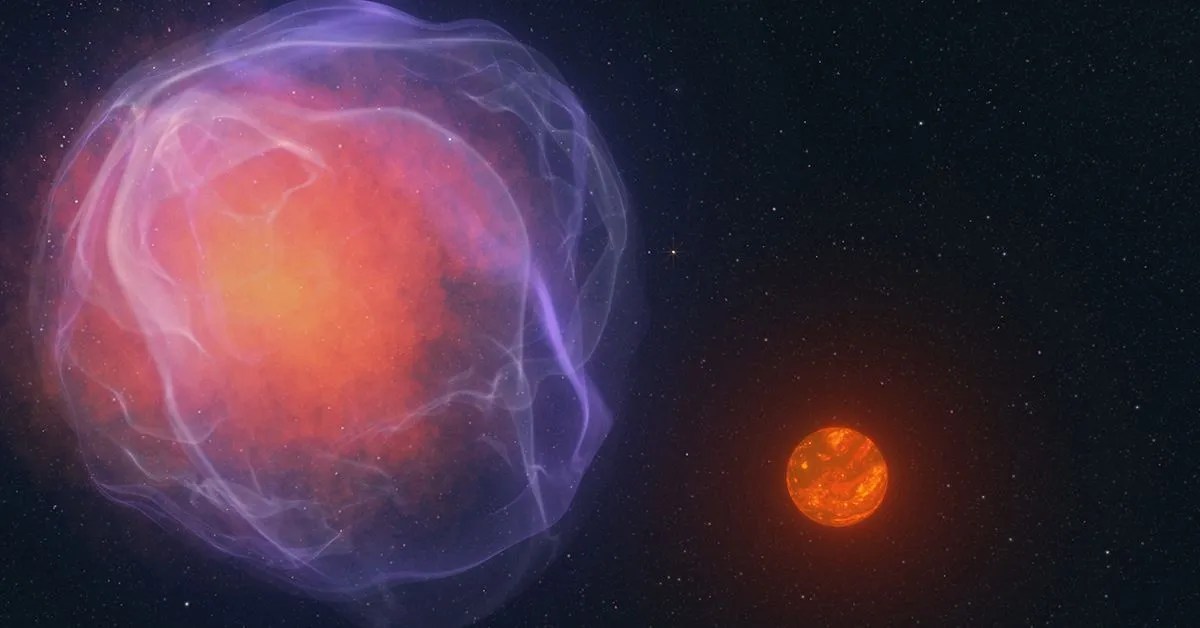
Every so often, the universe reminds us that it is not merely large; it is also extremely good at hiding weird things in plain sight. The latest cosmic “wait, what was that?” moment came when citizen scientists studying NASA data helped spot a faint, fast-moving object now known as CWISE J124909.08+362116.0, or CWISE J1249 for people who prefer their astronomy names with fewer keyboard injuries.
The object was found through Backyard Worlds: Planet 9, a citizen science project that invites volunteers to examine infrared images from NASA’s Wide-field Infrared Survey Explorer, better known as WISE, and its later NEOWISE mission. The goal is to find moving objects that computers might miss: brown dwarfs, low-mass stars, possible planetary neighbors, and occasionally something moving so quickly that it makes everyone in the room sit up straighter.
CWISE J1249 is estimated to be racing through the Milky Way at roughly 1 million miles per hour. That is fast enough to raise an extraordinary possibility: this object may eventually escape our galaxy altogether. For comparison, our Sun orbits the center of the Milky Way at about half a million miles per hour, which sounds fast until CWISE J1249 enters the chat wearing cosmic running shoes.
The Discovery Hidden in NASA Data
The discovery began not with a giant telescope eyepiece but with volunteers combing through digital “flipbooks” made from years of NASA infrared observations. Citizen scientists Martin Kabatnik, Thomas P. Bickle, and Dan Caselden noticed a faint red object shifting position across WISE images. In astronomy, motion is a clue. Stars in the background generally look fixed over short time spans, while nearby objects appear to slide against that backdrop.
That motion made CWISE J1249 interesting. Its faintness made it difficult. Its speed made it irresistible. After the citizen scientists flagged the object, professional astronomers followed up with observations from ground-based telescopes, including powerful instruments in Hawaii. Spectroscopic analysis helped researchers study the object’s light, estimate its composition, and narrow down what it might be.
The result is a fascinating mystery. CWISE J1249 appears to be either a very low-mass star or a brown dwarf, the class of objects sometimes described as “failed stars.” That phrase sounds harsh, like the universe gave them a performance review, but it simply means they are too small to sustain stable hydrogen fusion the way ordinary stars do.
What Is CWISE J1249?
CWISE J1249 sits near the blurry border between star and brown dwarf. Astronomers classify it as an L subdwarf, meaning it is cool, dim, and chemically unusual compared with many familiar stars. It also appears to be metal-poor, which means it contains relatively low amounts of heavier elements such as iron. In astronomy, “metals” means almost everything heavier than hydrogen and helium, because astronomers enjoy making simple words confusing.
That low-metal signature matters. It suggests the object may be very old, perhaps dating back to an earlier era of the Milky Way when fewer generations of stars had lived, died, and enriched the galaxy with heavier elements. In other words, CWISE J1249 may not only be moving fast; it may also be carrying a chemical diary from the ancient galaxy.
Researchers estimate that the object’s motion places it near the local escape velocity of the Milky Way. Escape velocity is the speed required to break free from a gravitational system. If CWISE J1249 is truly unbound, it may be on a one-way trip out of the galaxy. No passport, no snacks, just momentum.
How Citizen Scientists Made the Find
Backyard Worlds: Planet 9 is built around a simple but powerful idea: human eyes are still excellent at noticing patterns, oddities, and movement. Computers are fast, but they can struggle with messy astronomical data filled with artifacts, noise, and overlapping sources. Human volunteers, meanwhile, can look at a short animation and say, “That dot is doing something suspicious.”
The project uses images from NASA’s WISE mission, which surveyed the sky in infrared light. Infrared astronomy is especially useful for finding cool, dim objects such as brown dwarfs. These objects may not shine brightly in visible light, but they glow in infrared wavelengths, like cosmic embers too cool for ordinary stargazing.
Volunteers examine image sequences and mark objects that appear to move. Many candidates turn out to be known objects, image artifacts, or ordinary sources. But sometimes, the signal is real and scientifically valuable. Backyard Worlds has already contributed to the discovery of thousands of brown dwarf candidates and other ultracool objects. CWISE J1249 stands out because of its remarkable speed and possible galactic escape route.
Why One Million Miles Per Hour Is a Big Deal
Space is full of motion. Planets orbit stars, stars orbit galactic centers, galaxies drift through clusters, and your coffee is technically moving through the universe at ridiculous speed before you even take the first sip. But even in this restless environment, 1 million miles per hour is dramatic for a low-mass stellar or substellar object.
Hypervelocity stars are rare. Many known examples are massive stars that may have been flung outward by interactions with the supermassive black hole at the center of the Milky Way. CWISE J1249 is different because it is extremely low in mass. If confirmed as a hypervelocity low-mass star or brown dwarf, it would represent an unusual member of a rare cosmic category.
Its speed also raises questions about origin. Objects do not accelerate to such velocities politely. Something violent, crowded, or gravitationally extreme probably happened. Astronomers are now considering several possible launch scenarios, each more dramatic than the last.
Possible Origin Story: A Supernova Slingshot
One possibility is that CWISE J1249 once belonged to a binary system with a white dwarf. A white dwarf is the dense remnant of a Sun-like star after it has exhausted its fuel. If a white dwarf pulls too much material from a companion, it can explode as a Type Ia supernova. That explosion can destroy the white dwarf and fling the companion away at tremendous speed.
If CWISE J1249 survived such an event, it may be the cosmic equivalent of someone walking away from an exploding building in slow motion, except the building is a star and the walking speed is a million miles per hour. This scenario could explain both the object’s speed and its unusual journey through the galaxy.
Possible Origin Story: Black Holes in a Globular Cluster
Another possibility involves a globular cluster, a dense swarm of ancient stars bound together by gravity. In such crowded environments, close encounters are common. If a low-mass star passed near a pair of black holes, the three-body interaction could act like a gravitational slingshot, launching the star out of the cluster and across the galaxy.
This idea sounds like science fiction, but gravity is very good at turning close encounters into high-speed exits. A black hole binary can transfer orbital energy to a passing object, flinging it away while the black holes tighten their own orbit. It is the universe’s version of an overpowered pinball machine.
Possible Origin Story: A Galactic Fossil
There is also the possibility that CWISE J1249 came from outside the usual population of Milky Way stars. Its metal-poor composition suggests ancient origins, and some researchers have considered whether it may have been associated with a satellite system or old stellar population later absorbed by the Milky Way.
If so, the object could help astronomers study how our galaxy assembled itself over billions of years. The Milky Way is not a perfectly calm island of stars. It has grown by merging with smaller galaxies, swallowing stellar streams, and remixing ancient populations. A fast, metal-poor object like CWISE J1249 may preserve clues from that long history.
Why NASA’s WISE Data Was Perfect for the Job
WISE launched in 2009 and surveyed the entire sky in infrared light. After its original mission, the spacecraft was reactivated as NEOWISE to study near-Earth objects such as asteroids and comets. Along the way, its repeated observations of the sky created a treasure chest for astronomers looking for motion.
Repeated sky surveys are powerful because they add time to the picture. A single image can show where an object is. Multiple images taken over years can reveal where it is going. For nearby brown dwarfs and low-mass stars, that motion can be the key to discovery.
The WISE and NEOWISE archives are especially valuable because they cover infrared wavelengths, where cool objects shine more clearly. A faint red object that barely appears in visible-light surveys may stand out in infrared data. That is why Backyard Worlds volunteers are not just staring at random dots. They are scanning one of the most useful maps ever made of the cool, dim, nearby universe.
Why This Discovery Matters
CWISE J1249 matters because it touches several major questions in astronomy. How are low-mass stars and brown dwarfs formed? How often are objects ejected from the galaxy? Can ancient, metal-poor objects reveal early Milky Way history? And how many fast-moving objects are still hiding in public data archives?
The discovery also shows that citizen science is not a cute side dish to “real” science. It is real science. Volunteers helped identify the object. Professional astronomers followed up with advanced instruments. The combined effort produced a discovery that may reshape how researchers think about hypervelocity objects near the star-brown dwarf boundary.
It is a beautiful example of modern astronomy as a team sport. Space telescopes collect enormous datasets. Public archives preserve them. Online platforms make them searchable. Volunteers examine them. Researchers verify and interpret them. Somewhere in that chain, a faint dot becomes a headline.
The Human Advantage in a Machine-Learning Age
Artificial intelligence is increasingly important in astronomy, especially when surveys generate oceans of data. However, the CWISE J1249 story reminds us that human pattern recognition still has a place. Humans are excellent at spotting the oddball, the almost-missed signal, the thing that does not behave like its neighbors.
That does not mean humans and machines are rivals. The future of discovery will likely combine both. Algorithms can narrow the search field. Volunteers can review ambiguous cases. Scientists can confirm the best candidates with telescopes and models. The ideal system is not “human versus computer.” It is “human plus computer versus the universe’s habit of hiding the good stuff.”
What Happens Next?
Researchers will continue studying CWISE J1249’s motion, distance, composition, and possible origin. Better measurements can refine whether it is truly unbound from the Milky Way or simply moving very quickly within it. More detailed spectroscopy can reveal chemical fingerprints that point toward its birthplace and history.
Future surveys may also reveal more objects like it. If CWISE J1249 is the first known example of a broader population of hypervelocity low-mass stars or brown dwarfs, then it may be less of a cosmic freak accident and more of a preview. The galaxy may contain many more dim, fast objects that have been launched by supernovae, black holes, star clusters, or ancient galactic mergers.
Experiences and Lessons from the Citizen-Science Hunt
The experience of discovering an object like CWISE J1249 is part detective work, part patience test, and part cosmic treasure hunt. Citizen scientists do not begin with a dramatic explosion on screen or a glowing arrow that says, “Congratulations, you found something weird.” Instead, they examine frame after frame of faint sources, many of which look about as glamorous as dust on a laptop screen.
That is what makes the discovery so meaningful. The excitement comes from attention. A volunteer notices that a tiny point of light moves differently from the background. Another person checks it. A conversation begins. The candidate is compared with known catalogs. Eventually, professional follow-up turns a suspicious dot into a scientific target. The process is slow, careful, and deeply satisfying for anyone who enjoys the phrase “wait a second.”
For everyday participants, projects like Backyard Worlds offer a rare feeling: direct contact with real research. You do not need a Ph.D., a personal observatory, or a mountain in your backyard. You need curiosity, persistence, and a willingness to look closely. The data comes from NASA, but the discovery can begin on an ordinary computer screen in an ordinary room, possibly with snacks. Astronomy has rarely been more democratic.
The CWISE J1249 case also teaches a useful lesson about scientific humility. The object is not fully understood yet. Scientists have good measurements, strong hypotheses, and several possible origin stories, but the final answer is still being built. That uncertainty is not a weakness. It is the engine of science. A strange object appears, evidence accumulates, ideas compete, and the best explanation gradually survives.
There is also a motivational lesson here for anyone who assumes that all major discoveries have already been made. They have not. Public data archives contain years of observations waiting for fresh eyes. Some discoveries require billion-dollar spacecraft, but others require someone patient enough to notice a moving speck that everyone else overlooked. The universe is enormous, but it is also full of small clues.
In that sense, CWISE J1249 is more than a fast object. It is a reminder that science advances when professionals and the public work together. The citizen scientists who spotted it were not merely helping; they were participating. Their attention helped open a new scientific question: how does such a small, ancient-looking object end up moving fast enough to possibly leave the Milky Way?
That question is still traveling, just like CWISE J1249 itself. And thanks to citizen science, more people than ever can help follow where it leads.
Conclusion
The discovery of CWISE J1249 in NASA data is the kind of story that makes astronomy feel both enormous and personal. On one hand, it involves galaxy-scale speeds, ancient stellar populations, supernova theories, black hole slingshots, and the possibility of an object escaping the Milky Way. On the other hand, it began with people carefully studying public data and noticing that one faint dot was moving differently.
That combination is what makes the story powerful. NASA’s WISE and NEOWISE missions created a rich infrared archive. Backyard Worlds turned that archive into a public research opportunity. Citizen scientists spotted something unusual. Astronomers followed up. Now, CWISE J1249 may become a key example of a hypervelocity object near the boundary between star and brown dwarf.
The universe is not done surprising us. Sometimes the surprise is not hidden behind a brand-new telescope or a secret laboratory door. Sometimes it is already sitting in the data, waiting for someone with sharp eyes, curiosity, and just enough stubbornness to say, “That dot looks weird.”
Note: This article is based on publicly reported scientific information from NASA mission coverage, Backyard Worlds citizen-science materials, observatory follow-up reports, and the published discovery research on CWISE J124909.08+362116.0.