There was a time when owning a robot dog sounded like something reserved for billionaire villains, sci-fi labs, or that one neighbor who already has a refrigerator that talks too much. Today, the idea of leasing your own dog robot is no longer a futuristic joke. It is a practical option for companies, universities, event organizers, construction teams, security departments, and robotics enthusiasts who want the benefits of a quadruped robot without immediately buying a very expensive mechanical puppy.
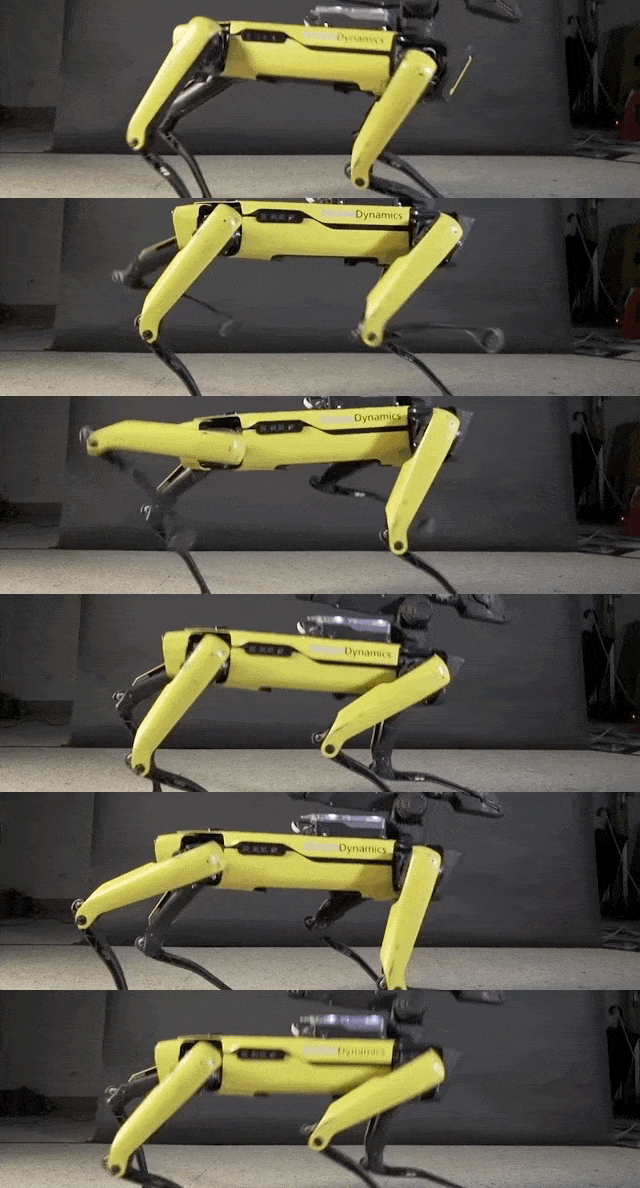
A dog robot, also called a quadruped robot, is a four-legged mobile machine designed to walk, climb, inspect, map, record, patrol, and sometimes entertain crowds by looking both adorable and slightly judgmental. Unlike wheeled robots, dog robots can handle stairs, uneven floors, curbs, industrial sites, grass, gravel, and other places where wheels start behaving like drama queens. That is why businesses are exploring robot dog leasing, robot-as-a-service plans, and short-term robot dog rentals for projects where mobility matters.
The big question is simple: should you lease your own dog robot, rent one for a short event, or buy one outright? The answer depends on your budget, your use case, your technical team, and whether you need a serious industrial inspection tool or just a booth magnet that makes trade-show visitors stop scrolling their phones.
What Does It Mean to Lease a Dog Robot?
Leasing a dog robot means paying for access to the machine over a defined period instead of purchasing it upfront. In practical terms, it can look like a monthly subscription, a robot-as-a-service contract, a short-term rental, or a managed deployment where the provider supplies the robot, software, support, training, and maintenance.
This matters because advanced robot dogs are not ordinary gadgets. A professional quadruped robot may need sensors, batteries, charging equipment, software licenses, mapping tools, camera payloads, staff training, maintenance, insurance, and safety procedures. Buying the robot is only the first bite. Leasing spreads those costs out and can include support that keeps the robot from becoming a very expensive hallway ornament.
Why Robot Dogs Became Lease-Worthy
Robot dogs became attractive because they are good at jobs humans either dislike, should not do too often, or cannot do safely. The classic robotics phrase is “dull, dirty, and dangerous.” That means repetitive inspections, hazardous areas, remote monitoring, large construction walks, industrial mapping, perimeter patrols, and data collection in places where sending a person every hour is inefficient or risky.
Boston Dynamics’ Spot is the most famous example. Spot has been used for industrial inspections, construction documentation, utility work, and research. It can be equipped with cameras, thermal sensors, mapping tools, and other payloads depending on the mission. In earlier commercial stages, Spot was offered through an early adopter leasing program before broader sales became available. That history helped prove something important: many organizations did not just want a robot dog; they wanted a supported robot dog program.
That is where leasing shines. A business may not want to become a robotics company overnight. It may simply want a mobile machine that can walk a route, collect data, and report problems. Leasing turns the robot from a capital purchase into an operational service, which is far easier for some teams to justify.
Who Should Lease a Dog Robot?
Construction Companies
Construction sites are constantly changing. Walls appear, materials move, equipment shifts, and yesterday’s clear path becomes today’s obstacle course. A leased robot dog can walk scheduled routes, capture progress photos, create visual records, support safety checks, and help teams compare real site conditions with project plans.
Instead of sending a worker to repeat the same documentation walk every day, a robot dog can collect consistent data. Humans still make decisions, but the robot helps gather the evidence. Think of it as a four-legged intern that never asks where the coffee machine is.
Utilities and Energy Facilities
Power substations, oil and gas sites, renewable energy facilities, and industrial plants often include areas where inspection is necessary but inconvenient. A robot dog can carry visual, thermal, acoustic, or mapping sensors into hard-to-reach locations. Utility companies have tested and used robot dogs for safety inspections, including in high-voltage environments where reducing human exposure is a major advantage.
For these organizations, leasing can be ideal because the technology may need customization. The robot may need special sensors, route programming, rugged operating procedures, and integration with existing reporting systems.
Security Teams
Robot dogs are also entering security. Systems such as DroneDog-style patrol robots are designed for perimeter monitoring, real-time video, remote oversight, and automated patrol routines. These deployments often come with a human-operated security operations center, charging station, maintenance support, and software management.
Leasing makes sense here because security is not just about owning hardware. It is about response procedures, monitoring, alerts, logs, and human supervision. A robot dog should support trained people, not replace judgment with a metal terrier and a Wi-Fi signal.
Schools, Universities, and Research Labs
Universities may lease dog robots for robotics courses, AI research, mobility studies, computer vision, sensor fusion, and STEM demonstrations. Lower-cost quadruped models such as Unitree Go2 have made hands-on robotics more accessible, especially for labs that cannot justify a premium industrial platform.
For education, leasing or subscription pricing can be easier than buying because it may include setup, curriculum support, repair coverage, and technical guidance. In a classroom, the robot needs to be more than cool. It needs to survive students, and students are basically stress-testing machines with backpacks.
Events, Trade Shows, and Brand Activations
Some organizations do not need a robot dog for inspection at all. They need attention. Robot dog rental services for trade shows, corporate events, product launches, and STEM exhibits have become a niche but useful market. A walking robot dog can attract visitors, start conversations, and make a brand look innovative without requiring the company to store, maintain, and program a robot afterward.
For this use case, short-term rental is usually better than leasing. You get the “wow” without the long-term responsibility. It is like borrowing a celebrity guest, except the guest has servos and does not ask for sparkling water.
Lease vs. Buy: Which Option Makes More Sense?
Buying a professional robot dog can cost tens of thousands of dollars before accessories, payloads, software, training, and maintenance. Some industrial deployments can rise far beyond the base price once cameras, sensors, charging stations, integration work, and support are included. Leasing lowers the entry barrier and gives teams a way to test value before making a major purchase.
Buying may make sense when your organization has a long-term robotics roadmap, internal technical staff, and a clear workflow that uses the robot frequently. Leasing may make more sense when your project is temporary, experimental, budget-sensitive, or dependent on vendor support.
Lease If You Want Flexibility
Leasing allows you to test whether a robot dog actually improves operations. You can evaluate route reliability, staff adoption, data quality, battery needs, software workflow, and safety requirements. If the robot saves time and reduces risk, you can expand the program. If not, you have learned an expensive lesson in a less expensive way.
Buy If You Know the Mission
Buying becomes attractive when the robot is mission-critical and used often. For example, a large facility that uses a robot dog daily for inspection may eventually prefer ownership. Even then, the total cost of ownership must include support, batteries, repairs, software updates, staff training, and replacement planning.
What Can a Leased Robot Dog Actually Do?
A leased robot dog can perform a wide range of tasks, but it is not magic. It cannot replace a real dog’s nose, a human inspector’s experience, or your office manager’s ability to detect nonsense from 40 feet away. What it can do is carry sensors through complex spaces and collect repeatable data.
Common Uses
Robot dogs are commonly used for visual inspection, site mapping, progress tracking, security patrols, thermal imaging, acoustic monitoring, remote observation, research experiments, and public demonstrations. Some can climb stairs, avoid obstacles, follow programmed routes, and operate under remote human control.
Higher-end models can integrate with specialized software platforms for autonomous missions. Lower-cost models may be better for education, demos, and development projects. The right choice depends on whether you need reliability in industrial environments or just enough capability to teach, test, or entertain.
How Much Does It Cost to Lease a Dog Robot?
Costs vary widely. A short event rental may cost far less than a long-term industrial robot-as-a-service contract. Educational subscriptions may start at a few hundred dollars per month for certain models through specific providers, while advanced inspection or security deployments may cost much more because they include support, sensors, software, operations, and maintenance.
Do not compare only the monthly price. Compare the full package. Ask whether the lease includes batteries, chargers, payloads, insurance requirements, operator training, software access, technical support, repair turnaround, replacement units, route setup, data storage, cybersecurity controls, and cancellation terms.
A cheap robot dog with no support can become expensive very quickly. A more expensive lease with training and maintenance may be the better value if it keeps the robot working and your team confident.
Important Questions Before You Lease
What Problem Are You Solving?
Do not lease a dog robot because it looks cool. It does look cool, but cool is not a business case. Define the problem first. Are you reducing inspection time? Improving worker safety? Capturing consistent construction documentation? Teaching robotics? Drawing event traffic? Monitoring a large property?
Where Will the Robot Operate?
Robot dogs are mobile, but they still have limits. Evaluate stairs, slopes, narrow spaces, reflective surfaces, weather exposure, dust, heat, cold, wireless coverage, lighting, and human traffic. A robot that performs beautifully in a demo room may act confused in a cluttered warehouse full of forklifts and mysterious puddles.
Who Will Operate It?
Even autonomous robots need people. Someone must configure missions, monitor performance, charge batteries, handle updates, review data, and respond when the robot gets stuck or politely refuses to understand a staircase. Make sure your lease includes training and a clear support path.
What Data Will It Collect?
Robot dogs often carry cameras and sensors. That means privacy and data governance matter. Before deployment, decide what the robot records, where the data goes, who can access it, how long it is stored, and how people will be informed. This is especially important in schools, public spaces, workplaces, and security settings.
Safety, Ethics, and the “Please Do Not Be Weird” Rule
Robot dogs are powerful tools, and public reaction can be mixed. Some people see innovation. Others see a walking surveillance toaster from a dystopian movie. Both reactions are understandable. The best deployments are transparent, limited, supervised, and clearly tied to practical benefits.
Responsible robotics companies have publicly stated that general-purpose robots should not be weaponized. That matters because trust is essential. A dog robot used for inspection, safety, research, or entertainment can be useful. A dog robot used in ways that frighten people, violate privacy, or create unnecessary risk will quickly turn a promising technology into a public relations chew toy.
Best Use Cases for Leasing Your Own Dog Robot
The strongest lease cases usually involve repeated data collection in difficult spaces. Construction progress tracking is a strong example because routes are repetitive and documentation has clear value. Industrial inspection is another strong case because robots can reduce human exposure and gather consistent readings. Security patrols can also work when the robot is part of a broader human-supervised system.
Education and events are different. They may not require long-term industrial performance, but leasing or renting still makes sense because the robot creates hands-on learning and memorable engagement. A school can introduce students to robotics without purchasing a machine outright. A company can create a futuristic booth without needing a robotics department afterward.
When Leasing a Dog Robot Is a Bad Idea
Leasing is not always smart. If you do not have a clear use case, a safe operating environment, or staff who can manage the robot, wait. If the robot will mostly sit in a lobby taking selfies, rent one for an event instead. If you expect it to replace skilled workers immediately, reset your expectations. Robot dogs are tools, not miracle employees with paws.
A robot dog is also a bad fit for tasks that require delicate manipulation unless it has the right arm, gripper, software, and operator training. Walking is impressive, but walking alone does not fix a valve, repair a cable, or explain to accounting why the invoice says “mechanical canine deployment package.”
How to Choose the Right Robot Dog Lease
Start with the mission. For industrial inspection, look at ruggedness, autonomy, payload support, integration options, vendor support, and safety features. For research, prioritize SDK access, sensor flexibility, ROS support, and documentation. For education, prioritize training, curriculum support, durability, and budget. For events, prioritize operator support, visual appeal, reliability, and audience safety.
Next, compare the contract. A good lease should explain what happens if the robot breaks, how quickly support responds, who owns collected data, whether software is included, what accessories are provided, and how the robot is returned. The robot may have four legs, but the contract has fine print. Read it.
500-Word Experience Section: What It Feels Like to Lease Your Own Dog Robot
Imagine the first day your leased dog robot arrives. The crate opens, the team gathers, and everyone suddenly becomes a robotics expert because they watched three videos online. Then the robot stands up. That is the moment the room changes. People stop joking. Phones come out. Someone whispers, “It’s alive,” even though it is mostly batteries, motors, sensors, and engineering discipline.
The first experience is usually a mix of excitement and humility. A robot dog can look incredibly capable, but deployment is not as simple as pressing “go” and watching it become Employee of the Month. You need to learn how it sees the world. You need to understand its walking pace, turning radius, battery rhythm, obstacle behavior, and what kind of surfaces make it confident. You also learn that humans are unpredictable obstacles. People walk in front of it, wave at it, crouch down, ask its name, and treat it like a celebrity golden retriever with a software license.
On a construction site, the experience becomes practical quickly. The robot follows a route, captures images, and creates a repeatable record. At first, workers may laugh at it. Then they notice it can perform the same documentation walk again and again without forgetting a room. The robot does not replace the superintendent’s judgment, but it becomes a dependable data collector. The team starts asking better questions: Can it walk this floor every morning? Can we compare last week’s images? Can it flag missing materials? That is when the robot stops being a novelty and starts becoming a workflow.
In a school or university, the experience feels different. Students are drawn to the robot immediately. They want to know how it balances, how it maps, how it avoids obstacles, and whether it can dance. A leased robot dog gives teachers a living demonstration of robotics, AI, controls, sensors, and ethics. It turns abstract engineering ideas into something students can see walking across the room. The real lesson is not just “robots are cool.” It is that robots require design choices, safety thinking, programming, maintenance, and responsibility.
At a trade show, a robot dog is pure attention fuel. People who would ignore another banner will stop for a walking quadruped. The robot becomes an icebreaker. It can demonstrate agility, respond to simple commands, or perform a short routine. The challenge is crowd control. Everyone wants the best video angle. A good rental provider will manage the robot, create safe boundaries, and keep the experience smooth instead of chaotic.
The most surprising part of leasing a dog robot is how quickly expectations become realistic. On day one, people ask whether it can do everything. By week two, the smart teams ask what it can do reliably. That shift is healthy. A dog robot is not a pet, not a toy, and not a replacement for human expertise. It is a mobile platform that becomes valuable when matched with the right job. Lease it with curiosity, train your team carefully, measure results honestly, and remember to give it a name that sounds professional in meetings. “Quarterly Inspection Unit 3” is accurate, but “Bark Twain” is better.
Conclusion: Should You Lease Your Own Dog Robot?
Leasing your own dog robot can be a smart move if you have a clear mission, a realistic budget, and a team ready to use the technology responsibly. For construction, utilities, security, research, education, and events, robot dog leasing offers a flexible way to test advanced robotics without committing to full ownership immediately.
The best approach is simple: start with the problem, not the robot. Choose a lease that includes support, training, maintenance, and software. Set rules for safety and privacy. Measure whether the robot saves time, improves data quality, reduces risk, or creates meaningful engagement. If it does, congratulationsyou have found a useful four-legged coworker. Just do not expect it to fetch coffee. Yet.
Note: This article is written for web publication and is based on real commercial robot dog products, leasing models, robotics-as-a-service examples, industrial inspection use cases, event rentals, and responsible robotics guidelines.