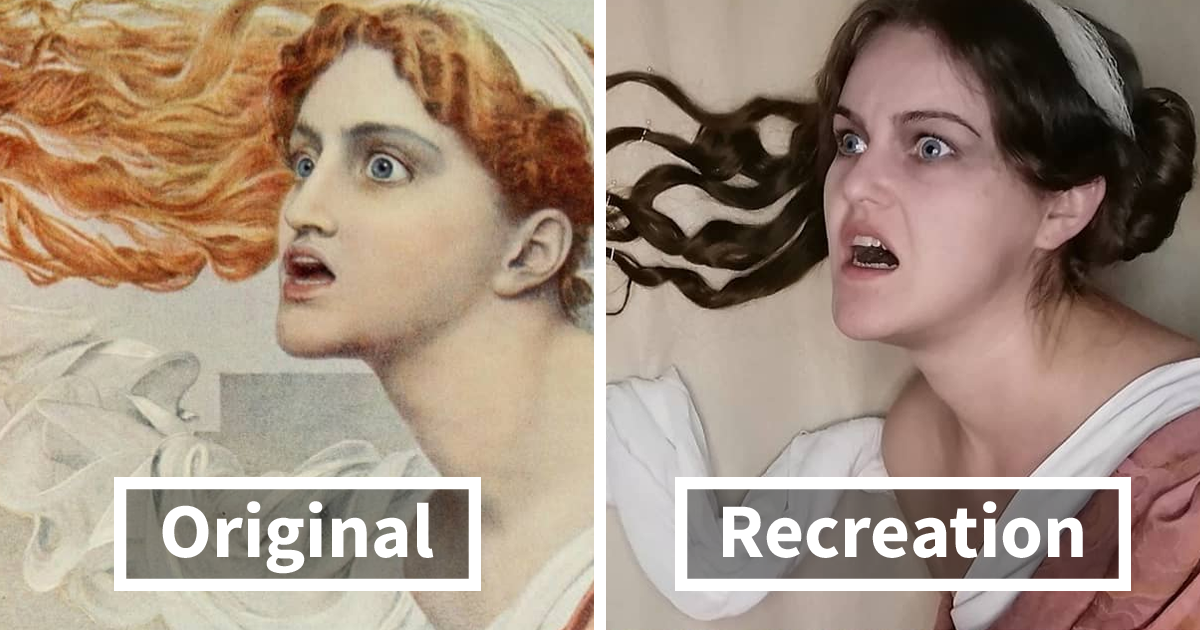
There are two kinds of people during an art challenge: those who say, “How inspiring,” and those who disappear into a closet, emerge wearing a curtain as a Renaissance gown, and somehow look like they belong in the Louvre. The story behind “Woman Decides To Recreate One Classical Painting Per Day, Does An Awesome Job (30 Pics)” belongs firmly in the second category.
The project became popular because it does something the internet loves: it takes high culture, removes the velvet rope, and makes it charmingly human. Instead of treating classical paintings as distant, untouchable masterpieces, the artist turns them into daily creative puzzles. A velvet sleeve becomes a bathrobe. A dramatic background becomes a bedsheet. A noble expression becomes the face you make when your camera timer gives you three seconds to become a duchess.
At the center of the viral series is artist Liza Yukhnyova, widely known for recreating famous paintings with remarkable patience, makeup, costumes, lighting, and resourcefulness. What began as a home art challenge grew into a daily practice, proving that classical painting recreation is not just a funny online trend. Done well, it becomes art history, theater, portrait photography, costume design, and emotional time travelall squeezed into one frame.
Why Classical Painting Recreations Are So Addictive
Classical paintings already have drama baked in. The lighting is theatrical. The fabrics are suspiciously luxurious. The poses say, “I have secrets, land, and possibly a tragic violin soundtrack.” When a modern creator recreates those images at home, the contrast creates instant delight. We recognize the grandeur of the original, but we also recognize the humble tools behind the remake: lamps, scarves, kitchen chairs, curtains, lipstick, cardboard, patience, and possibly one very confused cat.
The best famous painting remakes work because they are not lazy copies. They are translations. A painter once used oil, canvas, pigments, and a studio. A modern recreator uses a phone camera, thrifted clothing, household props, and a very serious relationship with natural light. The goal is not to replace the masterpiece. The goal is to understand it by stepping inside it.
The Real Skill Behind the “One Painting Per Day” Challenge
At first glance, the idea sounds simple: choose a painting, dress up, take a photo. In reality, recreating one classical painting per day is a creative marathon with a ridiculous number of tiny decisions. The artist has to study composition, match the angle of the head, imitate the emotional tone, build a costume silhouette, recreate hair, adjust shadows, and make the final image readable to viewers who may know the painting only vaguely.
1. Costume Is More Than Clothing
In classical portraiture, clothing is rarely just clothing. It communicates rank, wealth, personality, era, and symbolism. A heavy collar, a pearl necklace, a fur trim, or a red robe can change the entire mood of a painting. In a home recreation, the challenge is not to own a museum-quality wardrobe. The challenge is to make ordinary items behave like historical garments.
A scarf can become a turban. A blanket can become a cloak. A white shirt can suggest a Renaissance chemise. A tablecloth can suddenly look like noble drapery if folded correctly and photographed from the right angle. This is where Liza’s work stands out: the recreations often capture the spirit of the original painting without needing a Hollywood costume department. Budget: humble. Effect: surprisingly royal.
2. Makeup and Expression Carry the Illusion
Classical painting recreation depends heavily on the face. The model must not only look similar; she must perform the painting. A saintly gaze, a queenly stare, a dreamy tilt of the chin, or a slightly bored aristocratic expression can make or break the image.
Modern selfies usually say, “Here I am.” Classical portraits often say, “Here is my soul, my status, my grief, and my excellent cheekbone lighting.” To recreate that feeling, the artist needs restraint. Too much expression becomes parody. Too little becomes a passport photo from the 1600s. The sweet spot is subtle, and it is surprisingly difficult.
3. Lighting Is the Secret Sauce
Many old master paintings are famous for dramatic light. Think of glowing faces emerging from darkness, soft highlights on fabric, candle-like warmth, and shadows that look as if they have their own agent. Recreating that with household lighting is not easy.
A table lamp, window light, or carefully placed phone flashlight can create a convincing effect when used thoughtfully. The direction of light matters. The softness matters. Even the background matters. One wrong overhead bulb and suddenly a Baroque heroine becomes someone waiting at the DMV. Successful DIY art recreation requires looking at light like a painter, not just a photographer.
Why This Project Feels Bigger Than a Viral Photo Series
The charm of “Woman Decides To Recreate One Classical Painting Per Day, Does An Awesome Job (30 Pics)” is not only visual accuracy. It is also the way the project makes art history approachable. Museums can feel intimidating to people who think they need a degree, a black turtleneck, and the ability to pronounce “chiaroscuro” without spraining their tongue. A project like this says: relax, look closely, and play.
That playful spirit is deeply valuable. When someone recreates a painting, they must slow down and notice details: where the hand rests, how the fabric falls, what colors dominate, how the subject looks away or stares directly forward. This kind of looking is active, not passive. It turns a viewer into a participant.
That is why art challenges became so popular online, especially when museums and cultural institutions encouraged people to recreate artworks from home. Open-access collections from major museums have also made it easier for artists, educators, bloggers, and casual fans to discover public-domain masterpieces and use them as creative inspiration. The internet did not destroy the museum experience; in many cases, it invited people into it through the side door, wearing a bedsheet cape.
Famous Painting Remakes: Humor Meets Respect
The funniest recreations are often the most respectful. That sounds contradictory, but it is true. A thoughtful remake can wink at the original without mocking it. The humor comes from the gap between then and now: a solemn noblewoman recreated with a curtain, a mythological scene hinted at with kitchen props, a dramatic historical portrait rebuilt with modern makeup and clever framing.
The reason these images work is that the artist clearly cares. The pose is studied. The color palette is considered. The face is composed. The costume is improvised but intentional. This is not random cosplay. It is visual research disguised as fun.
What Makes Liza Yukhnyova’s Recreations Stand Out
Many people joined art recreation challenges, and plenty of them were hilarious. Liza Yukhnyova’s project gained attention because it combined consistency with craft. Recreating one famous painting is impressive. Recreating one painting per day turns the idea into discipline. It requires not only inspiration but routine, problem-solving, and the ability to keep going when the day’s masterpiece requires sleeves the size of sofa cushions.
Her work shows strong attention to historical mood. She often recreates portraits where posture, gaze, and fabric define the entire composition. The final images are not merely “close enough.” They feel carefully staged, as if the artist has entered the painting’s emotional weather.
Another reason the series feels special is the handmade nature of the process. There is a visible pleasure in invention. The viewer can enjoy both illusions at once: the recreation as a convincing classical image and the behind-the-scenes knowledge that much of it was built from everyday materials. That double reading makes the photos fun to revisit.
How Recreating Classical Paintings Helps People Understand Art
Recreation is one of the oldest ways to learn. Musicians play other composers’ work. Writers imitate sentence rhythms. Painters study masters by copying them. Recreating classical paintings through photography follows the same principle: imitation becomes education.
It Teaches Composition
Classical paintings are carefully arranged. Nothing is random. Hands, shoulders, eyes, furniture, drapery, and background elements all guide the viewer’s attention. When a modern artist tries to recreate that structure, composition becomes practical. You stop asking, “Why is this painting famous?” and start saying, “Oh, that hand is exactly where the eye needs it to be.”
It Teaches Color
Old paintings often rely on controlled palettes: deep reds, warm browns, ivory skin tones, muted greens, blue-black shadows, gold highlights. Recreating them forces the artist to think like a color editor. The wrong shade can ruin the illusion. The right scarf, wall, or lamp temperature can suddenly make a room look like a 17th-century studio.
It Teaches Patience
Modern content moves fast. Classical painting recreation slows everything down. You cannot rush a convincing pose, costume, and lighting setup unless you enjoy looking like a haunted laundry pile. The process rewards patience, which may be the most old-fashioned and useful art supply of all.
Why Audiences Love “30 Pics” Art Projects
Online readers love a visual series because it offers rhythm. One image is interesting. Thirty pictures become a journey. Viewers begin comparing the choices: Which recreation is closest? Which one is funniest? Which one required the most costume wizardry? Which one looks like it cost nothing but somehow belongs on a gallery wall?
The “30 pics” format also makes the project easy to share. People can scroll, react, save favorites, and send the link to a friend with a message like, “We should do this,” which usually means, “You find the props, I’ll provide moral support from the couch.”
But beyond scrollability, the series format shows growth. A daily art challenge creates a visible archive of effort. Each image is a small performance, and together they become a statement: creativity does not always require perfect conditions. Sometimes it requires starting today, then doing it again tomorrow.
Tips for Trying a Classical Painting Recreation at Home
If this project makes you want to recreate your favorite painting, good news: you do not need a castle, a powdered wig, or a personal lighting assistant named Sebastian. Start small and choose a painting with a clear pose and simple background.
Choose a Recognizable Painting
Pick a portrait or scene with a strong silhouette. Vermeer, Rembrandt, Frida Kahlo, Van Gogh, Whistler, and John Singer Sargent are popular inspirations because their compositions are memorable. Avoid overcrowded battle scenes unless your household includes twelve cooperative roommates and a horse.
Use What You Already Own
The magic is in substitution. A towel can become a headwrap. A bedsheet can become a gown. A broom can become a staff. A fruit bowl can become symbolic abundance, or at least proof that you bought apples this week.
Match the Light Before the Costume
Lighting does more than expensive fabric. Study the original and ask: where is the light coming from? Is the background dark or bright? Is the face softly lit or sharply shadowed? Once the light is close, even simple props look more convincing.
Respect the Original, Then Add Personality
A good remake does not have to be a perfect clone. The best versions capture the mood while allowing modern personality to peek through. That little spark of “I made this in my living room” is part of the joy.
The Cultural Value of Playful Art Imitation
Projects like this remind us that art is not locked in the past. A painting made centuries ago can still spark jokes, experiments, research, admiration, and new creative work. That is cultural life in action. The masterpiece survives not because it sits silently on a wall, but because people keep looking at it, interpreting it, and occasionally wrapping themselves in curtains because the sleeves must be dramatic.
Classical painting recreation also helps bridge the gap between experts and everyday viewers. Art historians may discuss technique, patronage, symbolism, and historical context. Online audiences may begin with, “Wow, that costume is amazing.” Both responses matter. Wonder is often the first step toward deeper learning.
Experiences Related to Recreating One Classical Painting Per Day
Anyone who has tried to recreate a classical painting, even once, quickly discovers that the project is half art and half detective work. The painting looks simple until you attempt it. Then the questions begin multiplying like museum rabbits. Why is the shoulder angled that way? Where is the light source? Is that fabric velvet, silk, wool, or the historical equivalent of “very expensive and not available at Target”? Suddenly, you are not just copying an image. You are reverse-engineering a visual world.
One of the most enjoyable experiences is the hunt for props. Ordinary household objects become dramatic possibilities. A wooden chair is no longer a chair; it is a throne if photographed from below. A curtain is no longer a curtain; it is a royal robe with commitment issues. A mixing bowl can become a helmet, a lampshade can become a halo, and a laundry basket can become architectural detail if everyone agrees not to ask too many questions.
The process also teaches humility. You may begin with confidence, thinking the pose will take five minutes. Forty minutes later, your arm hurts, your scarf keeps sliding, and your expression looks less like “mysterious noblewoman” and more like “person who smelled burnt toast.” This is when respect for painters increases dramatically. Capturing a believable human pose is hard. Making that pose feel alive is harder. Doing it every day is the kind of commitment that deserves applause and possibly snacks.
Another memorable part of the experience is seeing how friends and viewers react. People enjoy guessing the painting, comparing the recreation with the original, and pointing out clever substitutions. A good recreation creates a small community moment. It invites people to look closer and laugh kindly. In a digital world full of quick opinions, that kind of shared attention feels refreshing.
There is also a surprisingly emotional side. When you imitate a painted subject, you spend time inside another person’s posture. You hold their stillness. You borrow their gaze. You notice whether they seem powerful, tired, amused, trapped, proud, lonely, or serene. What begins as a funny photo challenge can become a quiet act of empathy. The old painting stops being “that famous image” and becomes a human arrangement of choices, feelings, and symbols.
For creators, a daily painting recreation challenge builds discipline in a friendly way. It lowers the pressure of perfection because another attempt is coming tomorrow. Some days will be brilliant. Some days will look like a Renaissance festival lost a fight with a linen closet. Both are useful. The habit matters. The looking matters. The willingness to keep making matters most.
That is why the story behind “Woman Decides To Recreate One Classical Painting Per Day, Does An Awesome Job (30 Pics)” is so satisfying. It is not only about pretty images. It is about curiosity turned into routine, art history turned into play, and the reminder that creativity often begins with the brave sentence: “I think I can make that with stuff I already have.”
Conclusion
The appeal of this project is simple but powerful: it makes classical art feel alive again. By recreating famous paintings one day at a time, the artist transforms museum images into personal performances filled with wit, discipline, and visual intelligence. The result is not just a collection of 30 impressive pictures. It is a joyful argument that art history belongs to everyone, including people with phone cameras, table lamps, improvised costumes, and enough determination to make a bedsheet look expensive.
In a world where online content often disappears faster than a cookie at a staff meeting, classical painting recreation has staying power. It invites viewers to slow down, compare details, appreciate craft, and laugh at the beautiful absurdity of becoming a masterpiece in your own home. That is why this series continues to resonate: it respects the past while making it wonderfully, unmistakably present.
Note: This article was written in original American English and synthesized from reputable art, museum, and open-access cultural resources, with no copied source text or unnecessary citation markup included.