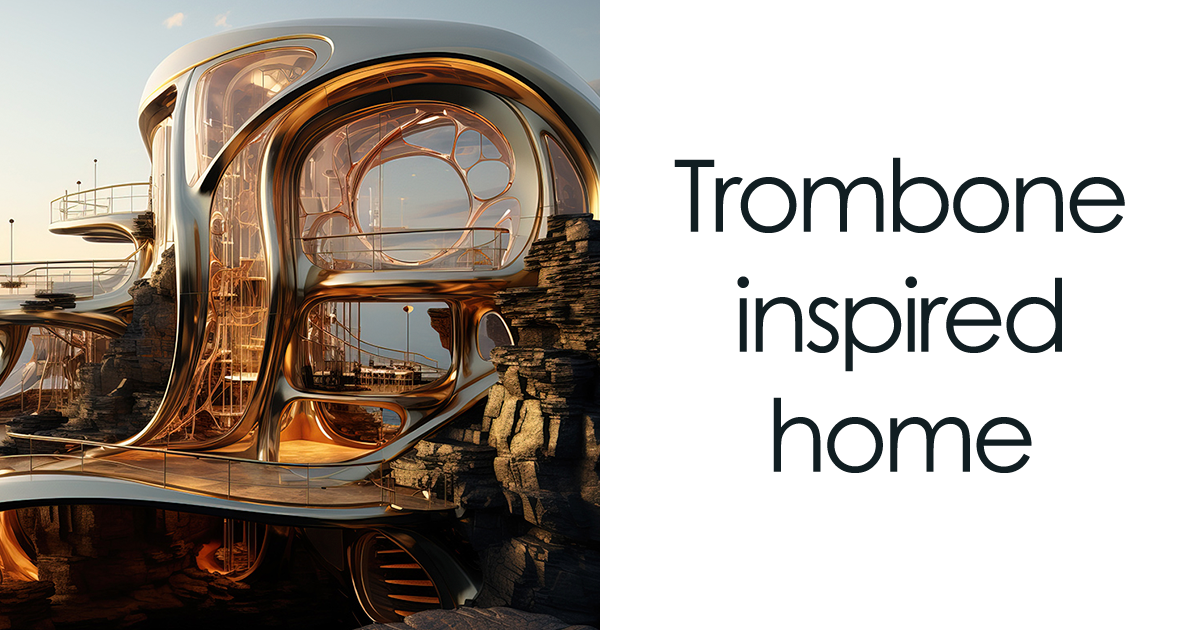
Some people hear music and tap their feet. I hear music and start mentally moving walls around. A violin curve becomes a roofline. A piano key turns into a hallway. A trumpet bell becomes a sunroom so dramatic it practically demands applause when the curtains open. That is the strange, wonderful starting point behind these 14 AI-assisted home concepts inspired by musical instruments.
This project began with one question: what would happen if a home did not merely contain music, but behaved like music? Not literally, of course. Nobody wants a front door that requires a saxophone solo to unlock. Instead, I used the physical traits of instrumentstheir rhythm, curves, resonance, materials, tension, silence, and balanceas design language. Then, with the help of AI, I explored how those traits could become livable architecture.
The result is a collection of imaginative homes that blend architecture, interior design, generative AI, acoustic thinking, and a little bit of daydreaming. These are not engineering drawings or ready-to-build blueprints. They are conceptual home designs, the kind that make you look at a cello and say, “Yes, obviously that should be a lakeside cabin.”
How AI Helped Turn Musical Instruments Into Home Concepts
AI is especially useful in the early stages of architectural imagination. It can quickly generate visual directions, compare forms, suggest unusual material combinations, and test different moods. But AI does not replace the human designer. It does not understand building codes, budget grief, plumbing surprises, or the emotional importance of a kitchen island where everyone mysteriously gathers even though the living room has perfectly good chairs.
For this project, I treated AI like a creative duet partner. I gave it prompts based on musical instrument characteristics: “a home inspired by the body of a violin,” “a desert retreat based on the geometry of a trumpet,” or “a coastal house shaped by the rhythm of piano keys.” Then I refined the results using real design logic: circulation, natural light, materials, acoustic comfort, privacy, structural believability, and the feeling a person should have when entering the space.
Why Musical Instruments Make Surprisingly Good Design Teachers
Musical instruments are not random objects. They are carefully shaped for sound, touch, balance, and performance. A guitar body is curved because resonance matters. A flute is narrow and precise because airflow matters. A drum is hollow because vibration matters. A piano is both mathematical and emotional, with a strict grid of keys hiding thunder, tenderness, and the occasional beginner version of “Chopsticks.”
Great homes work in a similar way. They need rhythm, pause, proportion, material honesty, and emotional range. A good floor plan has tempo. A good window placement has melody. A good entry sequence has drama. And a bad hallway? That is basically architectural elevator music.
The 14 AI-Assisted Musical Instrument Homes
1. The Violin House: Elegant Curves and Warm Wood
The violin inspired one of the most graceful homes in the collection. Its body suggested a curved exterior shell, while its strings translated into long vertical window mullions. I imagined this house on a wooded hillside, where the roofline bends softly like the shoulders of a violin and the main living room sits in the “resonant chamber” of the home.
Inside, warm walnut, maple, and amber lighting create a rich, intimate atmosphere. The central staircase acts like a bridge, connecting different “strings” of circulation. The design feels refined but not stiff. It is the kind of house that would wear a velvet jacket but still help you carry groceries.
2. The Guitar House: Casual, Social, and Sunlit
A guitar has a friendly personality. It belongs around campfires, in studios, on porches, and in the hands of that one person at a party who may or may not know more than four chords. The guitar-inspired home became a relaxed, open-plan retreat built around a rounded central living space.
The sound hole became a circular skylight above the family room. The neck of the guitar became a long gallery hallway leading to bedrooms and a music studio. Natural wood siding, exposed beams, and broad glass doors give the house a laid-back, indoor-outdoor feel. It is designed for conversation, creativity, and the kind of weekend where nobody knows what time it is.
3. The Piano House: Rhythm, Contrast, and Order
The piano house is all about structure. Black and white contrast, repeating modules, and a sense of disciplined rhythm shaped the design. I imagined the facade as a sequence of vertical panels, some dark and recessed, others bright and projecting, echoing piano keys without turning the home into a novelty building.
The floor plan follows a musical score. Public spaces are broad and expressive, while private rooms are quieter and more controlled. A double-height living room becomes the grand piano moment, while a long kitchen island acts like a keyboard where daily life plays out one coffee mug at a time.
4. The Trumpet House: Bold, Bright, and Full of Energy
The trumpet is not shy. It announces itself. So the trumpet-inspired home became a bold desert dwelling with flared roof forms, golden metal accents, and a dramatic circular observation room facing the sunset.
AI initially pushed the design toward something too literal, with bell-shaped rooms everywhere. That looked less like architecture and more like a brass section having a real estate crisis. I refined it into a home where the trumpet’s energy appears through expanding spaces, curved walls, reflective surfaces, and a strong entry sequence. The result feels confident, modern, and just theatrical enough.
5. The Cello House: Deep, Calm, and Grounded
The cello inspired a home with emotional depth. Its large curved body translated into thick walls, rounded corners, and a low, grounded silhouette. I pictured it beside a lake, with the main living space facing the water like an instrument waiting to be played.
Dark wood, stone floors, soft textiles, and low lighting make the interior feel quiet and resonant. The home is not flashy. It is thoughtful, steady, and a little mysterious. If the trumpet house enters the room with jazz hands, the cello house simply sits down and says something profound in a very low voice.
6. The Flute House: Light, Linear, and Airy
The flute suggested a narrow, elegant home full of light and airflow. I designed it as a long, slim residence with clerestory windows, breezeways, and a sequence of circular openings inspired by finger holes.
This concept works especially well for a compact site. The rooms are arranged in a clean line, but the circular windows and courtyards prevent the design from feeling rigid. Air movement becomes part of the experience. The house feels like it inhales and exhales, which is a very fancy way of saying the cross-ventilation is doing its job.
7. The Drum House: Social, Circular, and Rhythmic
A drum is about rhythm, gathering, and impact. The drum-inspired home became a circular courtyard house organized around a central open-air patio. Rooms wrap around the courtyard like a drum shell, while the roof creates a protective ring.
The design is ideal for family life or entertaining. Movement around the home has a natural beat: kitchen to patio, patio to living room, living room to garden. Materials include rammed earth, concrete, woven textures, and acoustic wall panels that soften sound. After all, a drum house should be rhythmic, not echo like a gymnasium full of toddlers with spoons.
8. The Harp House: Vertical Grace and Delicate Tension
The harp inspired one of the most visually poetic homes in the set. Its frame became a sweeping structural arch, while its strings became slender vertical screens that filter sunlight across the interior.
This home would suit a sloped site overlooking a valley or coast. The main facade opens in a tall, graceful curve, and the interior uses layered spaces rather than heavy partitions. The string-like screens provide shade, privacy, and a changing pattern of light throughout the day. It feels peaceful, elegant, and slightly magical, like a place where even your laundry would fold itself out of respect.
9. The Saxophone House: Smooth, Urban, and Playful
The saxophone brings curves, brass, nightlife, and a bit of mischief. The saxophone-inspired home became an urban townhouse with rounded corners, warm metal details, and a spiraling stair that acts as the design’s improvisational solo.
Inside, the spaces flow rather than march. A curved lounge, moody kitchen, rooftop terrace, and compact recording room give the home a jazzy personality. The color palette includes deep green, tobacco leather, brass, charcoal, and creamy plaster. It is sophisticated but playfulthe architectural equivalent of wearing sunglasses indoors and somehow making it work.
10. The Accordion House: Flexible, Expandable, and Clever
The accordion is a masterclass in expansion and compression. That idea became a flexible home with sliding walls, folding partitions, and rooms that can change size depending on the day’s needs.
The facade uses pleated panels that open and close to control shade and privacy. Inside, a guest room can become an office, the dining area can expand for a party, and the studio can be closed off for quiet work. This concept is perfect for modern living, where one room may need to host a Zoom call, a birthday dinner, and a child’s science project involving suspicious amounts of glue.
11. The Banjo House: Rustic, Bright, and Cheerful
The banjo inspired a charming rural home with a round central gathering room and a long porch that stretches like the instrument’s neck. The design is simple, bright, and welcoming, with farmhouse influences updated through clean lines and sustainable materials.
The round living room is the heart of the house, with built-in seating, a fireplace, and windows facing the landscape. The porch becomes a social instrument of its own, encouraging neighbors, family, dogs, and rocking chairs to participate in daily life. This home does not whisper luxury. It grins hospitality.
12. The Clarinet House: Slim, Precise, and Refined
The clarinet suggested a narrow urban home with elegant dark finishes, precise detailing, and a vertical plan. Instead of wide rooms, this concept uses stacked levels, tall windows, and carefully framed views.
The black exterior is softened by wood accents and warm interior lighting. Small circular windows nod to the clarinet’s keys, while built-in storage keeps the compact footprint efficient. The result is ideal for a city lot where every square foot must behave itself. It is polished, intelligent, and just a little dramatic, like a tiny concert hall in townhouse form.
13. The Marimba House: Warm, Modular, and Textural
The marimba inspired a home built around repeating wooden bars, tonal warmth, and modular rhythm. I imagined this design as a tropical or warm-climate house with deep overhangs, slatted screens, and separate pavilions connected by covered walkways.
Each pavilion serves a different function: living, sleeping, cooking, working, and relaxing. Together, they create a composition of spaces that feels rhythmic but relaxed. Wood is the star material, supported by stone, linen, clay tile, and lush planting. The house feels handcrafted and musical without needing to announce, “Look, I am a marimba!” which, frankly, is always a good architectural policy.
14. The Synthesizer House: Futuristic, Adaptive, and Smart
The synthesizer is different from the acoustic instruments in this collection. It is electronic, modular, experimental, and endlessly customizable. The synthesizer-inspired home became a smart, adaptive residence with programmable lighting, movable partitions, energy monitoring, and rooms that shift mood through color and sound.
The architecture uses clean geometric forms, translucent panels, and flexible interior zones. AI played a bigger role here, helping imagine responsive environments that could change from work mode to dinner mode to movie night mode. Still, the human side matters most. A smart home should support daily life, not make residents feel like they need an IT department to boil water.
Design Lessons From These AI-Generated Musical Homes
Form Should Follow Feeling, Not Just Function
Traditional design advice says form follows function. That is still true, but homes also need emotional purpose. The violin house feels intimate. The trumpet house feels bold. The flute house feels light. Each concept begins with an emotional tone before becoming walls, windows, and materials.
AI Is Best Used as a Sketch Partner
AI can generate a dozen surprising visual ideas before a human designer finishes sharpening a pencil. But speed is not wisdom. The best results came when I used AI for exploration and then applied human judgment. I removed impossible structures, corrected awkward proportions, and added details that make a home feel real: storage, privacy, transitions, daylight, and places to put shoes.
Acoustics Matter More Than People Think
Because this project began with musical instruments, sound became a central design concern. Homes are not just seen; they are heard. Hard surfaces can make a kitchen loud. High ceilings can create echoes. Soft furnishings, wood, rugs, bookshelves, curtains, acoustic panels, and thoughtful room shapes can make a home calmer and more comfortable.
Curves Can Make Homes Feel More Human
Many instruments rely on curves, and many of these homes became more inviting because of them. Rounded corners, arched openings, circular rooms, and curved furniture can soften a space. They also create movement, which is useful when you want a home to feel less like a box and more like a composition.
My Experience Designing These 14 AI-Assisted Homes
Designing these homes felt like conducting an orchestra where half the musicians were architects and the other half were slightly overexcited robots. The first lesson was that AI loves drama. Give it the word “violin,” and it may produce a house shaped exactly like a violin, complete with giant strings across the roof. Fun? Absolutely. Livable? Only if your dream is to explain your mortgage to confused birds.
So the real work was translation. I had to move from literal imitation to architectural interpretation. A guitar-inspired house does not need to look like a guitar. It needs to feel warm, social, and resonant. A flute-inspired home does not need to be a long metal tube. It needs lightness, airflow, and precision. This shift made the designs stronger, because the best inspiration is rarely copy-and-paste. It is more like borrowing a mood and teaching it how to hold up a roof.
Another experience that stood out was how quickly AI could reveal design directions I might not have tried by hand. For the harp house, AI repeatedly suggested vertical light screens. At first, they looked too decorative, but after refinement, they became one of the most practical parts of the concept: shade, privacy, rhythm, and beauty in one move. That is where AI shines. It throws visual sparks. The designer decides which sparks are fireworks and which ones are just the toaster misbehaving.
I also learned that musical instruments are excellent reminders that materials have personalities. Wood is not just “brown stuff for floors.” In a violin, wood vibrates. In a marimba, wood sings. In a home, wood can warm a room visually and acoustically. Metal can feel futuristic, industrial, luxurious, or cold depending on how it is handled. Glass can create openness, but too much glass can turn a living room into a greenhouse with furniture. Every material has a voice, and good design is about arranging those voices into harmony.
The biggest challenge was balancing fantasy with livability. Conceptual homes are allowed to dream, but they still need doors, bathrooms, kitchens, storage, daylight, and places where people can be messy human beings. A home inspired by a trumpet might have a spectacular flared roof, but it also needs a laundry room. This is where human experience matters. AI may understand the look of architecture, but humans understand the daily choreography of life: where the dog sleeps, where the mail piles up, where the morning light hits the coffee cup.
In the end, this project reminded me that AI is not the end of creativity. It is a strange new instrument. Like any instrument, it can make noise or music depending on who is playing it. Used lazily, it creates shiny nonsense. Used thoughtfully, it can help designers explore ideas faster, question habits, and discover forms that feel fresh. These 14 homes are not just about buildings inspired by instruments. They are about the creative duet between imagination and technologyand about making spaces that might, in their own quiet way, sing.
Conclusion
The idea of designing homes inspired by musical instruments may sound whimsical at first, but it opens a surprisingly rich design conversation. Instruments teach us about proportion, resonance, rhythm, craft, and emotion. AI helps expand those ideas quickly, giving designers new ways to visualize what a violin curve, piano rhythm, or trumpet flare might become in residential architecture.
The strongest concepts are not the ones that copy instruments literally. They are the ones that translate musical characteristics into livable spaces: a cello’s depth, a flute’s airiness, a drum’s gathering energy, a harp’s delicate structure, or a synthesizer’s adaptability. With careful human editing, AI-assisted home design can become more than visual spectacle. It can become a practical, poetic tool for imagining homes with personality, comfort, and soul.