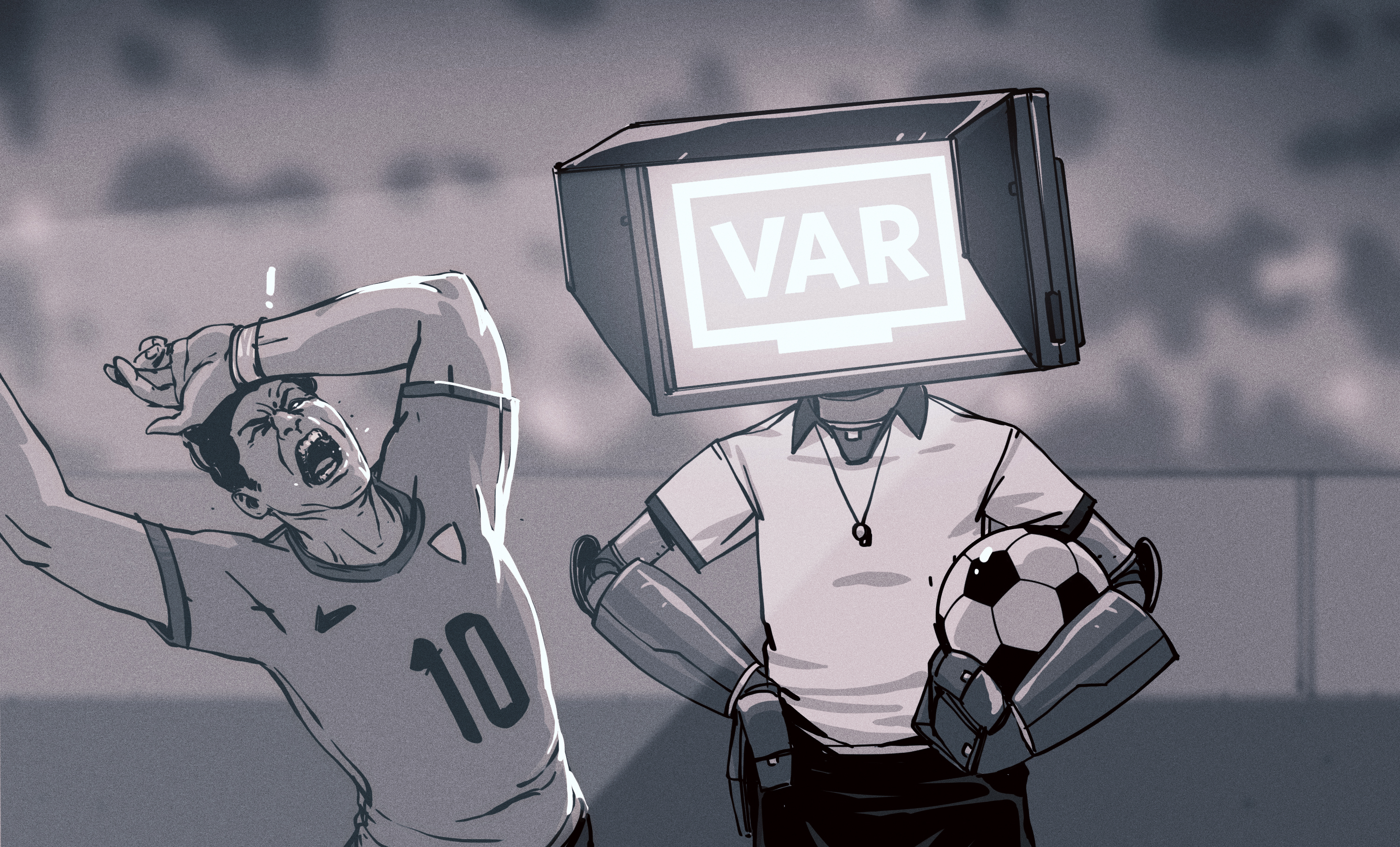
There was a time when a goal was a goal. The ball hit the net, strangers hugged, someone spilled a drink, and a defender stared into the middle distance like he had just remembered an unpaid electricity bill. Then came VAR. Now a goal is more like a software update: exciting at first, followed by waiting, confusion, mild dread, and the possibility that everything suddenly stops working.
Video Assistant Referee technology was sold to football fans as the great cleaner of injustice. No more obvious handballs missed. No more outrageous offsides. No more referees making one bad call and becoming the villain of a city for the next decade. In theory, VAR sounded sensible. In practice, it has often turned football into a courtroom with shin pads.
The problem is not technology itself. Goal-line technology, for example, is clean, fast, and almost invisible. The ball crosses the line, the referee’s watch buzzes, and everyone moves on. That is how technology should work in sport: like a good waiter, useful but not desperate for attention. VAR, however, has become a main character. It interrupts the rhythm, drains the emotion, and still somehow leaves fans arguing over whether an armpit was offside by the width of a bread crumb.
What VAR Was Supposed to Fix
VAR was introduced to help referees correct “clear and obvious errors” and serious missed incidents in major match-changing moments: goals, penalty decisions, direct red cards, and mistaken identity. On paper, this is reasonable. Football has suffered from famous officiating disasters for decades. Diego Maradona’s “Hand of God” goal in 1986, Thierry Henry’s handball against Ireland in 2009, and countless wrongly awarded penalties all became part of football folklore because there was no second look.
Supporters of VAR argue that the game is too important and too financially massive to rely only on the naked eye. A single decision can affect a title race, a relegation battle, a World Cup dream, or millions of dollars in prize money. From that perspective, adding video review seems not just helpful but necessary. Nobody wants a team eliminated because a referee blinked at the exact wrong moment.
But football is not a tax audit. It is a flowing, emotional, imperfect game. It lives on speed, instinct, noise, and release. The question is not whether technology can make some calls more accurate. The question is whether the price of that accuracy is too high.
The Death of the Spontaneous Goal Celebration
The most damaging thing VAR has done is not technical. It is emotional. It has trained fans to celebrate with one eye on the referee and the other on a giant screen. The ball goes in, the stadium explodes, and then the joy is placed on hold while everyone waits for a mysterious room of officials to decide whether someone’s kneecap had committed a felony.
Football’s greatest moment is the goal. Not the tactical setup. Not the heat map. Not the post-match expected goals debate between two people on social media whose profile pictures are anime wolves. The goal is the point of the sport. When VAR makes fans hesitate before celebrating, it attacks the very heartbeat of football.
This is why supporter surveys have repeatedly shown deep frustration with VAR. Many match-going fans do not simply complain that decisions are wrong. They complain that the matchday experience feels worse. The delay is part of it, but the bigger issue is uncertainty. A fan in the stadium often has less information than someone watching at home. They see players standing around, referees touching earpieces, and a scoreboard message saying “checking possible offside,” which is about as emotionally satisfying as watching a loading bar at the dentist.
VAR Has Not Ended Arguments. It Has Industrialized Them.
The promise of VAR was clarity. The reality has been debate in higher definition. Before VAR, fans argued over one replay angle. Now they argue over freeze frames, camera calibration, subjective thresholds, and whether slow motion makes normal contact look like a crime scene.
Offside decisions are the most obvious example. Semi-automated offside technology may speed things up, and newer systems using tracking cameras and connected balls can produce impressive 3D graphics. But when a goal is disallowed because a shoulder, toe, or sleeve edge is barely ahead, many fans feel that the law has become too microscopic. Football was not designed to be judged like a NASA docking maneuver.
Subjective calls are even messier. Was there enough contact for a penalty? Was the defender reckless or just late? Did the attacker exaggerate? Was a hand in an “unnatural position,” whatever that means on a planet where humans unfortunately have arms? VAR does not remove human judgment. It relocates it to a video room, slows it down, and dresses it in the costume of certainty.
The “Clear and Obvious” Standard Has Become Foggy and Annoying
The phrase “clear and obvious” should be simple. If a referee clearly missed something big, intervene. If not, let the decision stand. But football has discovered a magical loophole: almost anything can become clear and obvious if you replay it 23 times from six angles at one-eighth speed.
This creates inconsistency. One weekend, VAR refuses to intervene because the decision was subjective. The next weekend, a similar incident is reviewed, overturned, and explained with the confidence of a man assembling furniture without reading the manual. Fans are not only angry about the calls; they are angry about the changing logic behind the calls.
Referees also look less authoritative. Instead of making a decision and owning it, they often appear trapped between the pitch and the screen. Players surround them. Managers complain. Commentators debate. The crowd waits. By the time a decision is made, the match has lost its pulse.
Football Is Becoming Too Obsessed With Being Correct
Accuracy matters. Fairness matters. But sport is not enjoyable because it is perfectly correct. It is enjoyable because it is alive. A football match has mistakes from players, coaches, goalkeepers, defenders, and referees. That does not mean officials should be careless. It means imperfection is part of the drama.
Technology often enters sport with a noble mission: eliminate error. But error is not always the enemy of entertainment. A striker missing an open goal is an error. A goalkeeper dropping a cross is an error. A manager making a terrible substitution is an error. Nobody suggests stopping the match so an artificial intelligence system can tell the coach, “Sir, bringing on that defensive midfielder was emotionally harmful.”
When the pursuit of correctness becomes more important than the experience of the game, sport starts to feel less human. Fans do not attend matches to watch officials achieve administrative perfection. They attend to feel something.
Technology Works Best When It Is Fast, Objective, and Quiet
Not all sports technology is bad. In fact, some of it is excellent. Goal-line technology in football is widely accepted because it answers a binary question quickly: did the entire ball cross the line? Tennis line-calling technology can also be effective because “in” or “out” is usually a clean measurement. Even then, tennis has shown that technology still depends on human operation and trust.
The key difference is that good sports technology does not hijack the event. It supports the game and disappears. Bad technology turns the game into a meeting about the game. VAR too often does the second thing.
Other sports face similar issues. The NBA has expanded replay and coach challenges to improve accuracy, but reviews can slow the final minutes of games. The NFL has long struggled with replay rules around catches, fumbles, and subjective contact. Baseball introduced changes like the pitch clock to speed the sport up, showing that technology and rules can improve entertainment when they protect rhythm rather than interrupt it.
VAR Has Changed How Players Behave
Players know the cameras are always watching. That has benefits: violent conduct is harder to hide, off-the-ball incidents are more likely to be punished, and defenders may think twice before grabbing shirts in the penalty area. But it has also created new habits.
Attackers now appeal for reviews with the enthusiasm of lawyers discovering billable hours. Defenders raise imaginary screens. Goalkeepers delay restarts while hoping someone in the video room finds a technicality. Players no longer just play the referee; they play the entire review system.
The result is a strange atmosphere where every big moment feels provisional. A goal is not a goal. A penalty is not a penalty. A red card is not a red card. Everything is a draft version until the video room approves the final document.
Fans in the Stadium Get the Worst Version of VAR
Television viewers may see replay angles, commentary explanations, and graphics. Stadium fans often get vague messages and long waits. That imbalance is a serious problem because match-going supporters are the soul of the sport. They create the noise, the color, and the pressure that make football feel like football rather than a luxury streaming product.
In-stadium announcements can help, and some competitions have moved toward referees explaining decisions publicly. But explanations do not fully fix the emotional damage. If a supporter has already waited two minutes to find out whether they were allowed to be happy, a microphone announcement is not exactly a refund.
VAR has also made football feel more remote. Decisions come from somewhere off-screen, almost like customer support for joy. Fans are told the system is working, but they do not always see how. Trust decreases when the process feels invisible.
The Sweden Example: Saying No to the Machine
One of the most interesting football stories in recent years has been the resistance to VAR in Sweden. While most major European leagues adopted video review, Swedish football has remained cautious, influenced heavily by supporters and member-controlled club structures. The argument is simple: just because technology exists does not mean the game must surrender to it.
This does not mean every league should reject VAR entirely. But Sweden’s resistance highlights something important. Fans are stakeholders, not background decorations. If the people who buy tickets, sing songs, and travel in the rain feel that technology damages the experience, football authorities should listen before adding even more cameras, sensors, and automated alerts.
How to Fix VAR Without Pretending 1997 Was Perfect
Scrapping VAR completely would thrill many fans, but it may not be realistic in elite football. The game has already moved into the review era. The better question is how to make VAR less intrusive and less ridiculous.
Limit VAR to Truly Major Errors
VAR should be used only when the mistake is obvious at normal speed. If officials need several minutes, multiple angles, and a geometry degree, the original decision should probably stand. The goal should be rescuing the referee from a disaster, not searching for tiny technical violations.
Introduce a Strict Time Limit
If a decision cannot be reached within a short window, move on. Football’s rhythm matters. Long reviews drain energy from players and fans alike. A strict time limit would force VAR to focus on obvious mistakes rather than forensic analysis.
Improve Stadium Communication
Fans in the stadium deserve clear, quick explanations. Screens should show what is being reviewed and why. Referee announcements can help, but they must be simple and consistent. Nobody needs a legal lecture. Just tell people what happened.
Use a Challenge System
A limited challenge system could reduce constant intervention. Give each team one or two chances to request a review, similar to other sports. If the challenge is wrong, they lose it. This would make reviews more strategic and less random.
Protect the Goal Celebration
This should be the guiding principle. If a technology damages the most joyful moment in sport, the technology needs reform. Football should never become a place where fans celebrate like they are waiting for exam results.
Tech Is Not Ruining Sport Alone. Bad Tech Culture Is.
The broader issue is not that sport uses technology. The issue is that modern sport often worships data, precision, and control while forgetting why people watch in the first place. Fans enjoy tactics and analysis, but they also want chaos. They want a winger doing something absurd. They want a goalkeeper suddenly becoming Superman. They want the referee to be competent, yes, but not the star of a five-minute procedural drama.
Sport is increasingly packaged for broadcasters, betting markets, analytics departments, and social media clips. Every moment is measured, clipped, reviewed, and monetized. Technology can enhance that ecosystem, but it can also squeeze out the human messiness that made sport addictive.
When every decision becomes reviewable, every emotion becomes conditional. That is a dangerous road. A sport without instant emotion is not improved. It is sterilized.
The Human Element Still Matters
Referees make mistakes. Fans know this. They complain, chant, argue, and then return the next week because football has always contained injustice. That does not mean injustice is good. It means that the cure must not be worse than the disease.
A good referee manages the game, understands the temperature of the match, communicates with players, and makes decisions in context. A camera cannot fully capture that. Slow motion can distort physical contact. Freeze frames can make accidental moments look intentional. Technology sees details, but humans understand feel.
The best future for sport is not anti-technology. It is pro-human. Use technology where it clearly helps. Keep it away where it damages flow, emotion, and common sense. Let the referee referee. Let the players play. Let the fans celebrate before their snacks go cold.
Experience: What VAR Feels Like From the Stands and the Sofa
The strangest thing about watching football in the VAR era is how quickly joy has learned to defend itself. A striker races through, chips the goalkeeper, and the ball drops into the net. The old version of you would leap up instantly. The new version pauses for half a second, scanning the assistant referee, the referee, the defenders, and the scoreboard. That tiny pause is where modern football has lost something precious.
In the stadium, the experience can be even more awkward. You celebrate, then stop. You ask the person next to you what is happening. They do not know. Someone behind you claims the left back was offside, although they are 90 yards away and possibly looking at the wrong player. A few people check their phones. The players stand around like office workers waiting for a printer to stop making that terrible grinding noise. The stadium noise becomes nervous, not joyful.
Then the decision arrives. If the goal stands, the celebration returns, but it is not the same. It is a reheated celebration, and reheated celebrations are like reheated fries: technically edible, emotionally disappointing. If the goal is ruled out, the anger is sharp because fans feel tricked. They were invited into joy and then escorted out by a man drawing digital lines on a screen.
Watching at home is more informative but not always better. Television turns every review into a debate show. The same clip is replayed again and again until nobody remembers what normal speed looked like. Commentators begin confidently, then become less confident, then read the official decision and pretend it all makes sense. Social media explodes before the match has even restarted. Within seconds, screenshots appear with red circles, arrows, and captions written in the tone of a criminal investigation.
The emotional rhythm of the sport changes. Instead of reacting naturally, fans become amateur legal analysts. Every corner brings suspicion. Every penalty shout becomes a possible video review. Every goal carries an invisible asterisk until confirmed. Even when VAR gets the final decision right, the process often makes the moment feel smaller.
The irony is that fans do want fairness. Nobody enjoys losing because of a terrible call. But most fans also understand that football is not supposed to feel like airport security. The match should move. The crowd should breathe with it. The referee should be part of the game, not the manager of a software platform.
The best experiences in sport are immediate. The last-minute winner. The impossible save. The underdog goal that shakes a stadium. These moments work because they happen before the brain has time to protect itself. VAR has inserted doubt into that sacred space. It has made fans ask permission to feel.
That is why the complaint “VAR is ruining football” is not just old-fashioned grumbling. It is a defense of the live sporting experience. Technology should serve the game, not supervise every heartbeat of it. When fans leave a match talking more about the review process than the football, something has gone badly wrong.
Conclusion: Football Needs Less Tech Drama and More Football
VAR was created with a good intention: make football fairer by correcting major mistakes. But good intentions do not guarantee good entertainment. The technology has improved some decisions, yet it has also made football slower, more anxious, and less emotionally explosive. It has not ended controversy. It has simply moved controversy into a room with monitors.
Sport should not reject every innovation. Goal-line technology, better medical tools, improved broadcasting, and smarter performance data can all help the game. But football must draw a line between technology that supports the spectacle and technology that consumes it.
VAR needs serious reform: fewer interventions, faster decisions, clearer communication, and a renewed respect for the goal celebration. The beautiful game should not feel like a courtroom, a spreadsheet, or a customer-service ticket. It should feel like football.
Because in the end, fans do not fall in love with sport because it is flawless. They fall in love because it is unpredictable, emotional, unfair, hilarious, heartbreaking, and alive. If technology removes too much of that, it may win the argument and lose the game.