Celebrity engagement rings have always had a strange power over the internet. One minute, fans are admiring a beautiful diamond. The next minute, strangers are conducting forensic gemology from a blurry screenshot like they are auditioning for “CSI: Pinterest.” That is exactly what happened after a viral post compared Selena Gomez’s engagement ring from Benny Blanco with Hailey Bieber’s engagement ring from Justin Bieber, sparking backlash from fans who called the comparison unnecessary, materialistic, and, yes, “insulting.”
The post arrived shortly after Selena Gomez announced her engagement to producer Benny Blanco in December 2024. The announcement itself was sweet, simple, and very Selena: a cozy Instagram carousel, a close-up of a marquise diamond ring, and the caption “forever begins now.” But because the internet is the internet, the celebration quickly swerved into old fandom rivalries. Instead of focusing only on Gomez’s happy news, some users began comparing her ring to Hailey Bieber’s famous oval-cut diamond from Justin Bieber.
The result was predictable: screenshots, arguments, defensive comments, and a broader conversation about why women in pop culture are still being measured against each other by price tags, relationship timelines, and public narratives they did not ask to relive.
What Happened: From Engagement Joy to Viral Ring Debate
Selena Gomez and Benny Blanco’s engagement news landed like a glitter bomb. Fans celebrated the singer, actress, Rare Beauty founder, and “Only Murders in the Building” star as she shared the milestone publicly. Blanco also joined the playful mood, commenting with the kind of goofy affection that has become part of the couple’s public charm.
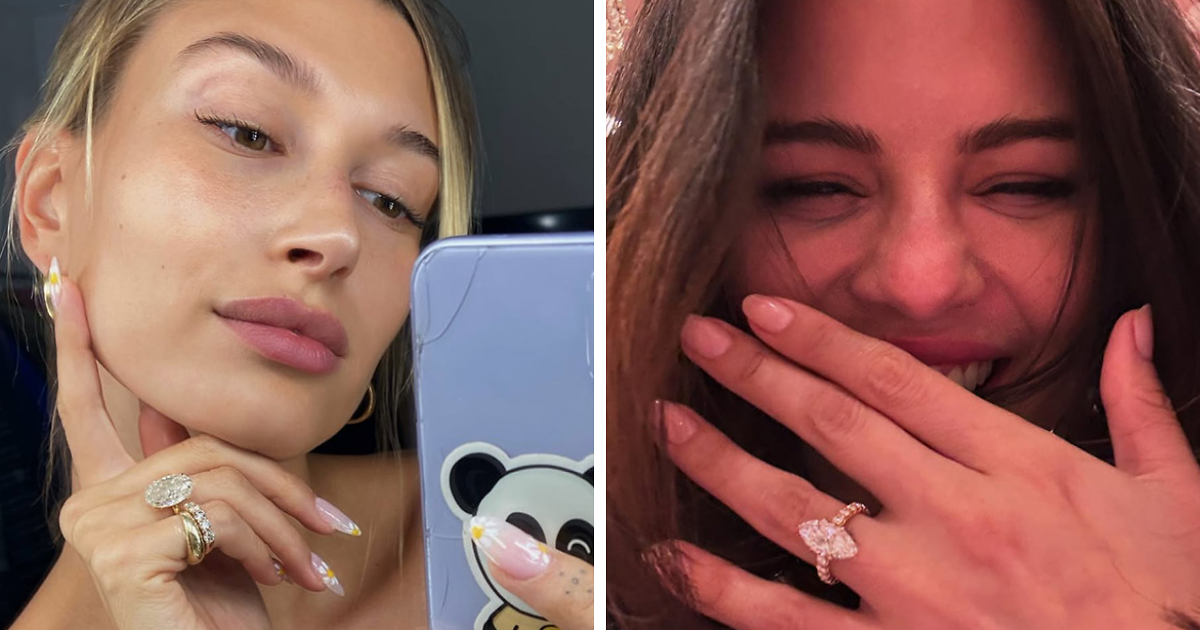
Then came the viral comparison. A social media post placed images of Gomez’s and Hailey Bieber’s engagement rings side by side and attached estimated prices to both. The claim suggested Hailey’s ring cost significantly more than Selena’s, framing the jewelry as if love could be scored like a luxury shopping receipt. Fans quickly pushed back, arguing that the comparison was tacky, inaccurate, and mean-spirited.
One of the strongest reactions came from people who felt the post dragged Gomez, Bieber, and their relationships into an old narrative that both women have repeatedly been pulled into. For years, the internet has tried to manufacture tension between Selena Gomez and Hailey Bieber because of their connection to Justin Bieber. Even when the women have publicly signaled kindness, calm, or a desire to move on, online fandoms often keep reheating the same drama like leftovers nobody ordered.
Selena Gomez’s Engagement Ring: A Marquise Moment
Selena Gomez’s ring immediately stood out because it was not the standard round or oval diamond that dominates celebrity engagement posts. Her ring features a marquise-cut diamond, a long, pointed shape with vintage glamour and a dramatic silhouette. Jewelry experts estimated the center stone at around six carats, set on an eternity-style band. Reports placed the value around $225,000, although celebrity ring estimates can vary because the true price depends on details that are not always public, including diamond quality, custom design, and sourcing.
The marquise cut also carries special meaning for Gomez fans. In her 2015 song “Good for You,” she references being a “marquise diamond,” which made the ring feel personal rather than random. That detail matters. A ring is not just a gemstone; it is a symbol. In this case, the shape seemed connected to Gomez’s style, her history, and the private language of her relationship.
Design-wise, the marquise diamond is having a comeback. The shape dates back centuries and has long been associated with elegance, length, and old-world drama. On the hand, it creates a visually elongated effect, which is one reason it photographs so well. It says, “I am classic,” but also, “I might own a velvet sofa and know exactly where the good lighting is.”
Hailey Bieber’s Engagement Ring: The Oval That Influenced a Trend
Hailey Bieber’s original engagement ring is also famous for a reason. Justin Bieber proposed in 2018 with a custom oval-cut diamond set on a simple gold band. The ring was designed with help from jeweler Jack Solow of Solow & Co., and reports have estimated the diamond at roughly six to ten carats. Its minimalist setting matched Hailey’s clean, modern style and helped fuel the popularity of elongated oval engagement rings.
Hailey later confirmed that Justin upgraded her ring, reportedly making the new version slightly larger. Her ring has often been discussed in fashion and jewelry circles because it combines high-impact sparkle with a restrained setting. In plain English: it is huge, but it does not scream. It whispers from across the room in a very expensive accent.
But comparing Hailey’s ring to Selena’s as if one woman “won” and the other “lost” misses the point. These are different rings, chosen for different people, in different relationships, years apart. A marquise diamond and an oval solitaire are not rivals. They are shapes. They do not need a boxing announcer.
Why Fans Called the Comparison “Insulting”
The backlash was not only about diamonds. It was about the framing. Many fans felt the viral post reduced Selena Gomez’s engagement to a financial contest and used Hailey Bieber as a measuring stick. That kind of comparison can feel especially ugly because it turns two women’s personal milestones into public ammunition.
There is also a long history of people pitting Selena and Hailey against each other. Gomez dated Justin Bieber on and off years before he married Hailey. Because all three are globally famous, fans have often treated the situation like an endless pop-culture triangle, even when the actual people involved appear to want peace. In 2022, Selena and Hailey were photographed together at the Academy Museum Gala, a moment many interpreted as a visual “please relax” message to the internet. In 2023, Gomez publicly asked fans to stop sending hate toward Hailey after Bieber received hostile messages and threats. Those moments should have closed the door on the feud narrative. Instead, parts of social media keep trying to pick the lock.
That is why the ring comparison bothered so many people. It was not simply “Which ring do you like better?” It revived a tired storyline and wrapped it in diamonds. Fans saw it as another attempt to rank women through men, jewelry, and perceived romantic success.
The Problem With Turning Engagement Rings Into Scoreboards
Engagement rings are emotional objects. They can be expensive, yes, but their meaning does not come only from the receipt. A ring might represent a proposal story, a shared joke, a favorite shape, a family tradition, or a partner paying attention. Sometimes the best ring is not the biggest one. Sometimes it is the one that proves someone listened.
The viral Selena Gomez and Hailey Bieber ring debate shows how quickly online culture can flatten meaningful moments into numbers. Carat size becomes a ranking. Estimated value becomes proof of devotion. A private milestone becomes a public spreadsheet. And suddenly, people are acting as if love comes with a luxury appraisal form attached.
That mindset is not just unfair to celebrities. It also affects everyday readers. When social media suggests that a proposal is only impressive if the ring costs as much as a starter home, it creates unrealistic expectations. Most couples are not shopping with celebrity budgets, and they should not feel pressured to pretend they are. Jewelers and financial experts often emphasize that engagement ring budgets are personal. The right amount is the amount that fits the couple’s finances, values, and comfort level.
How Celebrity Fandom Turns Small Details Into Big Drama
Celebrity fandom can be joyful. It builds communities, celebrates art, and gives people a shared language. But it can also become intense when fans treat stars like sports teams. In that world, every outfit, caption, hairstyle, and ring becomes evidence in a case nobody filed.
The Selena-Hailey ring debate is a perfect example. A celebrity gets engaged. Fans should be able to say, “Beautiful ring, congratulations,” and move on with their day. Instead, some corners of the internet turned it into a referendum on past relationships, husband quality, wealth, taste, and personal worth. That is a lot to place on a piece of jewelry, even a very sparkly one.
Part of the issue is that comparison content performs well. Posts that create conflict often attract more comments, more shares, and more emotional reactions. A calm post saying “Both rings are lovely” may be healthy, but it rarely goes viral. A post implying that one woman’s ring proves something about another woman’s relationship? That is algorithm food.
Unfortunately, what performs well online is not always what is fair, kind, or accurate. The fury around the post suggests many fans are becoming more aware of that pattern and are tired of seeing women turned into competitors for entertainment.
Ring Style Breakdown: Marquise vs. Oval
Marquise Cut
The marquise cut is long, narrow, and pointed at both ends. It has a vintage feel and tends to look larger than some other cuts of the same carat weight because of its elongated surface area. Selena Gomez’s ring helped bring new attention to the shape, especially among people looking for something less common than a round brilliant or oval diamond.
Oval Cut
The oval cut is soft, elegant, and modern. Hailey Bieber’s oval ring became a major reference point for brides who wanted a classic solitaire with a fashion-forward feel. Ovals are popular because they offer strong sparkle, a flattering shape, and a graceful balance between traditional and contemporary design.
Which Is Better?
Neither. That is the whole point. A marquise ring suits one person’s taste; an oval suits another. Style is not a courtroom. Nobody needs to present Exhibit A: Diamond Shape.
What the Backlash Says About Pop Culture in 2026
The outrage over the comparison reveals a shift in celebrity culture. Many fans still love glamorous details, but they are more skeptical of content that encourages bullying or unnecessary rivalry. People enjoy seeing celebrity rings, homes, outfits, and weddings. The problem starts when admiration becomes judgment.
There is a difference between discussing jewelry design and using jewelry to insult someone. A thoughtful article might compare marquise and oval diamond trends, explain settings, or explore why celebrity rings influence bridal fashion. A mean-spirited post, however, uses price tags to imply that one woman is more loved, more valued, or more successful than another. That is where many fans drew the line.
Selena Gomez and Hailey Bieber are both public figures with their own careers, businesses, marriages, relationships, and personal boundaries. They are not symbols for strangers to weaponize against one another. Gomez has built a major beauty brand and continues to act and make music. Hailey has shaped beauty and fashion trends through Rhode, modeling, and her minimalist style. Their value is not sitting on a ring finger.
Why This Story Became So Clickable
The story went viral because it combined several internet magnets: celebrities, romance, diamonds, old drama, fan loyalty, and outrage. That combination is basically a smoothie made by the algorithm. It has sparkle, conflict, nostalgia, and just enough “Wait, did they really say that?” energy to keep people scrolling.
But the deeper reason is emotional. Engagements are supposed to be happy, and people react strongly when that happiness is hijacked by comparison. Fans who defended Selena were not only defending a ring. Many were defending the idea that a woman’s joy should not be graded against another woman’s jewelry. Others were defending Hailey from being dragged into a conversation she did not start.
That is why the word “insulting” resonated. The comparison insulted the spirit of the occasion. It turned a personal celebration into a public contest, and many people simply had enough.
Experience Notes: What This Viral Ring Debate Teaches Anyone Posting Online
Watching this kind of celebrity story unfold offers a useful lesson for anyone who spends time online: not every comparison is harmless. It may feel casual to post two pictures side by side and ask which is better, but when real people are involved, especially women who have already been placed in years of public drama, the effect can be bigger than the post itself.
One experience many social media users recognize is the speed of reaction. You might open an app for five minutes, see a celebrity headline, laugh at a meme, like a comment, and suddenly you are part of a pile-on. It happens fast. The ring comparison shows how quickly a joyful announcement can become a battlefield when users reward the sharpest take instead of the fairest one.
Another relatable experience is the pressure to have an opinion. Online, silence can feel like missing out. If everyone is debating Selena’s marquise ring and Hailey’s oval diamond, you may feel pushed to choose a side. But the healthier response is often to step back and ask, “Why are these two women being compared in the first place?” That question changes the conversation. It moves the focus from gossip to media literacy.
There is also a real-life lesson for couples. Engagement rings should reflect the people wearing them, not strangers’ expectations. A meaningful ring might be a diamond, a sapphire, a lab-grown stone, a family heirloom, or a simple band. It might cost a lot, or it might not. What matters is the story behind it and whether both partners feel good about the choice. If celebrity ring discourse teaches anything, it is that outsiders will always have opinions. Fortunately, outsiders are not invited to the proposal.
For content creators, the lesson is even clearer: comparison posts may drive engagement, but they can also spread lazy narratives. A better approach is to add context. Instead of “Which ring wins?” ask “Why are marquise diamonds trending?” or “How do different diamond cuts express personal style?” That kind of content still satisfies curiosity without turning women into opponents.
For fans, the best experience is learning to celebrate without attacking. You can love Selena Gomez without insulting Hailey Bieber. You can admire Hailey’s style without diminishing Selena’s joy. You can discuss celebrity fashion without reviving old drama. The internet may not always reward nuance, but readers do remember it.
At the end of the day, both rings are beautiful, both women are successful, and the viral fury says more about online comparison culture than it does about either relationship. The most elegant response might be the simplest one: congratulations, beautiful ring, next topic.
Conclusion
The viral post comparing Selena Gomez and Hailey Bieber’s engagement rings sparked fury because it touched a nerve far beyond jewelry. Fans were not merely debating diamond cuts or celebrity budgets. They were reacting to a familiar pattern: women being placed in competition, personal happiness being reduced to material value, and old relationship narratives being recycled for clicks.
Selena Gomez’s marquise engagement ring is meaningful, stylish, and deeply connected to her personal story. Hailey Bieber’s oval diamond ring is elegant, influential, and perfectly aligned with her minimalist aesthetic. Both can be admired without turning either woman into a loser in a contest they never entered.
In a culture that loves sparkle, the real shine comes from knowing when to stop comparing and start respecting. A ring can be beautiful. A proposal can be joyful. And sometimes, the classiest thing the internet can do is let women enjoy their lives without turning every milestone into a scoreboard.