Note: This article is based on real, publicly available information current as of May 2026 and is written for web publication in standard American English.
The name USS Doris Miller sounds, at first, like another entry in the Navy’s long list of impressive ships with serious names and even more serious job descriptions. But this future aircraft carrier, officially designated CVN-81, is not just another floating runway with a nuclear heartbeat. It is a landmark in American naval history, a tribute to an enlisted sailor whose courage at Pearl Harbor turned him into one of World War II’s most powerful symbols of bravery, service, and long-overdue recognition.
USS Doris Miller will be the fourth aircraft carrier in the Gerald R. Ford class, following USS Gerald R. Ford, the future USS John F. Kennedy, and the future USS Enterprise. Built by Newport News Shipbuilding, a division of HII in Virginia, the carrier represents the Navy’s next generation of sea power. But the ship’s emotional weight comes from its namesake: Doris “Dorie” Miller, a Black sailor from Waco, Texas, who served in a segregated Navy and still rose to the occasion when history came crashing down on December 7, 1941.
In other words, this is not just a story about steel, reactors, flight decks, and shipyard schedules. It is a story about memory. It is about who gets honored, why names matter, and how a man once limited by the prejudices of his era came to be associated with one of the most powerful ships the United States has ever planned to build. Not bad for a guy who simply did what needed to be done while the world was on fire.
Who Was Doris “Dorie” Miller?
Doris Miller was born on October 12, 1919, in Waco, Texas. He joined the U.S. Navy in 1939, at a time when opportunities for Black sailors were sharply restricted. Like many African American men in the Navy during that period, Miller served as a mess attendant, a role centered on food service and domestic duties for officers. It was necessary work, but it reflected the racial barriers of the era rather than Miller’s full potential.
Before Pearl Harbor, Miller served aboard USS Pyro and later transferred to the battleship USS West Virginia, stationed in Hawaii. Shipmates knew him as strong, athletic, and dependable. He boxed, played football, and had the kind of physical presence that makes people say, “Good thing he’s on our side.” But nobody could have predicted how quickly his name would become tied to one of the most famous days in American history.
Doris Miller at Pearl Harbor
On the morning of December 7, 1941, Japanese aircraft attacked Pearl Harbor. USS West Virginia was hit during the assault, and Miller’s assigned battle station became unusable. Rather than freeze, hide, or wait for perfect instructions, he moved where help was needed. He helped carry wounded sailors, including Captain Mervyn Bennion, who had been gravely injured.
Then came the moment that turned Miller into a legend. Although he had not been trained as a gunner, he was directed to assist with an anti-aircraft gun and eventually operated it himself. He fired at attacking aircraft until ordered to stop and later continued helping injured sailors escape the damaged ship. History has a way of producing impossible job descriptions, and Miller accepted his without complaining to human resources.
For his actions, Miller received the Navy Cross, becoming the first African American to receive that honor. Admiral Chester W. Nimitz presented the award to him aboard USS Enterprise on May 27, 1942. The ceremony was more than a medal presentation. It was a public acknowledgment that courage did not care about segregation, rank, or whether the Navy had given a man the training he deserved.
From War Hero to Lasting Symbol
After Pearl Harbor, Miller became a national figure. He participated in a war bond tour and appeared in recruitment-related imagery that celebrated his bravery. Yet his fame existed inside a contradiction. America praised him as a hero while Black service members still faced discrimination in the armed forces. That tension is part of why Miller’s legacy remains so important today.
In 1943, Miller was assigned to the escort carrier USS Liscome Bay. On November 24, 1943, during operations near the Gilbert Islands, the ship was struck and sank. More than 600 sailors were lost, including Miller. He was only 24 years old. His life was short, but his legacy refused to stay small.
Over the decades, Miller’s story became part of a broader conversation about military service, racial justice, and national memory. His courage helped challenge assumptions about Black sailors and contributed to changing attitudes inside the Navy. He did not live to see the U.S. military desegregated in 1948, but his example helped push the country in that direction.
The Naming of USS Doris Miller
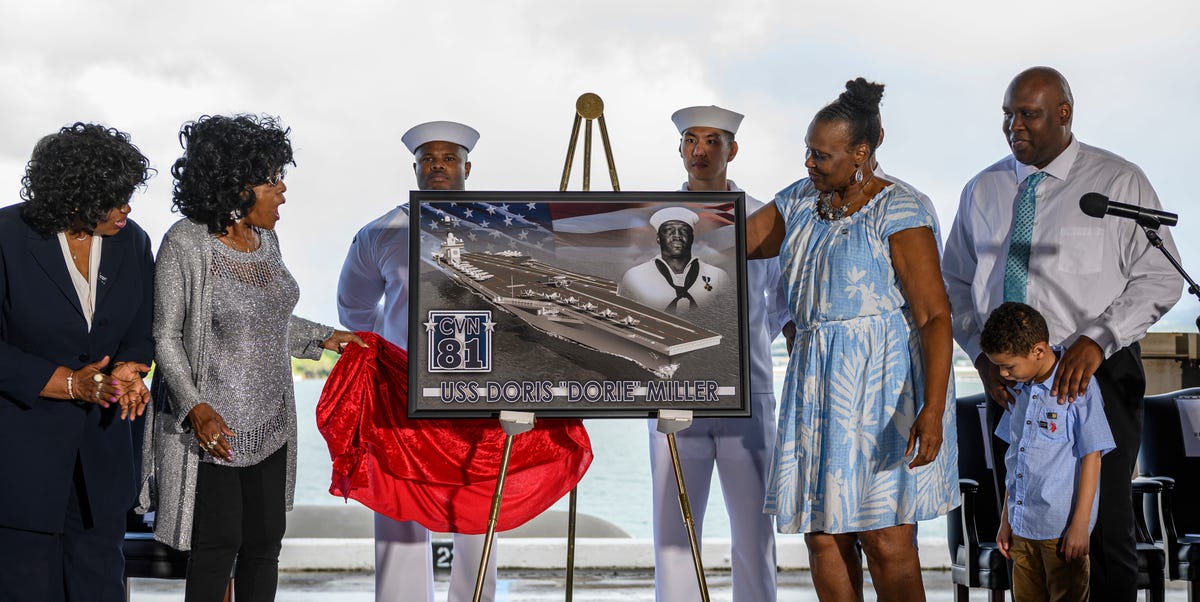
On January 20, 2020, the U.S. Navy announced that CVN-81 would be named USS Doris Miller during a Martin Luther King Jr. Day ceremony at Pearl Harbor. The symbolism was impossible to miss. The announcement took place where Miller had performed his heroic actions, on a day dedicated to a leader associated with equality and moral courage.
The naming broke historic ground. USS Doris Miller will be the first aircraft carrier named for an African American and the first aircraft carrier named in honor of an enlisted sailor for actions performed while serving in the enlisted ranks. That matters because aircraft carriers are usually named after presidents, major political leaders, or earlier famous warships. Naming one for Doris Miller says, in effect, that heroism from the lower decks can stand as tall as power from the Oval Office.
There had already been a previous Navy ship named for him, USS Miller, a frigate commissioned in the 1970s. But an aircraft carrier is a different level of recognition. It is not a footnote; it is a headline written in steel.
What Kind of Ship Will USS Doris Miller Be?
USS Doris Miller is part of the Gerald R. Ford-class aircraft carrier program. Ford-class carriers are designed to replace the older Nimitz-class carriers over time and serve for approximately 50 years with a single mid-life refueling. These ships are built to support modern naval aviation, long deployments, humanitarian response, maritime security, and crisis operations around the world.
Compared with earlier carriers, Ford-class ships include major technological changes. The class uses the Electromagnetic Aircraft Launch System, commonly known as EMALS, instead of traditional steam catapults. EMALS is designed to launch a broader range of aircraft more smoothly and efficiently. The class also incorporates advanced arresting gear, updated electrical systems, a redesigned flight deck, and digital construction methods.
In normal-person language: USS Doris Miller is being built for a Navy that runs on data, electricity, speed, and flexibility. It is less “old-school boiler-room thunder” and more “giant high-tech airport that happens to move across oceans.” Still, it remains a carrier, which means its purpose is serious: projecting power, supporting allies, deterring conflict, and responding when national leaders ask the famous question, “Where are the carriers?”
Construction at Newport News Shipbuilding
The ceremonial first cut of steel for Doris Miller took place at Newport News Shipbuilding on August 25, 2021. The event marked the start of a long, complex construction process involving thousands of shipbuilders, engineers, suppliers, and Navy personnel. Thomas Bledsoe, Miller’s great-nephew, gave the order to cut the first steel, connecting the ship’s future to the family behind its name.
Doris Miller is also part of a two-carrier purchase arrangement involving USS Enterprise (CVN-80). The Navy awarded HII a contract for both ships in 2019, an approach intended to create efficiencies across design, construction, supply chains, and planning. The ship is expected to be built using digital drawings and modern work packages rather than traditional paper-based methods, a major shift in how carriers are assembled.
Shipbuilding, however, is not exactly like ordering furniture online. You do not click “add to cart,” select free shipping, and wait for a 100,000-ton aircraft carrier to appear politely on your doorstep. Recent reporting based on Navy budget documents indicates that the projected delivery for CVN-81 has shifted from February 2032 to February 2034, largely because of shipyard footprint constraints and delays connected with earlier Ford-class construction work. As of the latest public updates, HII has indicated that CVN-81 units continue through steel fabrication and outfitting, with keel-laying expected in 2026.
Why the Delays Matter
The delay in USS Doris Miller’s projected delivery is not just a calendar issue. Aircraft carriers sit at the center of U.S. naval planning, and the Navy must balance aging Nimitz-class ships with incoming Ford-class replacements. When one carrier slips, the impact can ripple across fleet readiness, maintenance schedules, deployment planning, and congressional budget debates.
Still, delays in a program this large are not shocking. Ford-class carriers contain new technologies, complicated supply chains, and highly specialized industrial work. Newport News Shipbuilding is the only U.S. shipyard capable of building nuclear-powered aircraft carriers, which makes its physical space, workforce, and production sequencing enormously important. If one giant puzzle piece is late, the next giant puzzle piece may have to wait its turn.
The practical takeaway is simple: USS Doris Miller remains a future carrier, not an active ship. Its name is official, its construction has begun, and its symbolic significance is already secure. The exact timeline may continue to evolve, but the ship’s place in naval history has already been established.
Why USS Doris Miller Matters Beyond the Navy
The story of USS Doris Miller reaches beyond military circles. It matters to students learning about World War II, families visiting Pearl Harbor, veterans reflecting on service, and communities asking which heroes receive national recognition. Miller’s story is especially powerful because it shows how ordinary roles can become extraordinary under pressure.
He was not supposed to be a national icon. He was not assigned a glamorous job. He did not hold a high rank. He was a young sailor doing limited work in a segregated institution. Yet when the moment came, he acted with courage, initiative, and devotion to others. That is why his name belongs on a carrier. Not because history was fair to him, but because he was bigger than the unfairness around him.
There is also a deeper lesson about representation. When a ship as visible as an aircraft carrier carries Miller’s name, it tells future sailors that heroism has many faces. It tells the public that the Navy’s story is not only about admirals, presidents, and famous battles. It is also about cooks, mess attendants, mechanics, deck crews, and people whose names might have disappeared if others had not insisted they be remembered.
The Legacy of a Name
Names shape memory. A ship named USS Doris Miller forces people to ask, “Who was Doris Miller?” That question opens the door to Pearl Harbor, segregation, Navy reform, World War II sacrifice, and the courage of a man who did not wait for perfect conditions before doing the right thing.
For the sailors who may one day serve aboard CVN-81, the name will not be decoration. It will be a daily reminder painted into the identity of the ship. Every announcement, uniform patch, news headline, and port visit will carry Miller’s legacy forward. That is a powerful form of public history, and frankly, it is more useful than another statue that pigeons treat as a luxury apartment.
Experience-Based Reflections: What USS Doris Miller Can Teach Modern Readers
Experiencing the story of USS Doris Miller is not limited to standing beside a ship that has not yet entered service. The experience begins in places like Pearl Harbor, Waco, military museums, classrooms, shipyards, and even quiet moments of reading when one realizes that history is not as tidy as textbooks sometimes make it seem.
Imagine visiting Pearl Harbor and seeing the water where so much changed in a single morning. Visitors often arrive expecting a history lesson and leave with something heavier: the feeling that names on plaques were once young people with breakfast plans, family letters, jokes, bad hair days, and futures they expected to keep. Learning about Doris Miller in that setting makes his actions feel less like a paragraph and more like a human decision made under terrifying pressure.
There is also an experience in studying the shipbuilding side of the story. Newport News Shipbuilding is not just a location on a contract. It is a community of welders, designers, electricians, planners, crane operators, inspectors, and supervisors turning raw material into a national asset. A future carrier like USS Doris Miller is built through thousands of skilled tasks, many of them invisible to the public. That mirrors Miller’s own life in a poetic way. Much of the essential work in history is done by people who do not expect applause.
For families, Miller’s story can become a conversation about courage without turning courage into a cartoon. Courage is not always charging dramatically into danger while music swells in the background. Sometimes it is carrying someone who cannot walk. Sometimes it is doing a job you were never trained to do because nobody else is available. Sometimes it is serving a country that has not yet treated you with the dignity you deserve, while still believing your actions matter.
For students, USS Doris Miller offers a bridge between past and future. On one side is World War II: segregation, Pearl Harbor, naval combat, sacrifice, and the fight for recognition. On the other side is a high-tech Ford-class aircraft carrier built with digital tools, modern systems, and a mission that may stretch into the late 21st century. Few topics connect a 1941 battleship and a future nuclear-powered carrier so clearly. Miller’s name does that work.
For veterans and active-duty service members, the ship’s name may carry an even deeper meaning. Military culture depends heavily on tradition, but tradition is strongest when it becomes more honest over time. Honoring Doris Miller does not erase the Navy’s difficult history; it faces that history and chooses to remember a man who rose above it. That is not just symbolism. That is institutional memory with a backbone.
And for everyday readers, the experience is surprisingly personal. Most people will never serve aboard an aircraft carrier. Most will never witness a ship launch, attend a keel-laying, or understand the engineering behind EMALS without needing a second cup of coffee. But everyone understands being underestimated. Everyone understands moments when the job description does not match the emergency. Everyone understands wanting to be seen for what they can do, not boxed in by what others assume.
That is why USS Doris Miller resonates. It is a future carrier, yes, but it is also a floating question: What kind of courage do we honor, and whose stories do we carry forward? In Miller’s case, the answer is finally big enough to require a flight deck.
Conclusion
USS Doris Miller is more than the fourth Ford-class aircraft carrier. It is a correction in the language of naval tradition, a tribute to an enlisted Black sailor whose bravery at Pearl Harbor helped reshape public memory, and a future symbol of American sea power. From Waco to Pearl Harbor, from USS West Virginia to CVN-81, Doris Miller’s story reminds us that history often turns on the actions of people who were never given the spotlight but stepped into it anyway.
The ship’s construction timeline may shift, and the Navy’s carrier plans may continue to evolve. But the significance of the name is already clear. USS Doris Miller connects the courage of World War II with the technology of tomorrow. It honors a man who served in a restricted role but refused to be limited by it. And when CVN-81 finally joins the fleet, it will carry not only aircraft and sailors, but one of the most meaningful names ever placed on an American warship.