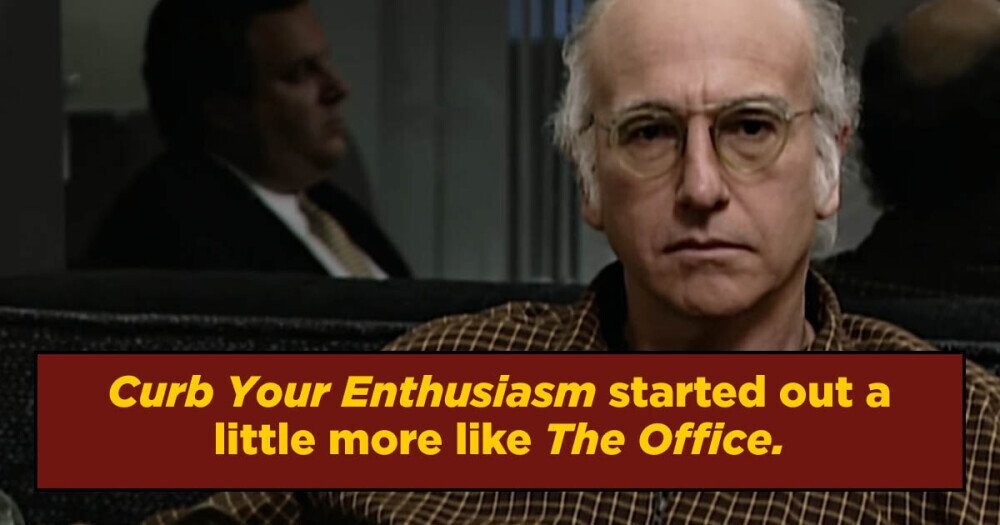
Before Curb Your Enthusiasm became shorthand for awkward dinners, social rule-breaking, accidental insults, and the phrase “pretty, pretty, pretty good,” it was something much smaller, stranger, and easier to overlook: a one-hour HBO special about Larry David pretending to return to stand-up comedy. That forgotten beginning matters because it explains almost everything that made the series feel so different from traditional sitcoms. It was not born from a network formula, a polished pilot season, or a perfectly engineered cast chemistry test. It grew out of discomfort, understatement, improvisation, and Larry David’s uncanny ability to turn a minor social irritation into a full civic emergency.
The funny thing about the origins of Curb Your Enthusiasm is that they are hiding in plain sight. Most fans know the show as the HBO comedy that ran for 12 seasons, starred Larry David as a fictionalized version of himself, and transformed petty grievances into premium television. But the series’ earliest DNA came from the 1999 special Larry David: Curb Your Enthusiasm, a mock documentary directed by Robert B. Weide. That special followed David as he supposedly prepared for an HBO stand-up performance after years away from the stage. It looked casual, almost tossed off, as if someone had accidentally left a camera running while a comedy legend became annoyed by lunch, parking, acquaintances, and the entire concept of human behavior.
The Forgotten HBO Special That Started Everything
The original 1999 special was not simply an early pilot with a different haircut. It was a mockumentary-style experiment built around Larry David’s public image after Seinfeld. At the time, David was famous inside comedy circles and television history, but he was not yet the instantly recognizable cranky philosopher of inconvenience that later fans would know. He had co-created Seinfeld with Jerry Seinfeld and helped shape its obsession with social minutiae. Yet unlike Jerry, he was not the face on the billboard. He was the behind-the-scenes brain, the writer-producer whose worldview seeped into George Costanza, awkward etiquette disputes, and arguments over nothing that somehow meant everything.
The special played with that gap between fame and invisibility. It presented Larry as a successful but oddly uncomfortable figure trying to step back into stand-up comedy. The premise was simple: a documentary crew follows him while he prepares a television special for HBO. The genius was in the texture. The world looked real. The conversations sounded unfinished. The jokes did not announce themselves with sitcom rhythm. Instead, they crept in sideways, like a neighbor asking why you used the good trash can.
In retrospect, the 1999 special looks like the seed of the entire Curb Your Enthusiasm universe. Jeff Garlin appeared as Jeff Greene. Cheryl Hines appeared as Cheryl. The basic idea of Larry’s life as comedy material was already there. So was the tension between real celebrity and fictional disaster. The special pretended to document Larry’s return to the stage, but it was really documenting something more valuable: how Larry David’s personality could function as a comedy engine.
Why the Show Did Not Begin Like a Normal Sitcom
Traditional sitcoms are usually built from scripts, sets, punch lines, rehearsals, rewrites, and a dependable structure that keeps chaos safely inside the walls. Curb Your Enthusiasm wandered in wearing sneakers and asked why everyone was making such a big deal about walls. The series that followed in 2000 kept the loose, observational feeling of the special, but moved away from the full mock documentary format. The characters no longer constantly acknowledged a camera crew, yet the show retained a cinéma vérité flavor: handheld energy, naturalistic pauses, overlapping dialogue, and the thrilling sense that nobody had completely agreed on how a conversation should end.
That style was not just a visual choice. It shaped the comedy. Each episode was built from an outline rather than a fully scripted teleplay. Larry David created the story beats, conflicts, reversals, and final collisions, while the actors improvised much of the dialogue. This is why Curb conversations often feel both messy and mathematically precise. The actors sound spontaneous, but the structure underneath is tightly engineered. The show is a jazz solo performed on top of a legal contract written by a very irritated man.
Improvisation Was the Secret Sauce
The improvisational format allowed performers to make scenes feel alive. Jeff Garlin’s exasperated warmth, Susie Essman’s volcanic insults, Cheryl Hines’s patient disbelief, Richard Lewis’s neurotic elegance, and later J. B. Smoove’s unstoppable Leon Black energy all worked because they were not trapped inside overly polished dialogue. They could react. They could interrupt. They could push Larry into corners and watch him try to argue his way out using the worst possible tone.
Improvisation also made the show dangerous in the best way. On a regular sitcom, a misunderstanding might be cute. On Curb, a misunderstanding can become a neighborhood scandal, a ruined party, a public shaming, or a multi-episode feud over a sandwich, a shirt, a chair, a tip, a sneeze, a bathroom rule, or a sentence that technically was not offensive until Larry explained it. The comedy often comes from watching a tiny social pebble roll downhill until it becomes a boulder with a country club membership.
Larry David After Seinfeld: The Perfect Moment for Curb
To understand the forgotten origins of Curb Your Enthusiasm, you have to remember where Larry David stood in the late 1990s. Seinfeld ended in 1998 as one of the most influential sitcoms in American television history. The show had turned everyday pettiness into prime-time art. It made entire episodes out of waiting for a table, losing a car in a parking garage, buying soup, and navigating the tiny contracts of friendship. David had left the day-to-day production before the final seasons but returned for the finale, which was famously divisive.
That post-Seinfeld moment created unusual pressure. What does a writer do after helping build a show about nothing that became everything? For Larry David, the answer was not to create a bigger sitcom with brighter sets and a more lovable hero. It was to make something smaller, rougher, and more allergic to charm. The title itself, Curb Your Enthusiasm, sounded like a warning label. Do not get too excited. Do not expect uplift. Do not come here looking for hugs unless you are prepared to argue about the proper duration of the hug.
The HBO environment was crucial. Premium cable gave David room to avoid network sitcom expectations. There was no need for a laugh track, no need for a morally improved main character, and no need to wrap every episode in a sweet lesson. In fact, one of the great pleasures of Curb is that Larry rarely learns anything. When he does appear to learn something, he usually weaponizes it incorrectly within minutes. Growth is for houseplants. Larry has principles, and unfortunately, he brings them everywhere.
The Mockumentary Roots Fans Often Forget
The 1999 special’s mockumentary setup matters because it gave the future series its core illusion: we are watching something too real to be scripted, even when it has clearly been shaped with expert comic architecture. The special used interviews, staged everyday moments, and documentary-style observation to blur fact and fiction. Comedy colleagues appeared as themselves, helping create the sense that the audience was peeking behind the curtain of Larry David’s actual life.
That blurred line became one of the show’s signature strengths. Curb Your Enthusiasm is not reality television, but it borrows reality’s texture. Larry plays “Larry David,” a version of himself close enough to confuse people and exaggerated enough to survive in sitcom logic. Celebrities appear as versions of themselves, which makes every social disaster feel more delicious. When Ted Danson, Wanda Sykes, Rosie O’Donnell, Mel Brooks, Lin-Manuel Miranda, or Jerry Seinfeld enters Larry’s orbit, the joke is not just that Larry is rude. The joke is that fame offers no protection from awkwardness. In the Curb universe, everyone is one misunderstood comment away from disaster.
How Everyday Etiquette Became Epic Conflict
The hidden brilliance of Curb Your Enthusiasm lies in its treatment of etiquette as battlefield strategy. Larry David’s character is not usually fighting over huge moral questions. He is fighting over whether someone took too many samples, whether a person abused a favor, whether a greeting was too enthusiastic, whether a social rule is real, or whether a line-cutter deserves public prosecution. The stakes are tiny. Larry’s commitment makes them enormous.
This approach connects directly to the show’s origins. The special framed Larry as a person whose discomfort with performance, celebrity, and social expectation could become narrative fuel. The series expanded that idea into a complete worldview. Larry notices the small print in everyday lifethe rules everyone follows but no one admits exist. Then he says the quiet part loudly, at the worst time, to the least forgiving person in the room. That is not just a character flaw. That is the entire show.
The Seinfeld Connection Without Becoming Seinfeld 2.0
Of course, Curb shares DNA with Seinfeld. Both shows love social codes, selfish behavior, circular plotting, and the comic power of tiny annoyances. But Curb Your Enthusiasm is not simply Seinfeld with premium cable vocabulary. Its forgotten origins reveal why. The 1999 special was built around Larry David himself, not a group of fictional friends in a Manhattan apartment ecosystem. It was more personal, more exposed, and more uncomfortable.
Where Seinfeld often transformed everyday irritations into elegant network sitcom machinery, Curb kept the seams visible. The camera moved like it had stumbled into the room. The dialogue scratched and bumped. The conflicts felt less like written jokes and more like social accidents caught on tape. That roughness was the point. It made the comedy feel immediate, as if Larry’s latest disaster had not been produced so much as discovered.
Robert B. Weide and the Shape of Early Curb
Director Robert B. Weide played a vital role in shaping the original special and the early identity of the series. His documentary background helped define the observational style that made the project feel so unusual. Instead of pushing Larry into a glossy sitcom frame, the early production leaned into awkward realism. Rooms looked like rooms. Conversations had dead air. Reactions mattered as much as lines. A stare, a pause, or a tiny change in Larry’s expression could do the work of an entire punch line.
This was especially important because Curb depended on credibility. The scenarios could become absurd, but the behavior had to feel recognizable. We believe Larry would escalate a small issue because we have all met someone who does thator worse, we have been that person for five embarrassing minutes at a pharmacy. The show works because it understands that social life is full of invisible tripwires. Larry simply brings a marching band through them.
The Cast That Made the Experiment Work
The forgotten origins of Curb Your Enthusiasm also remind us how important casting was. Larry David did not need traditional sitcom performers who would simply deliver jokes. He needed actors and comedians who could build tension in real time. Jeff Garlin’s Jeff Greene became the ideal manager-friend: loyal, compromised, amused, and usually unable to prevent Larry from doing the exact thing everyone knows he should not do. Cheryl Hines gave early Curb its necessary balance, often grounding Larry’s madness with a look that said, “I married this, legally.”
Susie Essman’s Susie Greene became one of television’s great comic detonators. Her fury did not feel random; it felt like the only sane response to Larry and Jeff’s behavior. Richard Lewis, playing a heightened version of himself, added decades of friendship, anxiety, rivalry, and affectionate hostility. Later, J. B. Smoove’s Leon changed the show’s chemistry by giving Larry a housemate and verbal sparring partner who could match his confidence while operating by a completely different social constitution.
Why the Origins Were “Forgotten” in the First Place
The 1999 special is easy to forget because the series became so much bigger than its starting point. Once Curb Your Enthusiasm evolved into a long-running HBO comedy, fans naturally focused on famous episodes, outrageous guest stars, and recurring bits. The special became a curiosity, a bonus feature, the thing dedicated fans mention when someone asks, “Wait, where should I start?”
But forgetting the special means missing the show’s original trick. Curb was not designed to chase mainstream approval. It emerged from a deliberately low-key experiment about Larry David’s discomfort with performance, his strange celebrity status, and his gift for turning irritation into structure. It began with an anti-spectacle. That is why the finished series could remain itself for more than two decades. Even when the guest stars became bigger and the plots became more elaborate, the show’s engine stayed the same: Larry versus the unwritten rules of being a person.
The Legacy of a Show That Refused to Learn
By the time Curb Your Enthusiasm concluded with its twelfth season in 2024, it had become one of HBO’s defining comedies. Yet its legacy is not only measured in awards, seasons, or celebrity cameos. Its deeper impact is stylistic. Curb helped prove that a comedy could be loose without being lazy, improvised without being shapeless, and uncomfortable without losing precision. It gave cringe comedy a uniquely American rhythm: sunny Los Angeles settings, successful adults, expensive lunches, and behavior so socially reckless it should come with insurance paperwork.
The show also changed how audiences thought about the line between performer and persona. Larry David’s fictional self became so vivid that viewers often treated him as a public utility for saying the unacceptable thing. That is part of the joke and part of the trap. Real Larry and TV Larry are not identical, but the show’s origins in mock documentary made the distinction intentionally slippery. Curb asks the audience to enjoy the confusion while knowing better. Naturally, the audience does not always know better. Very on brand.
Personal Viewing Experiences: Discovering Curb’s Origins Late
Watching Curb Your Enthusiasm after learning about its forgotten origins changes the experience. The first time many viewers encounter the show, they focus on the obvious pleasures: Larry arguing over dinner etiquette, Susie unloading a verbal cannon, Leon turning a simple conversation into street-corner poetry, or a guest star realizing too late that appearing as “themselves” means being dragged into Larry’s moral sinkhole. It is easy to laugh at the surface chaos. But once you know about the 1999 special, the show begins to look like a long-running experiment that accidentally became a cultural institution.
The original special makes early episodes feel more intimate. Larry is not yet the fully mythic Larry of later seasons. The comedy is quieter, drier, and sometimes almost suspiciously casual. That can surprise modern viewers who arrive expecting nonstop catchphrases and explosive confrontations. Instead, early Curb often feels like sitting near an argument at a restaurant and slowly realizing you are more invested in it than in your own meal. You do not want to stare. You absolutely stare.
One of the most enjoyable experiences related to this topic is introducing Curb to someone who has only heard about the later reputation. They expect a loud comedy about a grumpy rich guy. Then they watch the early material and discover something more subtle: a show about the terror of small talk, the politics of favors, the danger of honesty, and the way a normal errand can collapse because one person cannot let a minor injustice go unchallenged. At some point, every new viewer says some version of, “He’s wrong, but also… he has a point.” That sentence may be the official unofficial motto of the show.
The forgotten origins also make the series feel more human. The HBO special’s premiseLarry returning to stand-up and letting cameras follow his awkward preparationscaptures the discomfort of being observed. That discomfort never really leaves the series. Even when Curb becomes more confident, Larry’s character remains allergic to performance in everyday life. He hates pretending. He hates fake enthusiasm. He hates ritualized politeness unless he personally approves of the ritual, in which case everyone else must follow it perfectly or face prosecution in the Court of Larry.
For writers, comedians, and devoted TV fans, the origin story is especially inspiring because it shows how powerful a simple comic perspective can be. Curb Your Enthusiasm did not need a giant premise. It needed a point of view sharp enough to cut through ordinary life. The show’s forgotten beginning is a reminder that originality often starts with noticing what everyone else politely ignores. The awkward goodbye. The fake compliment. The suspiciously generous favor. The person who says “we should get together sometime” with no intention of surviving the scheduling process.
Rewatching the series with the 1999 special in mind also makes the finale feel more fitting. Curb never became sentimental in the traditional sense, but it did become deeply familiar. Its origins were modest, almost anti-grand. Its ending carried the weight of television history while still making room for one more argument, one more callback, and one more reminder that Larry David’s comic universe does not resolve so much as continue somewhere offscreen, probably near a buffet line with unclear rules.
In the end, the experience of exploring Curb Your Enthusiasm: Its Forgotten Origins is a little like discovering the receipt for a legendary meal. The final dish is famous, but the receipt tells you what it was really made of: a mock documentary, a post-Seinfeld identity crisis, improvised dialogue, documentary realism, brilliant collaborators, and one man’s heroic refusal to let minor annoyances remain minor. Pretty, pretty, pretty educational.
Conclusion
The origins of Curb Your Enthusiasm deserve more attention because they explain why the show never felt like anything else on television. Its roots in a 1999 HBO mockumentary special gave it a loose, realistic, semi-dangerous quality. Its post-Seinfeld timing gave Larry David the freedom to turn social discomfort into art. Its improvisational structure gave performers room to create scenes that felt spontaneous while still landing with expert precision. Most importantly, its small beginnings protected its strange personality. Curb did not arrive shouting that it would change comedy. It arrived shrugging, complaining, and wondering why everyone was making such a big deal. Naturally, it changed comedy anyway.