Note: This article discusses David Catá’s artwork as a professional performance and photography project. It is not a tutorial, challenge, or suggestion to copy the process. Please keep your creativity on paper, fabric, clay, pixels, or anything else that does not require turning your own body into an art supply closet.
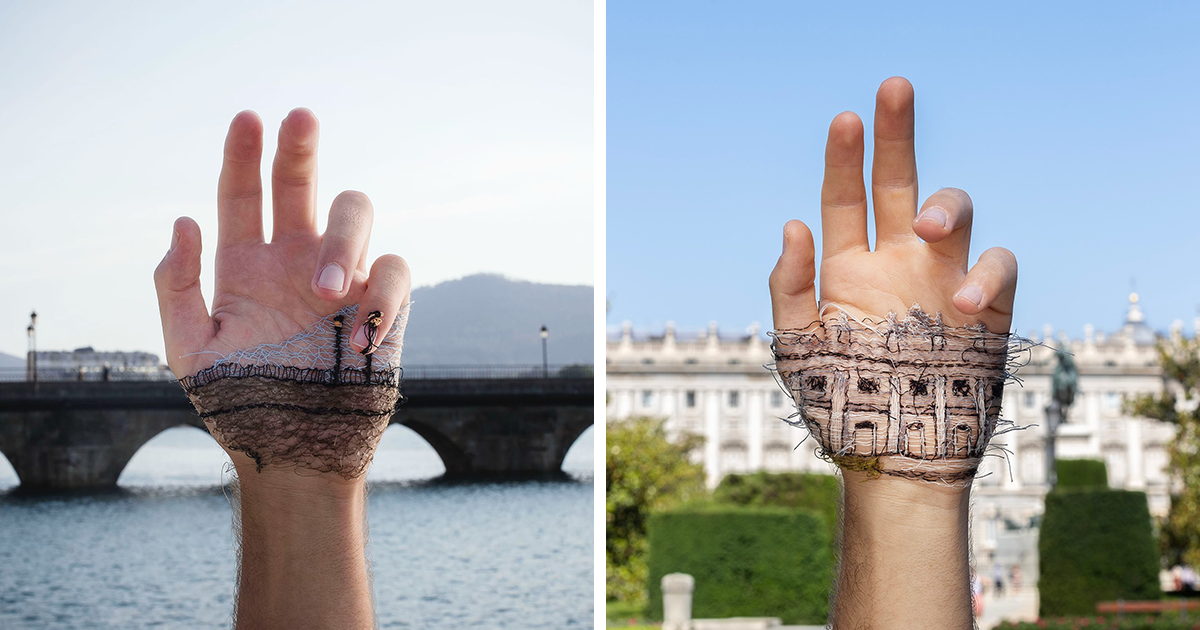
Some artists paint landscapes on canvas. Some photograph them at golden hour. Some hike to a cliff, whisper “this lighting is cinematic,” and take 300 photos of the same cloud. Then there is David Catá, the Galician artist whose series Horizontes takes the idea of “carrying a place with you” and makes it startlingly literal. In the project, landscapes that have shaped his memory are translated into delicate threadwork on his palm, then preserved through photography and video.
The result is strange, poetic, intimate, and yes, a little stomach-flipping if you are the sort of person who gets nervous watching someone remove a splinter in a movie. But beyond the initial shock, Catá’s work is not about spectacle for spectacle’s sake. It is about memory, place, family, time, and the invisible emotional maps we carry around every day. His hand becomes a temporary page. The landscape becomes a diary entry. The photograph becomes the proof that a passing moment once existed.
Who Is David Catá?
David Catá is a contemporary artist from Galicia, Spain, known for blending photography, video art, painting, music, and performance into deeply autobiographical work. Born in Viveiro, he has built a practice around memory and identity, often exploring how people, places, and personal history leave marks on us. In other words, he is not simply asking, “What does this look like?” He is asking, “What does this remember?”
Catá first became widely known for A Flor de Piel, a project in which he created portraits of loved ones on his palm as a tribute to people who had shaped his life. With Horizontes, he shifts attention from faces to places. The subject changes, but the emotional engine remains the same: the body as a living archive, the hand as a symbolic surface, and thread as a line connecting the present to memory.
What Makes “Horizontes” So Powerful?
The title Horizontes translates to “Horizons,” and that word does a lot of heavy lifting. A horizon is where the earth seems to meet the sky. It is also a promise, a boundary, a direction, and sometimes a reminder that the world is bigger than your current bad Wi-Fi connection. Catá uses horizons as emotional coordinates. Each stitched landscape points toward a place that matters to him: a coastline, a city, a park, a childhood memory, a place of change, or a landscape that holds personal meaning.
Among the works featured in the 21-picture series are places such as the Tower of Hercules in Galicia, the sea of A Coruña, Madrid’s Royal Palace, Retiro Park, and other locations tied to Catá’s life and travels. These are not random postcard views. They function more like memory landmarks. The landscape is not merely scenery; it is a witness.
The Palm as a Personal Map
Hands already tell stories. They show labor, age, habit, tenderness, and sometimes whether someone has ever successfully opened a jar without making dramatic sound effects. Catá turns the palm into a map of emotional geography. The lines of the hand meet the lines of the landscape, and suddenly the viewer is looking at two kinds of terrain at once: the terrain of the body and the terrain of memory.
This is where the work becomes more than a visual trick. The palm is associated with touch, connection, work, care, and communication. We hold hands, shake hands, wave, write, build, cook, comfort, and create with them. By placing landscapes on his palm, Catá suggests that places are not just seen. They are touched, carried, and felt.
Why the Photos Feel Both Beautiful and Unsettling
The 21 photos are stunning because they balance contradiction. They are small but expansive. Fragile but bold. Personal but instantly understandable. The thread lines mimic hills, buildings, waves, trees, monuments, and skylines, while the real landscape often appears in the background. The palm becomes a tiny echo of the world behind it.
That visual echo is the magic trick. A lighthouse appears on the hand while the real coastline stretches beyond it. A city skyline is reduced to a few essential lines. A park becomes a quiet symbol of pause inside an urban rhythm. The viewer sees the outside world and the inner world at the same time, like a double exposure made with thread instead of software.
The unsettling part comes from the fact that the body is involved. Contemporary art has a long history of artists using the body as a medium, especially in performance art, where the action itself may be temporary and the documentation becomes the object that remains. Catá’s work fits into that tradition, but it also feels quieter than many body-based performances. It is not loud. It does not shout. It whispers, which somehow makes it even harder to ignore.
Embroidery, But Not as Your Grandma Knew It
Embroidery has often been mislabeled as “decorative” or “domestic,” as if thread politely agreed to stay in the craft drawer forever. Contemporary fiber artists have spent decades proving otherwise. Thread can carry political memory, scientific data, personal grief, humor, family history, cultural identity, and experimental form. It can be gentle, rebellious, precise, messy, elegant, or wonderfully weird.
Catá’s work sits inside this larger shift. He uses the language of stitching, but removes it from the usual textile surface. Instead of fabric, the body becomes the symbolic ground. Instead of a permanent tapestry, the final artwork depends on documentation: the photograph, the video, the memory of the action. It is embroidery as performance, not embroidery as throw pillow. No disrespect to throw pillows, of course. Some of them are emotionally carrying entire living rooms.
The Role of Photography in the Project
Without photography, Horizontes would disappear almost as quickly as it appears. That is part of the point. The work is temporary, but the image remains. Photography becomes the bridge between action and audience. It preserves the moment while also reminding us that the original experience cannot be fully recovered.
This is a familiar challenge in performance and ephemeral art. When an artwork exists only for a short time, documentation is not an afterthought. It becomes part of the artwork’s life. Catá’s photographs are carefully composed so the viewer understands the relationship between hand, horizon, and place. The stitched image is not isolated in a studio void. It is placed back into the landscape that inspired it, creating a loop between memory and location.
Specific Examples From the 21 Pics
The Tower of Hercules
One of the most memorable images references the Tower of Hercules, the famous lighthouse in Galicia. In Catá’s visual language, the lighthouse becomes more than architecture. It becomes a symbol of endurance, guidance, and return. A lighthouse is built to help people find their way, and in this work, it feels like a metaphor for memory itself: a light that keeps flashing even when the surrounding weather gets moody and dramatic.
The Sea of A Coruña
Another image draws from the sea of A Coruña, a place connected to Catá’s life in Galicia. The sea is a perfect subject for this kind of work because it is always moving, always changing, and impossible to hold. Translating it into thread creates a striking tension. The ocean refuses to stay still, but the artwork briefly pins down the feeling of it.
Madrid’s Retiro Park
Retiro Park appears as a softer, more contemplative horizon. In a city known for movement, traffic, museums, cafés, and people who somehow look stylish while walking very fast, Retiro offers pause. In Catá’s hands, the park becomes a visual breath. The landscape is not just a location; it is a mood, a rhythm, a reminder that stillness can exist even in the middle of noise.
Chongqing, China
The series also reaches beyond Spain, including places such as Chongqing, a city known for its dramatic geography and layered urban forms. In a project about horizons, a vertical city adds an interesting twist. The skyline does not simply stretch sideways. It climbs, stacks, folds, and surprises. Catá’s translation of such a place into thread highlights how cities can feel almost embroidered into the mountains themselves.
Why Viewers Can’t Stop Looking
Part of the fascination is visual. The images are technically surprising. But the deeper reason viewers linger is emotional. Everyone has landscapes inside them. Maybe it is the street where you learned to ride a bike, the beach where your family took one chaotic vacation, the schoolyard that felt enormous when you were seven, or the view from a bus window during a year you were quietly becoming a different person.
Catá’s work reminds us that place is never just place. A hill can be a childhood. A city can be a heartbreak. A lighthouse can be a family story. A park bench can hold an entire season of your life. The landscape outside us becomes part of the landscape inside us, and sometimes the most accurate map is not geographic at all. It is emotional.
The Art of Temporary Marks
One of the most interesting ideas in Catá’s practice is impermanence. Many artworks are made to last: bronze sculptures, oil paintings, stone monuments, museum-quality frames that silently judge your cheap wall hooks. Catá’s work moves in the opposite direction. The action is temporary by design. What remains is the photograph, the video, and the viewer’s response.
This temporary quality gives the work its tenderness. It mirrors the way memory behaves. Memories are not fixed objects locked in a vault. They fade, return, shift, blur, and sometimes appear suddenly because a smell, song, or patch of afternoon light ambushed you in the grocery store. Catá’s thread landscapes feel like that: visible for a moment, then transformed into a record of what was felt.
Is It Beautiful, Shocking, or Both?
The honest answer is both. The beauty is obvious in the delicacy of the lines and the way the small image interacts with the larger view. The shock comes from the surface he chooses. But reducing the work to shock would miss the point. Catá is not making clickbait with thread. He is building a visual language for memory.
That distinction matters. A gimmick says, “Look at this because it is strange.” Art says, “Look at this because the strangeness reveals something true.” In Horizontes, the strange method points toward a familiar feeling: the desire to keep the places that made us, even though time keeps moving and refuses to sign a pause agreement.
What “21 Pics” Really Means for the Viewer
A 21-picture gallery sounds simple: scroll, admire, react, maybe send it to a friend with the message “art people are built different.” But viewed as a series, the photos become a journey. Each image adds another point to Catá’s personal atlas. Together, they suggest a life measured not only by dates or events, but by landscapes remembered through the body.
The number matters less than the accumulation. One image is striking. Several images create a pattern. Twenty-one images begin to feel like chapters. The viewer starts to understand that Catá is not simply repeating a technique. He is expanding a diary.
Experience: What This Artwork Teaches Us About Memory, Place, and Looking More Carefully
After spending time with Catá’s Horizontes, it becomes hard to look at ordinary landscapes in the same casual way. The project nudges you to ask a slightly dangerous question: which places have quietly shaped me? Not in the dramatic movie-trailer sense, with thunder and violins, but in the smaller, truer sense. Which windows, sidewalks, beaches, fields, bedrooms, train stations, and school hallways are still living rent-free in my head?
That question changes how you experience the world. A landscape stops being background. It becomes a container for memory. The corner store is not just where you bought snacks; it is where you learned independence one awkward purchase at a time. A family garden is not just a garden; it is weather, voices, chores, boredom, laughter, and maybe one heroic tomato plant that carried the whole season. A city skyline is not just architecture; it is ambition, loneliness, discovery, and the confusing miracle of finding your way without looking completely lost.
Catá’s work also teaches patience. In a digital culture where images appear and vanish faster than anyone can say “algorithm,” Horizontes asks for slower attention. You notice the line. Then the hand. Then the background. Then the relationship between them. Then the idea that the place is not behind the artwork; it is inside it. This layered looking is one of the best experiences art can offer. It turns your brain from a scrolling machine back into a noticing machine.
There is also a lesson here about documentation. Many meaningful things in life are temporary. A sunset, a conversation, a goodbye, a first day, a last visit, a song heard at exactly the right momentnone of these can be kept in their original form. But they can be honored. Catá uses photography and performance to honor what cannot be permanently held. For the rest of us, the method can be safer and simpler: take a photo, write a paragraph, sketch a view, collect a leaf, record a voice note, or make a playlist that sounds like a certain summer. The point is not to copy the artwork. The point is to understand the impulse behind it.
In that sense, Horizontes is not only about one artist’s memories. It becomes a mirror for the viewer’s own. You may arrive because the images look unusual, but you stay because they ask you to inventory your own internal landscapes. What place still glows in your memory? What view helped you survive a difficult year? What road, river, rooftop, or kitchen table feels stitched into who you are?
The most beautiful part of Catá’s series is that it makes memory visible without pretending memory is simple. It is tender, unstable, selective, and sometimes stubborn. It edits without permission. It keeps odd details and loses important ones. It can turn a landscape into a feeling and a feeling into a landmark. Horizontes captures that strange process with rare clarity. It says that the places we love do not disappear just because we leave them. They become part of our personal horizon, always somewhere ahead, behind, and within us.
Conclusion
David Catá’s Horizontes is stunning because it transforms landscape art into something intimate, temporary, and emotionally charged. The 21 pictures may first catch attention because of their unusual surface, but the lasting impact comes from the ideas behind them: memory as a map, the body as an archive, and photography as a way to preserve what cannot stay.
This is not art designed merely to impress the internet, even though the internet understandably stopped scrolling for a moment. It is a poetic reminder that places mark us. Some marks are visible. Most are not. Catá simply gives those invisible marks a visual form, using thread, performance, and photography to show how deeply landscapes can live inside a person.