Dusty streets. Nervous horses. A saloon piano that stops playing the instant a suspicious stranger enters. Few movie genres have a visual language as instantly recognizable as the Western.
Yet the best Western movies offer much more than hats, horses, and dramatic squinting. They explore justice, greed, loneliness, community, conquest, survival, and the uncomfortable question of who gets to write history. The genre stretches from silent-film train robberies to Italian gunfighter operas, revisionist frontier dramas, Australian outback tales, and modern neo-Westerns where pickup trucks replace stagecoaches.
This collection draws on film preservation records, institutional rankings, critical surveys, museum commentary, awards history, and major American movie publications. AFI’s genre survey places The Searchers, High Noon, and Shane among the defining American Westerns, while the Library of Congress has preserved numerous genre landmarks in the National Film Registry.
The list is arranged as a journey through Western movie history rather than a rigid mathematical ranking. After all, trying to prove whether Rio Bravo is exactly three saddles better than Stagecoach is how saloon arguments begin.
What Makes a Great Western Movie?
A memorable Western usually places its characters at a boundary: law versus lawlessness, settlement versus wilderness, freedom versus responsibility, or legend versus truth. The landscape matters almost as much as the actors. Monument Valley, empty plains, snowy mountain passes, and sunburned deserts make human beings look smalland their decisions look enormous.
Classic Westerns often celebrated heroic gunfighters and westward expansion. Later filmmakers challenged those myths, revealing violence, racism, displacement, environmental destruction, and the experiences of women, Black cowboys, Mexican vaqueros, and Indigenous communities. Historians note that the real frontier was more diverse and less continuously gun-crazy than Hollywood traditionally suggested.
The 120 Best Western Movies
Trailblazers and Golden-Age Landmarks
- The Great Train Robbery (1903) A revolutionary short that helped establish chases, outlaws, gunfire, and the cinematic Western itself.
- Hell’s Hinges (1916) William S. Hart brings fire, brimstone, and unusual moral intensity to silent frontier storytelling.
- The Covered Wagon (1923) A pioneering wagon-train epic filled with dangerous rivers, vast landscapes, and national mythmaking.
- The Iron Horse (1924) John Ford transforms railroad construction into a sweeping story of ambition and sacrifice.
- Go West (1925) Buster Keaton meets cattle-country chaos in a silent comedy with magnificent physical gags.
- The Big Trail (1930) An early widescreen spectacle featuring a young John Wayne and hundreds of determined pioneers.
- Cimarron (1931) Historically important and visually ambitious, though several cultural portrayals have aged poorly.
- Destry Rides Again (1939) James Stewart’s polite lawman discovers that manners and firearms occasionally require teamwork.
- Stagecoach (1939) John Ford turns a dangerous journey into a sharp study of prejudice, courage, and social class.
- The Ox-Bow Incident (1943) A bleak, powerful warning about mob justice and the deadly speed of certainty.
- My Darling Clementine (1946) Ford’s lyrical Wyatt Earp story favors atmosphere, community, and legend over strict historical accuracy.
- Duel in the Sun (1946) Romance, obsession, and blazing Technicolor collide in this wonderfully overheated frontier melodrama.
- Red River (1948) John Wayne and Montgomery Clift battle cattle, weather, and each other during an epic drive.
- Fort Apache (1948) A visually majestic cavalry drama questioning pride, command, and the manufacture of military legends.
- She Wore a Yellow Ribbon (1949) Wayne gives a restrained performance as an aging officer approaching reluctant retirement.
Psychological Westerns and 1950s Masterpieces
- Winchester ’73 (1950) A prized rifle passes between owners while revenge slowly tightens its grip.
- Broken Arrow (1950) An influential attempt to portray conflict between settlers and the Apache with greater sympathy.
- The Gunfighter (1950) Gregory Peck plays a notorious shooter who desperately wants to escape his reputation.
- Rio Grande (1950) Family tension and cavalry action complete John Ford’s celebrated informal trilogy.
- High Noon (1952) Gary Cooper waits for an outlaw while an entire town discovers urgent scheduling conflicts.
- The Naked Spur (1953) James Stewart’s bounty hunter becomes increasingly unstable in Anthony Mann’s tense mountain drama.
- Shane (1953) A mysterious gunfighter protects homesteaders in one of Hollywood’s most emotionally resonant Westerns.
- Hondo (1953) Wayne anchors a rugged story involving survival, family, and Apache territory.
- Johnny Guitar (1954) Joan Crawford commands a wildly colorful, psychologically charged Western unlike any conventional horse opera.
- The Man from Laramie (1955) Revenge and family corruption unfold against Anthony Mann’s striking CinemaScope landscapes.
- The Searchers (1956) Ford’s beautiful, disturbing masterpiece examines obsession, racism, family, and frontier mythology.
- Seven Men from Now (1956) Randolph Scott pursues revenge in Budd Boetticher’s lean, morally complex adventure.
- 3:10 to Yuma (1957) A rancher guards a charismatic outlaw while courage becomes harder to define.
- The Tall T (1957) A compact hostage drama where every conversation sounds one mistake away from violence.
- The Big Country (1958) Gregory Peck enters a feud-driven landscape where masculine posturing reaches industrial quantities.
Gunfighters, Spaghetti Westerns, and International Reinvention
- Man of the West (1958) Gary Cooper confronts a criminal past in one of Anthony Mann’s darkest films.
- Ride Lonesome (1959) Sparse dialogue and stark scenery make this revenge tale feel almost mythological.
- Rio Bravo (1959) Wayne, Dean Martin, and company defend a jail through friendship, patience, and excellent banter.
- The Magnificent Seven (1960) Seven gunfighters defend a village in this iconic adaptation of Seven Samurai.
- Comanche Station (1960) Boetticher concludes his Ranown cycle with another economical tale of grief and honor.
- One-Eyed Jacks (1961) Marlon Brando directs and stars in a brooding saga of betrayal and revenge.
- A Fistful of Dollars (1964) Clint Eastwood’s nameless gunslinger plays two criminal factions against each other.
- For a Few Dollars More (1965) Two bounty hunters pursue the same villain while Ennio Morricone supplies musical thunder.
- The Good, the Bad and the Ugly (1966) Three fortune hunters cross a Civil War landscape in Sergio Leone’s operatic triumph.
- Django (1966) Franco Nero drags a coffin into a mud-soaked town and changes Western iconography forever.
- The Big Gundown (1966) Lee Van Cleef hunts a fugitive in a politically sharp Italian Western.
- Death Rides a Horse (1967) Revenge partners unite, distrust each other, and generate enough tension to power a locomotive.
- Day of Anger (1967) A bullied stable hand receives dangerous lessons from a ruthless gunfighter.
- Face to Face (1967) A mild professor becomes corrupted after joining an outlaw gang.
- The Great Silence (1968) A snowbound anti-Western with bleak politics, haunting imagery, and a famously uncompromising conclusion.
Revisionist Westerns That Challenged the Myth
- The Misfits (1961) Clark Gable and Marilyn Monroe inhabit a melancholy world of fading independence.
- Ride the High Country (1962) Aging lawmen face changing values in Sam Peckinpah’s tender early masterpiece.
- How the West Was Won (1962) A massive multigenerational spectacle created for an enormous curved Cinerama screen.
- The Man Who Shot Liberty Valance (1962) Ford examines how comforting legends replace complicated truths.
- Hud (1963) Paul Newman’s magnetic rancher makes selfishness look dangerously stylish.
- Cheyenne Autumn (1964) Ford attempts a more sympathetic account of Indigenous displacement and endurance.
- Cat Ballou (1965) Jane Fonda leads a comic revenge tale featuring Lee Marvin’s Oscar-winning double performance.
- The Professionals (1966) Mercenaries enter Mexico for a rescue mission in a muscular adventure with shifting loyalties.
- El Dorado (1966) Wayne and Robert Mitchum revisit the friendly siege formula with relaxed confidence.
- Hombre (1967) Paul Newman’s Apache-raised outsider confronts prejudice aboard a threatened stagecoach.
- Will Penny (1967) Charlton Heston portrays cowboy life as lonely, exhausting, and far from glamorous.
- Once Upon a Time in the West (1968) Leone builds a grand funeral for the frontier from faces, music, and silence.
- The Wild Bunch (1969) Peckinpah’s aging outlaws meet modern warfare in a violent, influential elegy.
- Butch Cassidy and the Sundance Kid (1969) Paul Newman and Robert Redford make doomed outlaw friendship irresistibly charming.
- True Grit (1969) John Wayne’s Rooster Cogburn helps a determined teenager pursue her father’s killer.
The Wild, Weird, and Thoughtful West of the 1970s and 1980s
- The Ballad of Cable Hogue (1970) Peckinpah trades battlefield carnage for romance, comedy, and bittersweet modernization.
- Little Big Man (1970) Dustin Hoffman’s unreliable narrator wanders through a satirical revision of Western history.
- They Call Me Trinity (1970) Terence Hill’s lazy gunslinger turns Spaghetti Western violence into cheerful slapstick.
- McCabe & Mrs. Miller (1971) Robert Altman creates a muddy, snowy, dreamlike frontier ruled by business interests.
- Duck, You Sucker! (1971) A bandit and explosives expert stumble into the Mexican Revolution.
- Buck and the Preacher (1972) Sidney Poitier and Harry Belafonte protect formerly enslaved travelers heading west.
- Jeremiah Johnson (1972) Robert Redford seeks solitude in mountains that have other plans.
- The Cowboys (1972) Schoolboys join an aging rancher for a cattle drive with unexpectedly brutal consequences.
- High Plains Drifter (1973) Eastwood’s supernatural stranger delivers punishment to a town hiding a terrible secret.
- Pat Garrett and Billy the Kid (1973) Peckinpah mourns friendship and freedom as the old frontier disappears.
- Blazing Saddles (1974) Mel Brooks demolishes Western clichés with satire, anarchy, and weaponized baked beans.
- The Outlaw Josey Wales (1976) A revenge-driven farmer gradually forms an unconventional frontier family.
- The Shootist (1976) John Wayne’s final film gives the legendary star an unusually reflective farewell.
- Heaven’s Gate (1980) Once infamous, this visually stunning epic now stands as an ambitious revisionist work.
- The Long Riders (1980) Real-life acting brothers play members of the James–Younger Gang with bruising authenticity.
The Great Western Revival
- Pale Rider (1985) Eastwood’s mysterious preacher protects miners in a stylish echo of Shane.
- Silverado (1985) Lawrence Kasdan joyfully revives shootouts, saloons, stampedes, villains, and heroic teamwork.
- Dances with Wolves (1990) Kevin Costner’s expansive frontier drama won Best Picture and renewed Hollywood’s interest in Westerns.
- Quigley Down Under (1990) An American marksman battles cruelty and colonial injustice in Australia.
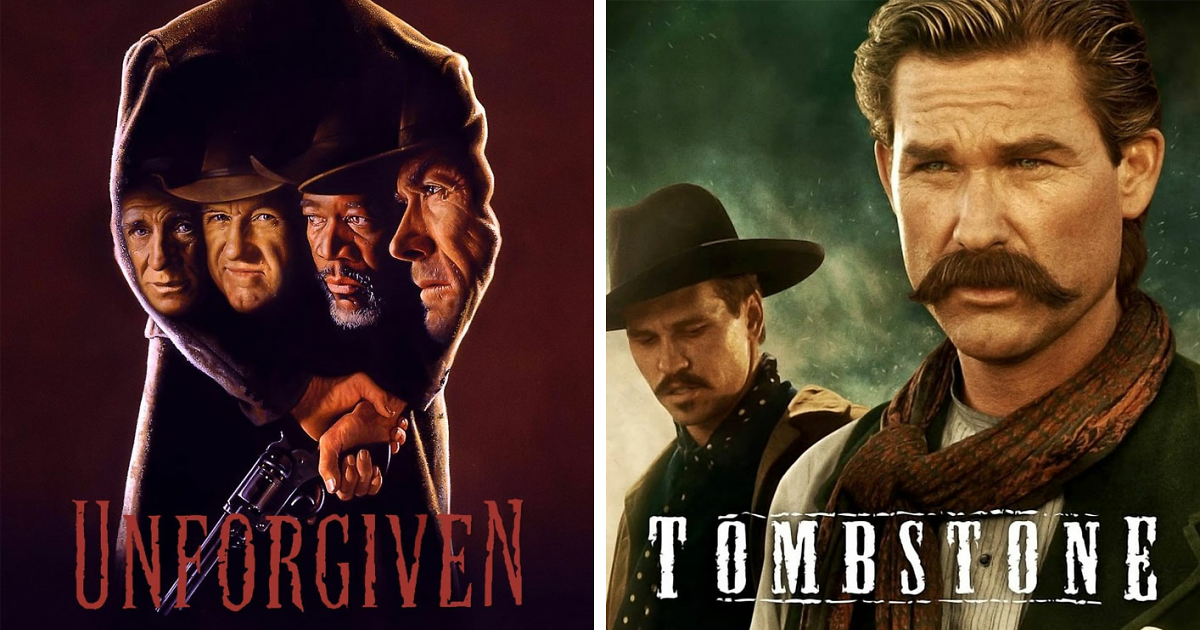
- Unforgiven (1992) Eastwood strips the glamour from killing in a haunting Best Picture winner.
- Tombstone (1993) Val Kilmer’s scene-stealing Doc Holliday makes this endlessly quotable frontier favorite.
- Posse (1993) Mario Van Peebles centers Black Western heroes too often omitted from popular mythology.
- The Ballad of Little Jo (1993) A woman disguises herself as a man to survive frontier society.
- Geronimo: An American Legend (1993) A serious, beautifully photographed examination of Geronimo’s final resistance.
- Dead Man (1995) Jim Jarmusch turns the Western into a strange, poetic journey toward death.
- The Quick and the Dead (1995) Sharon Stone enters a lethal shooting tournament directed with comic-book energy.
- Lone Star (1996) A Texas sheriff investigates a buried crime and generations of borderland secrets.
- Open Range (2003) Kevin Costner delivers patient character work followed by one thunderous gunfight.
- The Proposition (2005) Australia’s outback becomes a furnace of violence, family loyalty, and colonial brutality.
- Brokeback Mountain (2005) Ang Lee’s tragic romance expands the emotional and thematic boundaries of the Western.
Modern Westerns and Neo-Western Classics
- The Three Burials of Melquiades Estrada (2005) Friendship and guilt drive a harsh journey across the United States–Mexico border.
- The Assassination of Jesse James by the Coward Robert Ford (2007) A hypnotic study of celebrity, envy, fear, and doomed admiration.
- 3:10 to Yuma (2007) Christian Bale and Russell Crowe bring emotional weight to the classic prisoner escort.
- No Country for Old Men (2007) The Coen brothers replace horseback outlaws with trucks, drug money, and unstoppable evil.
- There Will Be Blood (2007) Oil, ambition, religion, and resentment reshape the Western landscape.
- The Good, the Bad, the Weird (2008) A Korean action Western featuring treasure maps, motorcycles, trains, and gleeful mayhem.
- Appaloosa (2008) Ed Harris and Viggo Mortensen play lawmen whose partnership feels quietly authentic.
- Meek’s Cutoff (2010) Kelly Reichardt views pioneer uncertainty through the women bearing its consequences.
- True Grit (2010) Hailee Steinfeld’s formidable Mattie Ross leads the Coens’ darkly funny adaptation.
- Rango (2011) An anxious chameleon accidentally becomes sheriff in a dazzling animated genre tribute.
- Blackthorn (2011) An elderly Butch Cassidy may have survived, but retirement remains annoyingly complicated.
- Django Unchained (2012) Quentin Tarantino combines revenge fantasy, Spaghetti Western style, and slavery-era brutality.
- The Retrieval (2013) A young Black boy faces an impossible moral decision near the Civil War’s end.
- The Homesman (2014) Hilary Swank and Tommy Lee Jones cross a frontier indifferent to suffering.
- The Salvation (2014) Mads Mikkelsen brings icy Danish resolve to a grim tale of frontier revenge.
Recent Western Movies Keeping the Frontier Alive
- Slow West (2015) A lovesick Scottish teenager discovers that the American frontier is not a romantic postcard.
- The Hateful Eight (2015) Suspicious strangers, a blizzard, and one cabin create a very unfriendly gathering.
- Bone Tomahawk (2015) A patient rescue Western suddenly gallops into extremely graphic horror territory.
- The Revenant (2015) Survival, revenge, and freezing wilderness produce a punishing visual experience.
- Hell or High Water (2016) Bank-robbing brothers challenge a system that has already taken nearly everything.
- The Rider (2017) A wounded rodeo performer must imagine an identity beyond the saddle.
- Hostiles (2017) Former enemies cross dangerous country while confronting grief and hatred.
- Sweet Country (2017) An Aboriginal stockman flees colonial authorities in this powerful Australian Western.
- Marlina the Murderer in Four Acts (2017) An Indonesian widow takes justice into her own hands with calm determination.
- The Ballad of Buster Scruggs (2018) Six Coen brothers stories move from musical comedy to existential dread.
- First Cow (2019) Friendship, stolen milk, and baked goods fuel a tender frontier capitalism story.
- News of the World (2020) Tom Hanks escorts an orphan across a wounded post–Civil War nation.
- The Harder They Fall (2021) Black historical figures populate a stylish, fictional revenge saga with explosive energy.
- The Power of the Dog (2021) Jane Campion dismantles cowboy masculinity through repression, manipulation, and quiet observation.
- Killers of the Flower Moon (2023) Martin Scorsese examines the systematic murder of wealthy Osage people in 1920s Oklahoma.
Where Should a Western Beginner Start?
Newcomers do not need to begin in 1903 and proceed chronologically like a determined film-school prospector. Start with a small group that demonstrates the genre’s range.
Choose Stagecoach for classical storytelling, High Noon for suspense, Rio Bravo for companionship, and The Good, the Bad and the Ugly for operatic style. Continue with The Wild Bunch to see the genre become bloodier and more skeptical, followed by Unforgiven for its moral reckoning.
Then watch Meek’s Cutoff, The Rider, The Harder They Fall, and Killers of the Flower Moon to understand how modern filmmakers have widened the Western’s perspectives. Smithsonian histories of Black Western cinema and Native representation demonstrate why this broader view matters: early Hollywood frequently excluded people of color or reduced them to harmful stereotypes.
How Western Movies Changed Over Time
The earliest Westerns presented movement itself as excitement. Trains raced, horses charged, and outlaws fired directly toward the audience. By the late 1930s, directors such as John Ford were using frontier adventures to examine society in miniature.
The 1950s brought psychological complexity. Heroes carried trauma, prejudice, selfishness, and regret. Italian filmmakers then exaggerated the genre’s rituals: longer silences, tighter close-ups, dirtier towns, stranger villains, and Morricone scores that could make someone opening a cupboard feel historically significant.
Revisionist Westerns questioned heroic conquest and uncomplicated justice. Modern films have gone further, examining race, gender, sexuality, corporate power, environmental hardship, and Indigenous sovereignty. TCM similarly describes the Western as a genre that has reflected debates about individualism, community, oppression, racism, justice, and national identity.
The Experience of Taking a 120-Movie Trip Through the Old West
Watching 120 Western movies is less like completing a checklist and more like traveling through several different versions of America. At first, familiar symbols dominate: white hats, black hats, swinging saloon doors, circling wagons, and dusty streets apparently maintained by a municipal ban on brooms.
After a dozen films, the differences become more interesting than the similarities. John Ford uses landscapes to create legend. Anthony Mann makes mountains feel like extensions of a hero’s damaged mind. Budd Boetticher removes almost everything unnecessary until only character, danger, and moral choice remain. Sergio Leone stretches a gunfight into a ceremony, allowing eyes, hands, boots, and music to announce violence before anyone touches a weapon.
A good viewing marathon also reveals how performance styles changed. Early heroes often stand upright and speak with certainty. Later protagonists hesitate, lie, fail, drink too much, or discover that their personal code is mostly a collection of excuses wearing a nice hat. Compare the clean heroic image associated with older Westerns to William Munny in Unforgiven. Munny is not a glamorous gunfighter returning for one final adventure. He is a damaged man returning to something terrible because he needs money.
The landscapes change emotionally as well. Monument Valley can represent heroic possibility in one film and isolation or conquest in another. Snow in The Great Silence removes the genre’s comforting golden sunlight. Mud in McCabe & Mrs. Miller makes frontier capitalism look cold, inconvenient, and terrible for footwear. The Australian outback in The Proposition and Sweet Country carries its own colonial history, proving that the Western’s central conflicts are not confined to one national border.
For the best experience, avoid watching only one type of Western. Pair an older classic with a revisionist response. Watch Stagecoach beside Meek’s Cutoff, or My Darling Clementine beside Tombstone. Follow The Searchers with a modern film centered on Indigenous experiences. Such pairings make cinematic assumptions easier to recognize.
Do not rush through all 120 titles in one enormous marathon unless your sofa has excellent lumbar support and your household accepts Morricone whistles at breakfast. Three films per week creates a manageable ten-month journey. One serious drama, one action-heavy favorite, and one comedy or unconventional Western make a balanced weekly program.
Keeping a simple viewing journal adds another layer of enjoyment. Note the landscape, the hero’s moral code, who controls the town, how violence is portrayed, and whose perspective is missing. Over time, patterns emerge. Railroads frequently represent progress and destruction simultaneously. Towns want law but dislike its inconvenience. Gunfighters seek peaceful retirement moments before the screenplay sends six armed men toward their porch.
Most importantly, a long Western journey shows that the genre was never truly dead. It simply changed horses. Modern Westerns may feature highways, oil fields, border patrol vehicles, or bank foreclosures, but they continue asking the same essential questions: Who owns the land? Who defines justice? Can violence ever settle violence? What happens when a cherished legend collides with historical truth?
Conclusion
The best Western movies are not museum pieces covered in cinematic dust. They remain exciting because their conflicts are still recognizable. Communities struggle against powerful outsiders. Individuals choose between loyalty and survival. Legends hide ugly truths. People search for freedom and discover that freedom usually sends an invoice.
From The Great Train Robbery to Killers of the Flower Moon, these 120 films demonstrate the genre’s remarkable flexibility. Some deliver glorious landscapes and perfectly timed gunfights. Others challenge the myths that earlier Westerns helped create. Together, they offer a wild, complicated, funny, tragic, and endlessly fascinating trip through the cinematic Old West.