Note: This article is based on public records and reporting from NASA, NASA Science, NASA Curation, the Lunar and Planetary Institute, AP, Space.com, collectSPACE, Fast Company, NPR, Architectural Digest, Axios, and other reputable U.S. space and history sources. Source links are intentionally not embedded in the article body.
Most Oval Office decorations are meant to say something. A portrait says, “Here are the leaders I admire.” A bust says, “Here are the values I want in the room.” A family photo says, “Please remember there is a human being under all this paperwork.” But Joe Biden’s Moon rock said something bigger, stranger, and more cosmic: “America once reached another world, brought part of it home, and now keeps it near the Resolute Desk like the universe’s most serious paperweight.”
The Moon rock in Biden’s Oval Office was not a decorative gimmick or a souvenir picked up at a museum gift shop. It was an authentic Apollo 17 lunar sample, loaned by NASA at the request of the incoming Biden administration and placed in the Oval Office on January 20, 2021. Known as Lunar Sample 76015,143, the rock came from the Taurus-Littrow Valley, where Apollo 17 astronauts Eugene Cernan and Harrison Schmitt walked on the Moon in December 1972. Command module pilot Ronald Evans helped bring it home. In other words, this was not just a rock. It was a 3.9-billion-year-old witness to lunar history, American ambition, scientific patience, and a time when “shoot for the Moon” was not a motivational poster but a federal project with rockets.
What Was Joe Biden’s Moon Rock?
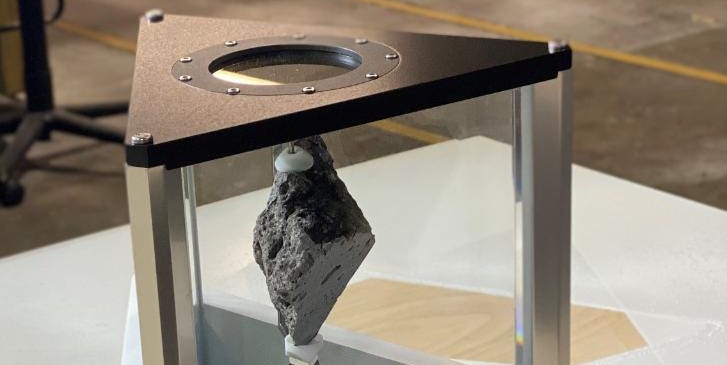
Joe Biden’s Moon rock was a small piece of a much larger lunar boulder collected during Apollo 17, the final crewed landing mission of NASA’s Apollo program. The display sample weighed about 332 grams, or a little less than three-quarters of a pound. That may sound modest until you remember it traveled roughly 240,000 miles from the Moon to Earth and had survived billions of years of micrometeorite bombardment before humans ever showed up wearing bulky white suits and excellent 1970s mission patches.
The sample was mounted in a glass and metal display case and held in place with a clamp. Its label identified it as Lunar Sample 76015,143. The number matters because NASA treats lunar material with the seriousness most people reserve for birth certificates, bank vaults, and the last slice of birthday cake. Every Apollo sample has a catalog identity, a chain of custody, and a scientific purpose.
NASA described the Biden Oval Office Moon rock as a symbol of earlier generations’ ambitions and accomplishments, as well as support for America’s Moon to Mars exploration goals. That symbolism was not subtle, but it did not need to be. A rock from another celestial body does not have to whisper. It can sit silently in a bookcase and still outshine half the room.
Where Did the Moon Rock Come From?
The story begins in the Taurus-Littrow Valley, a dramatic lunar region bordered by mountains and shaped by ancient impacts. Apollo 17 landed there in December 1972 because scientists believed the area could help answer big questions about the Moon’s geologic history. The mission was ambitious even by Apollo standards. It included the Lunar Roving Vehicle, extended surface operations, and Harrison Schmitt, the first trained geologist to walk on the Moon.
Cernan and Schmitt collected rock and soil samples during three moonwalks. Apollo 17 returned about 243 pounds of lunar material to Earth, the largest sample haul of any Apollo mission. Among that material was sample 76015, taken from a boulder near the base of the North Massif, roughly two miles from the lunar module. The piece displayed in Biden’s office, 76015,143, was a slice or subdivision of that larger parent rock.
The sample’s age is part of its magic. NASA identified it as roughly 3.9 billion years old, formed during a major impact event associated with the Imbrium Basin on the near side of the Moon. Its irregular surfaces contain tiny craters from micrometeorite impacts, while its flat sides show where NASA scientists cut the parent rock for study. It is both natural artifact and research specimen: part Moon, part laboratory record.
Why Did Biden Put a Moon Rock in the Oval Office?
The Biden administration requested the Moon rock before the president entered the Oval Office. It appeared in the room on Inauguration Day, January 20, 2021, as part of a broader redesign that emphasized history, civil rights, science, family, and national possibility. Nearby were symbols such as a portrait of Benjamin Franklin, busts of civil rights leaders, family photographs, and references to presidents Biden admired.
The Moon rock fit that theme perfectly. It represented science, exploration, and collective achievement. It also connected the office to President John F. Kennedy’s famous challenge to land a person on the Moon and return him safely to Earth before the end of the 1960s. Apollo turned that challenge into reality. Biden’s lunar display quietly asked visitors to remember that the United States can accomplish enormous things when politics, engineering, public will, and funding all briefly agree to sit at the same lunch table.
During a 2023 tour with Architectural Digest, Biden pointed out the rock and called it “pretty cool,” adding that it was literally a rock from the Moon. That plainspoken reaction may be the best possible description. You can discuss geology, symbolism, federal stewardship, and space policy for 2,000 words, but at the end of the day, yes: it is literally a rock from the Moon. Sometimes the obvious sentence is also the most astonishing one.
The Moon Rock and the Oval Office Message
Presidents decorate the Oval Office carefully because every object becomes a message. A painting behind the desk might appear in diplomatic photos. A bust might stand in the background during a national address. Even the rug can spark commentary, because in Washington, D.C., apparently no carpet is safe from interpretation.
Biden’s Moon rock sent several messages at once. First, it signaled respect for science. The Oval Office is where presidents make decisions about public health, energy, climate, education, technology, defense, and space exploration. Placing a NASA artifact in that room suggested that evidence, discovery, and long-term thinking deserved a seat near the president.
Second, it linked past and future. Apollo 17 marked the last time humans walked on the Moon. NASA’s Artemis program aims to return astronauts to lunar space and eventually prepare for Mars. The Biden Moon rock stood between those eras: collected at the close of Apollo, displayed during renewed lunar ambitions, and preserved by scientists for future generations.
Third, it offered perspective. Politics often rewards urgency, outrage, and short attention spans. A 3.9-billion-year-old Moon rock is not impressed by today’s trending topic. It has seen asteroids, solar radiation, cosmic dust, and geological deep time. Set beside the Resolute Desk, it seemed to say, “Everyone breathe. The universe is old, and your meeting can probably use fewer shouting interruptions.”
Was Biden the First President to Display a Moon Rock?
Biden was not the first president to have a Moon rock displayed in the Oval Office, but he was the first to request one for display from his first day in office. President Bill Clinton also displayed an Apollo 11 Moon rock after the 30th anniversary of the first Moon landing in 1999. Clinton later joked that the Moon rock helped calm tense political conversations because it reminded people that human disagreements look smaller beside billions of years of cosmic history.
That earlier example matters because it shows how lunar samples have functioned as more than scientific material. They are civic objects. They remind Americans that exploration is not just about astronauts, rockets, and heroic photographs. It is also about national coordination: machinists, mathematicians, seamstresses, programmers, geologists, engineers, cafeteria workers, test pilots, and taxpayers all pushing toward something absurdly difficult.
The Science Behind Lunar Sample 76015,143
Lunar samples are priceless because they can be studied repeatedly as technology improves. The Apollo astronauts brought back rocks in the late 1960s and early 1970s, but scientists are still learning from them today. Instruments now can detect details that earlier researchers could not measure with the same precision. That means an old Moon rock can still produce new science, which is the academic version of finding bonus fries at the bottom of the bag.
NASA stores and processes Apollo lunar material at the Lunar Sample Laboratory Facility at Johnson Space Center in Houston. The facility was built to protect the samples from contamination, humidity, and environmental threats. Many pristine samples are handled in cabinets filled with high-purity nitrogen gas, using special tools and strict protocols. This is not “put it on a shelf and hope for the best” storage. It is more like a lunar spa, if spas had glove boxes, vaults, and scientists with very clean instruments.
The Biden sample’s flat, cut sides show that the parent rock had been divided for research. Its rougher exterior tells another story: millions of years exposed on the lunar surface, struck by tiny particles moving at high speeds. The Moon has no thick atmosphere like Earth’s to burn up incoming debris, so its surface keeps scars that Earth often erases. Every pit and mark is part of a timeline.
How the Moon Rock Connected Apollo and Artemis
The Biden Oval Office Moon rock became especially meaningful as NASA prepared for Artemis missions. Artemis is designed to send humans back toward the Moon, including missions around the Moon and eventually landings near the lunar surface. In December 2023, Biden hosted the Artemis II crew at the White House. The astronauts saw the Moon rock on display, linking their future journey with the Apollo astronauts who had collected the sample half a century earlier.
That meeting created a beautiful loop in American space history. Apollo 17 astronauts brought home the rock in 1972. Decades later, the rock sat in the Oval Office as astronauts preparing for the next lunar era visited the president. The object was no longer just a relic of the past. It became a bridge between generations of explorers.
The Apollo program proved humans could reach the Moon. Artemis asks what comes next: longer missions, more diverse crews, better science, and preparation for deeper space exploration. The Moon rock in the Oval Office made that question visible. It transformed a shelf into a small lunar embassy.
What Happened to Biden’s Moon Rock?
The Moon rock remained in the Oval Office during Biden’s presidency. After the 2025 presidential transition, reports noted that the Apollo 17 sample was removed from the Oval Office as the room was redecorated for the new administration, with the rock expected to return to NASA. That is normal for a loaned government artifact. Biden did not own the Moon rock personally, and no president gets to slip a lunar sample into a moving box labeled “miscellaneous.”
This distinction is important. Apollo lunar samples are U.S. government property and are managed by NASA. They can be loaned for research, education, or display under controlled conditions, but they are not collectibles in the ordinary sense. You cannot buy an Apollo Moon rock legally at an estate sale, no matter how dramatic the auctioneer sounds. If someone claims they have one in a sock drawer, the safest response is curiosity, skepticism, and possibly a call to someone with a badge.
Why the Story Still Matters
The story of Joe Biden’s Moon rock matters because it compresses several American stories into one small object. It is a science story about lunar geology. It is a political story about the objects presidents choose to place around themselves. It is a space exploration story about Apollo, Artemis, and the long road from first footprints to future missions. It is also a cultural story about how physical things can carry meaning in a digital age.
In a world of screens, speeches, and endlessly refreshed feeds, the Moon rock was stubbornly real. It had weight. It had texture. It had a collection site, a mission number, an age, and a journey. It did not need Wi-Fi. It did not require a press release to be interesting. It simply sat there, quietly older than life on land, older than nations, older than every argument ever held inside the Oval Office.
Experiences and Reflections: What a Moon Rock in the Oval Office Teaches Us
There is something oddly personal about imagining a Moon rock in a room where presidents make decisions. Most people will never stand in the Oval Office, and even fewer will stand on the Moon. But the image of a lunar sample near the Resolute Desk makes both places feel connected by human effort. One is the symbolic center of American executive power. The other is a silent world of dust, craters, shadows, and impossible distance. Put them together, and you get a reminder that leadership should sometimes look beyond the next headline.
For students, the Biden Moon rock is a great doorway into science. A teacher could begin with a simple question: “How do we know how old a Moon rock is?” That opens the door to radiometric dating, impact basins, planetary formation, and the history of the solar system. A child who starts by asking why a president had a Moon rock might end up learning about geology, chemistry, engineering, and the Apollo program. That is the beauty of a good object. It invites curiosity before anyone realizes they are learning.
For writers and historians, the rock is a lesson in symbolism. Oval Office decor is never random. Biden’s Moon rock sat among objects tied to civil rights, family, science, public service, and national possibility. It told visitors that America’s past achievements should not be museum pieces only. They should push the country toward the next hard thing. The rock made ambition visible without saying a word.
For leaders, the Moon rock offers a different kind of advice. It says patience matters. Apollo did not happen because one person had a big idea on Monday and a rocket ready by Friday. It required years of investment, failure, recalculation, and teamwork. Modern problems such as climate change, public health, infrastructure, energy, and space exploration demand the same seriousness. The Moon rock is a tiny rebuke to shortcuts. Great achievements are built, tested, revised, and protected.
For ordinary readers, the most meaningful experience may be emotional. The rock reminds us that humans are capable of breathtaking cooperation. We argue, stumble, overpromise, underfund, and occasionally label the wrong office printer, but we also built machines that carried people to the Moon. We trained astronauts to collect samples in a hostile environment. We preserved those samples for generations. We placed one in the Oval Office not because it was shiny, but because it represented what collective imagination can do.
That is why Joe Biden’s Moon rock remains such a memorable Oval Office detail. It was small, dark, and quiet, but it carried an enormous story. It asked Americans to remember Apollo, support science, and think beyond immediate political weather. It also gave the nation one of the most charmingly literal presidential decor explanations ever: yes, it was a rock from the Moon. And somehow, that was more than enough.
Conclusion
Joe Biden’s Moon rock was more than a rare Oval Office decoration. It was a lunar time capsule, a NASA research sample, a symbol of American exploration, and a reminder that the best national projects require courage, patience, and teamwork. Collected during Apollo 17 in 1972 and displayed during Biden’s presidency, Lunar Sample 76015,143 connected the last human footsteps of Apollo with the renewed ambitions of Artemis. In the middle of political noise, it offered something wonderfully steady: a piece of another world, quietly telling Earth to dream bigger.