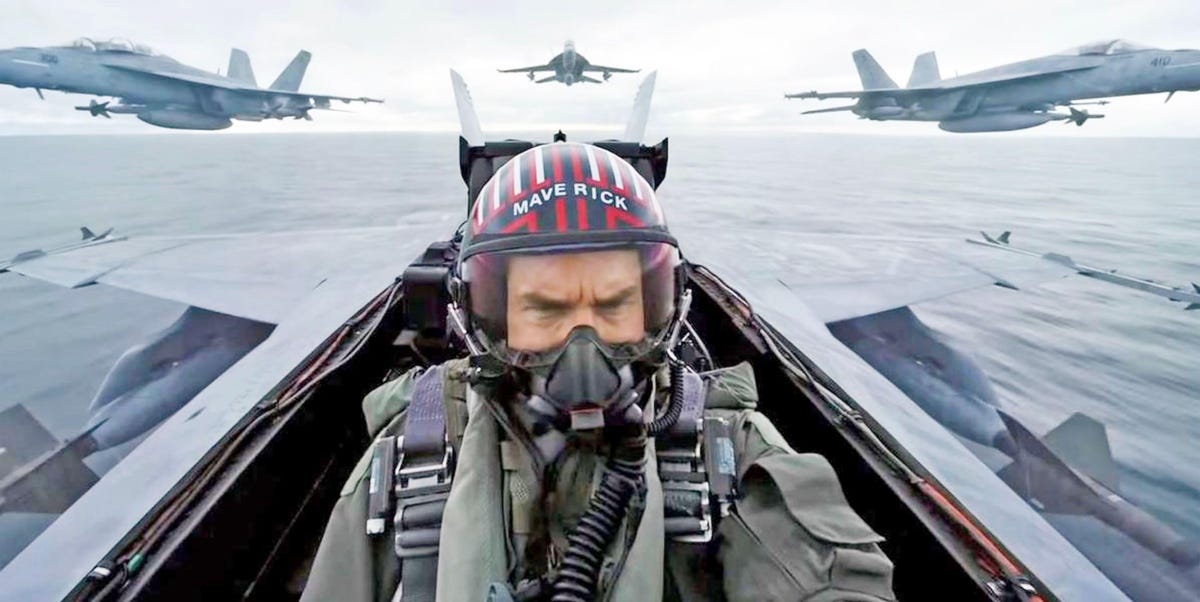
Top Gun: Maverick does not merely show fighter jets streaking across a giant screen. It places viewers inside the cockpit, tightens the harness, rattles their teeth, and politely asks their stomachs to remain seated until the ride is over.
The movie’s aerial sequences feel unusually convincing because much of the movement, acceleration, vibration, sunlight, terrain and physical strain was captured during actual flights. The actors were not piloting Navy combat aircraft, despite what an enthusiastic social media caption may claim. Professional aviators flew the jets while the performers occupied the rear seats of two-seat F/A-18F Super Hornets, delivered their lines, operated approved camera controls and endured genuine gravitational forces.
That distinction makes the production even more impressive. The filmmakers did not simply ask stunt pilots to fly aggressively. They asked elite pilots to repeat highly choreographed maneuvers safely, align them with camera positions, work within military operating limits and produce footage dramatic enough for a blockbuster. In aviation, repeating an extreme-looking maneuver for another take is slightly more complicated than asking an actor to enter the room again.
How Much of the Flying in Top Gun: Maverick Was Real?
A large portion of the aerial photography began with real aircraft, real pilots and real flight paths. Navy aerial advisor Capt. Brian Ferguson helped coordinate sequences according to the capabilities and limitations of the F/A-18 and its aircrew. When a proposed shot could not be performed within acceptable safety margins, the aviation and filmmaking teams worked together to find a safer method that still looked spectacular.
The actors were filmed during actual flights in two-seat F/A-18F Super Hornets. A qualified military pilot sat in front and controlled the aircraft, while the actor performed in the rear cockpit. Exterior scenes also used genuine aircraft flown by experienced Navy aviators. The resulting footage captured details that are notoriously difficult to imitate on a soundstage: faces distorted by acceleration, oxygen masks shifting, sunlight sliding across the canopy and the horizon rotating at a rate that makes the inner ear file an official complaint.
The Super Hornet is not a lightweight movie prop with a smoke machine attached. According to Naval Air Systems Command specifications, the F/A-18E/F can exceed Mach 1.8, operate above 50,000 feet and reach a maximum takeoff weight of 66,000 pounds. The single-seat E model carries one crew member, while the F model carries two, making the latter suitable for filming actors behind the actual pilot.
The Actors Did Not Fly the F/A-18s
Tom Cruise is an accomplished civilian pilot, but neither he nor the younger cast members were permitted to fly the Navy’s Super Hornets during production. Combat-aircraft operations require specialized qualifications, extensive training, military authorization and current proficiency that cannot be replaced by movie-star confidence, no matter how convincing the sunglasses may be.
The performers’ job was still extremely demanding. Once airborne, they had to remember dialogue, maintain character, direct their eyelines, activate cameras and manage their breathing while a professional pilot executed the planned maneuver. Cinematographer Claudio Miranda could not sit beside them adjusting a lens or asking for a slightly more heroic chin angle. The actors effectively became a miniature airborne camera department while also trying not to redecorate the cockpit with breakfast.
Why the Cast Needed a Custom Flight-Training Program
Placing an unprepared actor in a high-performance jet would have produced realistic footage, but probably not the useful kind. Motion sickness, disorientation, anxiety and exhaustion can quickly overwhelm someone who has never experienced aerobatic flight. To prevent every scene from becoming an expensive documentary about nausea, the cast completed a progressive aviation-training program.
The program began with relatively accessible Cessna 172 Skyhawks, allowing the actors to learn basic aviation concepts and become comfortable in a small aircraft. They then moved into Extra EA-300 aerobatic airplanes to build G-force tolerance before training in Aero L-39 Albatros jets. The L-39 stage helped prepare them for the speed, workload and physical sensations of a high-performance jet environment.
This gradual progression mattered because G tolerance is not developed by watching motivational videos while holding a dumbbell. The body must learn how acceleration feels, how quickly symptoms can develop and how breathing and muscle-straining techniques help maintain blood flow to the brain.
Water Survival Was Part of the Preparation
The cast also completed emergency water-egress training required for passengers flying with Navy pilots. In the exercise commonly called the “dunker,” trainees are strapped into a simulated aircraft cabin, submerged, inverted and required to escape. It teaches participants to remain oriented and follow procedures after a crash into water, where darkness, confusion and trapped air can turn a simple buckle into the world’s least entertaining puzzle.
This training was not included merely to make the behind-the-scenes documentary look intense. Flying in military aircraft involves genuine risk, even when the mission is filmmaking rather than combat. Every person in the cockpit must understand emergency signals, oxygen equipment, ejection considerations and survival procedures before takeoff.
What Seven Gs Actually Do to the Human Body
During some filming sessions, actors experienced forces reported at approximately five to seven Gs. At seven Gs, a person effectively feels seven times normal body weight in the direction of the acceleration. A 10-pound camera component can behave as though it weighs 70 pounds, which explains why the production needed compact equipment and carefully engineered mounts.
Positive G-force pushes blood away from the brain and toward the lower body. As the force increases, a person may experience reduced peripheral vision, gray-out, blackout or G-induced loss of consciousness. The Federal Aviation Administration notes that military fighters and high-performance aerobatic aircraft can expose pilots to acceleration approaching nine Gs.
Trained fighter pilots counter these effects with specialized breathing, lower-body muscle tension and anti-G equipment. Even then, high-G maneuvering is physically exhausting. It is not simply a matter of being tough. The cardiovascular system is trying to deliver blood uphill while the aircraft behaves as though gravity has received a major software update.
The cast’s visible strain therefore required very little acting. Tightened neck muscles, compressed cheeks, labored breathing and narrowed eyes were natural reactions to the maneuver. Digital effects can distort an actor’s face, but reproducing the tiny involuntary movements caused by acceleration is remarkably difficult. Reality supplied thousands of details for freealthough the Navy’s operating costs were presumably not free.
Why the Stunts Challenged Experienced Pilots Too
Real fighter pilots routinely execute demanding maneuvers, but movie flying introduces a different type of difficulty. Operational aviation emphasizes safety, tactical effectiveness, energy management and efficient aircraft positioning. Cinematic aviation must accomplish those goals while also placing the jet where the camera can see it, keeping the background visually dynamic and repeating the maneuver with enough consistency for editing.
Editor Eddie Hamilton explained that technically correct flying could sometimes look surprisingly uneventful on screen. A highly skilled pilot may hold a stable attitude and take the most efficient line, leaving the horizon almost motionless. For the movie, pilots occasionally had to adjust their presentation so the frame contained more visible energy without violating safety limits.
This meant that the aviation team was not simply performing air-combat maneuvers. It was translating those maneuvers into visual language. The audience needed to understand who was pursuing whom, where the threat was coming from and how close the aircraft were to terrainall while the jets covered enormous distances in seconds.
Low-Level Flight Leaves Almost No Room for Casual Decisions
The fictional mission requires pilots to fly through mountainous terrain at extremely low altitude. Real low-level flying demands constant attention to airspeed, terrain, obstacles, aircraft energy and escape routes. At fighter-jet speeds, a small navigation error can become a large geographical problem before anyone has time to say, “Let’s circle back.”
Some of the film’s desert-floor footage was achieved with real low-altitude flying performed by highly qualified pilots. Miranda described how an experienced former Blue Angels aviator executed exceptionally low passes for one of Maverick’s demonstration sequences. The bending wings, changing shadows and dust response visible in such shots came from real aerodynamic loads and real proximity to the landscape.
However, the most dangerous-looking moments were not created by abandoning regulations. The Navy and production team established operating boundaries, reviewed routes, coordinated airspace and rejected ideas that could not be performed safely. The objective was controlled precision, not airborne improvisation.
Six Cameras Inside a Fighter-Jet Cockpit
Traditional cinema cameras are not designed to fit beside an ejection seat, survive repeated high-G maneuvers and remain clear of every critical control. The production therefore developed a compact six-camera arrangement using Sony VENICE cameras and extension systems. Multiple angles could capture the actor’s face, forward view, pilot perspective and surrounding cockpit during a single flight.
Every mount had to be secure under acceleration and positioned so it would not interfere with flight controls, visibility or the ejection path. The equipment also had to endure vibration, changing temperature and intense sunlight. A loose accessory inside a maneuvering fighter jet is not merely inconvenient. It can become a high-speed object with ambitions.
Because there was no conventional live video feed from each cockpit, much of the visual preparation happened before takeoff. Miranda studied weather, terrain and the angle of the sun, then selected exposure settings in advance. Actors sometimes flew for roughly 90 minutes and were responsible for starting the cameras at the correct moment. The production team often had to wait until the aircraft returned before learning whether the footage worked.
That delay changed the filmmaking process. On a normal set, a director can review a take immediately and request a small adjustment. In the air, another take required another briefing, another aircraft launch, another fuel plan and another carefully coordinated maneuver.
Real Flying Did Not Mean Zero Visual Effects
The film’s marketing often emphasized practical aerial photography, but visual effects still played a major role. The achievement was not the absence of CGI. It was the use of real flight footage as a physical foundation for digital work.
The production could not fly operational F-14 Tomcats or foreign fifth-generation fighters for the final dogfight. Instead, available aircraft such as F/A-18s and L-39s were filmed performing real trajectories. Visual-effects artists then replaced or “re-skinned” those aircraft digitally while preserving the original camera motion, lighting, vapor, speed and aerodynamic behavior.
This hybrid approach explains why the computerized aircraft still feel heavy and believable. They inherit the movement of real machines flying through real air. Artists could enhance the aircraft type, cockpit, weapons, explosions and environment without inventing every physical cue from scratch.
The fictional Darkstar hypersonic aircraft followed a similar philosophy. Designers from Lockheed Martin’s Skunk Works collaborated on its appearance, giving the movie’s Mach 10 test vehicle the visual logic of a plausible aerospace concept rather than the shape of a kitchen appliance with wings. The sequence remains fictional, but its design language is connected to real high-speed aircraft engineering.
How Closely Does the Movie Reflect the Real TOPGUN?
The real TOPGUN program is less interested in dramatic rivalries and more interested in study, instruction, mission planning and brutally detailed debriefing. Students and instructors review flight decisions turn by turn, examining what happened and why. The culture values confidence, but it also values humility because graduates are expected to return to their units and teach others.
The movie compresses procedures, exaggerates personality conflicts and creates a mission designed for maximum cinematic tension. Nevertheless, its emphasis on preparation, teamwork, communication and disciplined execution reflects genuine fighter-aviation principles.
The most realistic quality may not be a particular maneuver. It may be the idea that elite performance comes from repetition, honest debriefing and trust. Real pilots do not survive difficult missions because a soundtrack begins playing at exactly the right moment. They survive because countless unglamorous hours have already taught them what to do when the glamorous moment arrives.
Experiencing Top Gun: Maverick’s Aerial Stunts From the Audience’s Perspective
Watching Top Gun: Maverick in a large theater creates a curious physical illusion. You remain safely planted in a padded chair, possibly holding a container of popcorn large enough to supply a small carrier group, yet your body responds to the moving horizon as though it has entered the turn.
During the canyon sequences, the camera does not float above the aircraft like an all-knowing observer. It stays close to the cockpit, wing or pursuing jet. Mountains rush toward the frame, the horizon tilts and sunlight flashes across the canopy. The visual system reports rapid movement while the inner ear reports that the viewer is sitting still. That disagreement can create a faint sensation of motion, especially on an enormous screen.
The experience becomes more convincing because the actors’ bodies respond before the dialogue explains anything. A performer’s face tightens as the aircraft pulls upward. Shoulders sink into the seat. Breathing becomes deliberate. The audience recognizes physical effort without needing a technical lecture about acceleration.
There is also a noticeable difference between footage captured from real aircraft and a completely digital flight sequence. Real aerial photography contains tiny imperfections: changing haze, unexpected reflections, vibration, atmospheric shimmer and slight variations in aircraft position. These details prevent the image from feeling too clean. The sky is not a digital wallpaper, and the mountains do not politely remain at a convenient distance.
For aviation enthusiasts, the experience offers another layer of enjoyment. They can watch control inputs, wing loading, vapor formation, formation spacing and the different behavior of aircraft during a turn. Some story elements remain exaggerated, but the underlying movement often feels familiar because it originates in genuine flight.
For viewers with no technical aviation knowledge, the stunts communicate through simple physical ideas. Speed is shown by terrain rushing past. G-force is shown by faces and posture. Risk is shown by shrinking clearance. Teamwork is shown through radio calls and coordinated positioning. The audience does not need to calculate turn radius or energy state to understand that the characters are operating near their limits.
The movie also creates a new appreciation for the pilots outside the frame. A spectator sees the actor appearing to control the jet, but a real aviator in the forward seat is managing the aircraft, safety margins, route, communication and timing. That pilot must deliver a maneuver exciting enough for Hollywood while remaining disciplined enough for naval aviation.
Imagine driving a high-performance car through a closed course while a passenger acts out an emotional scene, operates several cameras and occasionally requests another take because the sunlight was not sufficiently heroic. Now increase the speed, remove the road, add several Gs and place the entire operation thousands of feet above the nearest coffee shop. That begins to describe the production challenge.
The behind-the-scenes knowledge does not weaken the illusion. It strengthens it. Understanding that professional pilots, engineers, cinematographers, actors, military coordinators and visual-effects artists all contributed makes each sequence more impressive. The stunts are not reckless miracles captured by accident. They are the result of planning so detailed that spontaneity can appear on screen without actually governing the flight.
That may be the film’s greatest experiential achievement. It lets viewers feel the chaos of high-speed aviation while revealing, beneath the noise, an extraordinary level of control.
Conclusion: The Real Limit Was Coordination
Top Gun: Maverick pushed aerial filmmaking forward because it treated real aviation as more than background footage. The production placed trained actors in working fighter jets, exposed them to genuine acceleration, installed specialized cameras and asked elite pilots to transform precise flying into readable cinematic action.
The movie did not prove that actors can become combat aviators after a few months of training. It demonstrated something more credible: when pilots, engineers, performers and filmmakers understand one another’s limitations, they can create scenes that feel far more dangerous than the production is willing to become.
The real pilots pushed their skills toward carefully defined boundaries. The actors pushed their physical tolerance. The camera team pushed equipment into an environment where every pound became several pounds. Visual-effects artists extended what could not be filmed without erasing the physics captured in the air.
That combination is why the stunts remain so memorable. The audience is watching Hollywood spectacle, but beneath it lies something stubbornly authentic: real machines, real acceleration and highly trained people doing difficult work with no room for casual mistakes.
Editor’s note: The actors performed inside real F/A-18F aircraft, but qualified Navy pilots controlled the jets. Digital effects were used to enhance, combine or replace aircraft when practical filming was impossible.