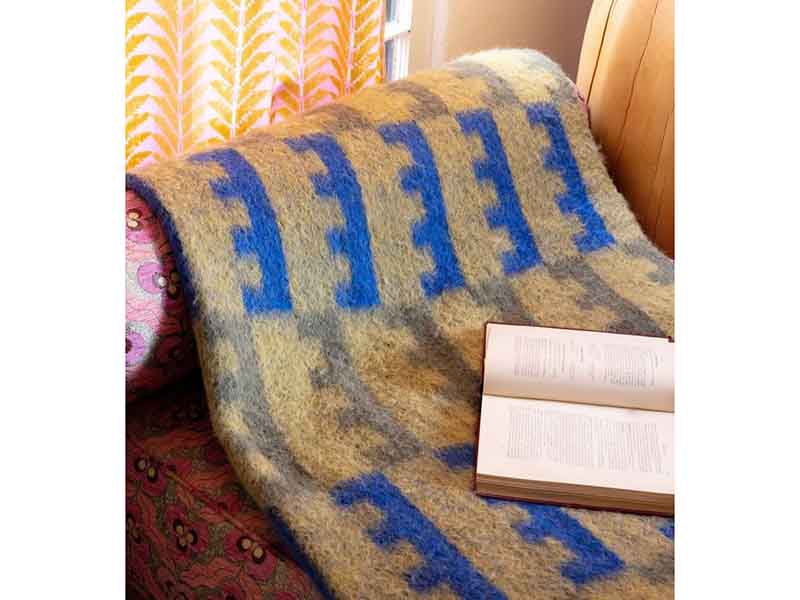
Some blankets politely wait at the end of the sofa. The Blue & Green Music Throw does not.
It arrives with sweeping color, gallery-scale geometry, and the quiet confidence of an object
that knows it will be photographed. Inspired by Georgia O’Keeffe’s abstract painting
Blue and Green Music, this alpaca-blend throw from Block Shop Textiles translates the
movement of a modernist canvas into something soft enough to curl up beneath.
That combination is what makes the throw interesting. It is not simply a warm blanket with a
fashionable pattern pasted on top. Its colors, construction, proportions, and reversible
jacquard weave allow it to function as bedding, an oversized sofa accent, a textile wall
feature, or a dramatic layer in an otherwise quiet room. In other words, it does more than
prevent cold feetalthough it appears perfectly qualified for that essential assignment.
What Is the Blue & Green Music Throw?
The Blue & Green Music Throw is a decorative alpaca wool-blend blanket designed by
Los Angeles-based Block Shop Textiles. According to the maker, it is woven in a family-run
mill in Prato, Italy, a city with a long association with textile manufacturing. The throw
measures approximately 57 by 98 inches, features a reversible design, and uses jacquard
construction to build the pattern directly into the textile.
At the time of research, the throw was listed for $385. That places it firmly in the
investment-textile category rather than the “grab three while buying paper towels” category.
The price reflects its substantial dimensions, specialized weaving, Italian production, and
alpaca-blend material. Whether those qualities justify the cost will depend on how much you
value textile design, natural fibers, and a blanket capable of acting like a portable piece
of modern art.
Key Product Details
- Approximately 57 by 98 inches
- Alpaca wool-blend construction
- Reversible geometric design
- Jacquard woven rather than surface printed
- Made in Prato, Italy
- Dry clean only
- Inspired by Georgia O’Keeffe’s Blue and Green Music
Product research:
From Georgia O’Keeffe’s Canvas to a Woven Textile
Georgia O’Keeffe created Blue and Green Music</em between 1919 and 1921, during a period
when she was exploring how musical sensations might be expressed visually. Instead of
painting an orchestra, a piano, or an extremely serious-looking person holding a violin,
O’Keeffe used color and abstract form to suggest rhythm, harmony, volume, and movement.
The painting combines deep greens, layered blues, dark contours, and pale central shapes.
Its forms can resemble unfolding leaves, rolling sound waves, stage curtains, or light
moving through a shadowed landscape. The ambiguity is part of its power. Viewers do not need
to identify a specific object; they are invited to experience the composition much as they
might experience a piece of instrumental music.
Block Shop’s throw does not attempt to reproduce the painting pixel by pixel. Instead, it
borrows the artwork’s visual harmony and reorganizes it for the logic of weaving. Broad
shapes become crisp geometric fields. Curves and tonal shifts are translated into blocks of
blue, green, black, cream, and related shades. The result feels connected to the painting
without turning the blanket into museum-shop merchandise with a rectangular image stamped
across the middle.
This approach is important because a textile has different demands than a canvas. It folds,
drapes, wrinkles, and moves around a room. Only part of the pattern may be visible at any
moment. A successful design must remain expressive whether the throw is spread flat across
a bed or casually collapsed over a chair after someone stood up to investigate the snack
situation.
Artistic context:
Why the Jacquard Weave Matters
In a printed blanket, color and imagery are applied to the surface of an existing fabric.
Jacquard weaving takes a different route. Individual yarns are controlled during the weaving
process so that the pattern becomes part of the textile’s structure. This technique can
create intricate images, strong color relationships, and different effects on the front and
back.
The technology is named after Joseph-Marie Jacquard, whose early-19th-century loom system
made it possible to automate complicated woven patterns. Contemporary jacquard equipment is
far more advanced, but the central idea remains: the design is constructed through the
interlacing of yarns rather than merely added afterward.
On the Blue & Green Music Throw, that construction supports its reversible appearance.
Flipping the blanket can reveal a shifted balance of light and dark, giving the owner two
related compositions instead of one fixed front. This is especially useful in interior
design, where reversing the throw can make it feel bolder, quieter, lighter, or more
graphic without purchasing another blanketor explaining a second $385 charge.
Weaving research:
Color That Behaves Like Music
Blue and green sit close together on the color wheel, so they usually create a more harmonious
relationship than strongly contrasting pairs. Yet harmony does not have to mean timid. Deep
navy, saturated teal, leafy green, and black can produce plenty of visual drama, particularly
when they are interrupted by areas of pale cream or icy blue.
The palette also makes the throw surprisingly adaptable. Blue can connect with navy
upholstery, painted cabinetry, ceramic lamps, or cool gray walls. Green can echo houseplants,
landscape views, velvet pillows, or natural stone. Cream sections can relate to linen,
plaster, pale rugs, and neutral bedding. Dark outlines give the softer colors definition and
prevent the composition from drifting into spa-waiting-room territory.
Rooms Where the Palette Works Especially Well
In a neutral living room, the throw can become the primary source of color. Place it on a
cream, tan, oatmeal, or light gray sofa and allow a generous portion of the pattern to remain
visible. Because the blanket is long, a relaxed vertical drape over the back and seat can
look more intentional than a tiny folded rectangle balanced nervously on one arm.
In a bedroom, it can lie across the lower third of a bed, where the graphic pattern contrasts
with plain white or natural linen bedding. Dark wood, walnut, oak, brass, and warm leather can
keep the blue-green palette from feeling too cool. A rust-colored pillow or ocher lamp adds a
small complementary accent without trying to outsing the main performer.
The throw can also work in an already colorful room. Pairing it with burgundy, mustard,
terracotta, or dusty pink creates a layered, collected look. The secret is repetition:
echo one or two of the blanket’s colors elsewhere in the room so it appears connected rather
than looking as though it wandered in from a stylish neighboring apartment.
Interior color research:
Comfort, Scale, and Everyday Use
Alpaca fiber is valued in luxury textiles for its softness, warmth, and smooth hand. Because
the Blue & Green Music Throw is described as an alpaca wool blend rather than pure alpaca,
its precise feel will also depend on the other fibers and their proportions. The manufacturer
describes it as substantial yet cloud-like, suggesting a blanket with more body than a thin
decorative wrap.
Its approximately 98-inch length is notably generous for a throw. Many decorative sofa
blankets are considerably shorter and provide excellent coverage for one person’s knees
while leaving the rest of the body to negotiate independently. This design offers enough
length for reclining, layering across a bed, or sharingprovided both people respect
international blanket-border agreements.
The scale also strengthens its decorative impact. Large shapes need room to develop. On a
smaller textile, the O’Keeffe-inspired geometry could become busy or fragmented. Here, the
pattern can stretch across furniture and create broad areas of color that read from across
the room.
How to Style the Blue & Green Music Throw
1. Use It as the Room’s Main Artwork
Keep surrounding furniture simple and let the throw supply the movement. A low-profile sofa,
plain rug, sculptural floor lamp, and one or two solid pillows are enough. This works well for
renters who want a strong visual statement without painting walls or hanging something heavy.
2. Create a Layered Modernist Bedroom
Combine crisp white sheets, a natural linen duvet, and the throw at the foot of the bed.
Add a rounded lamp, abstract print, or curved chair to repeat the pattern’s flowing forms.
The result can feel artistic without resembling a themed hotel suite called “The O’Keeffe
Experience.”
3. Pair It with Warm Natural Materials
Blue and green can become visually chilly when surrounded exclusively by gray and chrome.
Warm them with oak, walnut, rattan, aged brass, leather, clay pottery, or woven baskets.
These materials also reinforce the tactile quality of the alpaca-blend fabric.
4. Display It on a Blanket Ladder
A ladder or wall-mounted textile rail can show more of the composition while keeping the
throw accessible. Avoid prolonged direct sunlight, which may gradually affect rich colors.
Rotate the folds occasionally so the same area is not constantly compressed or exposed.
5. Reverse It When the Room Needs a Change
Use the side with stronger contrast during fall and winter, then switch to the visually
lighter side in spring. It is not a complete renovation, but it is considerably easier than
moving a wall.
Care and Maintenance
Block Shop specifies dry cleaning only for the Blue & Green Music Throw. That instruction
should be taken literally. Natural-fiber blends and woven structures may react to water,
agitation, heat, or unsuitable detergent with shrinkage, distortion, felting, or color
changes. A home washing experiment could become an exciting afternoon followed by an
expensive lesson in textile physics.
For routine maintenance, shake the blanket gently outdoors, use a soft garment brush when
appropriate, and address dry debris before it settles deeply into the weave. Keep food,
red wine, oily cosmetics, and enthusiastic pets in reasonable check. Small spills should be
blotted rather than rubbed, but professional guidance is safest because even spot treatment
can create rings or alter the texture.
When storing the throw, make sure it is clean and completely dry. Fold it loosely, place it
in a breathable cotton storage bag, and keep it away from moisture and pests. Avoid
long-term storage in airtight plastic, particularly in spaces with changing humidity.
Always retain and follow the original care label.
Care research:
Is the Blue & Green Music Throw Worth the Price?
Value depends on the job you expect the throw to perform. Someone seeking a washable blanket
for muddy dogs, camping trips, and popcorn-heavy movie nights can find more practical
choices at a fraction of the price. This piece requires professional cleaning and a certain
amount of household diplomacy.
Its argument becomes stronger when viewed as both textile and artwork. It offers large-scale
color, reversible jacquard construction, Italian manufacturing, an alpaca-blend hand, and a
recognizable connection to an important American modernist painting. A framed print, large
decorative object, or designer pillow collection could easily cost a similar amount while
providing no warmth whatsoever.
Before buying, shoppers should still ask practical questions. Does the room need color?
Will the long dimensions fit the intended sofa or bed? Is dry cleaning acceptable? Does the
household include children or pets who regard expensive textiles as performance spaces?
Finally, buyers interested in sourcing should request current information about fiber
percentages, traceability, and any applicable animal-welfare or environmental standards.
Responsible alpaca frameworks exist, but a consumer should not assume certification unless
the seller specifically documents it.
Materials research:
Experiences with the Blue & Green Music Throw
Because comfort and styling are experiential, specifications tell only part of the story.
The following scenes illustrate what living with a large, colorful, art-inspired throw may
feel like in an everyday home.
The First Unfolding
The first surprise is likely to be the scale. A 98-inch throw keeps unfolding long after a
standard decorative blanket would have finished introducing itself. Spread across a sofa,
the design shifts from a neatly packaged object into a broad composition. The blues appear
deeper, the green areas become more architectural, and the pale shapes create pauses between
darker passages. It begins to make sense as “music”: there are strong notes, quieter spaces,
and a rhythm that changes as the fabric bends.
Reversing it produces a second small revelation. The alternative side does not feel like a
totally different design, but the balance changes enough to influence the room. One side may
emphasize depth and drama; the other may feel softer or more graphic. That flexibility makes
the blanket enjoyable for people who rearrange their homes whenever they feel restless,
which is sometimes every six to eight business days.
A Quiet Morning on the Sofa
On a cool morning, the length becomes practical rather than merely impressive. It can cover
the legs, torso, and shoulders without requiring advanced blanket origami. The substantial
weave provides a cocooning sensation, while the smoother alpaca character keeps the textile
from feeling like a bulky camping blanket.
Visually, the experience is unusually engaging. Most blankets disappear from awareness once
they are in use. Here, sections of blue and green remain visible around the body, making a
simple cup of coffee feel suspiciously like a lifestyle photograph. The effect is luxurious,
but not necessarily formal. The geometry has energy and humor; it does not demand that anyone
sit perfectly upright.
Using It During a Music Night
The O’Keeffe connection becomes especially enjoyable when music is playing. Instrumental
jazz, ambient music, classical strings, or experimental electronic tracks can change how the
pattern is perceived. Slow music makes the curved forms appear calm and spacious. Faster
rhythms make the angles and color transitions seem more animated.
This does not require mystical powers. People naturally form associations between sound,
shape, movement, and color. Knowing that O’Keeffe explored music as something that could be
made visible simply gives the eye a useful prompt. The throw becomes a conversation piece
without needing to shout, “Please notice that I know about modernism.”
Hosting Guests
When guests arrive, the blanket can make an otherwise restrained room feel finished. Draped
over a sofa, it creates an immediate focal point and gives people something to ask about.
Its origin story is concise enough for casual conversation: an alpaca-blend jacquard throw,
woven in Italy and inspired by an O’Keeffe painting that translates music into visual form.
That is far more interesting than explaining where the remote controls are stored.
The practical challenge is deciding whether guests may actually use it. A beautiful throw
should not become an untouchable shrine, yet tomato-based appetizers introduce legitimate
concerns. A sensible approach is to use the blanket freely during ordinary evenings and
relocate it temporarily when the menu includes staining liquids, melting chocolate, or
children carrying uncapped markers.
Living with It Over Time
The most satisfying long-term experience may be its ability to migrate. It can begin on the
living-room sofa, move to the bed in winter, hang on a ladder during warmer months, and return
to an armchair when the room needs color. Reversibility increases those options, while the
generous proportions keep the throw visually substantial in each location.
Over time, care becomes part of ownership. The blanket encourages more deliberate habits:
folding rather than crushing, brushing away debris, managing direct sunlight, and scheduling
professional cleaning when necessary. Those habits may seem demanding compared with tossing
a polyester fleece into the washer, but they also reinforce the idea that this is a
long-term textile rather than disposable seasonal decor.
Conclusion
The Blue & Green Music Throw succeeds because its artistic reference, construction, and
practical function support one another. Georgia O’Keeffe’s exploration of visual music gives
the design conceptual depth, while the reversible jacquard weave transforms that inspiration
into a pattern suited to movement and daily use. The alpaca wool blend and generous dimensions
add warmth and presence, making the throw equally useful as a cozy layer and a room-defining
decorative object.
It is not the ideal blanket for every household. The price is significant, professional
cleaning adds responsibility, and the strong pattern will not disappear quietly into the
background. For buyers who appreciate modern art, expressive color, tactile natural fibers,
and objects that can change the personality of a room, however, it offers something rare:
a functional textile that feels composed rather than merely decorated.
Note: Product price, availability, fiber details, and seller policies may
change after publication. Confirm current specifications and follow the attached care label
before cleaning.