Beauty packaging has traditionally followed a glamorous but rather wasteful script: make the container shiny, wrap it in another container, place that inside a box, and hope nobody asks where everything goes after the last swipe of lipstick. Axiology decided that script needed a rewrite.
The vegan beauty brand founded by Ericka Rodriguez transforms discarded paper collected around Bali into distinctive makeup packaging. Hotels, offices, and schools provide part of the paper waste, which is processed by hand through a women-run local business before being folded and stamped into colorful boxes. Instead of looking recycled in the unfortunate “mushy egg carton” sense, the finished packaging feels textured, artistic, and intentionally luxurious.
That combinationethical formulas, practical makeup, striking design, and a waste-reduction storyis what makes Axiology more interesting than a brand that simply trades a plastic lid for a brown cardboard one. Its packaging is not decorative sustainability sprinkled on top. It reflects the values that shaped the company from its beginning.
How Axiology Began With One Very Dry Vegan Lipstick
Before launching Axiology in 2014, Rodriguez was already an animal advocate. She began searching for vegan cosmetics after learning more about animal testing in the beauty industry. The available vegan lipstick she tried, however, was so dry that it cracked and broke during application. Most people would have complained, tossed it into a drawer, and returned to buying the usual formula. Rodriguez decided to learn how to make lipstick.
She studied tutorials, visited libraries, researched ingredients, and experimented with early formulas. She did not arrive with decades of cosmetic chemistry experience or a corporate product-development department. She arrived with curiosity, determination, and apparently a high tolerance for kitchen experiments.
The brand name was equally deliberate. “Axiology” refers to the philosophical study of value, often connecting ethics with aesthetics. That definition neatly captures the company’s proposition: makeup should look beautiful, but the way it is made should matter too.
Rodriguez launched the company at age 26 and gradually developed a range of plant-based products, including lip colors, multi-use makeup crayons, complexion products, and balms. Axiology now describes its products as handcrafted in its own laboratory in Bend, Oregon, while its Balinese packaging partnership remains a central part of the brand’s identity.
How Bali’s Paper Trash Becomes Beauty Packaging
Rodriguez encountered Bali’s waste challenges while living on the Indonesian island. In communities without consistent access to formal collection and disposal services, unwanted materials may be burned, dumped, or allowed to enter waterways. Although Bali is internationally promoted through images of beaches, temples, and lush rice terraces, waste management remains a serious issue behind the vacation photography.
Indonesia has introduced national programs to reduce marine debris, but research has repeatedly identified gaps in collection services and disposal infrastructure. These gaps make locally operated recovery projects especially valuable because they intercept usable materials before they are burned, dumped, or washed toward the ocean.
Step 1: Collecting Discarded Paper
The Balinese packaging partner gathers used paper from locations around the island, including offices, hotels, and schools. This is ordinary material that might otherwise be treated as worthless: documents, worksheets, discarded stationery, and other paper scraps that have reached the end of their original purpose.
Upcycling changes the question from “How do we throw this away?” to “What else can this become?” In this case, yesterday’s office paper can eventually hold tomorrow’s cheek color. That is a considerably better career change than most paperwork receives.
Step 2: Turning Waste Into Handmade Sheets
The collected material is sorted and processed using traditional papermaking methods. The fibers are broken down, formed into new sheets, and dried. Because the work is done by hand rather than on a massive automated packaging line, the finished paper retains subtle variations in texture and appearance.
Those differences are not defects. They are visual proof that the material has a history. Slightly visible fibers and irregularities give each package the character of handmade stationery rather than a mass-produced plastic shell.
Step 3: Folding and Stamping the Boxes
Once the paper is ready, it is shaped into Axiology’s outer packaging and stamped with the brand’s graphics. Earlier lipstick boxes became known for their sculptural, folded form, while products such as Lip-to-Lid Balmies use playful packaging that makes the makeup resemble a set of art crayons.
The result is chic without pretending to be made from something it is not. The boxes still look like paper. They simply demonstrate that recycled paper can be colorful, expressive, and worthy of a beauty counter.
Step 4: Supporting Women’s Employment
The partnership also provides stable work and fair wages for Balinese women. That social dimension matters because environmental projects can become strangely incomplete when they celebrate rescued material but ignore the people doing the rescuing.
Axiology could purchase standardized packaging more cheaply from a conventional supplier. Working with a small producer across the world introduces additional logistics, costs, and quality-control challenges. The brand continues the partnership because it connects waste recovery with economic opportunity rather than treating sustainability as a material-selection exercise alone.
Plastic-Free Design Goes Beyond the Outer Box
Recycled paper packaging would mean less if it merely concealed an elaborate plastic tube. Axiology therefore redesigned its products to reduce or eliminate the components commonly found in conventional cosmetics.
The brand acknowledges that its earlier lipstick tubes included post-consumer recycled plastic. Although that was an improvement over using entirely virgin material, the tubes would still eventually become waste. In 2022, Axiology says it moved away from plastic and concentrated on paper-wrapped, low-waste formats.
Lip-to-Lid Balmies
Balmies are compact makeup crayons designed for the eyes, lips, and cheeks. They contain approximately the same amount of product as a conventional lipstick but skip the familiar twist-up tube. As the crayon becomes shorter, the paper can be peeled back gradually.
One product performing three jobs also reduces the number of separate compacts and tubes a customer may feel compelled to buy. It is makeup for anyone who would prefer not to carry a small hardware store in a cosmetic bag.
Multi-Sticks and Color Products
Axiology’s larger multi-use sticks offer cream color for areas such as the cheeks, lips, and eyes. The format encourages customers to experiment rather than follow rigid labels. A rosy shade can be blush on Monday, lip color on Tuesday, and the emergency solution to an overpacked travel bag on Wednesday.
Fungdation
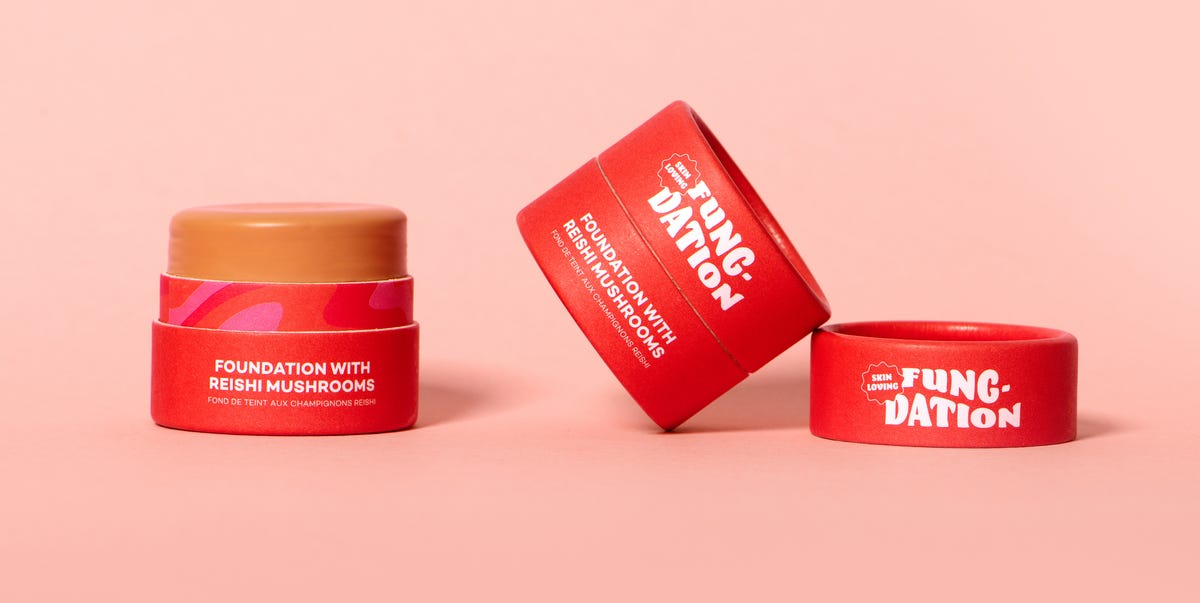
The brand has also expanded into complexion makeup with Fungdation, a buildable foundation made with ingredients that include reishi and snow mushrooms. It is marketed as a lightweight, sheer-to-medium coverage formula with a satin finish and comes in a paper-based, biodegradable tube rather than a standard plastic bottle with a pump.
Independent beauty coverage has praised Axiology’s multi-use products for being practical as well as environmentally ambitious. That distinction is important. A sustainable product that performs poorly is unlikely to remain in anyone’s routine, no matter how noble its box may be.
What Makes the Makeup Vegan?
“Vegan” and “cruelty-free” are frequently placed side by side, but they describe different things. Vegan makeup contains no animal-derived ingredients. Cruelty-free makeup concerns animal testing during product development and manufacturing.
A product can be cruelty-free while containing beeswax or lanolin. A vegan formula can also come from a company whose broader testing policies do not meet independent cruelty-free standards. Axiology addresses both areas: the brand is listed by PETA as cruelty-free and says its full range contains no animal-derived ingredients.
Its formulas exclude several materials that commonly appear in color cosmetics:
- Beeswax: A common structuring ingredient in lip products.
- Lanolin: A waxy substance derived from sheep’s wool.
- Carmine: A red pigment produced from cochineal insects.
- Palm oil and palm-derived ingredients: Avoided by Axiology because of concerns about deforestation and wildlife habitat.
- Added fragrance: The brand says its main color products are fragrance-free.
Balmies are made with a short list of nine naturally derived ingredients, including botanical oils, waxes, butters, and pigments. The minimalist formula helps the company communicate what is inside each product without handing customers an ingredient list long enough to qualify as airport reading.
Third-party verification is useful here. The U.S. Food and Drug Administration notes that terms such as “cruelty-free” and “not tested on animals” do not have standardized legal definitions for cosmetics. A recognizable certification or searchable company listing gives shoppers more information than an unsupported bunny illustration printed on a carton.
Why Beauty Packaging Needs a Makeover
Cosmetics are unusually difficult to package sustainably. A container must protect delicate formulas, prevent contamination, survive transportation, fit comfortably in the hand, and sometimes dispense tiny amounts with precision. Brands often achieve those goals by combining plastic, metal, mirrors, magnets, adhesives, pumps, and decorative coatings in a single item.
That engineering may create an excellent compact but a terrible recycling candidate. Small components can fall through sorting equipment, while mixed materials may be difficult or uneconomical to separate. Residual creams and oils complicate the process further.
The broader packaging problem extends far beyond beauty. U.S. Environmental Protection Agency data show that containers and packaging represent a major portion of municipal waste, with tens of millions of tons sent to landfills. Plastic packaging is particularly persistent because it is generally discarded much faster than it breaks down.
Research on ocean pollution also shows that no single cleanup project or recycled-material program can solve the problem. Progress requires reducing unnecessary packaging, improving collection, designing products for practical end-of-life systems, expanding reuse, and preventing leakage into waterways in the first place. Axiology’s approach addresses one piece of that larger puzzle by eliminating components rather than merely asking consumers to recycle a complicated container.
Why the Packaging Looks Chic Instead of Cheap
Sustainable design once seemed trapped in a beige phase. If an item was environmentally responsible, its package apparently had to resemble a sack of organic oats. Axiology rejects that false choice.
The packaging is bright, sculptural, and playful. Its tactile surface invites customers to touch it, while its visible fibers connect the polished finished product to the discarded paper from which it began. This makes sustainability part of the visual identity rather than a paragraph hidden beneath the ingredients.
That matters because packaging communicates before a customer ever tests the formula. A beautiful low-waste product challenges the assumption that environmental compromise is the entry fee for luxury. It also turns the package into a quiet educational tool. Someone who picks up a Balmie box because it looks charming may leave knowing more about paper recovery, plastic-free cosmetics, and women-led production in Bali.
A Thoughtful Model, Not a Magical Zero-Impact Product
No cosmetic product is entirely impact-free. Paper requires water and energy to process. Ingredients must be grown, mined, manufactured, and transported. Finished goods travel between suppliers, warehouses, retailers, and customers. Even recyclable packaging may become trash when local facilities cannot accept it or when people place it in the wrong bin.
Axiology’s Bali partnership should therefore be viewed as a meaningful improvement, not a spell that makes environmental consequences disappear in a puff of mushroom-infused foundation.
This distinction protects consumers from greenwashing. The Federal Trade Commission advises companies to avoid vague, unqualified environmental claims and to explain terms such as “recyclable,” “degradable,” and “compostable” accurately. Responsible brands should identify what material is used, how it should be handled, and which parts of a product a claim actually covers.
Axiology’s strongest message is specific: its boxes use paper waste collected around Bali, the packaging is handmade through a women-run operation, and the brand’s current makeup formats avoid conventional plastic tubes and compacts. Specificity is far more useful than simply announcing that something is “green,” a word that can otherwise mean everything from independently verified progress to “we printed a leaf on it.”
How to Shop for Sustainable Makeup More Critically
Axiology provides a useful framework for evaluating other eco-friendly beauty brands. Before being persuaded by a forest-colored label, shoppers can ask several practical questions.
Is the Packaging Actually Simpler?
Look for containers made from one or two easily separated materials. Packaging-free bars, paper tubes, refillable metal cases, and mono-material bottles may offer clearer disposal options than compacts built from six permanently bonded components.
Does the Product Serve More Than One Purpose?
A multi-use tint can replace separate lipstick, blush, and eyeshadow purchases. Buying fewer products is often more effective than buying a crowded shelf of items marketed as sustainable.
Are the Claims Specific and Verifiable?
“Made with recycled material” is more informative when the brand identifies the material and percentage. “Cruelty-free” is more reassuring when supported by a recognized third party. “Recyclable” should come with realistic disposal directions.
Will You Use the Product Completely?
The lowest-waste lipstick is the one that gets finished. A product that does not suit your skin, coloring, or routine may become expensive clutter regardless of its compostable credentials.
A Realistic Experience With Paper-Wrapped, Multi-Use Makeup
The experience of using plastic-free makeup differs slightly from opening a conventional lipstick, and that difference is part of its appeal. Based on Axiology’s product design and published product testing, here is what a shopper can reasonably expect.
The Unboxing Feels Handmade
The first noticeable feature is the paper itself. It does not have the perfectly smooth, laminated surface of a luxury plastic carton. Fine fibers and subtle variations may be visible, making the box feel closer to handmade stationery. The effect is polished but not sterile.
There is also less packaging theater. You are not likely to encounter a molded plastic tray, decorative insert, secondary sleeve, and mysterious scrap of foam protecting a product that was already perfectly safe. The box performs its job and then politely leaves the stage.
Application Requires a Small Adjustment
A paper-wrapped Balmie does not twist upward with a click. The exposed end is applied directly, and the wrapper is peeled back as the product wears down. During the first few uses, the format may feel closer to using an artist’s pastel than a traditional lipstick.
Body heat helps cream color glide across the skin. A quick swipe can be blended with fingers, a sponge, or a brush. On the cheeks, starting with a small amount is wise because concentrated pigment tends to travel farther than expected. Nobody plans to resemble an enthusiastic raspberry, yet makeup occasionally has ideas of its own.
For the lips, direct application creates stronger color, while tapping the formula with a fingertip produces a softer stain. On the eyelids, a light layer can work as a wash of color, although people with oily lids may prefer primer or setting powder.
The Multi-Use Format Simplifies a Routine
The strongest practical advantage appears during rushed mornings and travel. One crayon can add warmth to the cheeks, color to the lips, and a coordinated tint around the eyes. Using the same shade in several places creates an intentionally cohesive look without requiring advanced color theory before coffee.
A small collection of versatile shades may replace a much larger assortment of single-purpose products. This does not mean every customer will abandon conventional mascara, concealer, and powder. It means the color portion of a routine can become lighter, faster, and easier to carry.
Paper Packaging Needs Sensible Care
Plastic tolerates steamy bathrooms, spilled face oil, and the mysterious damp region at the bottom of a handbag. Paper is less enthusiastic about those environments. Products should be kept reasonably dry, stored away from direct heat, and placed inside their box or a small reusable pouch when traveling.
This is not an enormous inconvenience, but it changes the relationship with the object. The user becomes slightly more attentive instead of assuming the container can survive anything short of being run over by a salon chair.
Finishing the Product Is Satisfying
Conventional lipstick tubes often conceal product below the visible base, making it difficult to know how much remains. A paper-wrapped crayon is refreshingly honest. As it becomes shorter, progress is visible. The wrapper can be peeled gradually, and there is no rigid tube preventing access to the final portion.
At the end, customers should check local recycling instructions before disposing of the paper because acceptance varies by community and contamination level. The broader lesson is simple: responsible packaging works best when thoughtful design is paired with responsible use. Finish the product, separate materials when necessary, and follow the waste system that actually exists where you livenot the imaginary recycling paradise pictured on the label.
Conclusion: Beauty With More Value and Less Packaging
Axiology’s transformation of Bali’s paper waste into chic beauty packaging succeeds because it connects several ideas that are often separated. It reduces reliance on conventional plastic components, gives discarded material another useful life, supports employment for women, and wraps vegan makeup in a design people genuinely want to display.
The brand is not solving the global waste crisis one Balmie at a time. No lipstick deserves that much pressure. It is, however, demonstrating that better design can remove unnecessary materials without sacrificing performance, color, or personality.
The most persuasive part of Axiology’s story may be its refusal to choose between ethics and aesthetics. Its formulas are meant to be worn, its packages are meant to be admired, and its materials are selected with their next destination in mind. In an industry famous for selling fantasy, that practical combination feels surprisingly refreshing.
Editorial note: This independently rewritten article synthesizes brand information, interviews, product reporting, regulatory guidance, environmental data, and sustainable-beauty coverage from Axiology, Good Housekeeping, Allure, Forbes, PETA, Harper’s Bazaar, The Good Trade, Treehugger, the U.S. Environmental Protection Agency, the Federal Trade Commission, the U.S. Food and Drug Administration, the World Bank, The Pew Charitable Trusts, and Ocean Conservancy. Product formulas, packaging, prices, and availability may change over time.