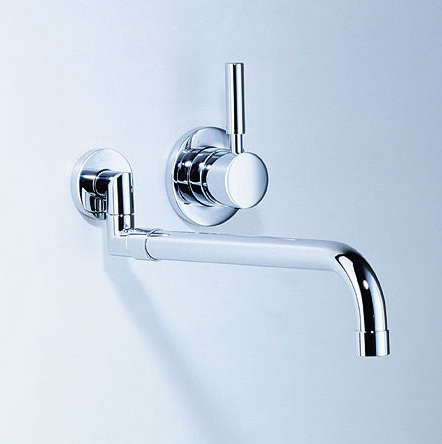
Some kitchen upgrades scream for attention (hello, neon glass tile). Others whisper, “I have excellent taste,”
and then quietly make your everyday routines smoother. The Dornbracht Meta.02 Wall Mounted Kitchen Mixer is
firmly in the second camp: minimal, architectural, and just a little bit smug in the best way.
This is a wall-mounted, single-lever kitchen mixer from Dornbracht’s Meta.02 erabuilt around clean cylinders,
a pared-down silhouette, and the kind of precision that makes you want to say “tolerances” in a serious voice.
If you’re remodeling (or building new) and want the sink wall to look like a design decisionnot a place where
faucet bases go to collect mystery grimekeep reading.
What It Is (and Why “Wall Mounted” Changes Everything)
A typical kitchen faucet lives on the sink deck or countertop. The Meta.02 Wall Mounted Kitchen Mixer lives on the wall
behind the sink, with the spout projecting over the basin and the control lever installed as a separate element.
That separation is a signature part of the Meta.02 appeal: instead of one chunky “faucet blob,” you get a composed,
intentional layoutspout here, handle therelike the sink area got a little architectural drafting session.
Practically speaking, this model is commonly specified with an approximate 8 7/8-inch (about 225 mm) spout projection,
a swivel spout, and a flow rate that’s typically limited to 1.5 gpm for U.S. compliance needs. It’s also
described as low-lead compliant, and it’s sold as exposed trim that requires a separate in-wall rough-in.
Translation: it’s meant for serious remodels, not spontaneous Saturday swaps.
Why Designers Love Wall-Mounted Kitchen Faucets
Wall-mount faucets are a bit like matte-black cars: gorgeous, slightly less common, and they reward people who plan ahead.
The benefits are real, especially if your kitchen sees daily action (or if your sink area is where clutter goes to multiply).
1) The “clean sink wall” effect
With nothing bolted through the countertop behind the sink, cleaning gets simpler. You can wipe the backsplash and the
rear sink ledge without navigating around faucet bases and escutcheonsless scrubbing, fewer crusty mineral rings, and
fewer moments of “how is there peanut butter back here?”
2) It can look more like a built-in feature
When a faucet is on the wall, it becomes part of the backsplash compositionespecially with tile, slab stone, or even
waterproof painted surfaces. The Meta.02 aesthetic plays particularly well with modern, utilitarian kitchens and
workstation setups that lean “chef-y” rather than “cottagecore.”
3) Frees up physical and visual space
Wall mounting opens the sink deck for soap dispensers, sponge caddies, accessories, or simply nothing at all (an underrated
lifestyle choice). Visually, the area reads calmermore negative space, fewer components fighting for attention.
Meta.02 Design DNA: Minimalism That Still Works Hard
The Meta.02 look is all about reduction: slim lever, cylindrical forms, and an overall “no unnecessary drama” attitude.
But in a kitchen, minimalism only wins if it’s also functional. The wall-mounted Meta.02 mixer earns its keep by keeping
the daily motions simpleturn on water, swivel where you need it, fill the thing, rinse the other thing, repeat forever.
One of the most user-friendly design touches is the flexible mixer placement: the handle can be installed above,
to the left, or to the right of the spout depending on layout, handedness, and what else is happening on that wall (windows,
shelves, outlets, backsplash seams, your future pot-filler dreams, etc.). It sounds small, but it’s the difference between
“this is gorgeous” and “why am I bumping my knuckles every morning?”
Key Specs That Matter in a Real Kitchen
Spout projection: reach without overreach
The commonly published projection for the Meta.02 wall-mounted kitchen mixer trim is about 8 7/8 inches.
That reach is meant to land the water stream comfortably into the sink, not right at the back wall (splash city) and
not so far forward that it feels awkward to use.
Pro tip: pair projection with sink depth. A deep single-bowl sink can tolerate a bit more reach; a shallower basin may
need careful placement so the stream hits the sweet spot. The goal is to avoid water slapping the bottom like it’s mad
at youbecause splashing is how countertops get “mysteriously wet” every day.
Swivel spout: the quiet hero
A swivel spout is especially valuable with double-bowl sinks, workstation sinks, and wide single bowls. It makes tasks like
rinsing produce, filling a stockpot, or washing sheet pans feel less like you’re negotiating with the faucet and more like
you’re simply… using water. (Wild.)
Flow rate: 1.5 gpm and why it’s not a dealbreaker
This trim is commonly specified with a 1.5 gpm maximum flow limit in U.S.-oriented documentation. That number can
sound low if you’re used to older “fire hose” faucets, but in practice, 1.5 gpm can still feel strong when the aeration and
stream shaping are well-engineered. You’ll notice it most when filling very large potsso if your kitchen frequently hosts
pasta nights for 40, consider whether you also want a pot filler or a secondary high-flow solution.
Finishes: the classics (and the honest truth about water spots)
Commonly listed finishes for this model include chrome and matt platinum. Chrome is timeless, bright, and
forgivinggreat for busy kitchens and hard water. Matte finishes can look stunningly modern, but they may show mineral
deposits differently depending on water chemistry. Either way, wall-mount helps because you’re not constantly wiping a base
ring around deck holes.
Trim + rough-in: the “don’t skip this” part
The Meta.02 wall-mounted kitchen mixer is typically sold as exposed trim that requires a separate rough-in
(selected based on where you want the lever relative to the spout). This is normal for higher-end wall-mounted systems,
but it’s the detail that trips people up. Plan it early, order the right rough, and coordinate with your plumber and tile installer.
Installation Real Talk: The Wall Is Not a Suggestion
If deck-mounted faucets are a “plug-and-play” situation, wall-mounted faucets are more like “coordinate the entire band.”
That’s not a bad thingjust a reality check. Most of the work happens behind the wall, and once the plumbing is set and the
backsplash is finished, moving things is… let’s call it “expensive character building.”
Height and clearance
You want enough room under the spout to comfortably wash hands and maneuver pots, without mounting it so high that the
water stream turns into a splash cannon. Many pros recommend planning clearance in the range of roughly
8–10 inches from the deck to the faucet head (exact ideal varies by faucet geometry and sink depth).
Reach and sink centering
The spout should land the stream well into the sink bowl. A common rule of thumb is ensuring the spout extends far enough
to keep hands from banging the sink wall during useoften achieved when the spout reaches at least several inches into the basin.
With wall-mount systems, centering is crucial: the rough plumbing must align with the sink position and cabinet layout.
Backsplash coordination
Tile makes wall-mounted faucets look incrediblebut it also makes misalignment obvious. If you care about clean symmetry,
coordinate grout lines, slab cutouts, and faucet centerlines. The Meta.02 uses separate rosettes, so you’re composing a small
“faucet constellation” on your wall: spout rosette, lever rosette, and the negative space around them.
Exterior walls, windows, and other plot twists
A window directly behind the sink can complicate wall mounting (sometimes it’s simply not feasible without redesign).
Exterior walls can introduce cold-weather concerns in some climates because the plumbing is in the wall cavity. If this is a
risk, builders sometimes fur out the wall and insulate appropriatelyanother reason wall-mounted faucets are best decided
early, not after the backsplash is already Instagram-famous.
Maintenance access
The biggest downside people mention is that investigating a leak can involve opening the wall. With a deck-mounted faucet,
you can often access connections from the cabinet below. With wall-mount, smart planning matters: use a qualified installer,
follow manufacturer requirements, and consider whether your project can accommodate a practical service strategy.
Who This Faucet Is Perfect For
You’ll probably love it if…
- You’re doing a full kitchen remodel or new build and can plan plumbing and backsplash details from the start.
- You want a minimalist, modern sink wall with fewer surfaces and seams to clean around.
- You’re using an undermount or apron-front sink where a deck faucet would feel visually busy.
- You like the idea of customizing lever placement for your workflow and layout.
You may want a different approach if…
- You’re trying to replace a faucet without touching tile, drywall, or plumbing in the wall.
- You rely heavily on a pull-down spray head and want that built into the main faucet body.
- You prefer easy future swaps with minimal labor and minimal coordination with the cabinet/sink layout.
- You have a window or other obstruction directly behind the sink that limits mounting options.
How to Make It Look (and Work) Even Better
The Meta.02 wall-mounted mixer looks best when it’s treated like part of an intentional sink “zone,” not a standalone object.
A few pairing ideas that consistently work well:
- Undermount or apron-front sink: keeps the countertop line clean and avoids awkward deck holes behind the basin.
- Full-height backsplash (tile or slab): gives the faucet a backdrop that reads architectural, not accidental.
- Workstation sink accessories: cutting boards, colanders, and drying racks pair well with a swivel spout and clean deck.
- Thoughtful outlet placement: keep plugs and switches clear of where hands and water will naturally travel.
Also: measure your habits. If you’re constantly filling tall stockpots, check the faucet’s practical clearance and stream position.
If you’re mostly rinsing produce and washing dishes, you’ll likely appreciate the uncluttered sink wall more than you’ll miss a pull-down sprayer.
of Real-World Experiences: What People Notice After Living With It
In real kitchens, the wall-mounted Meta.02 tends to spark a specific kind of feedback: “I didn’t realize how annoying my old faucet area was until it was gone.”
The first big change people notice is cleaning. Without a faucet base on the countertop or sink deck, wiping the backsplash becomes one smooth motion instead of
a little obstacle course. Over time, that mattersespecially in hard-water areas where mineral deposits love to set up camp around base plates and seams.
The second observation is how the faucet affects workflow. With the lever separated from the spout, users often place it where their hand naturally reaches
without crossing the water stream. Right-handed cooks frequently like the lever on the right; left-handed cooks do the opposite; some layouts look best with the
lever above the spout for a perfectly centered, symmetrical “composition.” That flexibility feels luxurious in daily use, not just visually.
Then there’s the “splash learning curve.” Wall-mounted faucets can be incredibly tidy, but they punish sloppy planning. If the spout isn’t positioned correctly
relative to the sink depth, the water stream can hit too close to the back wall or too far forward, causing splashing or awkward hand positions. Homeowners who
are happiest with wall-mount installations tend to mention that their plumber and designer coordinated measurements carefullysink model, cabinet placement,
countertop thickness, backsplash finish, and faucet rough-in all aligned before anything got sealed up.
Another common experience is how the faucet changes the look of the entire kitchen. A wall-mounted mixer can make the sink wall feel “custom,” like a restaurant
prep station or a high-end work zone. People often describe the Meta.02 aesthetic as calm and intentionalespecially when paired with simple tile, a slab backsplash,
or a minimal shelf above. The faucet becomes a small piece of industrial sculpture rather than a standard fixture.
Practical concerns come up, too. Some homeowners mention that they feel a little more protective of the wall behind the sinkbecause if something needs service,
it’s not always as simple as reaching under the cabinet. That doesn’t mean wall-mounted faucets are fragile; it means the stakes are higher for doing the rough-in
correctly. People who plan for sensible access (and who use experienced installers) typically report years of trouble-free use, while those who treat it like a
standard deck faucet can end up paying for corrections later.
Lastly, there’s the everyday “feel” factor. A well-made lever and a smooth swivel motion are subtle joyslike a good car door that closes with a confident thud.
You don’t think about it constantly; you just notice, in tiny ways, that the kitchen is easier to use. And that’s the real point of a luxury fixture: not to impress
guests (though it absolutely will), but to make daily life feel a little more refined.
Conclusion
The Dornbracht Meta.02 Wall Mounted Kitchen Mixer is a design-forward choice that rewards planning. You get a cleaner sink wall, a more architectural look, and a
streamlined daily experienceespecially if your kitchen is built around thoughtful workflows and easy-to-maintain surfaces.
The trade-off is complexity: you’ll need the correct rough-in, careful positioning, and tight coordination between plumbing, cabinetry, and backsplash work.
But if you’re already remodelingand you want a faucet that looks as intentional as the rest of your kitchenMeta.02 is the kind of upgrade you’ll appreciate
every single day.